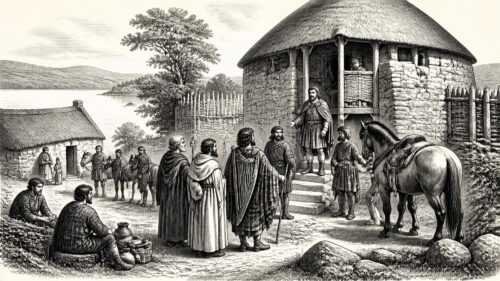
York at Drogheda1449 CE
In 1449 Richard, duke of York, arrived in Ireland as Henry VI’s lieutenant, combining royal office with extensive Irish lordships. At Drogheda, he concluded an agreement with Énrí Ó Néill, backed by Eóghan Ó Néill, exchanging military support for protection. York received earls, negotiated hostages from Meath and demonstrated government through personal alliances rather than conquest. Elsewhere, disputed successions destabilised Breifne, while warfare involved Ó Néills, MacQuillans, Scottish connections and Cenél Conaill. Annals also record religious renunciation, dynastic deaths and learned families. The year reveals a plural political landscape, where English administration and Gaelic rulers formed shifting, pragmatic coalitions locally.

Dateline
In 1449, Ireland became the scene of an unusually important encounter between a great English prince and the island’s many local powers. Richard, duke of York—also earl of Ulster and heir to vast Mortimer interests in Ireland—arrived as King Henry VI’s lieutenant. The Annals of the Four Masters record his coming with “great honour”, adding that the earls of Ireland came to his house and that Gaelic people of half Meath gave hostages into his keeping. Other evidence securely dates an agreement at Drogheda on 27 August between York and Énrí Ó Néill, acting with the consent of his father Eóghan, ruler of Tír Eóghain.
These events did not amount to the conquest of Ireland, nor did they make York an Irish king. They did, however, reveal how government worked in the fifteenth-century lordship: by personal appearance, negotiation, hostages, military promises and local bargains. York’s arrival was impressive because he combined royal office with an inherited Irish territorial stake. His dealings with Gaelic rulers were equally significant because they acknowledged political realities beyond the narrow area in which the Dublin administration could enforce its will directly.
A Lieutenant with Irish Interests
Richard had been appointed lieutenant in 1447, but only reached Ireland in the summer of 1449. The exact day of his landing is supplied by later English narrative sources as 6 July, at or near Howth; the Irish annals do not date it so precisely. What is firm is that he was present in Ireland during the year and that his arrival made an immediate political impression. As earl of Ulster, lord of Trim and Leix, and holder of the honour of Cork, he was not an absentee official with no local connection. His estates, rights and clients gave him reasons to cultivate support among the English-descended aristocracy of the lordship and among Gaelic lords who could either threaten or assist those interests.
The royal government he inherited was constrained. The lordship’s revenues were inadequate, its castles and towns needed protection, and its leading magnates pursued rival local interests. Royal authority was strongest in and around Dublin and the surviving districts of the English lordship, though even there it depended on cooperation from landholders, bishops, towns and office-holders. Beyond that zone, Gaelic lordships possessed their own structures of lordship, inheritance, military following and law. The language of submission could therefore be meaningful without implying obedience in every matter. It was a negotiated recognition of relationship, not a modern transfer of sovereignty.
The Four Masters’ phrase that the earls came to York’s house captures the politics of presence. A lieutenant’s household was a centre of hospitality, persuasion, display and administration. Provisioning it mattered. The annal’s reference to people of Meath delivering themselves as hostages should not be understood as a casual gesture of goodwill. Hostages were guarantees: persons whose safety depended on the continuing performance of an agreement. Their delivery was a visible acknowledgement that an accommodation had been reached, while their existence also showed how fragile that accommodation could be.
Drogheda and Tír Eóghain
The most clearly dated diplomatic act of York’s first Irish summer occurred at Drogheda on 27 August. Énrí Ó Néill, eldest son and recognised heir of Eóghan Ó Néill, confirmed an indenture with the lieutenant. The surviving descriptions indicate a reciprocal arrangement. Énrí undertook to fight York’s enemies in Ireland; York, for his part, offered legal and military protection to the Ó Néills. This was useful to both parties. York gained a powerful northern partner and a route towards reducing pressure on the lordship’s exposed north-eastern frontier. The Ó Néills gained recognition from the king’s lieutenant at a point when their authority in Ulster had been aggressively expanded.
Eóghan Ó Néill was no passive frontier chief. He had long been a leading ruler of Tír Eóghain, with interests reaching into Armagh, Louth, Breifne and the wider politics of Ulster. Dundalk had previously been compelled to pay him black rent, and he had raided or pressed neighbouring territories. During 1449 he again attacked Dundalk before York’s arrival transformed the immediate situation. The Drogheda agreement was therefore not a simple triumph of law over disorder. It represented an effort to turn an influential and potentially dangerous neighbour into a protected ally. Énrí’s place in the document also mattered within Gaelic politics: acting with his father’s consent, he demonstrated publicly that he was the dynasty’s established successor.
The agreement’s vocabulary is revealing. To promise military aid was not merely to acknowledge Henry VI’s distant lordship; it attached the Ó Néills’ military capacity to York’s local political network. York’s protection, conversely, could lend weight to Ó Néill claims against rivals. Such arrangements had precedents in Irish politics, but their value lay in present advantage. Neither side could assume that a written indenture would end competition in Ulster, nor that royal protection could be supplied everywhere it was promised.
Breifne’s Divided Succession
While York sought agreements, western and eastern Breifne showed the persistent instability created by disputed lordship. The Four Masters record the death of Donnchadh, son of Tighearnán Óg Ó Ruairc, lord of West Breifne, after eight full years of illness. Tighearnán, son of Tadhg Ó Ruairc, was then chosen in his place. The entry is concise, but it provides a useful corrective to any assumption that succession invariably passed automatically from father to son. Selection within a ruling kindred could elevate a collateral relative judged capable of maintaining the lordship.
In the neighbouring Uí Raghallaigh sphere, in what is broadly County Cavan, the death of Eóghan, son of Seán, lord of Muintir Maelmordha, produced an overt split. One faction, supported by Ó Néill and descendants of Seán Ó Raghallaigh, chose Eóghan’s son Seán. Another, backed by descendants of Mathghamhain Ó Raghallaigh and by “the English” of the annal, selected Fearghal, son of Tomás Mór. The result was warfare and disturbance. The justiciar and James Butler, fourth earl of Ormond, came to Fearghal’s assistance. Seán then attacked the front of their force; the annal says that sixty men were killed or captured, including sons of Toirdelbach and Domhnall Bán Ó Raghallaigh.
This struggle illuminates the limits of neat ethnic labels. The annal distinguishes Gaelic factions and “the English”, but political coalitions crossed cultural and linguistic frontiers. The administration and Ormond supported one candidate; Ó Néill supported another. Neither alliance makes its members simply English or Irish in modern terms. Land, kinship, military security and proximity were decisive. Breifne lay across routes linking the Pale, Meath, Ulster and Connacht, making its internal disputes of wider strategic consequence.
Violence Across Ulster
Elsewhere, the annalistic record for 1449 remains stark but valuable. MacQuillan won a major victory over Muircheartach Ruadh Ó Néill. Among those killed were the son of Mael Muire Mac Suibhne, described as Ó Néill’s constable, and Aonghus, son of Mac Domhnaill of Scotland, with many others. The reference to a Mac Domhnaill from Scotland points to the continued military and familial connections across the North Channel. Galloglass service and lordly alliances linked Ulster to the Hebrides and western Scotland; sea crossings did not separate these political worlds so much as connect them.
The Four Masters also note a great war among the Cenél Conaill, accompanied by extensive destruction. It offers no safe basis for reconstructing every campaign, casualty or locality, and no such precision should be invented. Yet it confirms that conflict inside Tír Conaill was serious enough to enter the annalistic record. In such wars, destruction meant more than fighting between armed retinues. Raiding could carry off cattle, burn food stores, disrupt cultivation and compel communities to move or submit. The political map of late medieval Ireland was continually remade through these local contests.
Lordship, Faith and Learning
Not all change came through warfare. The annals report that Aodh, son of Lochlann, lord of Clann Cathail, had given up his lordship long before his death “for the love of God”, having secured the installation of Diarmait, son of Seffraidh Ó Flannagáin, in his place. The notice is too brief to explain the circumstances, but it shows religious language operating within political life. Renunciation could express genuine devotion, provide an orderly succession, or both. Its inclusion by the annalist indicates that withdrawal from secular rule was remembered as an event of public consequence.
Deaths recorded in 1449 likewise map a society in which dynastic marriage, lordship and professional culture mattered. Mór, daughter of Aodh Mag Uidhir and wife of Art, son of Eóghan Ó Néill, died, as did Maghnus Buidhe Mag Uidhir. Their notices preserve the importance of marital links between Fermanagh and Tír Eóghain. Ua Fialáin and Giolla Críost Mac an Bhaird also died. The Mac an Bhairds belonged to the learned hereditary families who supplied poetry, praise, genealogy and historical memory to Gaelic patrons. Although the annal gives no poem or patronage transaction for this year, its naming of a Mac an Bhaird is a reminder that warfare and diplomacy existed alongside a durable culture of learning.
A Moment, Not a Settlement
York’s Irish progress in 1449 was therefore a real political achievement, but it should be measured carefully. He secured ceremony, hostages and alliances; he met earls and engaged important Gaelic rulers; and he entered the Irish political landscape as a magnate with credible authority. The agreements did not abolish contested successions in Breifne, end warfare in Ulster or extend routine government across the island. They instead show the practical methods by which power was made: personal trust, reciprocal obligation, strategic marriage, armed followings, ecclesiastical standing and carefully managed guarantees.
For contemporaries, the year’s central fact was not a distant constitutional theory but the arrival of a prince whose household could reward allies and whose protection might alter local calculations. For historians, 1449 offers an unusually sharp glimpse of late medieval Ireland as a connected but plural political world. York came in the king’s name. The people who met him did so on terms shaped by their own lordships, rivalries and ambitions.
Primary Sources
- Annals of the Four Masters
- Annala Rioghachta Eireann: Annals of the Kingdom of Ireland by the Four Masters
- O'Neill (Ó Néill), Eóghan
- O'Neill (Ó Néill), Enrí
- English Lordship of Ireland and the Irish Sea World: Re-assessing the Origins of the Kildare Ascendancy, c.1390–c.1513
- Statute Law Revision Act 2007
- Irish Script on Screen: MS 23 P 6 (The Annals of the Four Masters)
- Annals of the Four Masters: Irish History, Kingship and Society in the Early Seventeenth Century
- Exploring the Irish Annals
- Annála Connacht
- Annales Breves Hiberniae
- The MacQuillan or Mandeville Lords of the Route
- Richard, Duke of York as King’s Lieutenant in Ireland: The White Rose A-Blooming
- The Governing of the Lancastrian Lordship of Ireland in the Time of James Butler, Fourth Earl of Ormond c.1420–1452
- Moustaches, Mantles and Saffron Shirts: What Motivated Sumptuary Legislation in Late Medieval Ireland?
- The Mendicant Orders of Medieval Dublin
- Medieval Trim: History and Archaeology
- The Cambridge History of Ireland
- The Annals of the Four Masters: Manuscript and Editions Information
- The Description of Ireland