Youghal’s Ormond–Desmond Indenture1422 CE
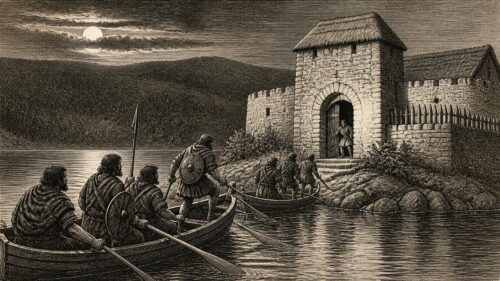
In 1422 Irish politics operated through local lordships, alliances, hostages, land and warfare. At Youghal, Ormond granted Desmond a life interest in 240 acres, securing revenues and services while retaining rights. In Tír Conaill, Toirdhealbhach Ó Domhnaill retired to Assaroe, succeeded by Niall Garbh, whose campaigns asserted authority across Ulster and into Connacht. Eóghan Ó Néill’s ransom and subsequent alliances demonstrated hostage diplomacy’s importance. Offaly’s An Calbhach defeated Meath forces near Trim, amid wider frontier fighting. Raids damaged crops, cattle, homes, churches and learned people. Henry V’s death brought Henry VI’s minority, while regional powers continued negotiating, raiding and fighting.
Dateline
In 1422 Ireland’s political map was neither neatly divided between an English colony and a Gaelic exterior nor governed from a single centre. Authority was assembled locally: through lordship, clientage, hostage-taking, marriage, castles, church connections and the ability to gather armed followers. The year’s surviving records show this with unusual clarity. A land agreement at Youghal linked two great Anglo-Irish earls; in Ulster, a new ruler of Tír Conaill demonstrated his reach through alliance and campaigning; and in the midlands, Offaly forces struck directly towards Trim. At village level, the same politics brought burned crops, taken cattle, destroyed homes and dangerous journeys through contested country.
An Indenture at Youghal
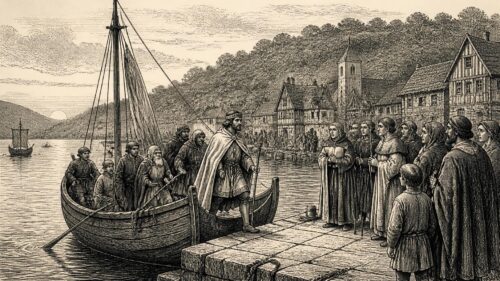
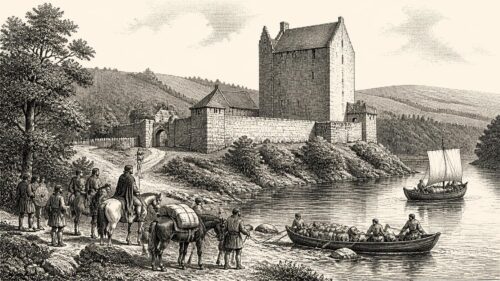
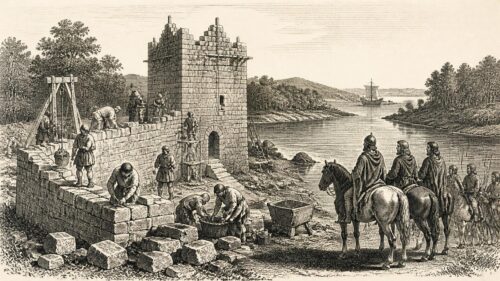
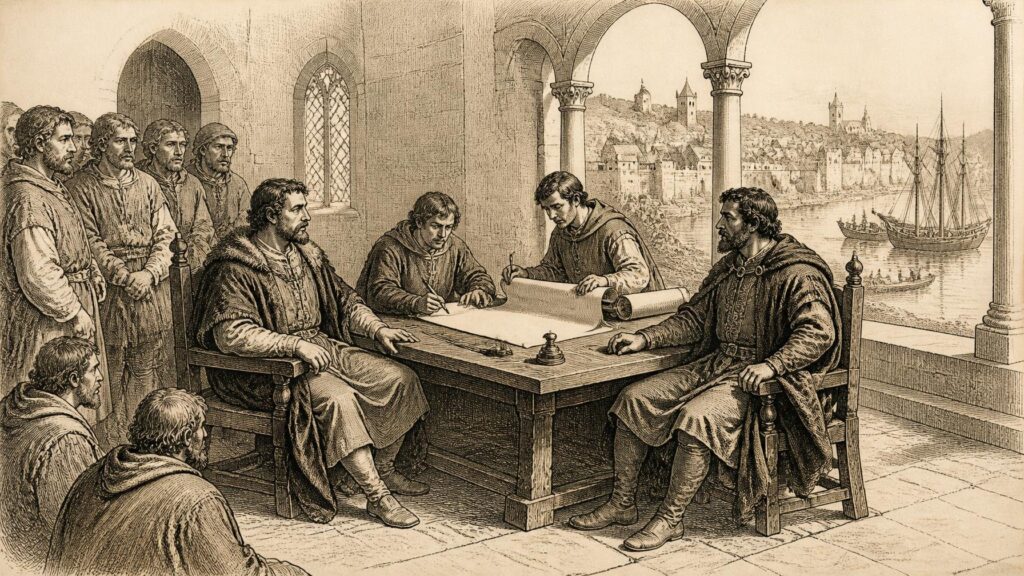
One firmly dated document belongs to 31 January. The Calendar of Ormond Deeds records an indenture between James Butler, fourth earl of Ormond, and James FitzGerald, seventh earl of Desmond. Ormond granted Desmond a life interest in 240 acres from his demesnes within the lordships of Imokilly, Inchicoyne and Youghal. The grant included cultivated land and the customary incidents of lordship: rents, heriots, seasonal labour services, payments connected with pasture and other obligations owed by tenants.
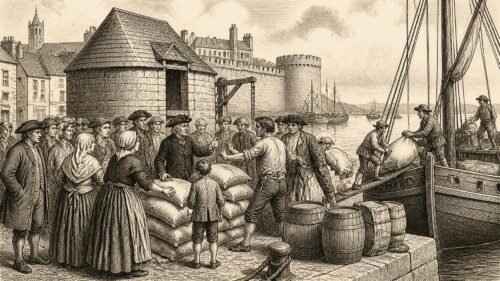
This was a practical settlement rather than a symbolic exchange. It placed Desmond in a position to receive income and service from tenants while preserving reversionary rights for Ormond’s family. The document offers a rare close view of estate management in southern Ireland. Land was measured in acres, but its worth rested on people as well as soil: tenants who farmed it, rendered rent, performed autumn work and observed manorial custom. The agreement also illustrates the fluidity of aristocratic politics. Ormond and Desmond were major rivals in Munster, yet accommodation over land and office could be more useful than open confrontation.
Ormond’s two-year term as royal lieutenant, begun in April 1420, was ending during 1422. His career joined the administration of the English lordship to the interests of a powerful Irish-based dynasty. The Youghal arrangement should therefore not be mistaken for a routine private conveyance detached from politics. It helped shape the resources available to leading magnates at a time when royal authority beyond the towns and settled districts depended heavily on local partnerships and bargains.
A New O’Donnell Ruler
In the north-west, the annals place a major dynastic transition in 1422. Toirdhealbhach Ó Domhnaill, ruler of Tír Conaill, entered the monastery of Assaroe near Ballyshannon and took a monk’s habit; his son Niall Garbh succeeded to the kingship. The wording is important. The annals celebrate Toirdhealbhach’s withdrawal from worldly life, while the Annals of Ulster place his death in 1423. It is therefore responsible to treat 1422 as the year of retirement and succession, not to assign his death to it.
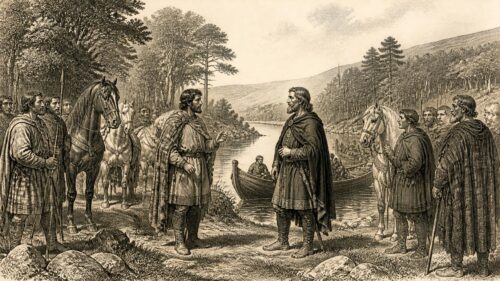
The succession placed Niall Garbh at the head of a formidable north-western lordship. His father had spent decades extending Ó Domhnaill influence across Ulster’s shifting political world, but Niall’s position still required active demonstration. The annals describe campaigns and submissions rather than an orderly inheritance. Niall moved through Fermanagh and eastern Ulster, drawing Maguire, MacMahon, Magennis and Ó Catháin into his following. With the sons of Ó Catháin, his forces then plundered the Glens of Antrim, the lands of the Bissetts, Clandeboye and Moylinny, carrying spoils towards Carrickfergus.
Such accounts use the language of “subjugation”, but the mechanics were concrete: military pressure, cattle and portable wealth taken as spoil, hostages delivered as security, and public acknowledgement of superiority. Lordship was not fixed by a line on a map. It had to be renewed through marches, assemblies and the ability to compel neighbouring rulers to cooperate. The record of Niall’s circuit is also a reminder that Gaelic polities were closely interwoven with the coastal and urban world. Carrickfergus, a seaport and castle town, appears not as a distant colonial outpost but as a place towards which plunder could be conveyed.
Ransom, Hostages and Northern Alliances
Eóghan Ó Néill’s release was another important event of the year. Captured in 1421 by the Clandeboye branch of the Ó Néill family while travelling to meet the earl of Ormond, he was ransomed in 1422 by his wife and sons. The annals specify cows, horses and other gifts as the price. This was no incidental domestic matter. A captive lord’s kin had to mobilise livestock and influence; his captor gained wealth and leverage; and the settlement rearranged alliances across Ulster.
After Eóghan regained his liberty, Niall Garbh and a wide northern coalition campaigned against the Clandeboye Ó Néills. The Annals of the Four Masters state that hostages were yielded and that the value received for Eóghan’s ransom was recovered. Yet the settlement was not simply a victory for one faction. Domhnall Bog Ó Néill, the disputed king of Tír Eógain, remained involved, and the sources indicate that the Clandeboye Ó Néills gave hostages to him rather than to Eóghan. Alliances in Ulster could thus combine close kinsmen, rivals and former captors, each pursuing advantage within the same expedition.
The year’s northern campaigning reached into Connacht. A large force associated with Niall Garbh, Eóghan, Domhnall and Mac Néill Buidhe burned Carbury, moved past Sligo and devastated Tírerill. Local resistance checked its advance: the annals report seven men of the invading host killed near Sligo, and record fighting involving rival branches of the Mac Donnchadha family. One account says the host passed through Breifne with Ó Ruairc’s consent; the more expansive Four Masters narrative adds that an Ó Ruairc was subsequently taken prisoner. These are retrospective annalistic accounts, not campaign diaries, and they should not be forced into an exact itinerary. Together, however, they securely show that a northern coalition brought war into north Connacht during 1422.
War at the Midlands Frontier
The most striking confrontation with the English of Meath involved An Calbhach Ó Conchobhair Fáilghe, ruler of Offaly. He attacked towards Trim, the great centre of English power in Meath. The Annals of Connacht says that forces from the town came out against him, were defeated, and suffered both deaths and capture. It gives the dramatic detail that more than a hundred prisoners were taken, with sixty “Galls” — here meaning English or Anglo-Irish opponents — fettered together on the floor of Ó Conchobhair’s house. Numbers in medieval annals must be handled cautiously, but the notice leaves no doubt about the scale claimed for the victory and captivity.
Calbhach’s success formed part of a wider struggle in Meath, Westmeath and Offaly. The annals report warfare among Gaelic lordships, the breaking of castles at Baile Meic Odaind and Brothalach, and the destruction of fields and dwellings in Delbna before a peace was made. They also record Feidhlim Ó Raghallaigh’s victory over the English of Meath near Kells after an attack on the Biatachs. These episodes reveal a frontier that was neither static nor exclusively ethnic. Gaelic rulers fought each other; Anglo-Irish lords joined Gaelic allies; and castles, passes, cattle and homes were all targets.
An expedition led by the earl of Desmond, accompanied by both “Galls and Gaels”, went to assist the Meath English against Calbhach. It entered Clann Feorais, burned the residence of a Mac Feorais lord and devastated country before facing Calbhach’s force. The army withdrew without a peace or the taking of pledges. This episode sharply qualifies any simple opposition between a Gaelic Ireland and an English Ireland. Desmond was an Anglo-Irish earl, yet his host was mixed; the Mac Feorais were of colonial descent but embedded in a regional world of competing interests; and military action did not automatically produce a durable settlement.
Learning, Faith and Vulnerable Communities
Conflict reached beyond fighting men. Cosnamhach Óg Mac Aodhagáin, an ollamh, or chief learned authority, in law for Cenél Fiachach and Ó Conchobhair Fáilghe, was killed during an attack on Ardnurcher. He had apparently come to help settle a dispute involving Mac Eochagáin. Mistaking raiders for another party, he rode after them and was killed by a missile. The detail matters because it shows a professional jurist acting in mediation, and because his death represents the danger that feuding posed to learned specialists as well as to warriors and farmers.
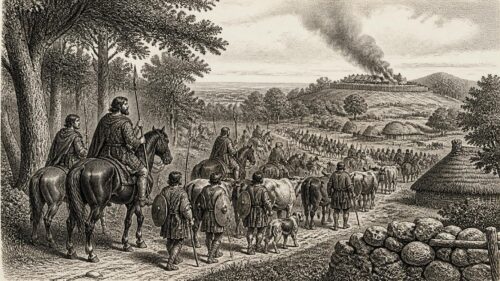
The annals also report killings within the Ó Flaithbheartaigh, Mac Siúrtáin, Ó Conchobhair and Mac Branáin kindreds, including the burning of a church during one Mac Branáin feud. In County Wexford, Geralt Caomhánach burned and plundered both the county and Wexford town. Such notices cannot tell us every household’s experience, but their repeated references to crops, fields, cattle, residences and churches show what warfare consumed. Raiding was economic as well as military: it seized movable wealth, ruined harvests and imposed costs on communities long after a host had marched away.
On 31 August, Henry V died at Vincennes in France, and his infant son became Henry VI, the king whose lordship included Ireland. Irish annals registered the change, though one Connacht account repeated a false report that Henry had been poisoned. The error is itself revealing: news from France travelled into Ireland, but imperfectly. The political consequence was real enough. A minority government now stood behind the English lordship, while Ireland’s strongest regional powers continued to negotiate, raid, submit, ransom and fight on their own terms.
Thus 1422 was not a year of one decisive Irish battle or royal act. Its significance lies in the overlapping systems exposed by the evidence: estate administration at Youghal; monastic retirement and dynastic succession at Assaroe; hostage diplomacy across Ulster; attacks on the Meath frontier; and the everyday material losses of war. Ireland was connected to the English crown and to events in France, but its immediate history was made in lordly households, castles, monasteries, passes, market towns and cultivated fields.
Primary Sources
- Annála Connacht: Annal 1422
- Annals of the Four Masters: Annal M1422
- Annals of Ulster otherwise Annala Senait, Annals of Senat
- Annals of Loch Cé
- Calendar of Ormond Deeds, Volume III, 1413–1509
- Deed between the Earl of Ormond and the Earl of Desmond by which the latter is made seneschal of the baronies of Imekelly, Incherogne and the town of Youghal, 1421
- O'Donnell (Ó Domhnaill), Niall Garbh
- O'Donnell (Ó Domhnaill), Toirdhealbhach
- O'Connor Faly (Ó Conchobhair Failghe), An Calbach
- O'Neill (Ó Néill), Eóghan
- O'Neill (Ó Néill), Domhnall Bog
- O'Neill (Ó Néill), Brian Ballach
- O'Carroll (Ní Chearbhaill), Mairghréag
- Butler, James
- Stanley, Thomas
- The English Lordship of Ireland and the Irish Sea World: Re-assessing the Origins of the Kildare Ascendancy
- Henry V
- Henry V and Catherine de Valois
- Annals of Inisfallen
- Translated Texts at CELT