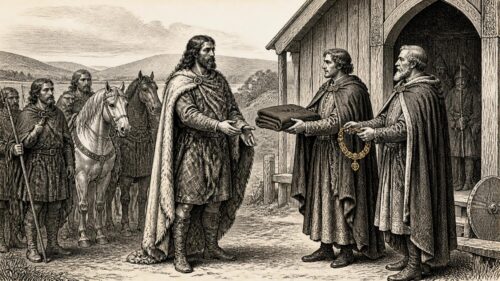
O’Neill’s Inauguration1455 CE
In 1455 Henry O’Neill was inaugurated at Tullyhogue as king over Ulster, backed by allied lords and Armagh’s ecclesiastical leader, although his father remained alive and dynastic conflict persisted. Elsewhere, Philip Maguire’s forces raided east Breifne, burning settlements, killing rivals and capturing a crannog, demonstrating mobile lordly warfare. Annals also recorded deaths among ruling, clerical and learned families, revealing networks of status, hospitality and service. At Navan, Abbot John Bole granted a Pentecost indulgence supporting religious observance and monastic repair. In Connacht, a lord was killed by his own men. These events illustrate Ireland’s multiple, localised and precarious political worlds.
Dateline
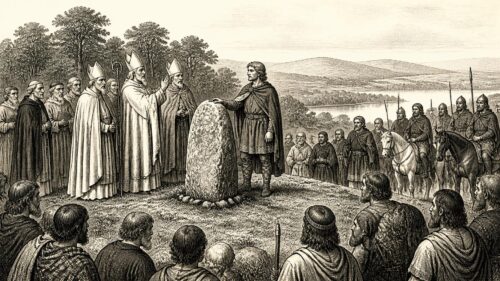
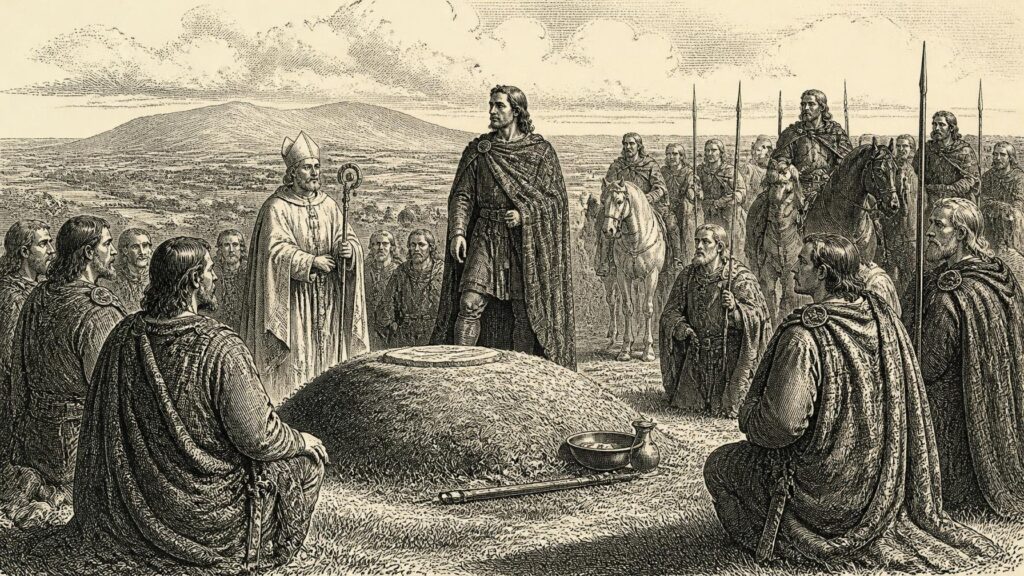
In 1455, the most conspicuous political act recorded in Ireland was not a royal decree from Dublin, but an inauguration at Tulach Óg, or Tullyhogue, in what is now County Tyrone. About a month before Lammas—1 August—the Irish annalist of Ulster recorded that Henry O’Neill, son of Eoghan O’Neill, was “made king over Ulster”. The wording matters. This was not a modern-style succession to a fixed crown, nor an uncontested transfer of a hereditary office. It was a public assertion of lordship, achieved through consent, ceremony, alliances and the visible support of powerful neighbours.
The surviving record for the year is uneven, as it is for much of fifteenth-century Ireland. It is strongest in the northern and western lordships, while the English administration in the Pale leaves no comparably vivid account of a single Ireland-wide development. The annals preserve deaths, raids, religious observance and the installation of rulers. They allow a view of 1455 as a year in which authority was actively made and defended at local and provincial level, rather than simply inherited.
An Inauguration at Tulach Óg
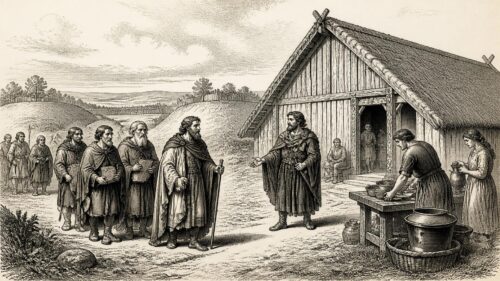
The Annals of Ulster name the men who accompanied Henry O’Neill to Tullyhogue: O’Cathain of north Derry, Maguire of Fermanagh, MacMahon of Oriel, the various O’Neill kindreds, and the “Successor of Patrick”, the ecclesiastical head of Armagh. Their presence gave the occasion both political reach and religious sanction. The annalist says Henry was made king “honourably, by the will of God and men”. That formula should not be mistaken for a literal transcript of a ceremony, but it captures the two languages of legitimacy available to a Gaelic ruler: the approval of leading people and the favour of the Christian God.
Tullyhogue was an established O’Neill inauguration place, a ceremonial landscape rather than merely a convenient meeting ground. Such sites connected the choice of a living leader with ancestry, territory and customary right. In Gaelic lordship, the head of a ruling dynasty was selected from a kin-group of eligible men; seniority, military capacity, alliances and command of followers could count as much as direct descent. Henry’s elevation therefore demonstrated that he had assembled a coalition capable of recognising him as the O’Neill, with a claim to wider supremacy in Ulster.
There is an important caution. Eoghan O’Neill, Henry’s father, is recorded as dying in 1456, the following year. The later Annals of the Four Masters go further and say that Henry had driven his father from his lordship in 1455. The difference between the accounts prevents a simple statement that Henry succeeded only because his father died. What can safely be said is that Henry was publicly installed during his father’s lifetime, and that the event exposed a serious contest within the ruling family. The title bestowed at Tullyhogue was thus a political victory whose permanence still had to be secured.
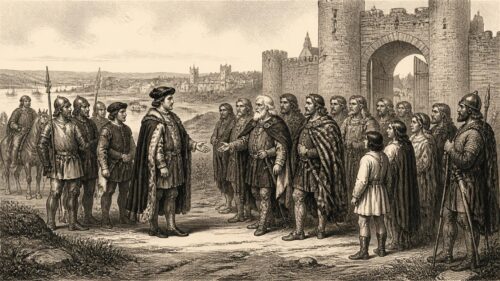
The gathering also reveals the geography of power. Maguire and MacMahon were not decorative witnesses: both commanded lordships whose support could affect the balance across Ulster and its southern approaches. O’Cathain’s attendance similarly mattered in the lands between the Foyle and Bann. Armagh’s successor supplied spiritual authority, but his participation also showed that ecclesiastical institutions were woven into secular diplomacy. The inauguration was a compact among men whose interests did not always coincide, not the creation of a centrally governed province.
War in Fermanagh and Breifne
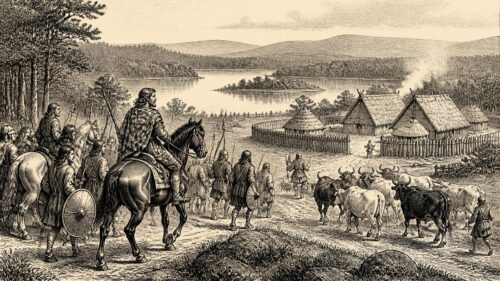
The same annal records a harsh conflict farther west. A “great war” broke out between Philip Maguire, a claimant described as destined for the kingship of Fermanagh, and Mag Samradhain, the leading family of east Breifne in present-day County Cavan. Philip established an encampment at Beann Eachlabhra. His sons Brian and Toirdelbach then entered Tellach Eachach with a small force, burned Mag Samradhain’s settlement and much of its territory, and killed Máel Sechlainn Dubh Mag Samradhain, a son of Eoghan Mag Samradhain, and others.
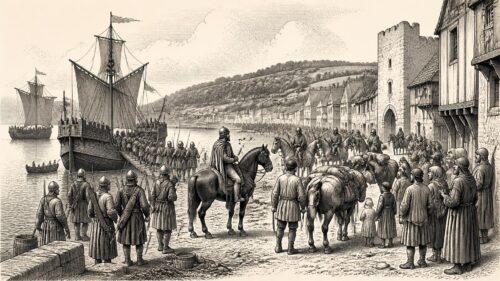
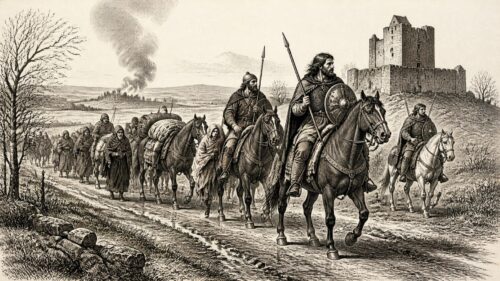
The details bring the mechanics of lordly warfare unusually close. The Annals of Ulster says the raiding party consisted of seven score footmen and twelve horsemen. The Four Masters, compiled much later, gives a much lower infantry number. The disagreement means the exact strength cannot be recovered. Both accounts nevertheless agree on the essentials: a mobile Maguire force penetrated enemy land, burned a principal settlement, inflicted fatalities and returned claiming victory. This was warfare directed at people, provisions, livestock, prestige and the ability of a rival lord to protect his dependants.
Toirdelbach Maguire soon struck again at Loch Melvin, where he captured and plundered the crannog of Mag Flannchadha, or MacClancy. A crannog—an occupied island or artificial island in a lake—could serve as a defended residence, storehouse and refuge. Its seizure was therefore more consequential than the taking of a remote dwelling. The raids show that lakes, rivers and wooded uplands were not barriers beyond politics: they were part of the strategic terrain through which men, news, goods and armed retinues moved.
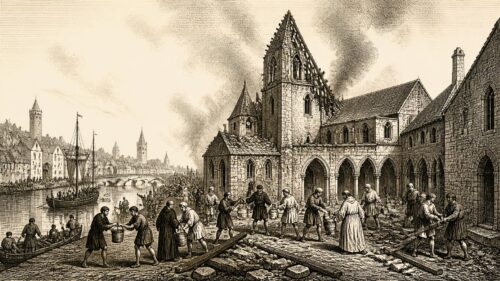
For ordinary households, the annalistic language of burning and plunder implies a much wider disruption than the named deaths alone reveal. A raid could destroy grain, houses, winter fodder and animals, as well as compel flight or dependency on a stronger protector. Yet the sources do not permit a numerical estimate of casualties, displaced people or economic loss. Their attention rests on the fortunes of leading families, not on a full social census of the countryside.
Deaths, Households and Local Rule
Several deaths recorded in 1455 help locate the human networks beneath these larger contests. Cumsgrach O’Reilly died, linking the year to the ruling dynasty of east Breifne. Maine Mac Cabe was praised as a man fitted to be constable of the two Breifnes, Oriel and Fermanagh for hospitality and prowess. Such language indicates the value attached to martial leadership, but also to the capacity to maintain a household, feed guests and reward retainers. Hospitality was not a private virtue alone: it was a political resource, enabling a lord or officer to gather support.
The annalist also noted the deaths of Diarmait Ruadh Ó Caiside of Cúil, Nuala Mac Maghnusa, and Conchobhar Mac Giolla Chalmha, vicar of Cuilmaine, who died on 11 April 1455. Their inclusion is a reminder that clerical and learned families belonged to the political fabric of the north-west. Genealogy, legal knowledge, medical learning, record-keeping and pastoral office could be sustained by hereditary or long-established professional lineages. The annals’ careful naming of fathers and grandfathers was itself part of that culture of lineage and status.
Pentecost at Navan
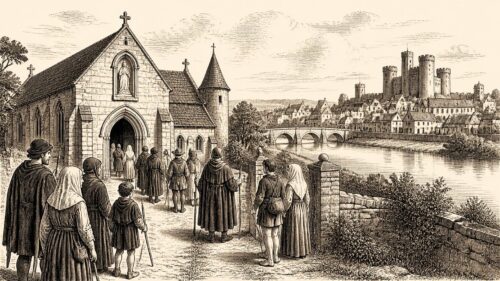
Religion entered the record in another, strikingly different form at Navan in County Meath. At the monastery of An Uaimh, John Bole, its abbot, dispensed a plenary indulgence on the feast of Pentecost. St Mary’s at Navan was an Augustinian house in a market town near the edge of the Pale. Bole had already secured papal indulgences connected with the repair and conservation of its church and buildings, which were said to have been impoverished by war. The 1455 observance therefore belongs to a practical as well as devotional world: pilgrimage, almsgiving, institutional finance and the repair of religious fabric could reinforce one another.
An indulgence did not erase punishment or worldly hardship at a stroke. It was a remission of specified temporal penalties for sin, granted under ecclesiastical authority on stated conditions. Its public distribution at a major feast made the monastery a place where spiritual concern, travel, exchange and charitable giving converged. We cannot reconstruct the size or social composition of the congregation in 1455, but the notice demonstrates that religious institutions in the English lordship remained connected to wider papal practice and could draw attention beyond their immediate locality.
Connacht’s Brief Notices
In Connacht, the annals give a terse but significant picture. Sefraid Ó Fergail, lord of Clann Aeda an tSléibhe, died. More violently, Eoghan Mac Diarmata Ruadh, lord of Coillte Conchobair, was killed by his own men. The brevity leaves motive obscure: it may have involved an internal dispute, a coup among followers or a wider dynastic struggle. It would be unsafe to choose among those explanations. What is certain is that lordship depended on the loyalty of a leader’s own household and fighting force as well as on public claims to descent.
The contrast with Tullyhogue is instructive. Henry O’Neill’s installation was staged before allies and churchmen; Mac Diarmata Ruadh’s death is recorded as an act by his own people. Together, the notices show the precariousness of late medieval power. A lord could be raised by collective recognition, but could also be undone when the men who armed, served or lived under him withdrew their support.
An Island of Several Polities
Events in 1455 should not be compressed into a story of a single Irish state awaiting control from Dublin or London. The Pale had its towns, religious houses, officials and links to the English crown; Gaelic and Gaelicised lordships governed most of the island through their own institutions, jurisdictions and alliances. Across the Irish Sea, the first battle of St Albans in May 1455 marked the opening violence of the Wars of the Roses, while Richard, duke of York, retained a formal connection with the Irish lordship as the king’s lieutenant. But the Irish annals for this year do not portray Ulster’s inauguration or the Maguire–Mag Samradhain war as consequences of English factional conflict.
Rather, 1455 shows distinct political worlds operating alongside one another. At Tullyhogue, Henry O’Neill acquired an exalted title through an alliance of lords and church authority. In the Fermanagh–Breifne borderlands, Maguire power was demonstrated by fire, mobility and the capture of a lake stronghold. At Navan, an indulgence made a monastery a centre of penitence and repair. In Connacht, the death of a lord at his own men’s hands exposed the fragility beneath formal lordship. Taken together, these securely dated notices make the year vivid: power in Ireland was personal, territorial, ceremonial and always vulnerable.
Source References
Hover over a number to see the source. Select it to open the source.

- [1] The Annals of Ulster: Year U1455
- [2] The Annals of Ulster: Year U1454
- [3] The Annals of Ulster: Year U1456
- [4] Annála Connacht: Annal 1455
- [5] Annála Connacht: Annal 1456
- [6] Annála Connacht: Bibliographic and Editorial Information
- [7] Annála Connacht: CELT Project Edition
- [8] Annals of the Four Masters: Annal M1455
- [9] Annals of the Four Masters: Volume 4 English Translation
- [10] The Annals of Ulster: CELT Project Edition
- [11] Irish Script on Screen: MS A 13, Annals of the Four Masters
- [12] National Library of Ireland Sources: Annals of the Four Masters Manuscripts and Editions
- [13] Exploring the Irish Annals
- [14] Bole (Bull), John
- [15] Navan Inner Relief Road EIAR, Appendix 12: Cultural Heritage
- [16] Navan Points of Pride Walking Tour
- [17] Navan Historic Core Architectural Conservation Area
- [18] Medieval Navan
- [19] Tomb of Bishop Bole
- [20] An Tulach Tinóil
- [21] Gaelic Lordship and Tudor Conquest: Tír Eoghain, 1541–1603
- [22] Duke Richard of York 1411–1460
- [23] The Church and Diocese of Meath in the Fifteenth Century
Primary Sources
- The Annals of Ulster: Year U1455
- The Annals of Ulster: Year U1454
- The Annals of Ulster: Year U1456
- Annála Connacht: Annal 1455
- Annála Connacht: Annal 1456
- Annála Connacht: Bibliographic and Editorial Information
- Annála Connacht: CELT Project Edition
- Annals of the Four Masters: Annal M1455
- Annals of the Four Masters: Volume 4 English Translation
- The Annals of Ulster: CELT Project Edition
- Irish Script on Screen: MS A 13, Annals of the Four Masters
- National Library of Ireland Sources: Annals of the Four Masters Manuscripts and Editions
- Exploring the Irish Annals
- Bole (Bull), John
- Navan Inner Relief Road EIAR, Appendix 12: Cultural Heritage
- Navan Points of Pride Walking Tour
- Navan Historic Core Architectural Conservation Area
- Medieval Navan
- Tomb of Bishop Bole
- An Tulach Tinóil
- Gaelic Lordship and Tudor Conquest: Tír Eoghain, 1541–1603
- Duke Richard of York 1411–1460
- The Church and Diocese of Meath in the Fifteenth Century