Ulster Rebellion1641 CE
In October 1641, Catholic grievances over plantation, exclusion and religious constraints combined with Stuart political instability to trigger rebellion in Ireland. A planned seizure of Dublin Castle failed, but Sir Phelim O’Neill’s Ulster rising captured Dungannon and Charlemont. His proclamation professed loyalty to Charles I and protection for Protestants, while a later forged royal commission fuelled confusion. The conflict brought flight, plunder, killings, dispossession and winter hardship, alongside retaliatory violence. Testimony in the 1641 Depositions records crisis but requires critical reading. Fighting spread towards Dublin, Leinster and Munster, intensified English and Scottish political conflict, and left Ireland fractured without settlement.
Dateline
In 1641, Ireland moved with shocking speed from a tense but functioning Stuart kingdom into a widening war. The October rising conventionally called the Irish Rebellion of 1641 began as a planned seizure of strategic places and a protest against an insecure political order. Before the year ended, it had become a struggle of local dispossession, armed occupation, sectarian fear and retaliatory killing, drawing Ireland irrevocably into the interconnected Wars of the Three Kingdoms.
A Kingdom Under Suspicion
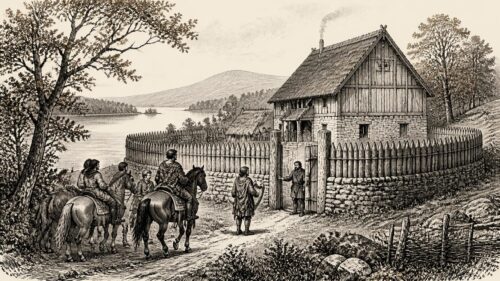
The conditions behind the outbreak were older than the year, but were acutely felt in 1641. Catholic landowners, both Gaelic Irish and Old English, had experienced decades of plantation, land-title challenges, political exclusion and religious constraint. In Ulster, the Plantation had created densely settled English and Scottish Protestant communities beside dispossessed or politically diminished Catholic families. That arrangement brought commercial farming, market links and new forms of local administration, but it also made landholding, worship and allegiance inseparable from questions of power.
The immediate political background was the collapse of confidence across the Stuart monarchies. Thomas Wentworth, earl of Strafford and Charles I’s powerful former deputy in Ireland, had been executed in May 1641. The king’s quarrel with the English parliament, and the recent war with the Scottish Covenanters, made authority seem both threatening and fragile. Irish Catholics feared that a Protestant and parliamentary-dominated intervention might bring confiscation or religious repression; Protestant settlers feared conspiracy and attack. Such fears were not merely abstract. They shaped decisions over arms, fortifications, tenants, food stores and whom one could trust.
Contemporary and later accounts also preserve rumours that circulated among Catholics in Ulster: that a Scottish force would come to extirpate Catholicism, or that recusants would face coercion. These stories cannot simply be treated as verified plans. Their importance lies in the fact that they were believed, repeated and politically useful in an atmosphere already charged by events in England and Scotland. A later Catholic narrative associated the rising with precisely these apprehensions, while modern historians treat it as evidence of a fearful political culture rather than straightforward proof of an intended Protestant assault.
The Dublin Castle Plot Fails
The best-dated turning point came on the night of 22 October. A group of Catholic conspirators planned to take Dublin Castle, the administrative and military centre of English government in Ireland, while allied forces secured strongholds in Ulster. Hugh Óg MacMahon disclosed the design to his foster-brother Owen O’Connolly, a Protestant convert. O’Connolly informed Sir William Parsons, one of the lords justices. The authorities strengthened the guard, and MacMahon and Conor Maguire were arrested. The intended bloodless coup in Dublin therefore failed before it began.
This episode has often been retold as a tavern drama of drunken plotters and heroic detection. That version was quickly shaped by hostile printed propaganda and later polemic. What is secure is more consequential than the colourful detail: intelligence reached the government in time; Dublin Castle remained in official hands; and the arrest of leading conspirators made compromise less likely. The failure also ensured that the rising unfolded not from the capital but from Ulster, where local networks could still act with speed.
Ulster Takes Arms
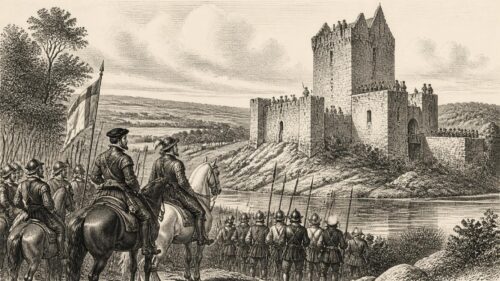
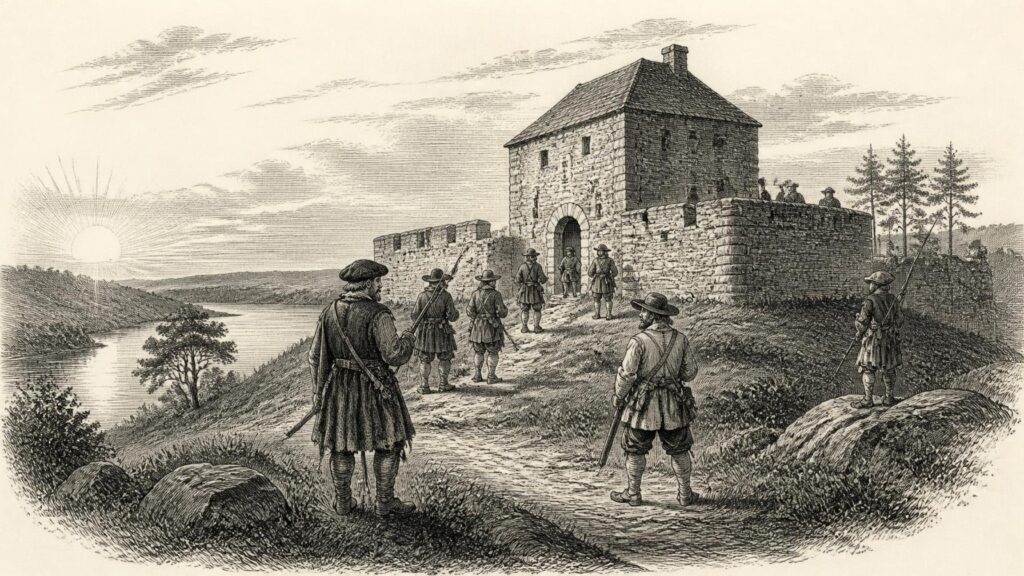
On 23 October, Sir Phelim O’Neill and his followers began the Ulster rising. Dungannon and the strategically important fort at Charlemont were among the places taken in the opening hours; other forts and houses were seized, often by surprise. Charlemont mattered far beyond its walls. Built on the Blackwater after the Nine Years’ War, it was an emblem of the Crown’s earlier military penetration of Ulster. Its capture by O’Neill signalled that an old political landscape, never fully reconciled to plantation and conquest, had again become militarily active.
On 24 October, O’Neill issued a proclamation at Dungannon. It claimed that the rising was not directed against Charles I and professed that English and Scottish subjects should not be harmed. Its declared language of defence, liberty and loyalty was an attempt to present armed action as the protection of the king and of the native Irish, rather than treason. That claim did not prevent violence, nor did it secure universal obedience among those taking part. Yet it reveals a central feature of 1641: rebels could imagine themselves resisting the Dublin administration while remaining loyal to the Stuart crown.
A more forceful proclamation issued from the rebel camp at Newry on 4 November and circulated an alleged royal commission authorising the seizure of strong places and the restraint of English Protestants. The commission became enormously influential because it allowed the uprising to be represented as royalist in purpose. Modern scholarship, however, finds the document almost certainly forged. Charles I had not supplied a warrant for rebellion. The false commission nevertheless exposed the deep constitutional confusion of the moment, because its claims drew plausibility from the king’s open conflict with the English parliament.
Flight, Plunder and Violence
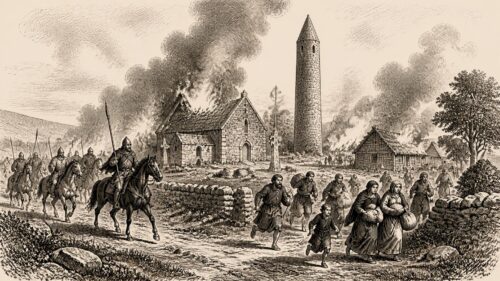
The rising rapidly transformed ordinary life. Protestant settlers and officials fled from scattered farms, villages and small towns towards defended places such as Dublin, Drogheda, Carrickfergus, Londonderry and Enniskillen. Many people lost livestock, crops, household goods, leases and debts alongside their homes. In a predominantly agrarian economy, this meant the destruction not only of property but of the means of winter survival. Catholic neighbours sometimes joined armed groups, took goods or benefited from the redistribution; others sheltered fugitives, negotiated protection or tried to preserve local order. The experience varied sharply from parish to parish.
Killings, assaults, imprisonment and forced stripping occurred during the upheaval. People also died from cold, hunger, illness and exposure after expulsion, especially as winter closed in. These realities must not be softened. But neither can every atrocity story be accepted at face value. The principal archive, the 1641 Depositions, consists largely of sworn Protestant testimony gathered by commissioners with compensation, prosecution and later confiscation in view. It is indispensable for recovering personal losses and violence, including women’s experiences, but it contains hearsay as well as eyewitness evidence and was shaped by the unequal authority of its collectors and deponents.
For that reason, modern historical practice distinguishes documented individual violence from later aggregate claims of massacre. The depositions demonstrate a grave and widespread humanitarian crisis; they do not justify repeating the extravagant casualty totals that later Protestant polemic made famous. They also record a society in which relationships could be contradictory: servants and masters, tenants and landlords, neighbours and kin were drawn to opposite sides, while identity might be described in terms of religion, language, origin, legal status or loyalty rather than a simple modern national divide.
War Reaches the Pale
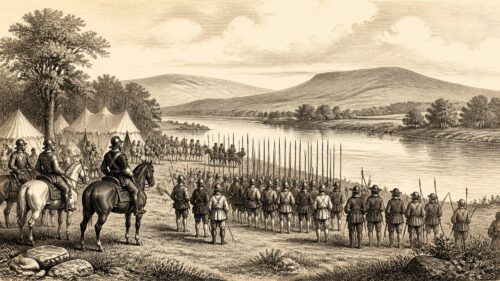
By November, the conflict had extended south from Ulster into the northern fringe of the Pale and the approaches to Dublin. Newry and Dundalk fell into rebel hands, while Drogheda, a vital walled port on the Boyne, held for the government under Sir Henry Tichborne. In late November a government relief force marching towards Drogheda was defeated near Julianstown in County Louth. The reverse yielded arms and ammunition to the insurgents and demonstrated that poorly organised official troops could not assume control of the roads outside Dublin.
Dublin did not fall, and that mattered decisively. It remained the base from which the lords justices, council and Protestant refugees sought men, money, provisions and assistance from across the Irish Sea. Yet its survival did not mean security. The city was crowded with displaced people and dependent on uncertain supply routes. Government forces launched operations against suspected rebels, and their conduct could be severe. The conflict was already becoming reciprocal: rebel attacks and confiscations were met by official and settler reprisals against Catholics, including people whose participation could not always be established.
In Leinster, unrest spread unevenly through November and December; in Munster, attacks and local risings gathered pace by the end of the year. This was not yet the organised Confederate Catholic government that would be created at Kilkenny in 1642. Nor was there a single rebel army under dependable central discipline. Rather, 1641 ended with intersecting local commands, gentry leadership, tenant participation, opportunism and emergency self-defence. The absence of a national structure made both restraint and negotiation difficult.
Religion, Information and Consequence
Religion supplied a language through which political danger was understood. Catholic participants invoked freedom of worship and fear of Protestant domination; Protestant refugees and clergy interpreted assault and displacement as evidence of a popish plot. Sermons, proclamations, letters and printed reports carried these interpretations rapidly to England and Scotland. The news from Ireland intensified the English crisis, as parliament and king disputed who should control forces raised to suppress the rebellion. Ireland was therefore not a side theatre. Its emergency helped make armed conflict in the other Stuart kingdoms more likely.
The first troops sent from England began to reach Dublin only at the end of December. Their arrival pointed towards a larger war, while Scottish intervention in Ulster was also approaching. For Irish communities, however, the significance of 1641 lay first in immediate losses: abandoned fields, broken tenancies, seized cattle, crowded refuges, armed roads and fear of the approaching winter. The year closed without settlement. Its opening proclamation had spoken of loyalty and protection; its actual legacy was a fractured island in which political trust, communal coexistence and the safety of everyday life had been profoundly damaged.

Primary Sources
- The 1641 Depositions Project
- 1641 Depositions
- 1641 Depositions Published In Volume Editions
- 1641 Depositions, Volume I: Armagh, Louth, Monaghan
- 1641 Depositions, Volume III: Antrim, Derry, Donegal, Down, Tyrone
- 1641 Depositions, Volume IV: Dublin
- 1641 Depositions, Volume V: Kildare, Meath
- MacMahon, Hugh Óg
- O’Connally, Owen
- Cole, Sir William
- MacDonnell, Randall
- Owen Connolly, Hugh Og MacMachon and the 1641 Rebellion in Clogher
- Manufacturing Massacre: the 1641 Depositions and the Wars of the Three Kingdoms
- Crowds and Political Violence in Early Modern Ireland: Galway and the 1641 Depositions
- Women and Sexual Violence in the ‘1641 Depositions’
- Who Framed Charles I? The Forged Commission for the Irish Rebellion of 1641 Revisited
- An Impartial Relation of the Most Memorable Transactions of General Owen O’Neill and His Party, from the Year 1641 to the Year 1650
- Copies of Letters of the Lords Justices and Privy Council of Ireland Relative to the Progress of the Rebellion, 1641–44
- ‘Till That Place Be Reduced’—Sir Phelim O’Neill’s Last Stand at Charlemont
- Campaigns of 1641–2
- The 1641 Rebellion