Lancaster’s Plague-Struck Return1408 CE

Dateline
In 1408 Ireland’s political geography remained sharply divided. The English lordship was strongest in and around Dublin, yet its government depended on cooperation from magnates, towns and religious houses, and on money which was chronically scarce. Beyond and across its frontier, Gaelic and Gaelicised lordships pursued their own rivalries, raiding routes and alliances. The year is unusually well illuminated by several annalistic traditions, although they do not all record the same matters. Their entries show an island in which a royal prince could arrive with military purpose, while deaths, cattle-raids, local feuds and new castles continued to shape life far from Dublin.
Thomas of Lancaster Returns
The most conspicuous development was the return of Thomas of Lancaster, second son of King Henry IV of England and the king’s lieutenant in Ireland. A later annalistic tradition places his landing at Carlingford on 2 August, the day after Lammas; the Irish annals simply record that “the son of the king of the Saxons” came to Ireland in 1408. Thomas had held the lieutenancy since 1401 but had spent long periods in England. His return therefore represented an attempt to restore a more direct, high-status royal presence at a time when the administration based in Dublin was under military and financial pressure.
Stephen Scrope, Thomas’s experienced deputy and governor of the wars, returned with him. Scrope had earlier relied not only on armed action but on negotiated submissions from neighbouring Irish rulers. Such arrangements were never a permanent settlement: they depended upon the lieutenant’s ability to pay troops, reward allies and punish defiance. The English administration’s revenues were limited, while the expense of a prince’s household, retinue and campaigning force was considerable. Thomas’s arrival was consequently a statement of authority, but not proof that the lordship possessed the means to impose that authority across Ireland.
The Earl of Kildare Arrested
One firmly recorded act of the new arrival was the seizure of Gerald FitzGerald, fifth earl of Kildare. Both the Annals of Loch Cé and the Annals of the Four Masters state that the earl was taken prisoner by the king’s son. The sources do not securely establish a single reason for the arrest. It should not, therefore, be represented as the punishment for one proven offence. What can be said is that Kildare was no marginal figure: his estates and following made him a central Anglo-Irish lord in Leinster. To imprison him immediately exposed a serious fracture within the political society on which the lieutenant depended.
The episode also demonstrates that “English” power in Ireland was not a unified bloc. Thomas was the king’s son and formal lieutenant; Kildare was a great lord of the colony with his own affinities, territorial interests and recent experience as chief governor. Later evidence shows that the earl was released before Thomas departed in 1409, but that outcome belongs to the following year. In 1408, the important fact is the arrest itself: the royal administration began its renewed intervention by coercing one of its own principal supports.
A Leinster Campaign Without Settlement
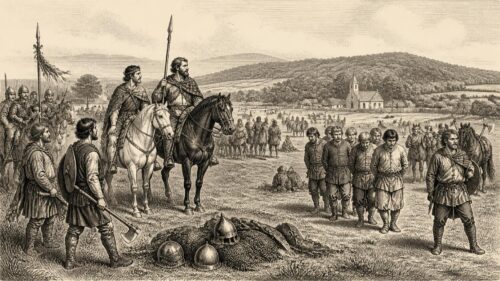
Thomas soon led, or authorised, a hosting from Dublin into Leinster. The Four Masters and Loch Cé agree that the expedition was led under the king’s son and that Hitsin Tuite was killed, a loss the annalist marked as grave. The sources do not give a full battle narrative, nor do they justify a precise reconstruction of its route or numbers. They do, however, make clear that this was not a ceremonial progress. It was a military movement into a region where the Mac Murchadha rulers and their allies contested the reach of the lordship.
Another entry in the Four Masters records war between Mac Murchadha and the English, and declares Mac Murchadha the victor. This should be read with care: it is a concise annalistic judgement rather than a campaign diary. Yet it establishes the larger result relevant to 1408. The lieutenant’s expedition did not produce an enduring submission in Leinster. Retrospective accounts place a skirmish at Kilmainham later that year, in which Thomas was wounded, but the Irish annals do not provide enough detail to turn that notice into a securely dated set-piece battle. The defensible conclusion is narrower: military pressure from Dublin met resilient opposition, and the political frontier remained unsettled.
Plague at Castledermot
Before the year was out, disease abruptly removed the man most capable of directing the lieutenant’s policy. The Annals of Loch Cé report a great pestilence in Meath and say that Scrope, described as a very valiant knight and deputy of the king in Ireland, died of the plague. The Annales Breves Hiberniae locates his death at Castledermot in County Kildare. Modern research places it within a month of Thomas’s arrival, but the annals themselves do not supply a day. The combination of sources permits a careful conclusion: Scrope died of plague at Castledermot during the 1408 outbreak, soon after returning to Ireland.
This was more than an obituary. Scrope brought administrative experience, military contacts and familiarity with the unstable borderlands around the Pale. His death left Thomas, still a young prince, without the deputy who had carried much of the practical work of his Irish government. The record of pestilence in Meath also gives a rare glimpse of a hazard shared across political boundaries. Medieval writers did not diagnose disease as modern medicine would, and the annal does not quantify mortality. Nevertheless, “great pestilence” indicates a disruption that would have touched households, labour, travel, religious observance and the movement of armed companies as well as high politics.
Conflict Beyond the Lordship
Elsewhere, the year’s notices reveal no national pause while Thomas was in Leinster. In Connacht, Fedlimid, son of Ruaidhrí Ó Conchobhair, made major depredations against Eóghan, son of Ó Conchobhair Ruadh. Such language points to the taking of movable wealth, above all cattle, alongside the intimidation of dependants and the assertion of lordship. Cattle were not merely food animals: they were stores of value, sources of dairy produce and breeding stock, and a measure of a household’s ability to sustain clients and fighting men. A raid could thus damage both immediate subsistence and future political capacity.
Violence within and between kindreds was equally visible. Conchobhar, son of Ímar Ó hAinlidhe, was killed on the bog of Cluain na gCailleach, at a place remembered as Lá na mBruach nDubh, early in winter; he was buried at Roscommon monastery. The annalist calls it a hard day for Cathal Dubh Ó Conchobhair and the sons of Ímar, language which suggests a wider political reverse rather than an isolated killing. Magnus Mac Samhradháin was killed by a thrown pole, while Miles Dalton was slain by his own brother; after the latter death, his castle was demolished by descendants of Cathal Ó Ferghail. These compressed notices show how succession, vengeance, property and fortified residence could become inseparable.
Castles, Learning and Local Continuity
Two castle-building entries in the Four Masters are especially significant. Conchobhar, son of Tadhg Mac Donnchadha, built Ballindoon Castle, while Murchadh, son of Cormac Mac Donnchadha, built Cúil Mhaoile Castle. The annals give no architectural description, so their materials and finished form should not be imagined too confidently. Their appearance in the record nevertheless signals investment in defended lordly centres during a period of feuding. Castles offered more than battlefield security: they were places from which a lord could store provisions, receive dependants, protect valuables and make territorial claims visible.
The year also preserves quieter signs of institutions and learning. Amhlaibh Mac Amhalghaidh, chief of Calraighe, died and was buried at Athlone. Mac an Bhaird of Cúil an Urtain, ollam to Uí Maine, also died. An ollam was a learned professional of high standing, associated in this case with the hereditary culture of poetry, history and praise maintained by lordly patronage. His death is a reminder that political households required more than soldiers: they sustained legal, genealogical and literary expertise through families trained over generations. The same annals that record plague and killings thus preserve the continuing work of memory and learned status.
An Uneven Year of Authority
For Ireland, 1408 was not defined by a single conquest or constitutional change. Its most securely dated developments are Thomas of Lancaster’s return, the imprisonment of Kildare, the Leinster hosting, Scrope’s death in plague, and a series of conflicts and constructions in Gaelic lordships. Together they reveal the limits of central power. A royal prince could enter Ireland, command an army and arrest an earl; yet he could not quickly settle Leinster, prevent disease from reshaping his government, or halt the local contests of Connacht, Breifne and other regions. The year’s annals instead present a crowded, decentralised Ireland, in which royal intervention was consequential but never the whole story.
Primary Sources
- Annals of Loch Cé, Part 3
- Annals of Loch Cé
- Annals of the Four Masters, Part 4
- Annals of the Four Masters
- The Annals of Ulster
- Annals of Ulster Otherwise Annala Senait, Annals of Senat
- Thadei Dowling Cancellarii Leighlen Annales Hiberniae
- Annales Hiberniae
- The Annals of Clonmacnoise: From the Creation to AD 1408
- Annals of Ireland, in English, from Adam to 1408, by an unidentified compiler
- Scrope, Stephen
- A Lancastrian Prince in Ireland
- Calendar of Ormond Deeds, Volume II, 1350–1413
- Accompt of Sir S. le Scrope, as Deputy-Lieutenant of Ireland, circa 1401–1408
- The Duke of Lancaster to Henry IV, His Father, Concerning His Own State in Ireland, and in Behalf of Sir S. Scroop
- Calendar of the Patent Rolls Preserved in the Public Record Office: 1405–1408
- Patent Roll 3 Henry IV (1401–1402), Item 24
- Exploring the Irish Annals
- Annals of the Kingdom of Ireland, Volume IV
- The Annals of Clonmacnoise, Being Annals of Ireland from the Earliest Period to AD 1408