Oriel Killing1372 CE
Records for 1372 reveal Ireland’s overlapping Gaelic, Hiberno-English and royal jurisdictions. Sir William Windsor left the lieutenancy in March, succeeded by Gerald FitzGerald, while Robert Ashton became justiciar in June amid inquiries into Windsor’s administration. Annals commemorate Brian Mór Mac Mathghamhna’s treacherous killing, although sources dispute whether it occurred in 1371 or 1372; his death affected Oriel’s politics. Seoán Mór Ó Dubhagáin, historian to Uí Mhaine, died at Rinn Dúin, where Gaelic scholarship met a former colonial settlement. Deaths, succession, capture and conflict in Connacht and the midlands further demonstrate political, social and religious interdependence, while underscoring annalistic chronology’s limitations.
Dateline
For Ireland, 1372 is best approached as a year of recorded transitions rather than a year dominated by one securely dated battle. The surviving evidence is uneven: Gaelic annals preserve deaths, a killing, and a capture, while English administrative material records a change of government in Dublin. Read together, they reveal an island divided not into two fixed worlds but into many overlapping jurisdictions. Gaelic lordships, Hiberno-English lineages, religious communities and the king’s administration all pursued their interests through alliances, payments, armed followings and learned memory.
A Change at Dublin Castle
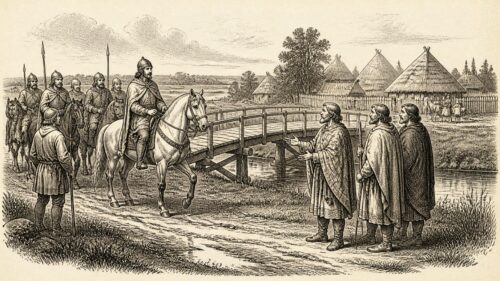
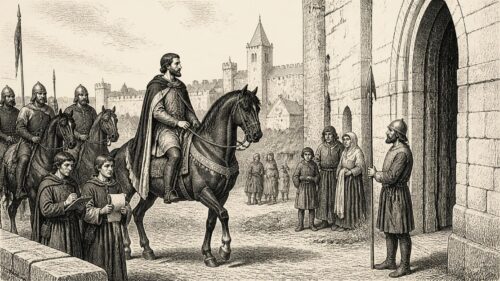
The clearest firmly dated development came in the English lordship. Sir William Windsor, the king’s lieutenant, left Ireland on either 20 or 21 March 1372; Gerald FitzGerald, earl of Kildare, took the oath of office on 22 March. The transition followed serious conflict between Windsor and the urban communities of the lordship, especially Dublin. In 1371 the crown had ordered him to stop disputed levies and to allow those who felt wronged by his government to travel to the king for redress. These orders did not mean that civic complaints had triumphed over royal authority. Rather, they show that government in the English areas of Ireland depended on negotiation between the crown, its officers, towns and local landholders.
The handover in March was not the last alteration of the year. Sir Robert Ashton began serving as justiciar on 20 June. He had been ordered on 28 May to investigate accusations made against Windsor, an inquiry that would continue into 1373. Such changes mattered chiefly within the areas where royal institutions could operate: Dublin and the principal towns, shires and lordships of the east and south-east. Even there, authority was constrained by finance, distances, local affinities and military need. Beyond those zones, royal office could influence events, but could not simply command them.
That limited reach is important when considering the events recorded by the Irish annals. Their Ireland was not a blank space beyond the lordship. It contained powerful, articulate political communities with their own rulers, churches, legal specialists and professional learned families. The vocabulary used by annalists—king, chief, heir, ollamh, gallowglass and community—describes a society in which rank and obligation were continually asserted, contested and remembered.
Brian Mór Mac Mathghamhna
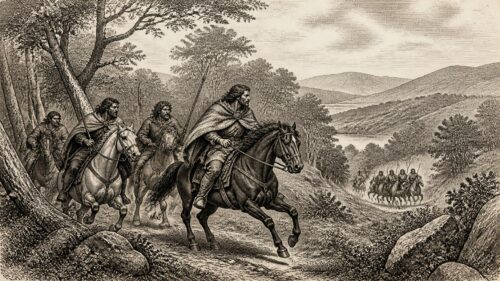
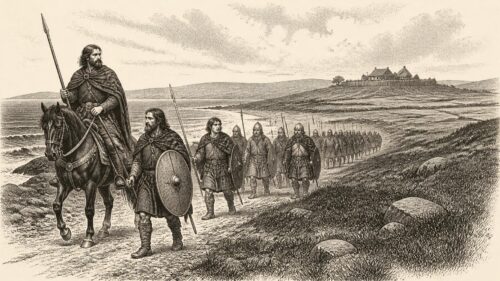
The most dramatic event assigned to 1372 by Annála Connacht and the Annals of the Four Masters was the killing of Brian Mór Mac Mathghamhna, ruler of Airgíalla or Oriel. Both accounts agree on the essential point: Brian was treacherously slain by a gallowglass. The Four Masters place him on the march to give battle to the English; Annála Connacht calls him the man who had killed more Galls and Gaels than any other in his time. These are not neutral modern assessments, but they make clear that he was remembered as a formidable war leader whose power had been made and maintained amid conflict with neighbours of several kinds.
His death must, however, be dated with care. The later annals place it under 1372, and the modern Dictionary of Irish Biography follows that year. But the Annals of Ulster contains a chronological note stating that the killing truly belonged to the calendar year 1371, adding that Brian was buried at Louth on 3 June. The discrepancy is a useful warning against treating every annal heading as an exact modern date. It is responsible to say that Brian’s assassination was commemorated in the 1372 annalistic record and belongs to the immediate political setting of 1372; it is not responsible to claim an undisputed date within that calendar year.
Whatever the precise dating, the loss was politically consequential. Brian had dominated Oriel after gaining the kingship in the 1360s, and his career had involved conflict with the O’Neills, the O’Reillys and the English settlers of Louth. His eldest son, Pilib Ruadh, succeeded him and soon adopted a less confrontational policy towards both the O’Neills and the English. That later change should not be projected backwards as an event of 1372, but it helps explain why the death of a ruler such as Brian mattered: a lord’s killing could reshape the calculations of kindreds, allies, mercenary captains and neighbouring communities.
The manner of the killing also illuminates warfare. Gallowglasses were heavily armed professional soldiers of Gaelic-Scottish background or connection, employed by Irish rulers and increasingly embedded in Irish political life. Their presence gave lordships access to experienced infantry, but military service rested on personal and political ties which could be precarious. The annals’ emphasis on treachery tells us less about battlefield tactics than about the breach of loyalty that made the death memorable.
The Passing of an Ollamh
A firmly placed death in 1372 was that of Seoán Mór Ó Dubhagáin, rendered John More O’Dugan in English translations. He was ollamh, or chief learned man, to Uí Mhaine, the powerful Ó Ceallaigh lordship spanning parts of eastern Galway and south Roscommon. His family had long served as hereditary historians to that polity. The title was not honorary in a casual sense. A learned historian and poet preserved genealogies, territorial traditions, precedents and praise; such knowledge helped define legitimate rule in a society where descent, land and political entitlement were closely connected.
Ó Dubhagáin’s surviving work shows the scale of that intellectual labour. His major topographical poem, Triallam timcheall na Fódla, surveys the leading families and territories of Meath, Ulster and Connacht, principally as they were understood before the Anglo-Norman conquest. It was unfinished, but it became a major vehicle for preserving a map of political Ireland in verse. His pupil Giolla-na-naomh Ó hUidhrín later wrote a complementary survey of Leinster and Munster. The poems did not provide a neutral census of fourteenth-century power. They instead organised knowledge of past lordship, ancestry and place into forms that could be recited, transmitted and used.
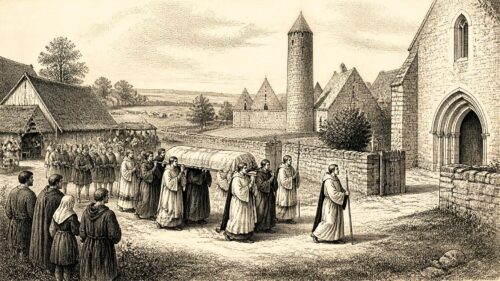
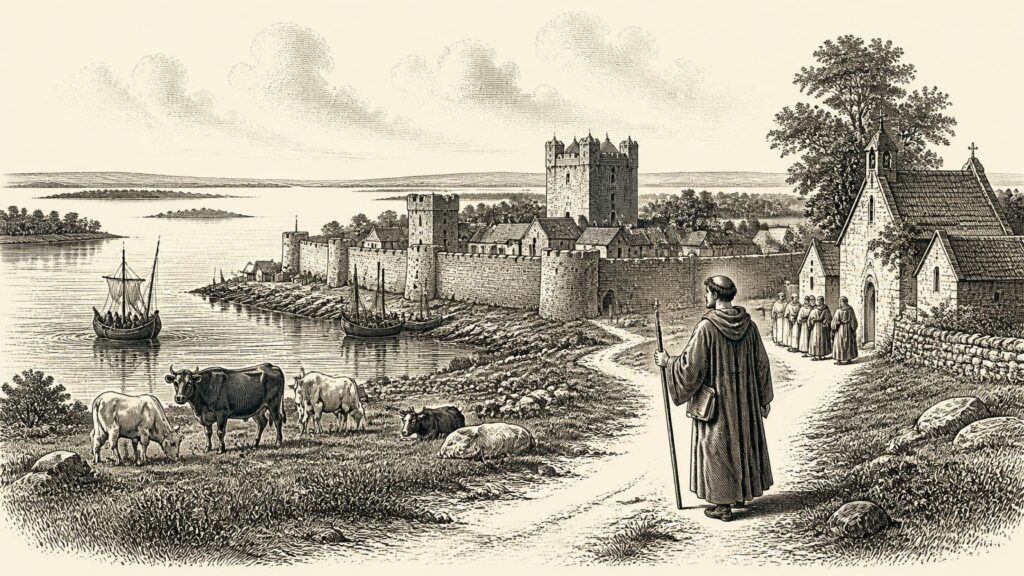
For his final seven years, Ó Dubhagáin had withdrawn to the community of St John the Baptist at Rinn Dúin on Lough Ree, where he died in 1372. Rinn Dúin was an especially resonant place for such a death. It was a fortified medieval settlement on a peninsula north of Athlone, with defences, harbour facilities, church, hospital and agricultural hinterland. Its castle had slipped from royal control by the mid-fourteenth century. Ó Dubhagáin’s residence there therefore joined Gaelic scholarship to a landscape shaped by both colonial construction and Gaelic political recovery. Religious retirement did not remove a learned man from public meaning; it gave his final years a monastic setting while his writings continued to serve secular lordship.
Connacht and the Midlands
Other notices from 1372 suggest how closely dynastic continuity, hospitality and religion were entwined. Annála Connacht records the death on 1 October of Muirchertach Muimhneach Mac Eochagáin, chief of Cenél Fiachach, a lordship in the central midlands. The date is unusually precise and reminds us that the annual record did not consist solely of warfare. A chief’s death involved succession, the redistribution or confirmation of dependants’ obligations, and the maintenance of a territorial household.
The annals also record the deaths of William son of Ulick Burke and Uilliam Óg Ó Ceallaigh, an heir of Uí Mhaine. William Burke was praised as a man of exceptional sociability or graciousness, while the death of the Ó Ceallaigh heir touched a lineage at the centre of the region that Ó Dubhagáin had served. Such praise is formulaic, but it is revealing. Medieval Irish political society expected a great man to display hospitality, good manners and generosity as well as martial capacity. These were practical as well as moral qualities: a ruler’s household had to retain followers, entertain visitors and sustain alliances.
The Four Masters further reports that Mac Feorais Bermingham was captured by Ó Ceallaigh and his sons, while Richard Mac Feorais, his heir, was killed. The brief notice cannot safely be expanded into a detailed campaign, for it gives neither a location nor a sequence of operations. Yet it confirms that power in Connacht and its borderlands was not neatly divided between ‘Gaelic’ and ‘English’ interests. The Berminghams were an established Hiberno-English family, and their fortunes were entangled with those of the Ó Ceallaighs and other Gaelic dynasties.
What the Year Can Show
1372 does not permit a simple story of advance or retreat. In Dublin, changes in royal personnel followed arguments over taxation and the accountability of government. In Oriel, the recorded killing of Brian Mór stood at the end of an aggressive career whose date remains contested by the sources. In Connacht, the death of Seoán Mór Ó Dubhagáin marked the passing of a scholar whose work preserved an authoritative vision of Ireland’s peoples and territories. At Rinn Dúin, a monastic community and a declining former colonial settlement formed the setting for that last chapter.
The year’s surviving notices are therefore modest but unusually instructive. They show politics being conducted by office-holders and urban petitioners, by chiefs and heirs, by mercenary soldiers, by religious communities and by custodians of inherited learning. They also show why medieval Irish chronology demands restraint. The annals are indispensable witnesses, but their dates, language and silences must be read as carefully as their vivid reports of death, betrayal and change.
Source References
Hover over a number to see the source. Select it to open the source.

- [1] Annála Connacht
- [2] Annála Connacht: Annal 1372
- [3] Annals of the Four Masters: Annal M1372
- [4] Annals of the Four Masters, Volume 3
- [5] The Annals of Ulster
- [6] The Annals of Ulster: Year U1372
- [7] The Annals of Ulster: Brian Mór Mac Mathghamhna Chronological Note
- [8] MacMahon (Mac Mathghamhna), Brian Mór
- [9] Ó Dubhagáin, Seoán Mór
- [10] Ó hUidhrín, Giolla-na-naomh
- [11] Corpas Stairiúil na Gaeilge: Annals Text Search
- [12] Rinn Dúin Conservation and Management Plan
- [13] Codices Hibernenses Eximii III: Book of Uí Mhaine
- [14] The Topographical Poems of John O'Dubhagain and Giolla na Naomh O'Huidhrin
- [15] Dublin and the Windsor Crisis, 1369–78
- [16] The Administration Of Ireland 1172–1377
- [17] Annales Breves Hiberniae
- [18] Annals of the Kingdom of Ireland
- [19] The Annals of Ulster
- [20] Roscommon Castle
Primary Sources
- Annála Connacht
- Annála Connacht: Annal 1372
- Annals of the Four Masters: Annal M1372
- Annals of the Four Masters, Volume 3
- The Annals of Ulster
- The Annals of Ulster: Year U1372
- The Annals of Ulster: Brian Mór Mac Mathghamhna Chronological Note
- MacMahon (Mac Mathghamhna), Brian Mór
- Ó Dubhagáin, Seoán Mór
- Ó hUidhrín, Giolla-na-naomh
- Corpas Stairiúil na Gaeilge: Annals Text Search
- Rinn Dúin Conservation and Management Plan
- Codices Hibernenses Eximii III: Book of Uí Mhaine
- The Topographical Poems of John O'Dubhagain and Giolla na Naomh O'Huidhrin
- Dublin and the Windsor Crisis, 1369–78
- The Administration Of Ireland 1172–1377
- Annales Breves Hiberniae
- Annals of the Kingdom of Ireland
- The Annals of Ulster
- Roscommon Castle