Fínghin at Callann1261 CE
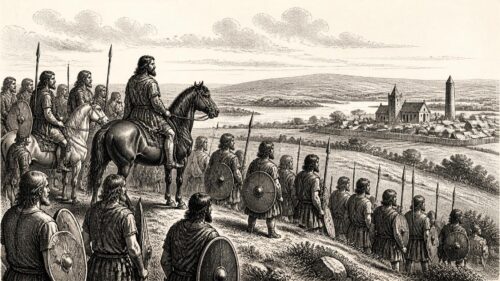
In 1261, Fínghin Mac Carthaigh defeated a major Geraldine force at Callann in Desmond, killing John fitz Thomas FitzGerald, his heir Maurice and many followers. The victory checked Geraldine expansion, but Fínghin was killed soon afterwards, leaving Desmond disputed. Annals differ over details, including dating, casualties and participants, while confirming the battle’s significance. Conflict elsewhere included raids, burned settlements and fortresses, rival successions in Breifne and Tír Eógain, and struggles in Thomond and Connacht. Clerics and churches suffered violence at Derry and Ballysadare, while Raphoe’s bishop was elected archbishop of Armagh. The year reveals politically fragmented, shifting power across Ireland.
Dateline
In 1261, the most consequential recorded Irish event was the destruction of a major Geraldine-led army in Desmond by Fínghin Mac Carthaigh, known as Fínghin Reanna Róin. The encounter is conventionally called the battle of Callann. It killed John fitz Thomas FitzGerald, the leading Anglo-Norman magnate of south-west Munster, and Maurice fitz John, his eldest son and heir. Yet the year was not reducible to one battle. Annalists also recorded warfare from Breifne to Tír Eógain, contested lordships, attacks on churches and clerics, a major archiepiscopal election, and the destruction of fortresses. Together, these episodes show an island divided among many competing powers rather than two united sides.
A Battle Firmly Linked to 1261
The Annals of Connacht, Annals of Loch Cé, Annals of Ulster and Annals of the Four Masters all place the defeat of John fitz Thomas and other ‘Foreigners’ in 1261. Their language needs care. In Gaelic annals, ‘Foreigners’ or Gallaibh commonly meant the Anglo-Norman settlers and their descendants in Ireland, not necessarily men newly arrived from England. The sources agree on the essentials: the Geraldines entered Desmond to attack Mac Carthaigh; Fínghin struck them; John fitz Thomas was killed; and the losses were grave.
One Munster chronicle, Mac Carthaigh’s Book, records the same expedition under its heading for 1262. That discrepancy is a warning against claiming more chronological precision than the evidence permits. Modern accounts often give 24 July 1261, but the surviving annalistic notices do not supply a day. It is responsible to treat the campaign and battle as securely connected with 1261, while recognising that its precise date and even the chronology used by every compiler cannot be recovered with certainty.
The fullest annalistic accounts report the deaths of John fitz Thomas, his son, fifteen knights, eight ‘noble barons’, younger men and innumerable soldiers. The Four Masters offers a different total for knights. Such figures demonstrate the scale of the shock rather than provide a modern casualty return. What is beyond reasonable doubt is that the expedition lost its senior commander and immediate successor, together with a substantial body of mounted and lesser fighting men. The Annals of Ulster also name the Barrach Mór, or Barry More, among those killed. The identification of that figure, and whether he died in this particular battle, has remained less certain than the death of John fitz Thomas.
Desmond’s Contested Lordship
John fitz Thomas had not been a mere local captain. He was a powerful lord whose position in Decies and Desmond rested on a mixture of royal favour, inherited claims, marriage connections and armed assertion. He had sought to enlarge his power in Munster and had repeatedly campaigned against the Mac Carthys. In 1260 he gained the support of William de Dene, the king’s justiciar in Ireland. The justiciar was the crown’s chief representative, based within an administration centred on Dublin, but his presence in the Callann expedition should not be mistaken for a centrally controlled conquest. Great landholders supplied much of the military force and pursued their own regional interests.
Mac Carthaigh’s Book names William de Dene, Clann Ghearailt, Mac Risdeard and a very large force of Galls in the expedition. It also records the participation of Domnall Ruadh, son of Cormac Fionn Mac Carthaigh, and Irish followers he could assemble. This is an important corrective to a simple ethnic reading of the conflict. A Mac Carthy claimant could stand with the Geraldine force against another Mac Carthy leader. Dynastic rivalry, landholding, kinship and opportunity mattered alongside language and ancestry.
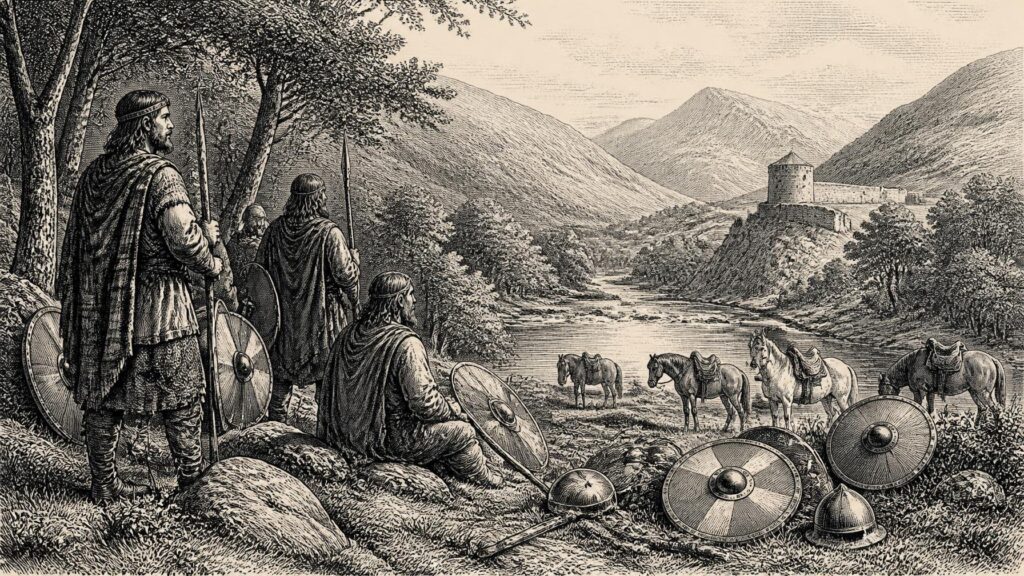
The battle site is traditionally located in the mountainous country near modern Kilgarvan and Kenmare, at Callann Gleann Ó Ruachtaigh. A nineteenth- and twentieth-century scholarly tradition associated it with the meeting of local rivers near Ardtully. The medieval texts, however, preserve no tactical narrative. We should not imagine a fully documented set-piece battle with known manoeuvres. The evidence allows only a restrained conclusion: Fínghin’s side chose or met the invading force in difficult south-western terrain and won a decisive engagement.
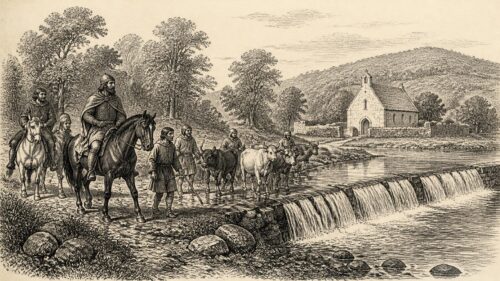
For communities in the region, a hosting was never solely an affair of elite names. Armies required food, animals, guides, transport and shelter; their movements brought burning, seizure and disruption. The annals explicitly describe Fínghin and his kinsmen waging destructive war against the settlers, while Mac Carthaigh’s Book records him carrying out burnings, plundering and killings in Ciarraighe Luachra during the year. These terse notices do not tell us how particular households endured the violence, but they make clear that crops, cattle, settlements and unarmed people lay within the reach of political warfare.
Victory and Sudden Succession
Callann did not give Fínghin a long period in which to consolidate his success. The Annals of Ulster, Loch Cé, Connacht and the Four Masters all state that he was subsequently killed by the Galls, still in their 1261 annals. They do not securely establish the circumstances, location or date of his death. His brother, called the Aithchleireach or ‘ex-cleric’ Mac Carthaigh, assumed the lordship or kingship of Desmond. Thus the year joined victory and bereavement on both sides: the Geraldines lost father and son at Callann; the Mac Carthys lost the commander who had inflicted that defeat shortly afterwards.
The political consequences were nevertheless substantial. John fitz Thomas’s grandson Thomas fitz Maurice, born in 1261, inherited as a child after the death of his father and grandfather. His minority left the lordship exposed to competing relatives and neighbours. Callann did not expel Anglo-Norman power from Munster, nor did it create a unified Gaelic kingdom. It did, however, check the Geraldine advance in south-west Munster at a moment when new settler lordships and castles were becoming harder to establish beyond the areas already controlled before the mid-thirteenth century.
War Across the Island
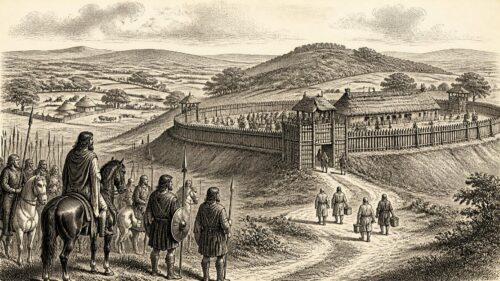
Elsewhere, 1261 was equally unsettled. In Connacht and Breifne, Aedh, son of Feidlimid Ó Conchobair, led a hosting into Breifne that burned settlements and crops, before part of his force suffered defeat. His son Turlough Óg was given in fosterage to Art Ó Ruairc. Fosterage was not a private domestic detail: placing a child with another ruling family could bind allies, signal a settlement or create obligations across political frontiers. The same annals record Art Ó Ruairc’s escape and recognition by Breifne and Conmaicne leaders, while the strongholds of both Aedh and Feidlimid Ó Conchobair were burned. Authority depended on people, cattle, alliances and fortified places, all of which could be attacked.
In Thomond, Conchobhar na Siúdaine Ó Briain defeated forces associated with David Prendergast at Coill Bairin, according to Mac Carthaigh’s Book. Annals of Connacht and the Four Masters report that Brian Ruadh Ó Briain burned and destroyed Castleconnell, killing those inside. These were not side-shows to Callann but parallel contests in a Munster landscape where castles were instruments of lordship and conspicuous targets. John de Verdun’s marking out of a castle site at Moydow in the same year likewise illustrates continuing investment in fortification and territorial control in the lordship’s east and midlands.
Churches, Clergy and Political Violence
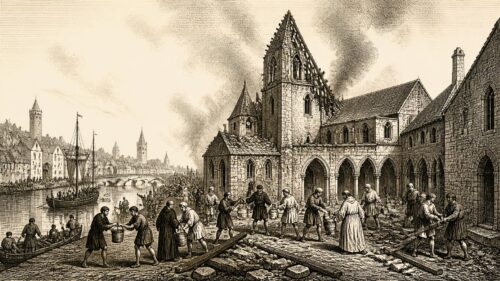
Religious institutions were deeply entangled in the year’s conflicts. At Derry, sixteen prominent clerics of Cenél Conaill were killed by Conchobhar Ó Néill and Cenél nEógain, alongside Conchobhar Ó Firghil. The annals immediately frame Conchobhar Ó Néill’s own killing by Domnall Ó Breslén of Fanad as a miracle of Colum Cille. This was not detached reporting: the chroniclers interpreted violence against Derry’s clerical community through the saint’s protective power and the moral order of the church.
At Ballysadare, Cathal Ó hEghra and five people of Luighne were killed in the great church of St Feichín by Mac Fheorais’s men. Domnall Ó hEghra retaliated, killing Sefin Mac Fheorais; one annal adds the vivid detail that a helmet taken from the church was on Sefin’s head when he died. Whether every detail is recoverable as literal fact, the record plainly marks the church killing as sacrilege and associates retaliation with violated sanctuary. Meanwhile Máel Pátraic Ó Scannail, bishop of Raphoe, was elected archbishop of Armagh and, according to the Annals of Ulster, defended his election at the Apostolic See. Amid local warfare, Irish ecclesiastical office remained connected to papal authority beyond the island.
In Tír Eógain, Áed Buidhe Ó Néill was expelled and Niall Cúlánach Ó Néill made king in his place; another annal adds that Ó Domhnaill subsequently defeated Niall. These changes underline the year’s central pattern. Kingship was not a stable office bestowed from above, but a prize continually negotiated through kin groups, church connections, fosterage, hostages, raids and force. Callann was its most resonant clash, but 1261 as a whole was a year in which authority was fought over from Derry to Desmond.
Primary Sources
- The Annals of Ulster, Year U1261
- Annala Uladh: Annals of Ulster, Year U1261 (Irish text)
- Annála Connacht, Annal 1261
- Annals of Loch Cé, Annal LC1261
- Mac Carthaigh’s Book, Annals 1257–1262
- Mac Carthaigh’s Book
- Annals of the Four Masters, Annal M1261
- Annals of the Four Masters (Irish text), Annal M1261
- The Battle of Callann, A.D. 1261
- FitzGerald, John fitz Thomas
- FitzGerald, Thomas fitz Maurice
- The Celtic Lands of the British Isles
- Henry III Fine Rolls
- British Library Archives: Extract from the Great Pipe-roll of Ireland, 1261–1263
- Calendar of Documents Relating to Ireland, 1171–1307
- Annals of Inisfallen
- Annals of Inisfallen Bibliography and Annal Index
- CELT: List of Published Texts
- Irish Texts at CELT
- Exploring the Irish Annals