Kilcolman Demolition1284 CE
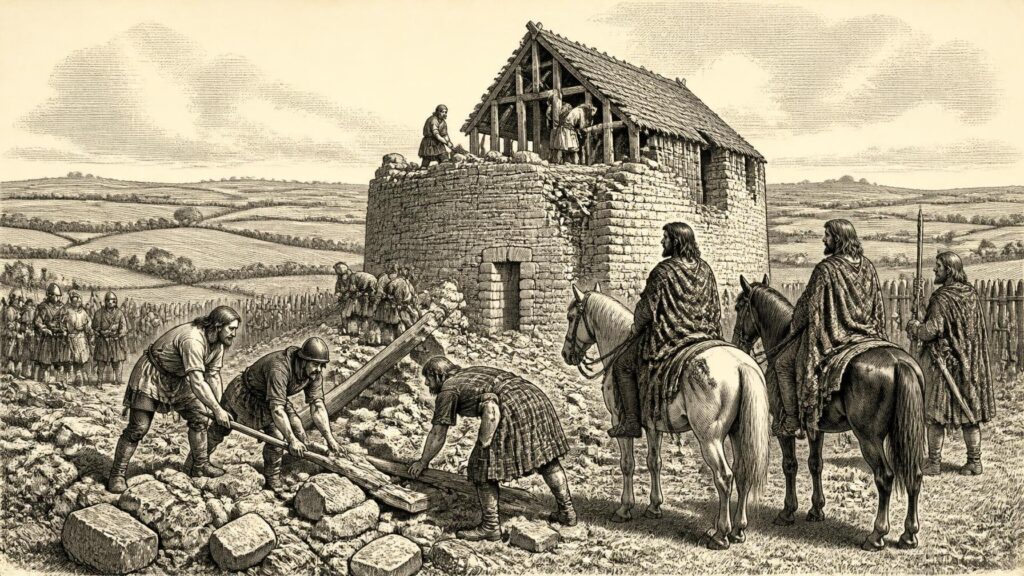
In 1284, Irish politics was shaped by local conflict, succession and contested lordship rather than an island-wide crisis. In Thomond, Toirdelbach Ó Briain killed his rival Donnchad, strengthening his position and troubling Thomas de Clare’s Bunratty lordship. In Connacht, Simon d’Exeter’s death provoked raids, while losses suffered by Holy Trinity Island and Boyle Abbey were repaid; Fiachra Ó Flainn burned Dunmore. King Cathal mac Conchobair Ruaid demolished Kilcolman Castle, challenging fortified authority. Elphin saw rapid episcopal changes after two deaths. Killings of northern chiefs further demonstrate fragile regional power, where kinship, churches, compensation and strongholds shaped political control across Ireland.
Dateline
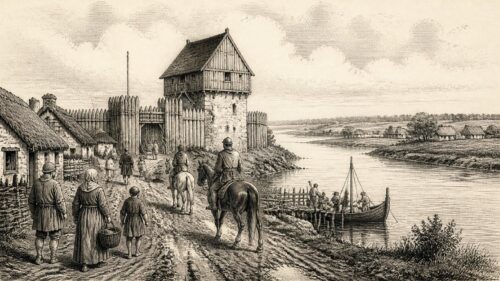
For Ireland in 1284, the clearest surviving record is not of a single island-wide crisis but of several sharp local turns: a royal killing in Thomond, violence and counter-violence across Connacht, the demolition of a castle at Kilcolman, and an unusually compressed episcopal succession at Elphin. Taken together, these notices show how late thirteenth-century Ireland was governed and contested through rival kin-groups, lordships, churches and fortified places. Power lay neither wholly with the English crown’s administration nor with any single Gaelic ruler. It was exercised locally, often precariously, and could be challenged through raiding, hostage-taking, destruction of strongholds, negotiated compensation or the killing of a rival.
Thomond After Donnchad
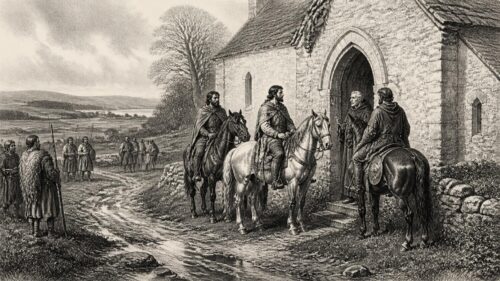
The most consequential death recorded for the year was that of Donnchad Ó Briain, lord or king of Thomond, who was killed by his kinsman and rival Toirdelbach Ó Briain. The annals give no day, place or detailed account of the encounter. A later biographical reconstruction, drawing on the annalistic tradition, identifies it as a killing at a parley. That qualification matters: 1284 can securely be associated with Donnchad’s death and Toirdelbach’s victory, but not with a fuller narrative of the meeting than the evidence permits.
The killing ended one phase of a long Ó Briain succession struggle. Donnchad belonged to the line of Brian Ruad, while Toirdelbach came from the competing Clann Thaidhg branch. Their quarrel had been entangled with the ambitions of Thomas de Clare, the Anglo-Norman lord established at Bunratty. A settlement in 1281 had divided Thomond between rival claimants, both of whom accepted de Clare’s overlordship. That arrangement did not remove the dynastic competition beneath it. Donnchad’s death instead left Toirdelbach dominant and removed the immediate rival around whom resistance to him had gathered.
The event also exposed the limits of de Clare’s position. He had spent much of the preceding year in England in Edward I’s company. According to the evidence assembled in the Dictionary of Irish Biography, he returned to Thomond late in 1284 because the killing threatened a renewed devastation of the region. His concern was understandable. The colonial lordship around Bunratty depended on settlements, rents, labour and secure routes through the Fergus plain; a revived Ó Briain war endangered all of them. Yet de Clare’s return should not be mistaken for direct control. His power rested on castles, armed followers, royal support and alliances with particular Irish factions, not on an uncontested authority over Thomond.
Connacht in Raids and Reprisals
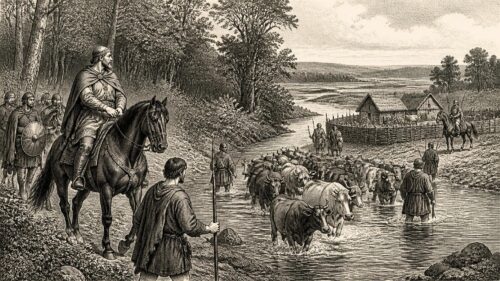
Connacht’s annals convey a different but equally unsettled picture. Simon d’Exeter was killed by Brian Ó Flainn and Diarmait and Máel Sechnaill, sons of Ó Flannacáin. The immediate consequence, the Annals of Connacht state, was “great war and strife” in the province. The word choice is significant. Simon’s death was not treated as an isolated homicide but as an act capable of drawing groups into wider conflict. The annal then records great raids by the Galla, the ‘Foreigners’ or settler forces, after which the losses of the community of Holy Trinity Island and the monks of Boyle were fully repaid.
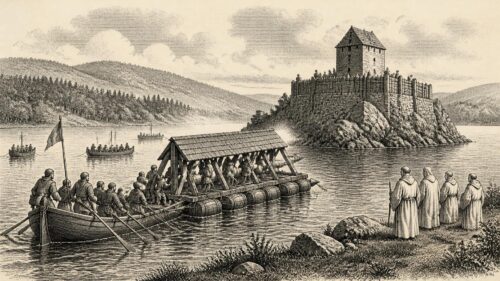
That last detail offers a rare glimpse of what conflict meant beyond the leaders named in the record. Raiding was a way of asserting dominance and extracting wealth, but it could also imperil ecclesiastical communities with land, livestock, rents and dependent households. Holy Trinity Island on Lough Key was a Premonstratensian house, while Boyle was one of Connacht’s leading Cistercian monasteries. Both were institutions embedded in the political economy of the region, supported by patrons and dependent upon landed resources. The annal does not explain who imposed the repayment, how it was calculated, or whether it followed arbitration, coercion or a settlement. It does show, however, that church property was recognised as having claims capable of being repaired even amid warfare.
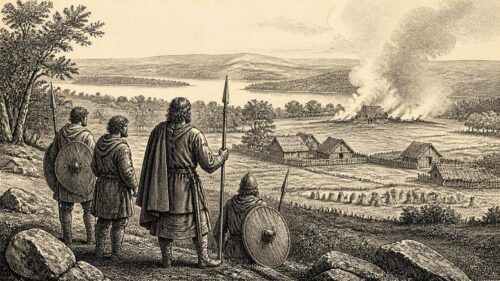
Fiachra Ó Flainn burned Dunmore in the same year. The terse entry does not specify the scale of the fire, the people affected or the motive. It should therefore not be expanded into a story of siege or massacre. Even so, burning was a deliberate political instrument in medieval Ireland: it could punish an opponent, spoil a locality’s resources and announce that its defenders had failed. The pairing of raids, restitution and burning in the Connacht record captures the insecurity of communities living amid struggles that crossed Gaelic and settler interests rather than respecting a simple ethnic division.
A Castle Demolished
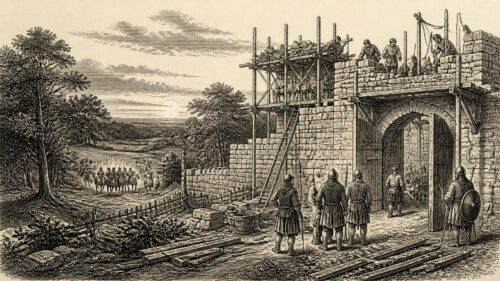
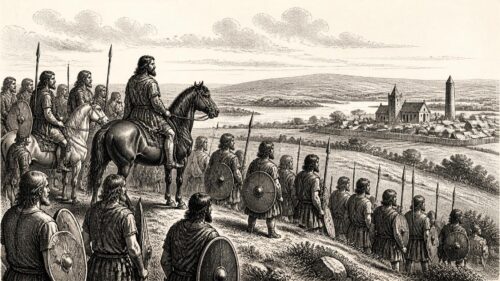
Cathal mac Conchobair Ruaid, king of Connacht, “knocked down” Kilcolman Castle. This was one of the year’s most tangible assertions of Gaelic royal power. A castle was more than a military structure. It was a centre from which a lord’s officers could collect dues, secure an estate, store supplies, shelter a garrison and project authority into a surrounding district. Its demolition was accordingly a statement that such authority could be broken. The surviving notice does not establish whether Cathal captured the castle after a fight, whether its defenders withdrew, or how completely it was destroyed. Nor does it prove that the site ceased thereafter to matter. What it firmly records is the intentional overthrow of the castle by Connacht’s king in 1284.
Kilcolman lay in the north-eastern Connacht frontier zone later associated with the Mac Costellos, descendants of the Anglo-Norman de Nangle family. Archaeological and local historical work places the lost castle site near modern Ballaghaderreen, though little is now visible above ground. The destruction recorded in 1284 belongs to a wider pattern in which fortified centres were repeatedly built, damaged, rebuilt and contested. Castles could strengthen incomers’ claims to land, but they were never invulnerable symbols. Cathal’s action demonstrated that a Gaelic ruler could strike at the built infrastructure of lordship, not merely raid open countryside.
Elphin’s Rapid Vacancy
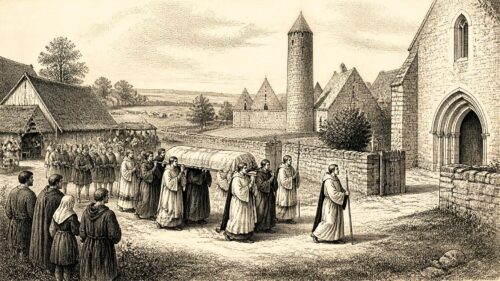
The church was also affected by sudden change. Muiris Ó Conchobair, bishop of Elphin, died in 1284. Amlaíb Ó Tomaltaig was elected and confirmed as his successor, but himself died soon afterwards. The see was then offered to Gilla Ísa, son of Liathánach Ó Conchobair, abbot of the Premonstratensian community of Holy Trinity Island on Lough Key. The sequence is unusually revealing because it preserves successive stages rather than merely recording a bishop’s death: vacancy, election and confirmation, another death, and a further election.
It also shows the closeness of diocesan office to the religious houses and leading families of Connacht. Gilla Ísa was an abbot from a reformed religious order and bore the name Ó Conchobair, the dominant royal kindred of the province. This does not mean that the bishopric was simply a family possession: election and confirmation were recognised ecclesiastical processes, and the annal carefully marks Amlaíb as elected and confirmed. But the choice of a monastic superior tied by name and lineage to Connacht’s foremost dynasty illustrates how spiritual authority, learning, landed endowment and political influence met in a medieval Irish see.
At the northern edge of the island, the annals also record the killing of Dubgall, son of Magnus Ó Baigill, chief of Cloch Chinnfhaoladh, by the followers of Ó Máelgáithe, and the death of Mac na hOíche Mac Dorchaid, chief of Cenél Luachain. These brief notices resist easy interpretation, but they are a useful corrective to accounts focused exclusively on Thomond and Connacht. Irish political life consisted of many lordships, each with its own rivalries, obligations and vulnerable succession lines. The death of a regional chief could alter local balances even when it scarcely appeared in records produced elsewhere.
A Year of Local Power
What can responsibly be said of 1284, then, is that it was a year in which established arrangements proved brittle. In Thomond, Donnchad Ó Briain’s killing gave Toirdelbach the advantage and required Thomas de Clare to reckon with the danger to his lordship. In Connacht, a killing prompted raids and compensation involving two major religious communities; Dunmore was burned; and Cathal Ó Conchobair Ruaid destroyed Kilcolman Castle. At Elphin, two deaths and a fresh election quickly reshaped the diocese’s leadership.
The evidence is strongest for these individual developments, not for a general national campaign or a coordinated conflict. It nevertheless reveals a connected political landscape. Kinship determined claims to kingship; churches held resources worth protecting and repaying; castles embodied contested control of land; and violence was often followed by negotiation rather than ending only in conquest. Ireland in 1284 was not politically static between larger, better-known wars. It was a country in which local decisions—at a parley, in a raid, before an episcopal election, or at the walls of a castle—could recalibrate power across whole regions.
Source References
Hover over a number to see the source. Select it to open the source.

- [1] Annála Connacht
- [2] Annála Connacht
- [3] Annals of the Four Masters, Volume 3
- [4] Annals of the Four Masters, Volume 3
- [5] The Annals of Ulster
- [6] Annala Uladh: Annals of Ulster otherwise Annala Senait, Annals of Senat
- [7] O'Brien (Ó Briain), Brian Ruad
- [8] Clare, Thomas de
- [9] Burgh, Richard de
- [10] Clare, Richard de
- [11] MacCarthy (Mac Carthaig), Domnall Ruad
- [12] Caithréim Thoirdhealbhaigh
- [13] Caithréim Thoirdhealbhaigh
- [14] Annals of Inisfallen
- [15] Annals of Inisfallen
- [16] Annals of Inisfallen: Bibliographical Details
- [17] Boyle Cistercian Abbey
- [18] School of the West
- [19] Recent Revelations from Thirteenth-Century Roscommon
- [20] Statute of Rhuddlan
- [21] Annales Breves Hiberniae
- [22] Annales Hiberniae
Primary Sources
- Annála Connacht
- Annála Connacht
- Annals of the Four Masters, Volume 3
- Annals of the Four Masters, Volume 3
- The Annals of Ulster
- Annala Uladh: Annals of Ulster otherwise Annala Senait, Annals of Senat
- O'Brien (Ó Briain), Brian Ruad
- Clare, Thomas de
- Burgh, Richard de
- Clare, Richard de
- MacCarthy (Mac Carthaig), Domnall Ruad
- Caithréim Thoirdhealbhaigh
- Caithréim Thoirdhealbhaigh
- Annals of Inisfallen
- Annals of Inisfallen
- Annals of Inisfallen: Bibliographical Details
- Boyle Cistercian Abbey
- School of the West
- Recent Revelations from Thirteenth-Century Roscommon
- Statute of Rhuddlan
- Annales Breves Hiberniae
- Annales Hiberniae