Thomas Maguire’s Fermanagh Succession1430 CE
In 1430, Irish political life was marked by warfare, negotiation and succession rather than an island-wide event. Tomás Mág Uidhir died on 13 November after thirty-six years ruling Fermanagh, and his son Tomás Óg succeeded with publicly affirmed support. Eóghan O’Neill raided Oriel and Meath, securing tribute, submissions and a hostage without permanently conquering these territories. In Cork, Kilbrittain castle changed hands amid MacCarthy and Desmond conflict. Raids and rival claims affected Connacht and Breifne, where sanctuary and éraic enabled settlement. Deaths of clerics and legal scholars underline ecclesiastical and learned institutions’ roles in authority, hospitality, memory and social order.

Dateline
The records for 1430 reveal no single island-wide turning point, but they do show several local powers testing their reach, defending their authority and arranging succession. The clearest dated event came in Fermanagh, where Tomás Mág Uidhir, known in the annals as An Giolla Dubh or ‘the Black Gillie’, died on 13 November after thirty-six years as king. His son, Tomás Óg, was accepted as his successor. Elsewhere, Eóghan O’Neill led forceful expeditions across Oriel and into Meath; conflict reshaped ownership of Kilbrittain castle in south-west Cork; and rival lineages in Breifne, Connacht and beyond pursued their claims through raids, seizure and negotiated settlement.
O’Neill’s Western Demonstration
The most expansive military activity recorded for the year belonged to Eóghan O’Neill, son of Niall Óg, then a leading figure within the divided O’Neill dynasty of Tír Eoghain. It is important not to project his later career backwards: he did not become king of Tír Eoghain until 1432. Yet the hostings of 1430 demonstrate the regional stature that made that accession possible.
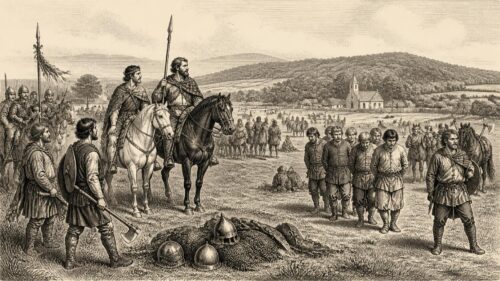
First, Eóghan led a large force against the English settlers of the plain of Oriel, the lowland region around modern south Armagh, Monaghan and Louth. The Annals of Ulster say that the settlement was harried, stripped and burned, and that Sradbaile was burned before its inhabitants were left paying tribute. The entry does not provide a day or month, and its formula of triumph belongs to annalistic rhetoric; nevertheless, it firmly places a major O’Neill incursion against colonial communities in this calendar year. The target was not simply a battlefield opponent. Burning settlements, taking livestock and imposing tribute were means of extracting resources and of making political superiority visible.
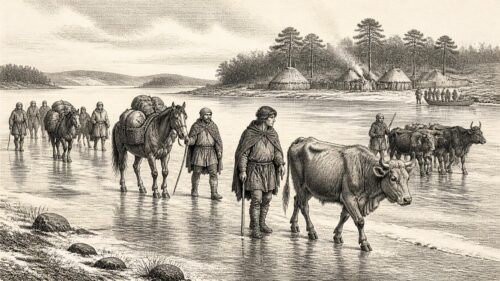
A second hosting carried Eóghan and the magnates of Ulster south-westwards through Anghaile, the O’Farrell lordship in what is now County Longford, and onwards into Fremainn in Meath. The expedition drew in a wide coalition: the annals name the O’Connors Faly, O’Melaghlins, O’Maddens and MacGeoghegans among Gaelic lords who came to meet him. They are said to have received Eóghan’s stipend, while lands around Cell Bicsighe in western Meath were burned. The baron of Delvin, the Plunkets, Herberts and other English of western Meath then came to submit and honour him in relation to their lands.
Such language should not be mistaken for the permanent conquest of Meath. It records a successful armed demonstration, followed by payments, acknowledgements and a withdrawal. Its significance lies precisely in that temporary but public reversal of normal hierarchies. The Anglo-Irish lordship remained rooted in Meath; yet its local landholders could be compelled to bargain with a powerful Gaelic commander. Eóghan took Edmond, son of Domhnall Ua Ferghail, back to Dungannon as a hostage connected with the lordship of the O’Farrells. Hostage-taking was not an incidental cruelty but a recognised political security: a living guarantee that an agreement, tribute arrangement or submission would be observed.
The campaign also belonged to a sequence rather than an isolated burst of violence. In 1429 Eóghan had aided Eóghan O’Reilly against opponents in East Breifne at Achadh Cille Móir. The following year’s movement through Anghaile can therefore be read as connected to an alliance system stretching from Tír Eoghain through Fermanagh and East Breifne towards Meath. That is context, not evidence that every participant in the 1430 hosting was an obedient dependant. Gaelic politics rested on negotiated relationships among dynasties, churchmen, military households and local communities, and those relationships could change rapidly.
A Carefully Managed Succession in Fermanagh
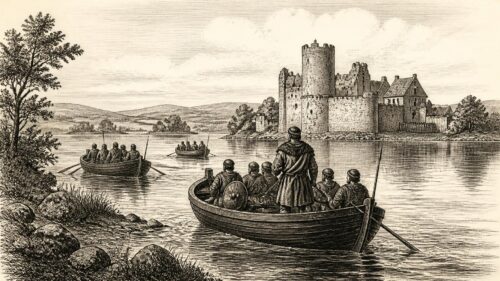
The death of Tomás Mág Uidhir was more securely dated than most events in the year. The Annals of Ulster place it on the Ides of November, 13 November 1430. Tomás had ruled Fir Manach for thirty-six years, making his passing a significant moment for the lakeland kingdom centred on Lough Erne. The Annals of Loch Cé independently note his death and the succession of his son, although without the precise date.
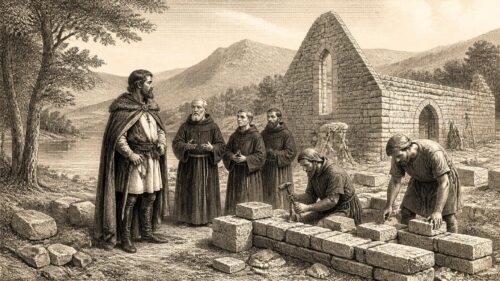
The Ulster annalist’s obituary is exceptionally full. It describes Tomás as a man of hospitality and prowess, credits him with founding or furnishing churches, monasteries, oratories, crosses and Marian images, and praises him for making peace between clergy and laity and defending his territory against neighbours. Such statements are not a modern audit of building works or social welfare. They are a formal, laudatory obituary written within the values of elite Gaelic society. Even so, they are valuable evidence for what contemporaries expected a successful ruler to do: protect the territory, sustain hospitality, patronise religious places and cultivate good relations with ecclesiastical institutions.
Hospitality was political as well as charitable. A lord’s household had to feed retainers, travellers, learned men, clergy and dependants, while gift-giving helped turn military power into durable loyalty. The annalist’s praise of Tomás as outstanding in hospitality therefore points to the material foundations of lordship: cattle, grain, fisheries, labour, storehouses, boats and the capacity to move provisions through the Lough Erne waterways. The evidence does not allow a reconstruction of ordinary diets or annual harvests in 1430, but it does show that provisioning and open-handedness were regarded as public measures of authority.
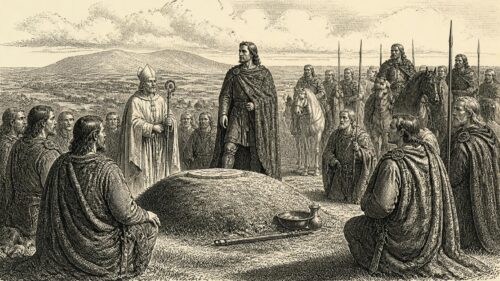
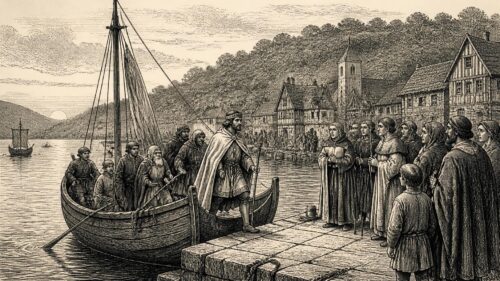
Tomás Óg was then made king “unanimously”, according to the annal. The approval of clergy, laymen, elders, ollams, yeomen and hospitallers is emphasised. This too should be treated cautiously: unanimity in an annalistic succession notice is an idealised claim, not proof that every branch of the Mág Uidhir kindred agreed without reservation. Yet the wording makes clear that accession required more than simple father-to-son inheritance. A viable ruler needed recognition from a broad political community, including hereditary learned professionals and ecclesiastical interests. Tomás Óg’s succession was thus presented as an orderly act of consent at a time when several neighbouring lordships were unstable.
Castles, Kinship and Compensation
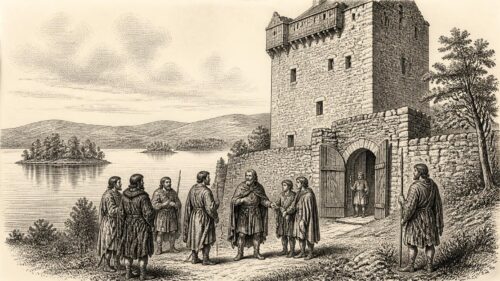
South-west Cork saw a different expression of contested power. The annals record a great war between Mac Carthaigh Riabhach and James FitzGerald, earl of Desmond. James captured Kilbrittain castle and handed it to Donnchadh Mac Carthaigh, brother of the MacCarthy leader, who had assisted in taking it. The event shows how a stone castle could be both a military asset and a lever in a family dispute. By backing one kinsman against another, the earl could intervene in the politics of Carbery without necessarily absorbing the whole lordship into direct control.
In Connacht, Mac William of Clanricarde joined Mac Donnchadha of Tír Oilella and the sons of Domhnall son of Muircheartach O’Connor in a hosting into Conmaicne Cúile. The annal records extensive burnings and the deaths of Aodh O’Connor Ruadh and Cairbre Ó Beirn. Cathal, son of O’Connor Ruadh, meanwhile captured Tulsk castle from the sons of Toirdelbach Óg O’Connor. These entries are terse, but their combination demonstrates that warfare involved strongholds, farmland and rival inheritance claims at once. A castle changed hands; surrounding communities bore the cost of burning and plunder.
Breifne offers a rare glimpse of conflict brought to settlement. Brian, son of Tighearnán Óg O’Rourke, was killed by the sons of Máel Sechlainn Mac Raghnaill at Maethal of St Manchan. Donnchadh Mac Tighearnáin was driven into the monastery there with leading men of his people. He emerged under Mac Raghnaill’s safeguard; peace was made, and the éraic—the compensation due for Brian’s killing—was paid by O’Rourke. The monastery was therefore not only a religious site but a place capable of offering sanctuary and facilitating negotiation. The payment of éraic did not erase loss, but it supplied a recognised mechanism for limiting the cycle of revenge.
Another Breifne killing carried longer consequences. The Annals of the Four Masters state that Art O’Rourke, a claimant to the lordship, was murdered in his own house by his nephew Maghnus, specifically a week before Easter. Modern biographical work identifies Art as a figure in the continuing contest for West Breifne, where rival O’Rourke branches and outside allies had repeatedly advanced competing candidates. The exact regnal outcome cannot be compressed into a single clean succession story, but Art’s murder removed one experienced contender from a conflict that continued for years.
Religion, Learning and the Limits of the Record
The year’s entries also preserve quieter losses. Gilla-na-naem Ua Leannáin, canon and sacristan of Lisgoole, died on 31 August. His notice reminds us that religious communities depended on officers responsible for worship, property and the practical life of a monastery. In Fermanagh, Tomás Mág Uidhir’s obituary similarly links political authority to churches, monastic houses and learned society. Far from standing outside secular politics, ecclesiastical institutions offered patronage, literacy, sanctuary and legitimacy.
Ferghal Mac Aodhagáin, an ollam of Lower Connacht in féineachas, or traditional legal learning, also died in 1430. The obituary calls him a master in every branch of his art and a keeper of a guest-house. Learned law, hospitality and status were closely connected. Such specialists preserved and interpreted legal tradition, served leading families and relied on lordly support. Their deaths mattered because political society depended upon more than warriors: it required judges, poets, clerics, historians and household officers to maintain rights, memory and reputation.
What survives for 1430 is therefore a selective record, chiefly of elites, violence, succession and ecclesiastical distinction. It cannot tell us the name of every farmer whose crops were burned in Meath or Conmaicne, nor quantify the tribute taken by Eóghan O’Neill. But its silences are instructive. Raiding worked because settlement, cultivation, livestock and storehouses were worth seizing; hospitality mattered because households depended on reliable production; and peace required hostages, sanctuary and compensation because local society had to continue after armed conflict. In 1430, authority in Ireland was repeatedly made—and contested—through those practical ties.
Primary Sources
- The Annals of Ulster
- Annals of the Four Masters
- Part 6 of Annals of the Four Masters
- Annals of Loch Cé
- Annala Locha Cé
- Annála Connacht
- Annála Connacht
- Translated Texts at CELT
- List of Published Texts at CELT
- O’Neill (Ó Néill), Eóghan
- O’Neill (Ó Néill), Enrí
- O’Neill (Ó Néill), Domhnall Bog
- O’Reilly (Ó Raghallaigh), Eóghan
- O’Reilly (Ó Raghallaigh), Tomás Mór
- O’Rourke (Ó Ruairc), Tadhg
- O’Rourke (Ó Ruairc), Donnchadh
- Fitzgerald, James fitz Gerald
- The Rise and Fall of the Clann Éinrí Aimhréidh Uí Néill: Dynastic Feuding and Geopolitics in the Late Medieval Irish Sea World
- English Lordship of Ireland and the Irish Sea World: Re-assessing the Origins of the Kildare Ascendancy, c.1390–c.1513
- Northern Studies, Volume 49
- Maguire Chieftains
- Research: Clann Mhic Cárthaigh Riabhaigh