Disertcreaght Battle1281 CE
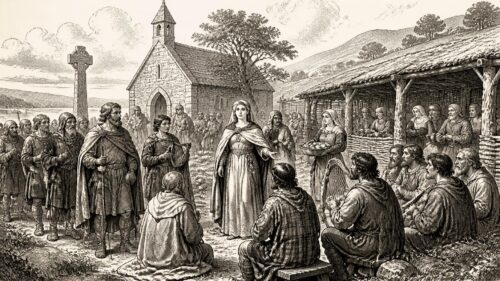
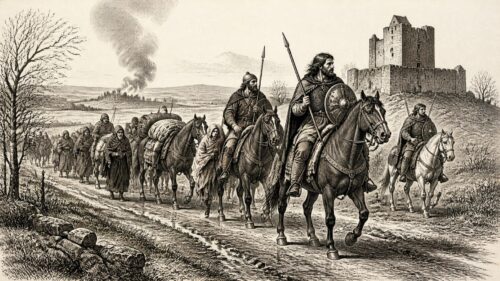
In 1281, Domhnall Óg Ó Domhnaill of Tír Conaill was defeated and killed at Disert-da-chrioch by Áed Buide Ó Néill’s forces, supported by the English of Ulster, devastating his wider political coalition. His son Áed succeeded him. Connacht saw fighting between the Barretts and Cusacks, while Tadhg Mac Diarmada of Moylurg died. In Thomond, rival Ó Briain factions accepted division and Thomas de Clare’s overlordship, enabling relative peace and Quin Castle’s completion. Richard de Burgh assumed Ulster and Connacht. Dublin strengthened administration under Stephen de Fulbourn, reopened its mint, and established one at Waterford, expanding royal revenue and fiscal capacity.
Dateline
The year 1281 was marked by a decisive northern battle, a reshaping of lordship in Thomond, and a notable tightening of royal administration in the English lordship. These developments did not amount to a single national story: Ireland remained a land of overlapping kingdoms, lordships and ecclesiastical jurisdictions. Yet the events securely assigned to this year show how rapidly power could change hands—through battlefield losses, negotiated settlements, inheritance, coinage and the appointment of officials.
The Battle at Disert-da-chrioch
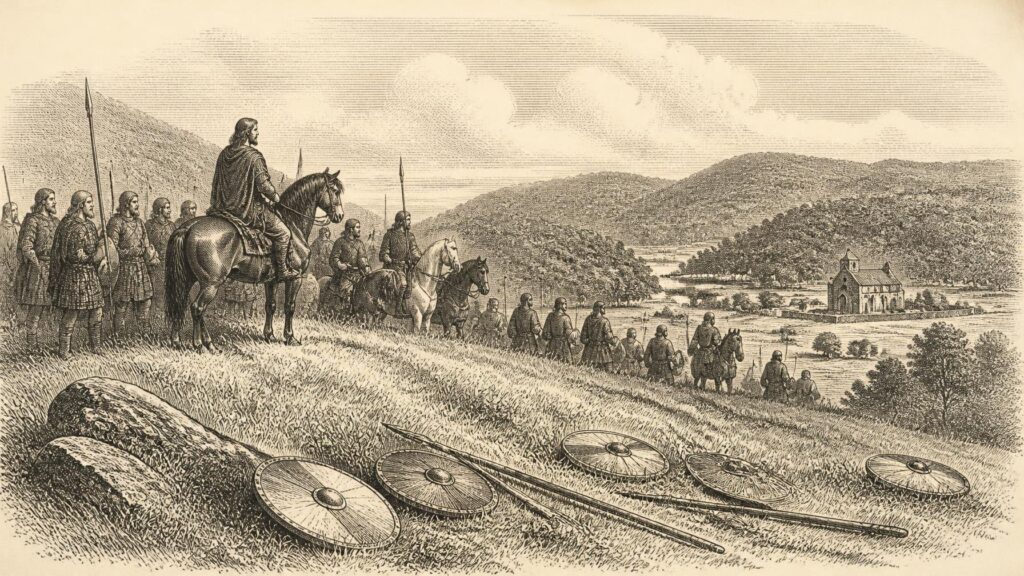
The central Irish event recorded for 1281 was the battle of Disert-da-chrioch, generally identified with Disertcreaght, north of Dungannon. It was fought between Cenél Conaill, the people of Tír Conaill, and Cenél nÉogain of Tyrone. The surviving annals do not provide a day or season, but they firmly place the encounter in the calendar year.
Domhnall Óg Ó Domhnaill, ruler of Tír Conaill, led the invading side. The annalists represent his following in exceptionally expansive terms: Fermanagh, Airgialla, much of Gaelic Connacht and Ulster, and the men of Bréifne were said to have submitted to him. Such language is celebratory and should not be read as a precise map of direct administration. It nevertheless conveys Domhnall’s standing as a major northern ruler, able to draw allies and dependants from far beyond Donegal.
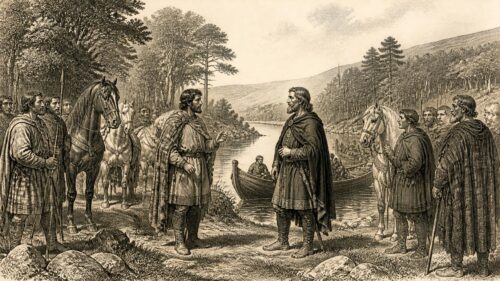
Against him stood Áed Buide Ó Néill, king of Tyrone, aided by the English of Ulster. The Annals of Ulster also name Mac Mairtin among Áed Buide’s supporters; modern scholarship identifies this figure with Thomas de Mandeville. The alliance is important. The battle was not a simple contest of “Irish” against “English”: an Irish king and an Anglo-Norman lord fought together against another Irish ruler whose authority stretched across several Gaelic regions. Such alliances were practical instruments of regional politics, shaped by local rivalries, landholding and dynastic claims.
Cenél Conaill was defeated. Domhnall Óg was killed, together with a striking roll-call of lords, kinsmen and retainers. The annals name Maelruanaid Ó Baoighill of the Three Tuatha, chiefs from Dartraige, Muintir Fheadacháin, Cenél Moáin, Fánad and Lurg, and many more men described simply as sons of rulers and chieftains. This was therefore more than the death of one king. It was the destruction of a substantial section of a political network, with consequences for households, clients, churches and territories whose leading men had marched under Ó Domhnaill’s banner.
The language of commemoration is revealing. Domhnall is praised for hospitality, dignity, valour and leadership; Cellach Ó Baoighill, one of those killed with him, is remembered for generosity towards learned men and ollamna, the professional scholars and teachers of Gaelic society. These are conventional elite virtues, not neutral description, but they show what contemporaries expected a successful ruler to sustain: martial protection, open-handed provision and patronage of learning. Domhnall was buried at the monastery of the friars in Derry, linking a dynastic catastrophe to an important religious centre in the north-west.
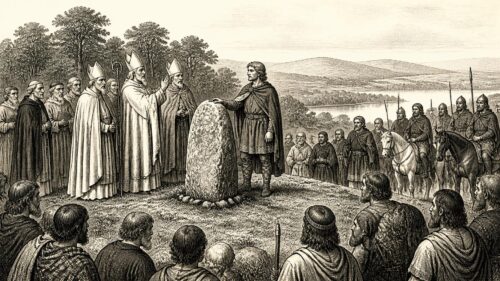
The succession was immediate. The Annals of the Four Masters state that Áed, Domhnall Óg’s son, was inaugurated in his father’s place during the same year. No ceremonial details survive, but the notice matters. Inauguration affirmed continuity after defeat, while also signalling that the new ruler inherited a weakened coalition and the urgent task of preserving Ó Domhnaill authority in Tír Conaill.
Conflict Across Connacht
Elsewhere, 1281 brought another recorded battle, this time between the Barrett and Cusack families in Connacht. William Barrett, Adam Fleming and many others were killed when the Barretts were defeated. The sources do not securely identify the immediate cause, the exact site or the size of either force; those gaps should not be filled with invention. What is clear is that the conflict involved powerful settler families whose local interests could produce violence independent of any grand royal campaign.
Two Gaelic men, Taichlech Ó Dubhda and Taichlech Ó Baoighill, fought on the Cusack side. The annals single them out for courage, agility and skill with weapons. Their presence again complicates any easy ethnic division. Military service, alliance and personal reputation could connect Gaelic warriors to Anglo-Norman factions, just as the northern battle connected Áed Buide Ó Néill with the English of Ulster.
The death of Tadhg mac Cathail Mac Diarmada, lord of Moylurg, is also recorded under 1281. Both the Annals of Loch Cé and the Annals of Ulster praise his hospitality, prowess and nobility. His death was not accompanied by a reported battle or succession dispute, but it removed the head of a significant Connacht lineage. In a political landscape built upon family authority and clientship, the death of such a lord could matter even when the annals preserve no further detail.
Thomond’s Uneasy Settlement
In Munster, 1281 was a year of settlement after years of destructive competition within the Ó Briain dynasty and the advance of Thomas de Clare’s lordship. The broad outline is securely placed in this year, though the sources do not give a precise date for the agreement. Through the separate efforts of Domnall Ruad Mac Carthaig of Desmond and the royal government, the rival Ó Briain parties agreed to divide Thomond and to accept de Clare’s overlordship.
This was not the disappearance of Gaelic kingship. Toirrdelbach Ó Briain retained substantial authority, and the later evidence shows him paying an annual rent to the lord of Thomond for possession of seven cantreds and sixteen vills. But the arrangement recognised a new political fact: de Clare’s castle-centred lordship at Bunratty and Quin had become an enduring force. The settlement brought a relative peace, sufficient for the completion of Quin castle in 1281, but it was a compromise rather than a final resolution. Rivalry inside Thomond soon returned.
Richard de Burgh’s arrival as the new earl of Ulster added another powerful actor to this unstable world. On 5 January 1281 he received his inheritance, becoming earl of Ulster and lord of Connacht; he crossed to Ireland early that year and intervened in the fighting involving de Clare and Toirrdelbach Ó Briain. In October he and the Mandevilles raided the lands of William fitz Warin, the king’s former nominee as seneschal of Ulster. Dublin ordered restraint on fitz Warin’s behalf, but the dispute continued into 1282. De Burgh’s actions demonstrated that even the crown’s administration had to negotiate with a newly adult magnate commanding extensive resources and regional alliances.
Mints, Government and Revenue
Royal authority was also strengthened from Dublin. Robert of Ufford’s term as justiciar appears to have ended at Michaelmas 1281, and on 21 November Stephen de Fulbourn was appointed justiciar while remaining treasurer. Fulbourn was already bishop of Waterford and a Hospitaller brother, but his significance in 1281 lay especially in finance and government: he now combined the lordship’s two most powerful administrative offices.
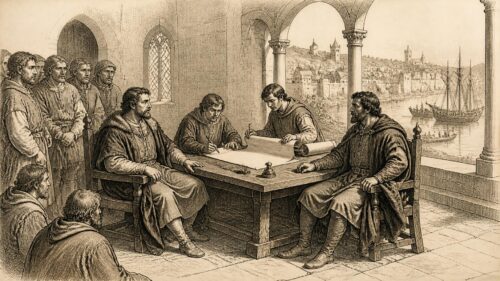
That concentration of office coincided with an important monetary development. In 1281 the Dublin mint was reopened, and a mint at Waterford followed later in the year. Coin production was not merely a technical reform. It tied Ireland’s towns, markets, rents and official payments more tightly to Edward I’s fiscal needs. Between 1281 and 1283, the two mints struck more than £40,000 in coin, much of which went overseas to support the king’s purposes. The immediate experience of ordinary people cannot be reconstructed in detail, but new and changing money would have affected those paying dues, receiving wages, selling produce or trading through the ports.
What the Year Reveals
There is no securely dated evidence for a nationwide harvest failure, epidemic or environmental disaster in 1281, and it would be wrong to manufacture an account of village life from silence. The record is dominated by rulers, warfare, offices and religious houses. Even so, its emphases are meaningful. Ireland’s political order rested on people as well as castles: kin groups, armed followers, scholars, clerics, tenants, merchants and mint-workers all operated within systems shaped by lordship.
In 1281, the killing of Domhnall Óg Ó Domhnaill at Disert-da-chrioch was the year’s sharpest rupture. His burial at Derry, his son’s inauguration, the cross-community alliances visible in Ulster and Connacht, the Thomond settlement, and the reopening of the mints together show an Ireland neither unified nor static. It was a country of regional powers, negotiated dependencies and institutions capable of surviving—even profiting from—political upheaval.
Source References
Hover over a number to see the source. Select it to open the source.

- [1] Annals of the Four Masters, Part 11
- [2] Annals of the Four Masters: CELT Project Edition
- [3] Annals of Ulster otherwise Annala Senait, Annals of Senat
- [4] Annals of Loch Cé, Part 12
- [5] Annals of Loch Cé: CELT Project Edition
- [6] Annales Hiberniae
- [7] Mandate, 6 January 1280, Winchester
- [8] Burgh, Richard de
- [9] Fulbourn, Stephen de
- [10] Ufford (Offord), Sir Robert of
- [11] Clare, Thomas de
- [12] O'Brien (Ó Briain), Toirrdelbach
- [13] O'Neill (Ó Néill), Aed Buide
- [14] O'Neill (Ó Néill), Domhnall
- [15] FitzGerald, Maurice fitz Maurice
- [16] O'Brien (Ó Briain), Brian Ruad
- [17] Mac Con Midhe (MacNamee), Giolla Brighde
- [18] The New Cambridge Medieval History, Volume V: c.1198–c.1300
- [19] The Crusades to 1291 in the Annals of Medieval Ireland
- [20] Caithréim Thoirdhealbhaigh, Part 1
- [21] Annals of Inisfallen
- [22] The Ancient Dominican Foundations in Ireland: Derry Abbey
Primary Sources
- Annals of the Four Masters, Part 11
- Annals of the Four Masters: CELT Project Edition
- Annals of Ulster otherwise Annala Senait, Annals of Senat
- Annals of Loch Cé, Part 12
- Annals of Loch Cé: CELT Project Edition
- Annales Hiberniae
- Mandate, 6 January 1280, Winchester
- Burgh, Richard de
- Fulbourn, Stephen de
- Ufford (Offord), Sir Robert of
- Clare, Thomas de
- O'Brien (Ó Briain), Toirrdelbach
- O'Neill (Ó Néill), Aed Buide
- O'Neill (Ó Néill), Domhnall
- FitzGerald, Maurice fitz Maurice
- O'Brien (Ó Briain), Brian Ruad
- Mac Con Midhe (MacNamee), Giolla Brighde
- The New Cambridge Medieval History, Volume V: c.1198–c.1300
- The Crusades to 1291 in the Annals of Medieval Ireland
- Caithréim Thoirdhealbhaigh, Part 1
- Annals of Inisfallen
- The Ancient Dominican Foundations in Ireland: Derry Abbey