The Liffey’s Two-Mile Ebb1452 CE
In 1452, Ireland was governed through competing lordships, kinship, warfare and negotiation. Neachtan Ó Domhnaill’s assassination by nephews destabilised Tír Chonaill, enabling Énrí Ó Néill to broker a settlement while gaining territory and tribute. Marriage alliances drew James Butler, fourth earl of Ormond, north to compel Énrí’s reconciliation with his first wife. Fighting in the Fews ended with compensation and peace. Ormond’s rapid circuit across the midlands and north-east secured submissions, payments and prisoners, but he died at Ardee in August. His death weakened settlements. Annals also noted the Liffey’s recession, raids on Teagh-Munna, plague, and deaths among learned families.

Dateline
In 1452, Ireland’s political map was shaped less by a single government than by overlapping lordships, kin-groups, clientships and negotiated obligations. The English crown’s authority was strongest in and around the towns and lordships of the east and south-east, but its leading Irish magnates depended upon bargains with Gaelic rulers. Beyond those areas, regional dynasties exercised power through armed followings, tribute, marriage alliances, hostages and the capacity to protect dependants. This was the setting for a year marked by a spectacular killing in Tír Chonaill, a costly clash in the Fews, the final campaigning circuit of James Butler, fourth earl of Ormond, and an unusual observation on the River Liffey.
A Killing in Tír Chonaill
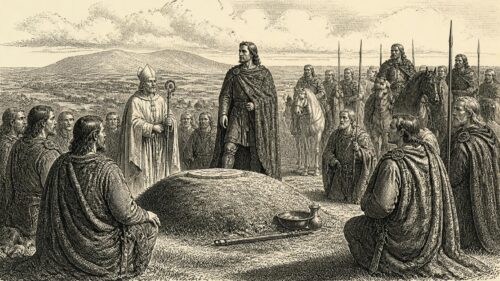
The most consequential event recorded for 1452 was the death of Neachtan Ó Domhnaill, ruler of Tír Chonaill, the O’Donnell lordship centred on much of modern County Donegal. The annals agree on the essentials. Neachtan was killed by his nephews, the sons of his brother Niall Garbh, after he had expelled them from the country. The Annals of Ulster place the killing at Dubhrann on the eve of St Brendan’s feast, while the Annals of the Four Masters describe it as a night attack and give Neachtan’s age as sixty. Such agreement across annalistic traditions makes the assassination securely placeable in 1452, even though the surviving accounts were compiled or copied later.
This was not merely a private revenge. Neachtan’s death reopened a dynastic contest at the heart of Tír Chonaill. His son Ruaidhrí claimed leadership, while Domhnall and Aodh Ruaidh, sons of Niall Garbh, pressed their own family’s claim. The Annals of Ulster preserves a strikingly fuller account: Énrí Ó Néill, the ambitious son of Eóghan Ó Néill of Tír Eóghain, had been captured by the sons of Niall Garbh; men attached to Énrí then joined them in the move against Neachtan. After the killing, Énrí entered Tír Chonaill with a substantial Ulster hosting and mediated a settlement.
The agreement did not end the rivalry, but it reveals the rewards of intervention. Ruaidhrí was recognised as Ó Domhnaill, while the sons of Niall Garbh received half of Tír Chonaill. Énrí gained Cenél Moen, the castle on the River Finn, and tribute from Inis Eógain. In other words, a dispute within one ruling kindred gave a neighbouring lord an opportunity to acquire territory, revenue and prestige. The annalist’s phrase that Énrí returned home “in triumph” should be read as evidence of his political advantage, not as proof that the arrangement brought lasting peace. The O’Donnell succession struggle continued in later years.
Marriage, Honour and Northern Power
The Tír Chonaill crisis also became entangled with marriage and kinship. Énrí Ó Néill had married Gormflaith Mac Murchadha, a niece or step-niece of the earl of Ormond, but after Neachtan’s death he took Neachtan’s widow, a daughter of Mac William Burke. Modern biographical scholarship identifies this as a calculated but provocative act: it bound Énrí to the O’Donnell succession crisis while insulting the Mac Murchadha and Butler connection represented by his first wife.
That connection mattered because James Butler, the “White Earl” of Ormond, was far more than a distant English noble. He was a major Irish lord and chief governor who had repeatedly dealt with Gaelic rulers as allies, clients and opponents. In 1452, he was able to march north and compel Énrí to dismiss Neachtan’s widow and take Gormflaith back. Marriage here was therefore political infrastructure. A wife’s removal or restoration affected alliances, honour and the security of wider kindreds; it was a question that could bring a leading magnate and an armed following across Ireland.
It is important, however, not to overstate Ormond’s command. His intervention was successful at that moment because his family connections, military resources and established relationships could be mobilised together. It did not turn Tír Eóghain or Tír Chonaill into territories governed from Dublin. Eóghan Ó Néill remained ruler of Tír Eóghain, while his son Énrí was already demonstrating the independence that would later allow him to displace his father.
Fighting in the Fews
Another 1452 episode shows how quickly alliances could shift. Eóghan Ó Néill led a hosting into the Fews, on the Armagh–Louth frontier, against the “Foreigners” of the plain of Oirghialla; Maguire of Fermanagh joined him. A raiding party led by Eóghan’s younger namesake, Eóghan Óg, carried off spoil from Cloch an Bhodaigh. It was then overtaken by a pursuing force made up of the local Anglo-Irish and men of the MacMahon kindred of Oirghialla.
The ensuing fight was a reverse for Ó Néill’s side. Somairle Mór Mac Domhnaill, described as a gallóglaigh captain, was killed, and other men were slain or captured. Gallóglaigh were professional heavily armed infantry, frequently recruited through the maritime connections linking Ireland with the Hebrides and western Scotland. Their presence in this local campaign demonstrates that warfare combined household troops, allied lordships and specialist fighting men rather than neatly separated “Irish” and “English” armies.
Yet the encounter ended not in a widening war but in settlement. Énrí came to his father, and Aodh Ruadh MacMahon met the Ó Néills; peace was made. The annals state that éric, compensation under Gaelic legal custom, was paid both for Mac Domhnaill’s death and for the dishonour suffered by Ó Néill. This was no sentimental reconciliation. Compensation converted a military loss and an affront to status into a settlement that the parties could recognise. It also underlines the practical coexistence of different legal and political habits along the frontier.
Ormond’s Last Circuit
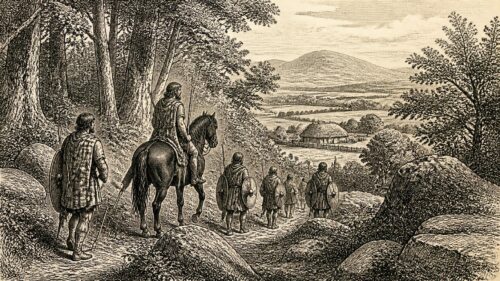
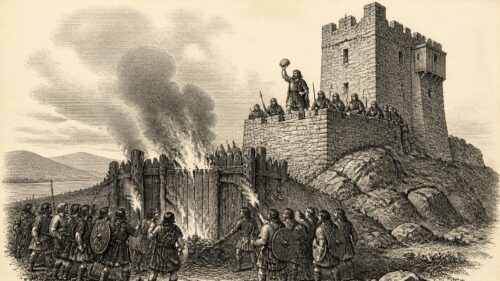
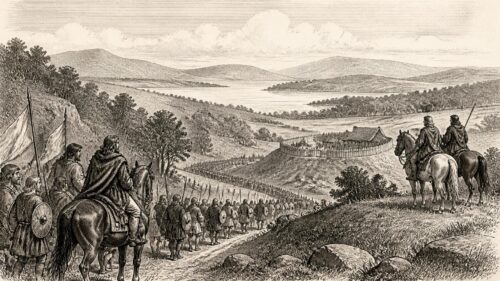
Ormond’s own campaign was the year’s most extensive display of lordly power. The Annals of the Four Masters describe him breaking the castle of Owney held by O’Mulryan, taking the castle of Leix from the O’Dempseys, and moving through Airem, Offaly, Annaly, Breifne, Fore, Magh Maine and Machaire Oirghialla. The route was not a simple royal progress. It combined rescue, punishment, negotiation and the collection of submissions.
At Airem, Ormond freed the imprisoned son of Mac Feorais Bermingham and burned the place afterwards. In Offaly, Ó Conchobhair came into his house as security for the captive’s release. In Annaly, Ó Fearghail promised 180 cattle for peace. Elsewhere, a castle was demolished and much corn destroyed; the Ó Raghallaighs and MacMahons accepted his demands. These details give a rare view of the material language of power. Cattle, grain, castles, prisoners and personal submission all mattered. A lord’s household was not only domestic space: entering it could be a public act of submission or surety.
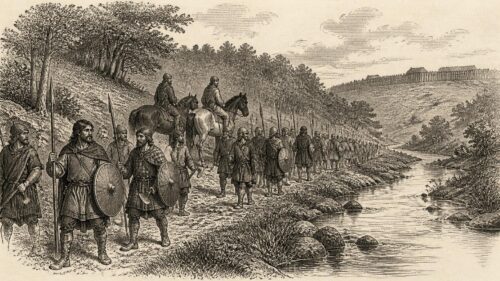
The campaign was rapid. The annalist says it was completed in “half a quarter of a year”, a contemporary expression that should not be converted into an exact modern timetable. Its speed was itself part of the message. Ormond could bring armed force across the midlands and north-east, but he also needed local rulers to negotiate, pay, offer guarantees and permit passage. His authority rested on those transactions as much as on demolition and burning.
Death at Ardee
Ormond died at Ardee during or immediately after this circuit. The date requires care. Annála Connacht gives 3 August 1452, while the Annals of the Four Masters places the death between the feasts of the Assumption and Nativity of the Virgin, 15 August and 8 September. The safest conclusion is that he died at Ardee in August 1452, rather than to present a disputed day as certain. His wife, Joan Beauchamp, countess of Ormond and daughter of the earl of Kildare, had died about three weeks earlier.
The consequences were immediate enough for the Annals of the Four Masters to say that the peace between English and Irish “became null” after the earl’s death. Sir Edward Eustace was appointed lord justice. This should not be understood as the collapse of all order across Ireland; rather, the death removed an unusually experienced broker whose personal ties had helped sustain particular settlements. Ormond’s eldest son James inherited the earldom, but spent much of his life in England. In Ireland, the resulting gap would increasingly benefit other magnatial networks, above all the FitzGerald earls of Kildare.
Water, Learning and Local Lives
Amid war and political change, the annals preserve smaller but revealing notices. Before Ormond’s death, the Annals of the Four Masters recorded as a “wonderful presage” that part of the River Liffey had dried up for two miles. The entry supplies no explanation, and it would be irresponsible to diagnose a drought, tidal event or engineering cause from this brief report. What can safely be said is that an exceptional change in the river was noticed and interpreted as meaningful in the political atmosphere of the year.
Other entries remind us that elite conflict reached religious and learned communities. Teagh-Munna was plundered and burned. Hugh Mac an Chlásaigh Ó Cofaigh, a learned poet known for hospitality, died of plague in Feara Tulach. Máel Sechlainn Ó Maolchonaire died, as did Manus Ó Duibhgeannáin, members of families associated with hereditary learning and record-keeping. Their notices do not prove a general cultural decline; rather, they show the continuing importance of learned households, hospitality and ecclesiastical places in a society whose political history is often told only through raids and killings.
Thus 1452 was a year in which authority travelled: through armed columns, marriage ties, cattle payments, castles, compensation and the intervention of powerful neighbours. Neachtan Ó Domhnaill’s killing destabilised the north-west; Énrí Ó Néill used that instability to enlarge his position; Ormond’s final circuit briefly imposed settlements across a wide arc of the island. His death then exposed how dependent those settlements had been on people as well as institutions. Even the strange recession of the Liffey entered the record as part of a year in which contemporaries saw political change, natural irregularity and providential warning as closely connected.
Primary Sources
- Annals of the Four Masters
- Annals of the Four Masters: Irish Text, Part 8
- The Annals of Ulster, Year U1452
- The Annals of Ulster: CELT Edition Information
- Annála Connacht, Annal 1452
- Annála Connacht: CELT Edition Information
- Annales Hiberniae
- Butler, James (c.1390–1452), 4th Earl of Ormond
- Butler, James (1420–61), 5th Earl of Ormond and Earl of Wiltshire
- O'Neill (Ó Néill), Enrí
- O'Neill (Ó Néill), Eóghan
- O'Donnell (Ó Domhnaill), Neachtan
- O'Neill (Ó Néill), Aodh
- MacMahon (Mac Mathghamhna), Aodh Ruadh
- O'Reilly (Ó Raghallaigh), Eóghan
- English Lordship of Ireland and the Irish Sea World: Re-assessing the Origins of the Kildare Ascendancy, c.1390–c.1513
- CELT Project: Annals of the Four Masters
- Ormond Deeds, 1162–1542
- Edmund MacRichard Butler: Books and Warfare in Fifteenth-Century Ireland
- One World: The Communities of the Southern Dublin Marches
- Worlds Apart?
- A Remonstrance to King Henry VI, Showing the Expediency of Appointing the Earl of Ormond Lord Lieutenant of Ireland, 1442