Nobber Disaster1434 CE
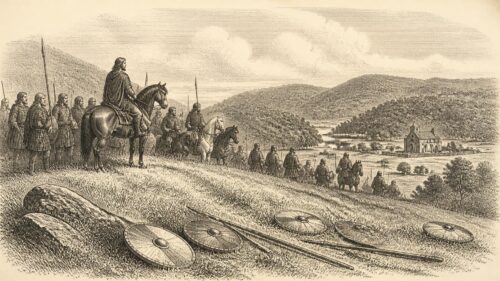
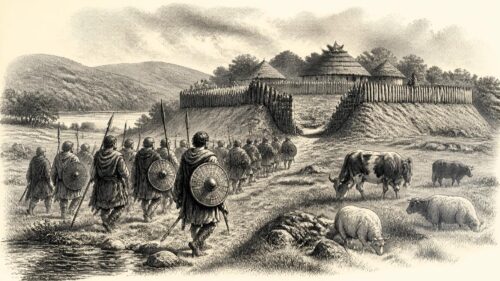
In 1434, Eóghan Ó Néill of Tír Eóghain and Niall Garbh Ó Domhnaill of Tír Chonaill, recently rivals, led a broad Ulster coalition into the English lordship. They exacted tribute at Sradbaile, burned Sliabh Breagh and Oriel, and attacked Nobber Castle. Thomas Stanley’s mounted response allowed Ó Néill’s sons to withdraw safely but trapped Ó Domhnaill’s separated party seeking cattle. His heir Toirdhealbhach and other leaders died, while Niall Garbh was captured, enabling his brother Neachtan to rule. Annals also recorded deaths among churchmen and learned families. Late in the year, severe frost froze major lakes, disrupting life and travel.
Dateline
In 1434, the most consequential events in Ireland unfolded along the uneasy frontier between the English lordship and the powerful Gaelic lordships of Ulster. The year brought a remarkable joint expedition by Eóghan Ó Néill of Tír Eóghain and Niall Garbh Ó Domhnaill of Tír Chonaill into Louth, Oriel and Meath. It also brought an abrupt reversal: Niall Garbh’s heir was killed and the king of Tír Chonaill himself taken prisoner. Before the year closed, an exceptional frost began, freezing lakes sufficiently hard for people, laden horses and herds to cross them. These events reveal a country in which lordship rested on mobile warfare, tribute, cattle and household followings, while both political order and ordinary survival could be unsettled by weather.
An Ulster Alliance Re-formed
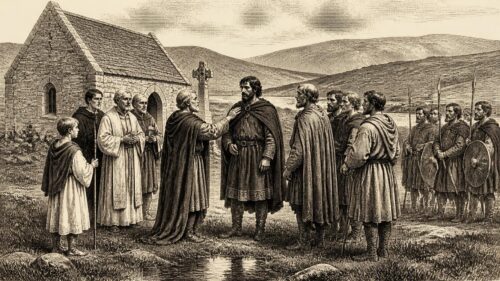
The campaign of 1434 mattered because its leaders had recently been enemies. Niall Garbh Ó Domhnaill, king of Tír Chonaill in the north-west, had spent much of the previous year locked in a struggle with Eóghan Ó Néill, the leading figure in Tír Eóghain. Their rivalry had drawn in the MacQuillins, the MacDonalds of the Isles, the Maguires and other powers across Ulster and the Irish Sea. It had also exposed divisions within the Ó Domhnaill family. In 1433 Niall Garbh’s wife and his brother Neachtan had made peace with Ó Néill while Niall was absent, an accommodation that humiliated the king and helped to provoke a bitter fraternal conflict in 1434.
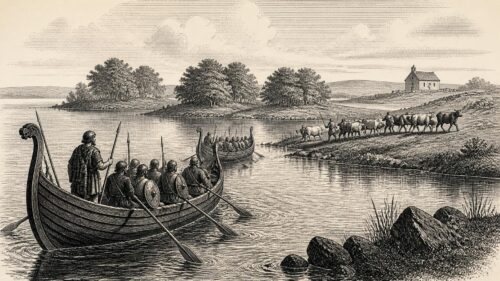
That internal war is firmly recorded for this year. The Annals of the Four Masters describe raids and counter-raids between Niall Garbh and Neachtan. Neachtan found support among the sons of Domhnall Ó Conchobhair of Sligo. Their men burned houses and carried away movable goods and small cattle in Tír Chonaill and Tírhugh; Niall’s side retaliated in the Moy and Carbury. Such entries should not be mistaken for set-piece national warfare. They describe the hard mechanics of late-medieval lordship: seizing livestock, destroying food stores and dwellings, and demonstrating that a ruler could protect followers and punish rivals.
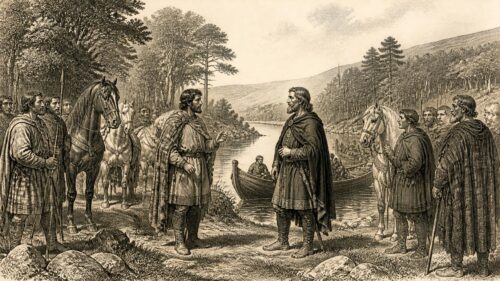
Yet the dispute did not prevent Niall Garbh from joining Eóghan Ó Néill against the English-held districts to the south-east. This was a pragmatic alliance, not evidence that their earlier antagonism had disappeared. Each ruler could gain from a major expedition into the lordship: booty, prestige, payments and the chance to compel communities on the frontier to recognise northern power.
Tribute at Sradbaile
The Annals of Ulster date the departure of Ó Néill’s host to a week before the feast of St Michael, placing the opening of the expedition in the late autumn. It says that Ó Domhnaill went with him, accompanied by “the host of the whole province of Ulster”. That formula is not a muster-roll and should not be read literally as every fighting man in Ulster. It does, however, signal an unusually broad coalition and the annalist’s sense that the expedition was a provincial display of force.
The target was the English lordship’s exposed northern and western edge. The annals say that the “Foreigners” of Sradbaile met Ó Néill and gave tribute and other contributions. The wording is important. In Gaelic Irish chronicles, “Foreigners” commonly denoted the English or Anglo-Irish inhabitants of the lordship, rather than newly arrived outsiders. The payment was therefore an immediate political concession obtained under military pressure, not necessarily a lasting change of allegiance. It demonstrated that communities nominally within the English king’s dominion could be made to bargain with an Ulster ruler when a large host stood nearby.
The raiders then burned Sliabh Breagh and the plain of Oriel. These broad regional names cover fertile, settled country extending through parts of modern Meath, Louth and Monaghan. Burning was a military method with social consequences: standing crops, stored fodder, houses, fences and the confidence to travel or trade could all be damaged. The annals do not quantify losses, and it would be unsafe to turn their compressed language into a measured account of devastation. Nonetheless, their emphasis on fire, tribute and livestock makes plain that the campaign was designed to extract resources as well as to advertise military reach.
The Burning at Nobber
Ó Néill’s sons, Énrí and Aodh, led a separate detachment against English-held fortifications. The Annals of Ulster calls the place an Obair; modern biographical scholarship identifies the episode with the burning of Nobber Castle in Meath. That identification is helpful but should be treated as an interpretation of the annal’s place-name, not as an exact wording supplied by the contemporary record. What is certain is that the young Ó Néills were caught while burning a fortification.
Thomas Stanley, the king of England’s lieutenant in Ireland, came upon them with a pursuing force. Stanley had returned to Ireland in the autumn after a lengthy absence caused in part by the Crown’s financial failures. His intervention showed that the administration could still assemble a mounted response when its frontier was directly threatened, even though its authority was limited and uneven beyond its core districts. Énrí and Aodh sent their followers ahead and held the rear. The annalist praises their retreat as spirited and successful: they brought their people away without loss. This was not a trivial detail. A raid that ended with the preservation of the fighting force protected a lord’s reputation; losing retainers, horses and captives could undo the gains of plunder.
Ó Domhnaill’s Reversal
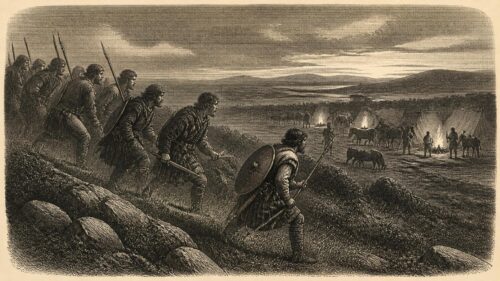
The same day, or in the immediate course of the retreat, the allied army split. Niall Garbh Ó Domhnaill, his son Toirdhealbhach, and Mac Cathmhaoil went in another direction seeking cattle. English cavalry found and surrounded them. Both principal annalistic accounts agree on the outcome: Toirdhealbhach was killed, together with Mac Cathmhaoil, Aodh Mac an Easbuig Mac Cathmhaoil and many others; Niall Garbh was captured. The Four Masters places the clash on the day after Michaelmas, while the Annals of Ulster connects it to the expedition begun in the week before that feast. The sources therefore permit a secure autumn dating, but not a confidently reconstructed timetable for every movement.
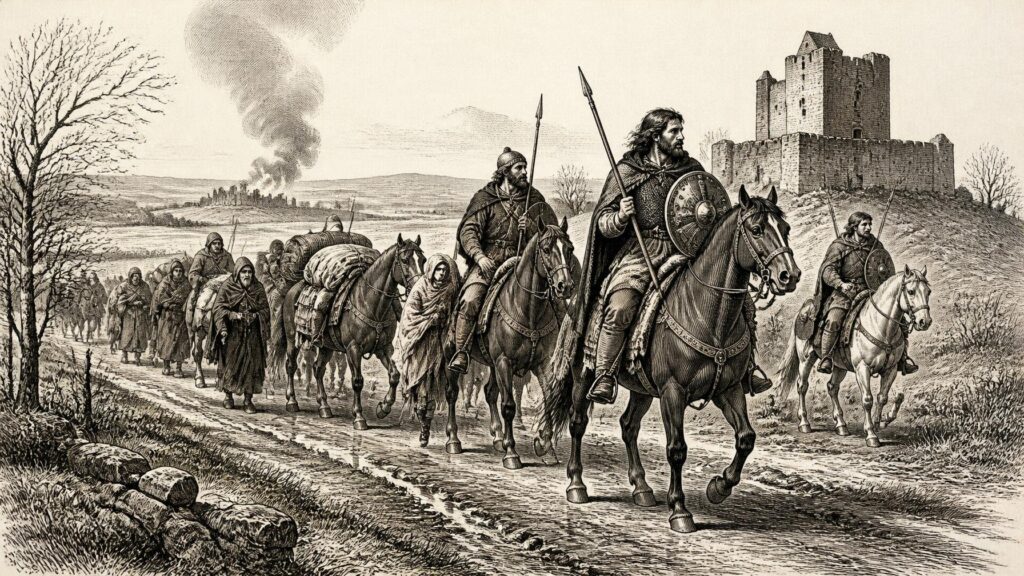
For Ó Domhnaill, this was a disaster greater than the loss of a raid. Toirdhealbhach was his recognised heir, and Niall’s capture removed the reigning king from Tír Chonaill at the very moment when his dispute with Neachtan remained unresolved. The prisoner was taken to Dublin; his later transfer to England belongs to 1435, not to 1434. In the shorter term, Neachtan ruled in Tír Chonaill during his brother’s captivity. Thus an expedition intended to impose tribute on the English lordship unintentionally altered the balance of power within the Ó Domhnaill dynasty.
Eóghan Ó Néill, by contrast, returned home after the campaign. The capture of his ally did not make the raid a simple English victory. The northern army had obtained payments, burned a wide tract and escaped in substantial part. But it did prevent the alliance from delivering a decisive, durable extension of Ulster power into Meath and Louth. The episode instead underlined how quickly a mounted counterstroke, directed against a separated raiding party, could reverse a campaign’s political meaning.
Churchmen and Learned Families
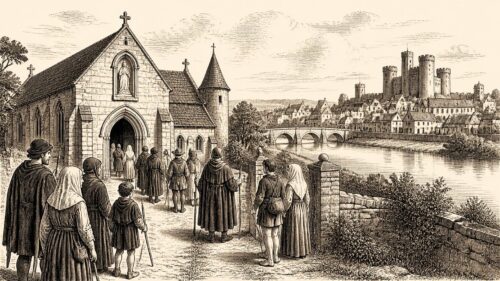
The year’s obituaries show another Ireland alongside the campaigning hosts: one sustained by churches, hereditary ecclesiastical offices and learned lineages. Donn Cathanach Mag Uidhir died on 22 February. Master Denis Mac Gilla-Coisgle died on 3 May, and Luke Ó Leannáin, prior of Lisgool near Enniskillen, on 18 October. The annals also record the death of Matthew Ó Conghaile, erenagh of Rossory and an eminent student of learning. An erenagh was the hereditary lay or clerical manager of church lands and resources, a role that connected religious institutions to local kin-groups and agricultural estates.
Most strikingly, Sencha Mac Cruitín died in 1434. The Annals of Ulster calls him historian to the Ua Briain; the Four Masters describes him as ollamh, or master, of history in Thomond and skilled in every art. Such phrases are formulaic praise, but they identify a real professional world. Historical memory, genealogy, legal knowledge and formal praise-poetry were cultivated skills with political value. Lords depended upon learned families to articulate ancestry, rank and precedent; their deaths were therefore events worth recording across regional boundaries.
The Great Frost Begins
At the end of 1434, a severe frost began. The Annals of Ulster calls it the “year of the great frost”, stating that it started five weeks before Christmas and lasted for seven weeks after it. The cold therefore began within this calendar year and continued deep into 1435. The annalist reports that people, pack-horses, cattle and horses crossed Ireland’s principal lakes on the ice, while birds suffered great destruction.
This was an exceptional occurrence in Ireland’s normally ocean-moderated climate, and modern climate historians regard the annalistic report as evidence of a notably severe winter. Its practical effects were potentially wide-ranging. Frozen waterways could create unexpected routes for movement, but frost also impeded cultivation, stressed livestock, reduced wild food and made poorly insulated homes more dangerous. The source specifically records harm to birds; it does not claim a famine in 1434, and none should be inferred automatically. After the famine of 1433, however, a winter that disrupted work and threatened animals would have been particularly alarming to households dependent on stored grain, cattle and local exchange.
By year’s end, then, Ireland’s political and environmental worlds were both in motion. In the north, an alliance had raided boldly into the lordship but sacrificed the king of Tír Chonaill’s freedom and his heir’s life. Across the island, a freezing winter was beginning to reshape the most basic conditions of travel, labour and survival. The annals preserve these developments in short entries, but together they give 1434 its distinctive character: a year of tribute won, succession endangered, learning mourned and lakes turned temporarily into roads.
Source References
Hover over a number to see the source. Select it to open the source.

- [1] The Annals of Ulster, Year U1434
- [2] Annals of the Four Masters, Annal M1434
- [3] Annals of the Four Masters
- [4] Annála Connacht
- [5] O'Neill (Ó Néill), Eóghan | Dictionary of Irish Biography
- [6] O'Donnell (Ó Domhnaill), Niall Garbh | Dictionary of Irish Biography
- [7] O'Donnell (Ó Domhnaill), Neachtan | Dictionary of Irish Biography
- [8] O'Neill (Ó Néill), Aodh | Dictionary of Irish Biography
- [9] Stanley, Thomas | Dictionary of Irish Biography
- [10] O'Connor (Ó Conchobhair), Domhnall | Dictionary of Irish Biography
- [11] O'Donnell (Ó Domhnaill), Aodh Ruadh | Dictionary of Irish Biography
- [12] MacMurrough Kavanagh (Mac Murchadha Caomhánach), Art Mór | Dictionary of Irish Biography
- [13] The Historic Record of Cold Spells in Ireland
- [14] Medieval Irish Chronicles Reveal Persistent Volcanic Forcing of Severe Winter Cold Events, 431–1649 CE
- [15] A Short History of Extreme Weather Events at Christmas in Ireland
- [16] The Irish Annals and Climate, Fifth–Seventeenth Centuries CE
- [17] Extremes of Weather Recorded in the Annals of Connacht, 1224–1562
- [18] A Surprisingly Useful Source of Information About Ireland's Past Climate - The Irish Annals
- [19] The Governing of the Lancastrian Lordship of Ireland in the Time of James Butler, Fourth Earl of Ormond c.1420–1452
- [20] The Annals of Ulster
Primary Sources
- The Annals of Ulster, Year U1434
- Annals of the Four Masters, Annal M1434
- Annals of the Four Masters
- Annála Connacht
- O'Neill (Ó Néill), Eóghan | Dictionary of Irish Biography
- O'Donnell (Ó Domhnaill), Niall Garbh | Dictionary of Irish Biography
- O'Donnell (Ó Domhnaill), Neachtan | Dictionary of Irish Biography
- O'Neill (Ó Néill), Aodh | Dictionary of Irish Biography
- Stanley, Thomas | Dictionary of Irish Biography
- O'Connor (Ó Conchobhair), Domhnall | Dictionary of Irish Biography
- O'Donnell (Ó Domhnaill), Aodh Ruadh | Dictionary of Irish Biography
- MacMurrough Kavanagh (Mac Murchadha Caomhánach), Art Mór | Dictionary of Irish Biography
- The Historic Record of Cold Spells in Ireland
- Medieval Irish Chronicles Reveal Persistent Volcanic Forcing of Severe Winter Cold Events, 431–1649 CE
- A Short History of Extreme Weather Events at Christmas in Ireland
- The Irish Annals and Climate, Fifth–Seventeenth Centuries CE
- Extremes of Weather Recorded in the Annals of Connacht, 1224–1562
- A Surprisingly Useful Source of Information About Ireland's Past Climate – The Irish Annals
- The Governing of the Lancastrian Lordship of Ireland in the Time of James Butler, Fourth Earl of Ormond c.1420–1452
- The Annals of Ulster