Emain Macha1387 CE
In 1387 Niall Ó Néill junior built a house at Emain Macha to support Ireland’s learned companies, linking Ulster lordship with cultural patronage. The year also saw deaths of chief poet Gofraidh Fionn Ó Dálaigh and historian-scribe Ruaidhri Ó Cianáin, illustrating networks sustained by aristocratic hospitality. Annals record feuding, killings and Nualaith Ó Fearghail’s capture in the Midlands, while Richard Óg de Burgh died in Connacht. In Munster, royal officials mediated discord between Desmond and Ormond. Deaths and marriages reflected ecclesiastical, kinship and Irish Sea connections. Sparse sources nevertheless show authority negotiated through force, patronage, reputation and learning across Ireland.
Dateline
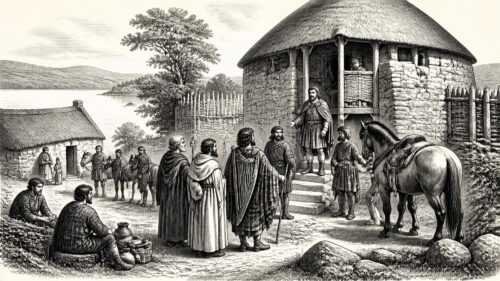
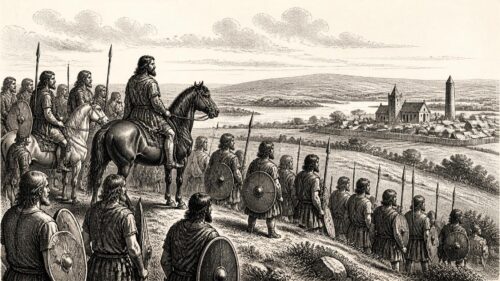
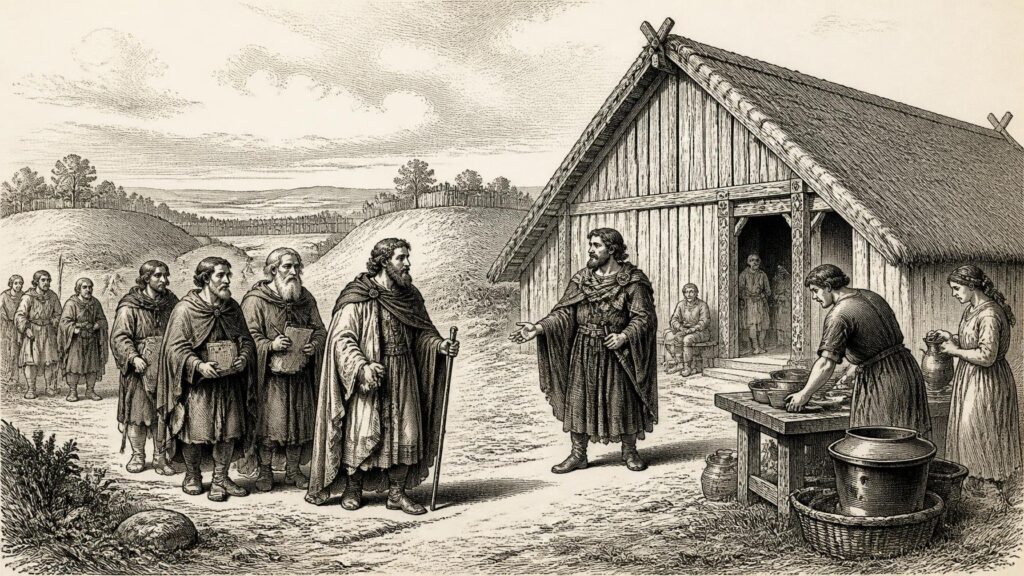
The clearest Irish event of 1387 was neither a battle nor a royal decree, but the building of a house at Emain Macha, near Armagh, by Niall Ó Néill junior. The Annals of Ulster say that it was made “to recompense the learned companies of Ireland”; the later Annals of the Four Masters similarly describe a house erected for the entertainment of learned men. The wording does not permit a modern reconstruction of its size, appearance or daily routine. Yet the notice is unusually revealing. In a year marked by local seizures, killings and aristocratic rivalry, an Ulster lord made a conspicuous investment in the people who preserved genealogy, law, history, praise-poetry and political memory.
A Deliberate Act at Emain Macha
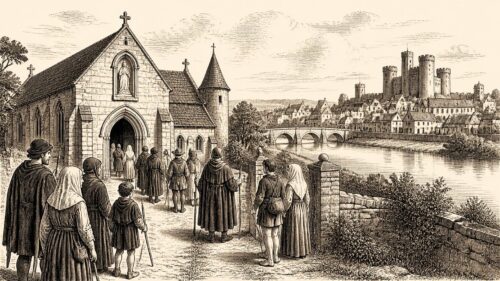
Emain Macha carried immense historical and symbolic weight. It was associated in Irish tradition with the ancient kingship of Ulster, while the nearby ecclesiastical city of Armagh was the foremost church centre of the province. Building there allowed Niall to connect lordship, landscape and learning. The annal’s phrase “learned companies” should not be reduced to an image of a few wandering storytellers. Learned families and their pupils formed a professional world: poets, historians, genealogists, lawyers and scribes trained over long periods, served patrons, composed formal works and moved between regions. Their authority mattered because political standing rested heavily on remembered descent, inherited rights and public reputation.
The word translated as “recompense” is important. It suggests more than private comfort, though the Four Masters’ language of entertainment points towards hospitality. In late medieval Gaelic society, food, lodging, gifts and protection were political as well as social acts. A ruler who sustained learned people could expect his name, ancestry and conduct to be recorded and judged within a wider Irish world. The annals do not say that a school was founded at Emain Macha in 1387, nor do they specify an assembly held there. What can responsibly be said is that Niall’s building was publicly remembered as support for learning on an all-Ireland scale.
This was an assertion of status at a time when no single ruler governed the island in practice. Ireland contained Gaelic lordships, Anglo-Irish estates, church jurisdictions and walled towns, all connected by marriage, service, trade, warfare and diplomacy. The English crown claimed the lordship of Ireland, but effective royal administration was concentrated in and around the Dublin-centred colony and depended elsewhere upon agreements with powerful families. Niall’s initiative therefore belonged to a politics in which regional rulers cultivated influence through force, kinship and cultural patronage alike.
The Passing of Poets and Historians
The same annalistic year brought deaths that underline why the Emain Macha notice matters. Geoffrey, or Gofraidh Fionn, Ó Dálaigh was recorded as the best ollamh in poetry in Ireland; the Four Masters call him the chief poet of Ireland. Such titles were not casual compliments. An ollamh stood at the summit of a learned profession, and the Ó Dálaigh were among the great hereditary poetic families. Their verse could praise patrons, admonish them, commemorate the dead, articulate religious devotion and give polished expression to aristocratic ideals. Gofraidh’s death in 1387 was thus the loss of a recognised national figure within the Irish-language literary order.
Ruaidhri Ó Cianáin also died, described in the Annals of Ulster as a historian “without defect” and in the Four Masters as a learned historian and ollamh of Airgíalla or Oriel. His importance is unusually tangible. The National Library of Ireland’s fourteenth-century Book of Magauran, the earliest surviving family poem-book of its kind, identifies Ruaidhri Ó Cianáin as its principal scribe; he had copied it for Tomás mac Briain Mhéig Shamhradháin of Tullyhaw in County Cavan. That manuscript was created before 1387, not in the year itself. Nevertheless, Ruaidhri’s obituary gives the year direct relevance to the survival of written Gaelic culture: a named historian-scribe whose work still exists passed from the learned world.
These notices should not tempt us to imagine learning as detached from power. Poets and historians depended upon patrons; patrons needed their skills. The deaths of Gofraidh Ó Dálaigh and Ruaidhri Ó Cianáin, alongside Niall Ó Néill’s new house, make 1387 a particularly well-attested year for that reciprocal system. They also show the geographical reach of learned culture. A poet associated with Munster, a historian-scribe linked with Cavan and Oriel, and an Ulster patron at Emain Macha belonged to overlapping networks rather than isolated provincial traditions.
Captivity and Feuding in the Midlands
Much of the annalistic record is less ceremonial. In the territory of the Ó Fearghail, centred on Anghaile in what is now much of County Longford, the Clan of John Ó Fearghail attacked Tomás, son of Cathal Ó Fearghail. Tomás’s wife, Nualaith, was captured. The Annals of Ulster pause to praise her as the woman of greatest hospitality and piety in her district. This is valuable evidence both of the violence of lordship and of the standards by which elite women could be publicly remembered. Nualaith was not mentioned merely as a passive relation: her reputation for hospitality and religious virtue was itself considered worth entering into the record.
The sources do not explain the immediate cause of the attack, the length of Nualaith’s captivity or the terms of any release. It would be unsafe to supply them. But the episode demonstrates that conflict within a kindred could reach households as well as fighting men. Captivity was a political weapon: it endangered honour, imposed pressure on relatives and could be converted into ransom, concessions or advantage. In a society where authority was dispersed among competing branches of leading families, a dispute over lordship, land or precedence could readily become an assault on a rival’s residence and dependants.
Other brief entries confirm a landscape of small-scale but lethal rivalry. Domnall, son of Donnchadh Mag Uidhir, and Matthew Mac Conléaga were killed at Cill Naile in Fermanagh. Conchobhar, son of Brian Carrach Ó Néill, was killed by the “English of Sradbhaile”, an annalistic designation that preserves a frontier between Gaelic and colonial communities without explaining the particular encounter. William, son of Diarmaid Mac Raghnaill, described as material for a chiefship of Muintir Eolais, was killed by Muintir Birn, the Ó Beirnes. These were not necessarily parts of one general war. The annals instead reveal several local theatres in which lineage, territory and armed followings determined security.
Connacht and Munster Power
In Connacht, Richard Óg de Burgh, called Mac William Uachtar or the Upper Mac William in the Irish annals, died in 1387. His lordship lay in south Connacht, where the de Burgh or Burke family had become deeply embedded in Gaelic political life. The obituary records a death, not a dated succession settlement, and it should not be made to bear more than that. Still, the loss of a leading Mac William mattered in a region where de Burgh branches, Gaelic dynasties and the town of Galway all pursued their interests amid shifting alliances. It is one reminder that the boundary between “Gaelic” and “Anglo-Irish” was neither simple nor fixed: families of settler descent could wield power through Irish language, marriage, clientage and local custom.
Further south, the surviving Irish chancery evidence records “great discords” between Gerald fitz Maurice Fitzgerald, third earl of Desmond, and James Butler, third earl of Ormond, in the spring of 1387. The administration considered the quarrel serious enough to commission mediation. Maurice Fitzgerald, fourth earl of Kildare, was again involved, alongside senior churchmen including Alexander Petit, bishop of Meath, and Thomas le Reve, bishop of Lismore and Waterford. This is firmly connected to 1387, but the documentary evidence does not reveal the dispute’s immediate cause, its precise incidents of violence or the settlement’s terms. The restraint is significant: the rivalry was real, whereas its detailed story has not survived.
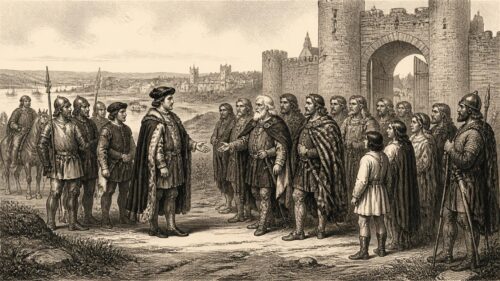
The need for mediation illustrates the weakness of any neat contrast between a peaceful English lordship and a disorderly Gaelic outside. Magnate conflict affected the south just as kin-feuding affected Anghaile or Fermanagh. Royal government could appoint arbitrators and issue commissions, but its success depended on cooperation from the same earls and bishops whose regional connections gave them influence. In 1387, authority in Ireland was negotiated continually, from the houses of local rulers to the administrative circles of the lordship.
Church, Kinship and the Irish Sea
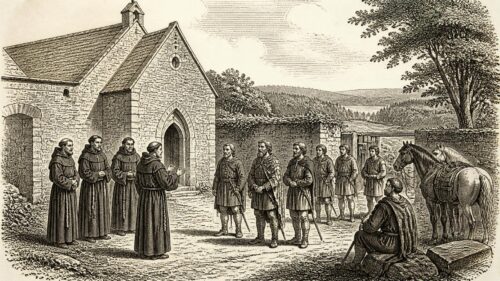
The annals also record the death of Sadhb, daughter of Aedh Ó Néill and wife of a son of John Bisset. Her obituary says that she died after gaining victory over world and demon; the Four Masters add that she died after penance. Such phrasing is devotional and formulaic, not a report of particular religious practices, but it indicates the ideal of a penitential Christian death. Her marriage to a Bisset connects an Ó Néill woman to a family of Anglo-Norman origin long established around the north-eastern coast. It is a small but telling sign of how marriages joined families across cultural and political labels.
John Mac Domnaill, king of the Hebrides or Isles, also died in 1387. His death belongs directly in Irish history because the western seaways linked Ulster, the Hebrides and western Scotland. Lords, clerics, mercenaries, traders and learned people crossed those waters; Irish annals consequently treated the Isles as part of their political horizon. The entry does not establish an Irish intervention in the succession to the Isles, and none should be invented. It does show that contemporaries in Ireland regarded developments across the North Channel as relevant to their own world.
What the Year Does Not Reveal
There is no securely dated annalistic report for 1387 of an island-wide harvest failure, epidemic, major overseas trade change or general campaign. Everyday cultivation, fishing, market exchange and household labour continued, but the sources do not allow them to be described in detailed yearly terms. Their silence is itself a warning against turning a thin record into a fully documented national narrative. What survives instead is selective: elite deaths, patronage, seizures, killings and official attempts to contain magnate rivalry.
Even so, the year has a coherent character. The house at Emain Macha stands at its centre as a durable statement of patronage. Around it appear the deaths of a chief poet and an eminent historian-scribe, conflict that reached a noted woman through captivity, the passing of a Connacht lord, and mediation between the earls of Desmond and Ormond. In 1387, the making and keeping of authority in Ireland depended not only upon weapons and offices, but upon hospitality, kinship, religious reputation and the learned men who could make a lord’s standing endure in memory.
Source References
Hover over a number to see the source. Select it to open the source.

- [1] The Annals of Ulster: Year U1387
- [2] CELT Project: The Annals of Ulster
- [3] Annals of the Four Masters: Annal M1387
- [4] CELT Project: Annals of the Four Masters
- [5] Irish Script on Screen: MS A 13 (Annals of the Four Masters)
- [6] Annála Connacht
- [7] CELT Project: Annála Connacht
- [8] Annals of Loch Cé
- [9] Murphy: The Annals of Clonmacnoise
- [10] The ‘Calculus of Faction’ and Richard II's Duchy of Ireland, c. 1382–9
- [11] The ‘Calculus of Faction’ and Richard II’s Duchy of Ireland, c. 1382–9 (full text)
- [12] Exploring the Irish Annals
- [13] Irish Script on Screen: Duanaire Mhéig Shamhradháin (The Book of Magauran)
- [14] Irish Script on Screen: Royal Irish Academy Collection
- [15] Irish Script on Screen: MS 1318 (The Yellow Book of Lecan)
- [16] Annals of the Kingdom of Ireland, Volume IV
- [17] A History of Ireland Feature
- [18] Irish Genealogy
- [19] Hardiman: The History of the Town and County of the Town of Galway
- [20] Irish Script on Screen: MS G 1304 (Formerly Sir Con O’Neill’s Irish Manuscript)
- [21] Irish Script on Screen: MS 1337/1-4
- [22] The Annals of the Four Masters
Primary Sources
- The Annals of Ulster: Year U1387
- CELT Project: The Annals of Ulster
- Annals of the Four Masters: Annal M1387
- CELT Project: Annals of the Four Masters
- Irish Script on Screen: MS A 13 (Annals of the Four Masters)
- Annála Connacht
- CELT Project: Annála Connacht
- Annals of Loch Cé
- Murphy: The Annals of Clonmacnoise
- The ‘Calculus of Faction’ and Richard II's Duchy of Ireland, c. 1382–9
- The ‘Calculus of Faction’ and Richard II’s Duchy of Ireland, c. 1382–9 (full text)
- Exploring the Irish Annals
- Irish Script on Screen: Duanaire Mhéig Shamhradháin (The Book of Magauran)
- Irish Script on Screen: Royal Irish Academy Collection
- Irish Script on Screen: MS 1318 (The Yellow Book of Lecan)
- Annals of the Kingdom of Ireland, Volume IV
- A History of Ireland Feature
- Irish Genealogy
- Hardiman: The History of the Town and County of the Town of Galway
- Irish Script on Screen: MS G 1304 (Formerly Sir Con O’Neill’s Irish Manuscript)
- Irish Script on Screen: MS 1337/1-4
- The Annals of the Four Masters