Glendun’s Grain Truce1327 CE
In 1327, Ireland experienced overlapping political, military and social crises amid the accession of Edward III. Thomas FitzGerald, earl of Kildare, became justiciar, but magnates contested royal authority while trade and administration continued. At Glendun, Robert Bruce secured a year’s truce with Ulster, paid for by promised wheat and barley. Domhnall Mac Murchadha was proclaimed king in Leinster before capture by royal officers. Rival Anglo-Irish lords devastated lands during private war, while O’Rourkes and O’Reillys fought over Lough Oughter. A widespread speckled sickness, probably smallpox but diagnostically uncertain, killed people across social ranks alike, disrupting labour, food supplies and lordship.

Dateline
Ireland in 1327 was not governed by a single rhythm or a single authority. It was a land of lordships, earldoms, towns, church jurisdictions and Gaelic dynasties, joined to events in England and Scotland yet capable of making its own political weather. The year brought a change of English king, a Scottish king’s intervention in Ulster, a revival of the Leinster kingship, disorder among magnates of the English lordship, conflict around Lough Oughter, and a widely recorded epidemic. The evidence is uneven: some events are fixed by documentary dates, while others survive chiefly in annals compiled later. Read together, they show a society in which control of grain, cattle, castles, roads and loyalties mattered as much as grand claims of sovereignty.
A New King, An Unsteady Lordship
Edward II was deposed in England in January 1327 and his son was crowned Edward III on 1 February. This succession mattered immediately in Ireland, which was held by the English crown as the lordship of Ireland. Yet the change did not produce instant clarity. Administrative records indicate that Irish business still sometimes proceeded in Edward II’s name into the spring, a reminder of the distance between Westminster’s political revolution and practical government across the Irish Sea.
On 13 February, Edward III’s government sent leading Irish magnates letters announcing the accession and naming Thomas fitz John FitzGerald, earl of Kildare, as justiciar. The justiciar was the crown’s principal officer in Ireland, responsible for administration, justice and defence. Thomas was already an experienced figure, with extensive interests in Kildare and the English colony’s central counties. But his authority rested on the co-operation of other great lords, and that was far from assured. Several magnates resisted or delayed acceptance of him. In July, the young king’s government issued conciliatory letters to important Irish lords, seeking to contain the political damage.
Even routine privileges exposed the material basis of lordship. A royal writ of 1 March addressed a claim by James le Botiller, or Butler, to the prisage of wine: a customary entitlement to take specified casks, on payment, from merchant vessels arriving at Dublin, Drogheda, Waterford, Cork and Limerick. Such a claim connected aristocratic income with the sea trade that sustained Ireland’s principal ports. It also demonstrates that, despite political turmoil, ships, wine and royal legal procedures continued to link the towns of Ireland with wider markets.
Robert Bruce at Glendun
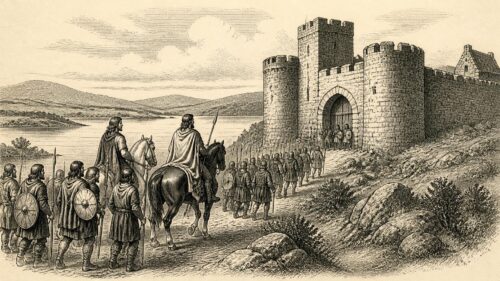
The most consequential firmly dated Irish agreement of the year was concluded on 12 July at Glendun in Antrim. Robert Bruce, king of Scots, and Henry de Mandeville, seneschal of Ulster, sealed a truce intended to last for a year from 1 August. Bruce had landed at Larne in the spring or early summer. His presence was a serious reminder that the Irish Sea remained a political highway rather than a frontier. His brother Edward Bruce’s attempt to win an Irish kingship had ended in 1318, but Scottish connections, ambitions and military leverage had not vanished with Edward’s death.
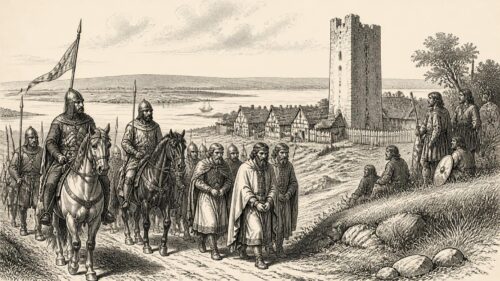
The Glendun agreement was not a peace treaty between equal kingdoms. It was a local settlement made at a moment when Ulster was vulnerable. Richard de Burgh, earl of Ulster and Bruce’s father-in-law, had died in 1326. His heir, William de Burgh, was still young and absent. Mandeville, as seneschal, had to reckon with a Scottish king on the Antrim coast and with uncertain loyalties within the earldom. Under the truce, Ulster was to supply Bruce at Larne with 100 cendres of wheat and 100 of barley, delivered in two instalments at Martinmas and Pentecost. Grain, not battlefield glory, was the price of a temporary breathing-space.
The agreement reveals the practical stakes of warfare. Cereals were portable stores of power: food for households, ships and armed retinues. Larne’s harbour offered Bruce a supply point and a route back to Scotland; Glendun, a narrow valley opening towards the Antrim coast, offered a plausible meeting place. The annals’ brief statement that “the King of Scotland came to Ireland” therefore conceals a carefully documented episode of diplomacy, provisioning and pressure. It should not be confused with Bruce’s later visit to Carrickfergus in 1328, which belongs to the following calendar year.
A King Made in Leinster
Before Lent, according to the Annales Hiberniae, the Irish of Leinster assembled and made Domhnall son of Art Mac Murchadha their king. This was a marked assertion of Gaelic political tradition in a region long divided between the English lordship’s counties and the mountain and woodland lordships of Uí Cheinnselaig, Uí Bhroin and Uí Thuathail. Domhnall’s elevation was not the restoration of a unified provincial state in any modern sense. Rather, it represented the renewed leadership of the Mac Murchadha dynasty among allies and dependants in south-east Leinster.
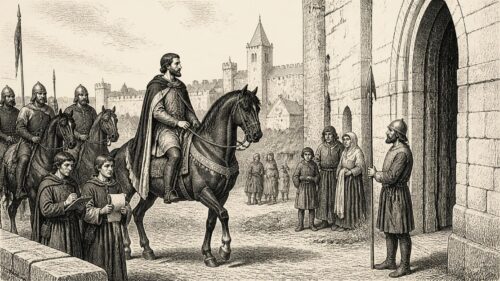
The same source reports, in hostile language, that Domhnall proposed to place his standard within two miles of Dublin and then progress through Ireland. That boast should not be treated as a fulfilled programme. It is evidence of the alarm felt by a colonial chronicler, not proof that Dublin itself was about to fall. What followed is clearer: Henry Traherne, seneschal of Carlow, captured Domhnall; he was taken first to Leixlip and then to Dublin Castle. A payment of £100 is recorded in connection with his capture, before he was held for the royal council’s decision. The episode shows both the symbolic potency of a Leinster kingship and the continuing ability of the Dublin government and its local officers to strike back.
Magnates at War
1327 also exposed deep fractures within the English political community. Maurice fitz Thomas FitzGerald, the future earl of Desmond, quarrelled with Arnold le Poer. James Butler and William de Bermingham supported Maurice; the Burkes supported Arnold. The dispute was not a simple contest between “English” and “Irish”, but a struggle among powerful families whose estates, affinities and ambitions crossed lordship boundaries.
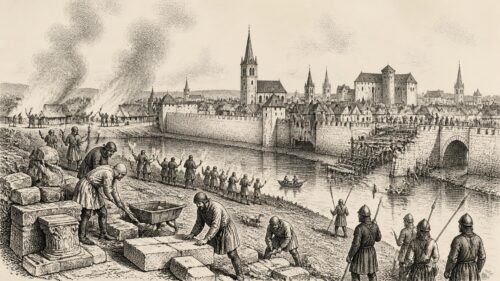
After Michaelmas, the conflict escalated. Arnold, aided by the Burkes, summoned Maurice to an assembly and insulted him as “Maurice the Rhymer”. Maurice, Butler and Bermingham responded with a military gathering and devastated Arnold’s lands in Offaly. Bermingham also burned possessions associated with Arnold in Munster, Ossory and Kells. Arnold and the baron of Donoil withdrew to Waterford. A settlement day was appointed by the justiciar and others, but Arnold did not attend; he went to Dublin and sailed for England. The chronicler says that towns, frightened by the armed disorder, strengthened themselves with garrisons. Whatever the rhetorical colouring, the picture is of lordly private war imposing costs on tenants, travellers and urban communities.
Lough Oughter and Twenty Cows
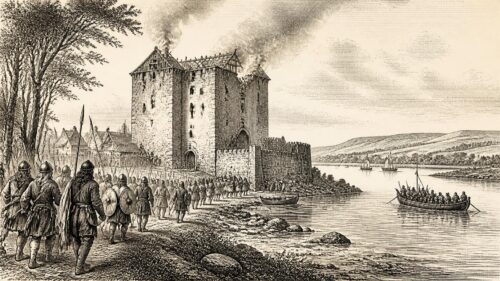
In Breifne, war broke out between the O’Rourkes and O’Reillys. The Annals of the Four Masters preserve two linked notices concerning Lough Oughter: Cathal O’Rourke burned the stronghold, and O’Rourke took the castle by cunning but surrendered it for twenty cows. The entries do not provide enough detail to reconstruct the precise sequence, and no exact day should be invented. They do, however, securely place the castle within the conflict of 1327.
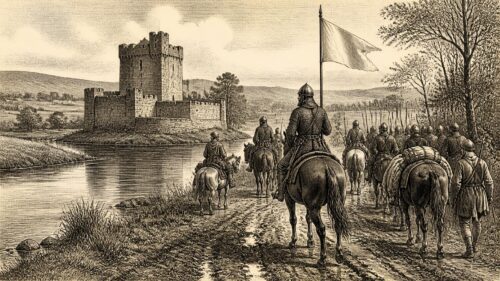
Clough Oughter stood on a crannog, an artificial island in the watery maze of Lough Oughter in what is now County Cavan. Its site gave defenders protection and made movement by boat decisive. The extraordinary detail of twenty cows is valuable. Cattle remained both a source of food and a readily assessed store of wealth; they could serve as compensation, tribute or ransom. The episode also warns against imagining castles as exclusively English institutions. This castle, associated with the O’Reillys, became an object of rivalry among Gaelic lordships as well as a defensive structure in a lake landscape.
The Speckled Sickness
The gravest shared experience recorded for 1327 was disease. The annals state that galar breac, literally the “speckled sickness”, raged throughout Ireland and killed many people, “lowly and great”. Annála Connacht explicitly renders the outbreak as smallpox, and records that Máel Sechlainn Riabach Ó Conchobair died from it. Other deaths entered in the year include Gormlaith, daughter of Mac Diarmata, whose marriages had linked the leading families of Connacht, Uí Maine and Luighne; Fergal, son of Ualgarg Ó Ruairc; Cuilén Ó Díomasaigh; and Sadb, daughter of Mac Aodhagáin.
Modern diagnosis must remain cautious. Medieval annalists named diseases from visible symptoms or inherited terminology, not laboratory observation, and galar breac cannot be made clinically precise from these notices alone. Still, the wording makes clear that contemporaries understood it as a general epidemic rather than a local illness. In a society dependent on household labour, seasonal cultivation, livestock care and the hospitality of lordly households, widespread sickness would have disturbed more than dynastic succession. It threatened work, food preparation, travel, military service and the capacity to sustain dependants.
Thus 1327 was a year in which political authority was repeatedly negotiated rather than simply exercised. At Glendun, peace was bought with grain. In Leinster, a revived kingship met arrest and imprisonment. In the south and midlands, magnates turned private rivalry into devastation. At Lough Oughter, a castle changed hands amid cattle-based bargaining. Across the island, epidemic sickness cut through rank. Ireland’s history in this year is not one story but several overlapping struggles over protection, provisions, legitimacy and survival.
Primary Sources
- Annals of the Four Masters, Part 16: Annal M1327
- Annals of the Four Masters, Irish Text: Annal M1327
- Annála Connacht
- Annála Connacht: Project Documentation
- The Annals of Ulster
- Annales Hiberniae
- Annales Hibernie ab anno Christi 1162 usque ad annum 1370
- CELT Project: Annales Hiberniae Notes and Editorial Material
- MacMurrough (Mac Murchadha), Domhnall — Dictionary of Irish Biography
- Mandeville, Henry de — Dictionary of Irish Biography
- Transcript of an Agreement for a Truce between Robert Bruce and Henry de Mandeville, 1327 — National Library of Ireland Sources Database
- Clough Oughter Castle — Heritage Ireland
- Edward II and Ireland in Fact and in Fiction — Irish Historical Studies
- The Scottish War and the Reign of Edward III, 1327–1330 — Durham E-Theses
- A Sequel to Edward Bruce’s Invasion of Ireland — Irish History Online
- Ireland c.1250–1500: Gaelic Revival — Trinity College Dublin Course Guide
- Climate and Society in Ireland: From Prehistory to the Present — JSTOR
- From Blefed to Scámach: Pestilence in Early Medieval Ireland — University of Limerick Research Portal
- Exploring the Irish Annals — University of Galway
- Annals of the Kingdom of Ireland — National Library of Ireland Catalogue
- Published Medieval Sources — Virtual Treasury of Ireland
- The Anglo-Irish Colony under Strain, 1327–99 — Oxford Academic
- The Archaeology of Medieval Ireland — Terry B. Barry
- The Irish Pipe Roll for 14 John: Early Evidence for Bureaucratic Royal Government in Ireland — British Association for Irish Studies