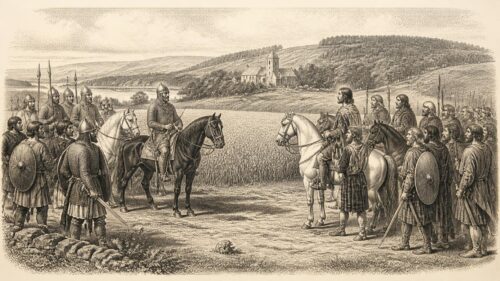
O’Nolan Attack1322 CE
In 1322 Ireland was divided among royal, settler, ecclesiastical and Gaelic powers, while Edward II demanded troops, supplies and revenue for war against Scotland. John de Bermingham organised the Irish levy, leaving William de Bermingham deputy justiciar. On 29 September, O’Nolan forces killed Andrew Bermingham, Nicholas de la Launde and others in the unstable Leinster frontier. Dynastic murders, capture and plunder in Annaly, Connacht and the midlands revealed competition within Gaelic lordships. Obituaries recorded the deaths of Ardagh’s bishop and legal scholar Andrias Mag Mailin. Uneven, sometimes misdated annals portray military, political and economic pressures rather than a nationwide crisis.
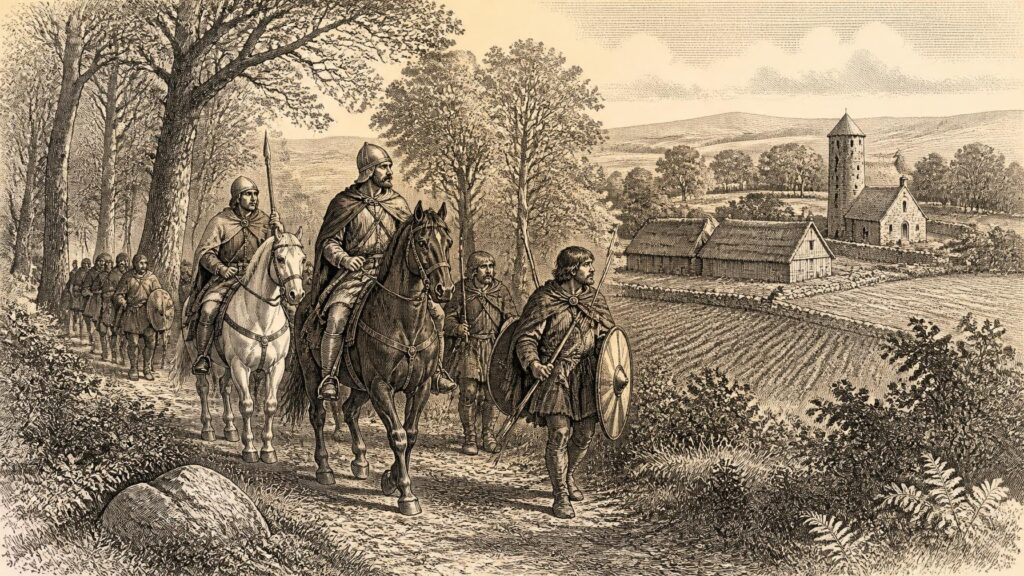
Dateline
In 1322 Ireland was neither a single political unit nor a quiet outer province of the English crown. Authority was divided among the royal administration centred on Dublin, great settler lordships, towns and ecclesiastical jurisdictions, and numerous Gaelic lordships with their own dynastic claims and military followings. The year’s surviving notices are scattered, but together they show a country in which distant wars drew upon Irish men and resources while local rivalries determined security from one district to the next. The sharpest precisely dated event came at Michaelmas: on 29 September, Andrew Bermingham, Nicholas de la Launde and many others were killed by the O’Nolans.
A Crown at War Beyond Ireland
The wider political setting was grave. The Annals of Connacht tersely noted a “great war” between the king of England and his own earls. This referred to the final, violent phase of Edward II’s conflict with the Marcher opposition and Thomas of Lancaster. That struggle was settled in England during 1322, but Ireland could not stand apart from it. Roger Mortimer, the former justiciar whose estates and influence were deeply rooted in Ireland, had joined the defeated opposition and was a prisoner of the English king. His fall mattered in the lordship of Ireland, where the crown was already seeking to scrutinise Mortimer connections and to shore up its own authority.
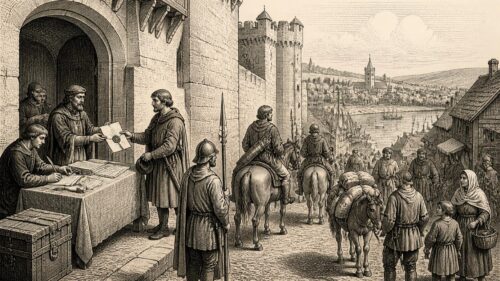
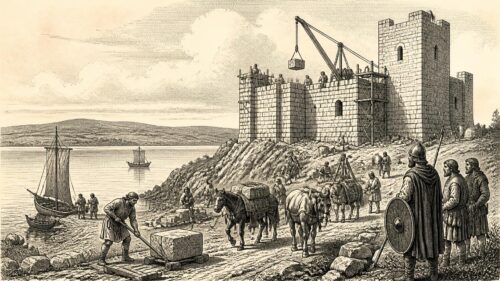
At the same time Edward II was preparing another major effort against Scotland. In April, John de Bermingham, earl of Louth and justiciar of Ireland, was summoned to organise an Irish contribution for a muster at Carlisle. The projected force was formidable on paper: 300 men-at-arms, 1,000 hobelars and 6,000 foot soldiers. The royal government also ordered provisions from Ireland, including grain, malt, beans, pigs, wine and salt. These orders demonstrate the strategic value which the crown attached to Irish revenue, foodstuffs and mobile light cavalry. They do not prove that every man or every consignment arrived as planned; medieval military orders frequently exceeded what officials could actually raise and transport.
Nevertheless, the demands had practical consequences. Men capable of service were to be armed and mustered; horses, food and shipping had to be found; and the Irish exchequer was expected to meet wages from the point at which troops left Ireland. For communities in the king’s lordship, this was an additional burden after the famine years and warfare of the previous decade. Bermingham reached the northern theatre only in August, by which time the English position was deteriorating. His departure also created an administrative gap at home. His brother William de Bermingham acted as deputy justiciar from 18 August 1322 until February 1323, a reminder that government in Dublin depended heavily on the resources, kinship and availability of a small Anglo-Irish elite.
Michaelmas in O’Nolan Country
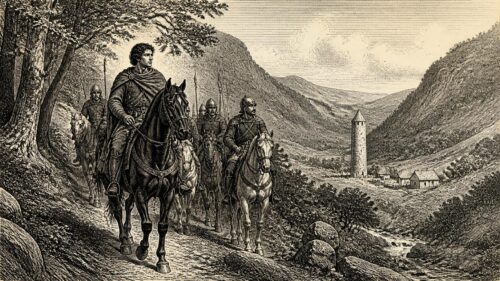
The killing on 29 September was a more immediate expression of insecurity. The annal names Andrew Bermingham and Nicholas de la Launde among those slain by O’Nolan, adding that many others died with them. The encounter is not supplied with a battlefield, a cause or a full casualty list, so it would be unsafe to turn the terse notice into a detailed campaign. Its date, however, is unusually exact: the feast of St Michael, or Michaelmas.
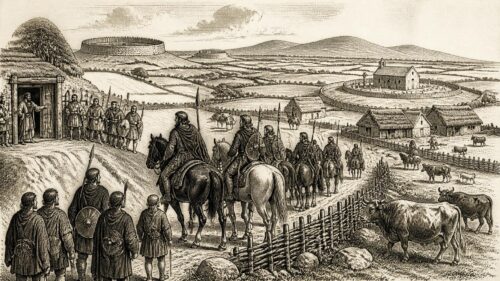
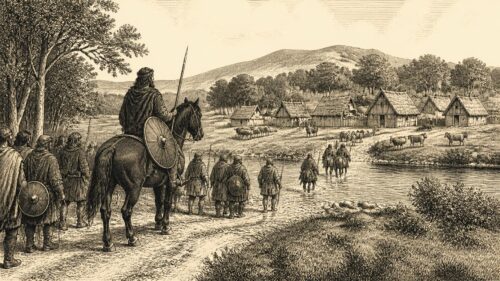
The O’Nolans were associated with Forth in the region of modern County Carlow, an area on the unstable edge of the lordship of Leinster. Here royal and seigneurial claims overlapped with enduring Gaelic power. The deaths of men bearing prominent settler names show that frontier violence was not simply a matter of raids by a distant, undifferentiated “Irish” population upon an established colony. It arose from local contests over land, lordship, routes, cattle, protection and political standing. The O’Nolans could inflict a serious loss, while the Bermingham connection reveals how families with interests across Meath, Offaly, Kildare and beyond were exposed to such conflict.
Michaelmas also fell at a crucial point in the agricultural calendar. Rents, dues, labour services and provisions were often reckoned around the autumn term, while travelling parties and armed escorts moved through the countryside. The sources do not say that the 29 September attack was caused by harvest business, and that conclusion should not be made. Yet the date underlines how political violence could intrude upon the season when households were securing grain, livestock and supplies for winter.
Annaly and the Cost of Succession
In the midlands, the Annals of Connacht preserve an exceptionally concentrated account of dynastic killing in Annaly, the Ó Fergail lordship in the Longford district. Murchad, son of Gilla na Naem Ó Fergail, who had held the chieftainship for three years, was killed at Cluain Lis Beci by his nephew Seoinín Ó Fergail. On the same day Muirchertach, son of Amlaib Ó Fergail, was killed by his brother Lochlainn and by Roiberd. Lochlainn was then himself killed by Seoinín. Later in the year Gilla na Naem, son of Sefraid Ó Fergail, assumed the chieftainship.
This sequence provides a rare glimpse of politics at lordship level. It was not a succession governed by automatic primogeniture. Seniority, descent, armed support, fosterage, alliances and immediate control of people and resources could all matter. The annalist’s repeated use of the language of treachery conveys moral condemnation, but it also confirms that internecine violence could be a means of political transfer. For inhabitants of Annaly, changes at the top were unlikely to have been abstract affairs. A new chief needed clients and fighting men, could demand food-renders and hosting, and had to establish authority over contested territories and subordinate families.
Other Connacht and midland notices reinforce that picture. Enri Mac Gilli Finnein, chief of Muintir Pheodacháin, was killed by the sons of Amlaib Mag Uidir. Gillibert Ó Cellaig, king of Uí Maine, died. In Moylurg, Maelruanaid Mac Diarmata was captured and plundered at Cluain Cummaisc by Conchobar, son of Tadc Ó Conchobair, and the household of Cathal Ó Conchobair. These were not necessarily connected incidents, but they show how imprisonment, plunder and targeted killing remained ordinary instruments of competition between ruling families and their followers.
Connacht, Thomond and Uncertain Annal Dating
Deaths recorded in the Connacht annal included Rican Mac Feorais, lord of Athenry, and Donnchad Mac Diarmata. Such notices matter because Athenry was a significant walled settlement and market centre within the de Burgh sphere of influence, while the Mac Diarmatas were central to the politics of Moylurg around Lough Key. They also show why annal evidence needs close handling. The same annal places the death of William Liath de Burgh under 1322, but independent evidence dates his death to 1324. Its entry that Brian Ó Briain inflicted a great defeat on the Galls—the settlers or foreigners—therefore cannot securely be expanded into a named 1322 battle. It may preserve memory of conflict in Thomond and the Shannon region, but its chronology and circumstances are not firm enough for more than that.
This caution does not diminish the importance of Brian Bán Ó Briain, who was emerging as a powerful figure in the politics of Thomond and neighbouring Munster. It does, however, distinguish a securely dated development from a plausible wider context. In 1322 the regional balance remained fluid: Gaelic dynasties could exploit divisions among colonial lords, while Anglo-Irish families relied upon alliances, castles, towns and royal office without possessing uninterrupted control of the countryside.
Church, Learning and Record
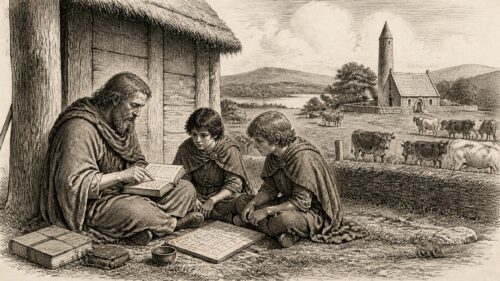
Religious and learned life appears in the year chiefly through obituaries. Matha Ó hEothaig, bishop of Ardagh, died, an event of consequence for a diocese whose episcopal authority intersected with the political world of the midlands. More revealing still is the death of Andrias Mag Mailin, described as the chief master of both old and new law, in civil and canon law. The wording points to a learned professional culture able to work across inherited legal traditions and the universal disciplines of the Latin church. His title should not be made to imply a modern university or legal office, but it is strong evidence that expert learning had social value and named practitioners.
Dublin’s university, founded only two years earlier with papal authorisation, formed part of the same broad ecclesiastical-intellectual landscape, although no specific event there is securely recorded for 1322. The deaths of a bishop and a law master nevertheless remind us that monasteries, cathedral chapters, clerical households and learned families were places where legal knowledge, Latin literacy and historical memory were cultivated alongside pastoral and administrative work.
A Year of Pressures, Not a Single Crisis
There is no reliable evidence for a kingdom-wide battle, famine, weather disaster or constitutional settlement in Ireland during 1322. The year is better understood through overlapping pressures. Edward II’s wars demanded soldiers and provisions from the lordship; a fatal encounter in O’Nolan territory exposed the limits of settler power on the Leinster frontier; and a run of killings, captures and successions showed how intensely local politics shaped Gaelic Ireland. The documentary record is uneven and some annal entries are demonstrably displaced. But its most secure notices leave a vivid impression: authority in 1322 was exercised through households, armed retinues, food supply, legal expertise and the hard-won ability to survive a contested landscape.
Source References
Hover over a number to see the source. Select it to open the source.

- [1] Annála Connacht: Annal 1322
- [2] Annala Uladh: Annals of Ulster otherwise Annala Senait, Annals of Senat
- [3] Annales Hiberniae, 1322 entry
- [4] Annales Hiberniae
- [5] Annales Breves Hiberniae
- [6] Bermingham, John | Dictionary of Irish Biography
- [7] Bermingham, William de | Dictionary of Irish Biography
- [8] O'Brien (Ó Briain), Brian Bán | Dictionary of Irish Biography
- [9] Darcy, Sir John | Dictionary of Irish Biography
- [10] Outlaw (Outlagh, Outlawe, Utlagh, Utlawe), Roger | Dictionary of Irish Biography
- [11] Burgh, William Liath de | Dictionary of Irish Biography
- [12] Burgh, Richard de | Dictionary of Irish Biography
- [13] FitzGerald, Thomas fitz John | Dictionary of Irish Biography
- [14] Mortimer, Roger | Dictionary of Irish Biography
- [15] Morice (Moriz), John | Dictionary of Irish Biography
- [16] English Lordship in Ireland, 1318–1361: A Study in the Development and Instability of the English Lordship in Ireland in the Early Fourteenth Century
- [17] The King’s War: The English Army and the Scottish War, 1322–1323
- [18] Kingship and Crown Finance under Edward II, 1307–1327
- [19] XLIV: An Attempted Escape from Dublin Castle: The Trial of William and Walter de Bermingham, 1332
- [20] Exploring the Irish Annals
- [21] List of Published Texts at CELT
- [22] Irish Texts at CELT
Primary Sources
- Annála Connacht: Annal 1322
- Annala Uladh: Annals of Ulster otherwise Annala Senait, Annals of Senat
- Annales Hiberniae, 1322 entry
- Annales Hiberniae
- Annales Breves Hiberniae
- Bermingham, John | Dictionary of Irish Biography
- Bermingham, William de | Dictionary of Irish Biography
- O'Brien (Ó Briain), Brian Bán | Dictionary of Irish Biography
- Darcy, Sir John | Dictionary of Irish Biography
- Outlaw (Outlagh, Outlawe, Utlagh, Utlawe), Roger | Dictionary of Irish Biography
- Burgh, William Liath de | Dictionary of Irish Biography
- Burgh, Richard de | Dictionary of Irish Biography
- FitzGerald, Thomas fitz John | Dictionary of Irish Biography
- Mortimer, Roger | Dictionary of Irish Biography
- Morice (Moriz), John | Dictionary of Irish Biography
- English Lordship in Ireland, 1318–1361: A Study in the Development and Instability of the English Lordship in Ireland in the Early Fourteenth Century
- The King’s War: The English Army and the Scottish War, 1322–1323
- Kingship and Crown Finance under Edward II, 1307–1327
- XLIV: An Attempted Escape from Dublin Castle: The Trial of William and Walter de Bermingham, 1332
- Exploring the Irish Annals
- List of Published Texts at CELT
- Irish Texts at CELT