The Red Earl’s Last Summer1326 CE
Richard de Burgh, the Red Earl of Ulster and lord of Connacht, died at Athassel on 29 July 1326, ending a powerful four-decade lordship. His fourteen-year-old grandson William inherited vast but vulnerable estates, exposing Ulster and Connacht to guardians, rivals and local conflict. Munster saw fighting between Maurice FitzGerald of Desmond and Arnold le Poer, temporarily restrained by Justiciar John Darcy. Royal administration continued through travelling chancery business and financial enforcement. Local records note Ímar Mag Ragnaill’s killing and the succession at Elphin. Meanwhile, English political crisis unsettled Ireland, making 1326 a pivotal year of insecure lordship and contested authority.

Dateline
In 1326 the most consequential Irish event that can be firmly dated was not a battle or a royal expedition, but the death of Richard de Burgh, the ‘Red Earl’. Lord of Connacht and earl of Ulster, Richard had for more than four decades stood among the greatest landholders and political actors in Ireland. His death at Athassel, in the lordship of Tipperary, ended a long and unusually powerful personal lordship. It also left a minor as heir to estates reaching from Ulster through Connacht and into Munster, creating a dangerous opening in an Ireland already marked by local war, disputed authority and a distracted English crown.
A Death Recorded with Precision
The annals preserve an unusually precise date. Richard died on Tuesday before the feast of St Peter ad Vincula, 29 July 1326, at the Augustinian priory of Athassel. A Kilkenny chronicle praised him as prudent, eloquent, wealthy and wise; the Irish annals called him the foremost, or best, of the English settlers in Ireland. Such language was conventional in obituaries of great men, but it also reflects his exceptional standing. Richard had inherited the earldom of Ulster in 1281 and, as lord of Connacht, commanded resources comparable with those of leading earls in England.
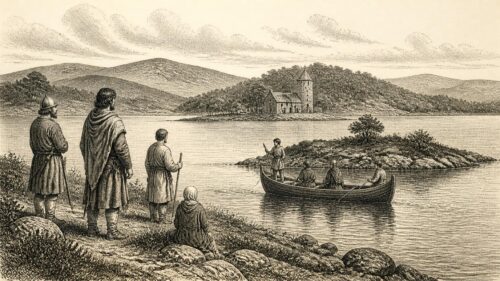
His last known public appearance came at a parliament held at Kilkenny in May 1326. Afterwards he withdrew to Athassel, near Cashel, where he died little more than two months later. The sequence matters. This was not the abrupt killing of a lord in war, but the retirement and death of an elderly magnate at a religious house closely associated with lordly patronage and burial. He was buried there before the end of August. Athassel was therefore, for a short period, the setting for both a major political transition and the religious rites that marked it.
Richard’s career had made him a figure of island-wide consequence. He had intervened repeatedly in Gaelic Irish succession struggles, built and held castles, influenced government in Dublin, and maintained relationships with the English royal court. His family connections extended far beyond Ireland: one daughter, Elizabeth de Burgh, had married Robert Bruce, king of Scots; other daughters married into the Kildare, Louth and Desmond comital families. These marriages did not produce political harmony, but they made the de Burgh household a web linking the principal Anglo-Irish lordships with Scottish kingship and English aristocratic politics.
An Earldom Passed to a Boy
The immediate heir was Richard’s grandson William de Burgh, born in 1312. William’s father, John de Burgh, had died in 1313, so the inheritance passed over a generation. In 1326 William was still about fourteen. That fact is central to the year’s significance: the de Burgh lands did not simply acquire a new adult lord capable of commanding retainers, collecting revenues and imposing settlements. They entered a minority in which relatives, officials and rivals all had reason to seek influence.
It is important, however, not to project later arrangements backwards. William’s formal grants of the English and Irish inheritance, with the title of earl of Ulster, belong to February 1327. Likewise, the appointment of his uncle Edmund de Burgh and cousin Walter de Burgh as guardians of the Irish lands was made after Richard’s death. Those measures were consequences of the vacancy created in 1326, not events of 1326 itself. What can responsibly be said for this year is that Richard’s death made the minority unavoidable and exposed the difficulty of holding together a lordship whose centres of power were widely scattered.
The scale of the problem had been shaped by the Bruce invasion a decade earlier. Edward Bruce’s Scottish army had occupied much of Ulster between 1315 and 1318, and Richard’s political judgement during that crisis had brought grave suspicion upon him. His earldom suffered badly, though Connacht was more successfully defended by other members of the de Burgh affinity. By 1326 the Red Earl had not restored the old security of Ulster. The succession of a boy therefore came at a time when regional lordship depended less on inherited title alone than on the ability to sustain armed followers, retain local alliances and control castles and ports.
War, Feud and Royal Government
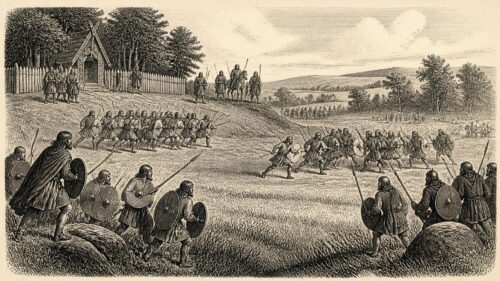
Elsewhere, 1326 brought no single campaign that dominated all Ireland, but it was not a peaceful year. In Munster, Maurice fitz Thomas FitzGerald, lord of Desmond, was engaged in open conflict with Arnold le Poer. The origins of their quarrel were complex, involving rival power, disputed interests and the unsettled legacy of earlier contests over the Clare inheritance. In February the justiciar, Sir John Darcy, led an expedition into Munster to restrain the fighting. By July a temporary accommodation had been arranged. It was a pause rather than a durable solution: the struggle between leading Anglo-Irish affinities would soon resume with greater force.
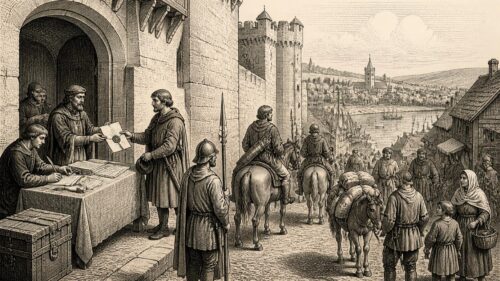
This affair shows the limits of central administration. The lordship of Ireland was ruled in the name of Edward II, but royal officers could not simply command the great lineages into obedience. They needed negotiations, recognisances, military displays and the cooperation of local magnates. Darcy had been justiciar since 1324, while Roger Outlaw, prior of the Hospital of St John at Kilmainham, held the chancellorship. Their government was active and mobile. A chancery order issued at Cork on 7 April and another at Cashel on 16 April show administration moving through the southern towns and ecclesiastical centres rather than operating only from Dublin.
One April order concerned Walter Islip, a former treasurer of Ireland, who had been pardoned after making a very large fine for misconduct involving official rolls. The surviving calendar records directions for the sale of his goods and the collection of debts, so that money owed to the crown could be remitted to him in England. Such business is a useful corrective to a history made solely of earls and armies. Government in 1326 also meant clerks, seals, debts, custody of goods, treasurers and officials attempting to make royal finance work across the Irish Sea.
Kilkenny remained an important place in this administrative and political landscape. It was a substantial walled town, a meeting-place for magnates and a centre of ecclesiastical authority under Richard Ledrede, bishop of Ossory. The earlier Kyteler controversy had not simply vanished from local memory. In August 1326 William Outlaw, son of Alice Kyteler and nephew of Chancellor Roger Outlaw, acknowledged a debt of £1,000 to Roger. That obligation was connected to the costly settlements that had followed the 1324 accusations of heresy and sorcery. The episode reveals how ecclesiastical discipline, family solidarity, credit and political office could remain intertwined long after the public drama of a trial had subsided.
Gaelic Lordships and Local Loss
The Irish annals also preserve events beyond the circles of the great earls. In Muintir Eolais, the territory around the upper Shannon and the modern Leitrim–Longford borderlands, Ímar Mag Ragnaill, its chieftain, was killed by his own kinsmen. The record offers no fuller explanation, but its terseness is revealing. Kin-based lordship could bring protection and continuity, yet succession, land and precedence also made kindred a source of violence. No wider national conflict need be invented from this killing: it was a local political loss, recorded because the dead man was the head of his people.
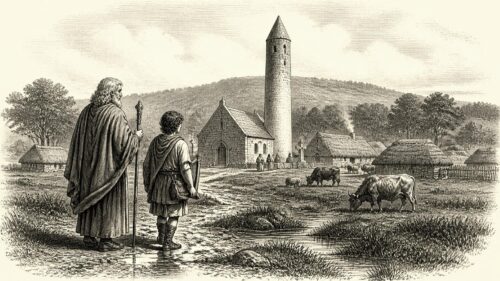
Church leadership changed too. Laurence Ó Lachtnáin, bishop of Elphin, died in 1326, and Master John Ó Finnachta was elected to succeed him. Elphin’s diocese lay in a region where Gaelic dynasties, de Burgh power and church institutions met. An episcopal vacancy mattered not only to clergy. Bishops administered property, exercised jurisdiction, confirmed benefices and provided a recognised authority in disputes. The annal’s use of ‘Master’ for John suggests formal learning and reminds us that ecclesiastical office linked local society to the wider Latin Christian world of canon law, papal provision and educated clerical networks.
There is no secure evidence for attaching a major weather event, general famine or nationwide epidemic specifically to 1326. The Annals of Connacht had noted continuing cattle plague in the preceding year, 1325, but do not state that it persisted into 1326. The destructive harvest failures of 1315–18 and the Bruce wars remained part of living memory, especially in Ulster, but they should not be represented as fresh events of this calendar year. The evidence instead points to a society living with their political and material after-effects: contested lordship, vulnerable estates and the continuing need to secure food, livestock, rents and armed service at local level.
An Unsettled Inheritance
The broader crisis of Edward II’s rule sharpened the uncertainty. In England, Queen Isabella and Roger Mortimer invaded in September 1326, and the Despenser regime began to collapse. Ireland did not change ruler during this year: Edward II remained lord of Ireland until his deposition in January 1327. Yet the political shock was already relevant. Thomas fitz John FitzGerald, earl of Kildare, received a warning late in 1326 not to join rebellion. His absence from Irish parliaments in 1325 and 1326, and the crown’s anxiety about his links with Mortimer, demonstrate how English faction could unsettle Irish politics before formal news of regime change arrived.
Thus 1326 was a hinge rather than a conclusion. The Red Earl’s death closed the career of a lord who had helped define late thirteenth- and early fourteenth-century Ireland. But it did not settle Ulster or Connacht. Instead, it transferred immense expectations to a teenage heir, empowered guardians and kinsmen, and left the crown to manage a succession while its own authority was collapsing across the sea. The year’s surviving records—an obituary at Athassel, a bishop’s election, a kin-killing, administrative orders from Cork and Cashel, and attempts to contain magnate warfare—show an Ireland in which power was intensely local, yet continually connected to Britain, France, the papacy and the wider Irish Sea world.
Primary Sources
- Annála Connacht
- Annals of the Four Masters, Part 16
- Annales Hiberniae
- The Annals of Ulster
- Annales Breves Hiberniae
- Annalium Hiberniae Chronicon ad annum MCCCXLIX
- Burgh, Richard de | Dictionary of Irish Biography
- Burgh, William de | Dictionary of Irish Biography
- Darcy, Sir John | Dictionary of Irish Biography
- Outlaw (Outlagh, Outlawe, Utlagh, Utlawe), Roger | Dictionary of Irish Biography
- FitzGerald, Thomas fitz John | Dictionary of Irish Biography
- FitzGerald, Maurice fitz Thomas | Dictionary of Irish Biography
- Kyteler (Kettle, Keyetler), Dame Alice | Dictionary of Irish Biography
- Bruce, Edward | Dictionary of Irish Biography
- The Bruces in Ireland, 1315–18 | Irish Historical Studies
- Irish Parliaments in the Reign of Edward II | Transactions of the Royal Historical Society
- Close Roll 19 Edward II (1325-1326), Item 9
- Close Roll 19 Edward II (1325-1326), Item 11
- Close Roll 20 Edward II (1326-1327), Item 19
- Close Roll 20 Edward II (1326-1327), Item 76