Darcy’s Irish Commission1323 CE
In 1323, Ireland’s importance lay in its connections with wider Plantagenet politics rather than a single decisive event. A Scottish truce cancelled planned paid military service by leading Anglo-Irish magnates, leaving local rivalries intact. Roger Mortimer’s escape from the Tower raised fears for his Irish estates and supporters, prompting Chancellor Roger Outlaw’s warning mission to Edward II. The king appointed John Darcy justiciar in November, although John de Bermingham remained in office until Darcy’s arrival in 1324. Legislation addressed official abuses, requisitioning, trade, fees and pardons. Meanwhile, Cistercian authorities condemned national exclusion in Irish monasteries, revealing ethnic and institutional tensions.
Dateline
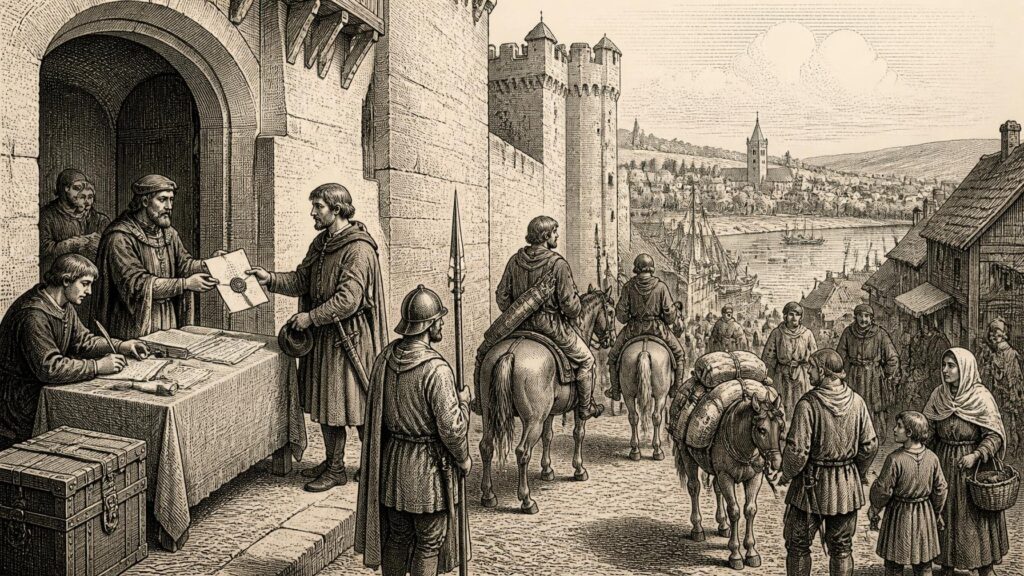
The surviving record for 1323 does not offer a single island-wide battle, coronation or natural disaster around which to organise Ireland’s history. Its significance lies instead in movement: men, orders, money and anxieties travelled between Ireland, northern England and the royal court. In June, leading lords of the English lordship were excused an intended summons for service in the Scottish war. In August, Roger Mortimer of Wigmore escaped from the Tower of London, alarming an administration whose Irish lands and affinities were extensive. In September, the Irish chancellor, Roger Outlaw, crossed to warn Edward II about the danger to the lordship. And on 18 November, the king appointed Sir John Darcy as justiciar of Ireland. These were not separate incidents. Together they show a government trying to hold Ireland within a wider Plantagenet political and military world while authority on the ground remained divided among great lords, churchmen, towns and Gaelic rulers.
A Muster Called Off
The year opened with Ireland still closely tied to the English crown’s conflict with Scotland. In December 1322, a group of magnates holding land in Ireland had been summoned to meet Edward II at Carlisle on 1 June 1323. They included Richard de Burgh, earl of Ulster; Thomas fitz John, earl of Kildare; William de Burgh; John de Barry; John le Poer; Arnald le Poer; John de Verdun; Walter Cusack; Maurice de Rocheford; Simon de Geneville; and Richard le Waleys. Their names mark the political geography of the lordship: Ulster and Connacht, the midlands and Meath, Kildare, the south-east and the port-oriented territories of Munster were all represented by families with interests reaching beyond Ireland.
On 1 June, however, all but Arnald le Poer were notified that their service would not be required because a truce had been made with the Scots. This is a firmly dated Irish development, even though the decision was made outside the island. The summons had envisaged paid service rather than an automatic feudal levy, an important reminder that war drew upon negotiated obligations, wages and transport as well as lordly allegiance. It also suggests the scale at which royal planners expected Ireland to contribute. Ireland was not an isolated dependency at the edge of the king’s dominions: its mounted men, lighter horsemen and foot soldiers could be reckoned as resources in the northern war.
The cancellation spared those magnates an immediate expedition, but it did not make their local power less important. Service overseas could remove armed retainers and leading men from contested estates at home; its suspension left them in Ireland, where rivalries, private lordship and frontier warfare continued to shape politics. The record should not be stretched into a claim that the whole island was peaceful in June. Rather, the truce changed one particular demand placed upon the English aristocracy of Ireland. Gaelic lordships, which did not appear in this royal summons, followed their own political calculations and were not thereby incorporated into the king’s military system.
Mortimer’s Shadow
On 1 August 1323 Roger Mortimer of Wigmore escaped from imprisonment in the Tower of London and made his way into exile. The date matters greatly for Ireland. Mortimer was not merely an English rebel with distant Irish possessions. Through his marriage to Joan de Geneville he was lord of Trim, and his inheritance and connections gave him a major stake in the midlands and Leinster. He had also served as justiciar of Ireland in 1319–20. His escape therefore made the security of Irish castles, revenues, retainers and political friendships an urgent issue for Edward II’s government.
In September, Roger Outlaw, chancellor of Ireland and prior of the Hospital of St John of Jerusalem at Kilmainham, was sent to England. His purpose was to warn the king of risks to the lordship from Mortimer and from those in Ireland who might support him, and to urge a royal visit. The mission is revealing even without assuming that a rebellion was imminent. It shows that the Dublin administration believed Mortimer’s escape could disturb Ireland and that a senior ecclesiastical office-holder was a crucial political messenger. In a realm where communications depended on sea crossings, trusted personnel and sealed letters, Outlaw’s journey was itself an act of government.
A New Justiciar
Edward II’s response included a change at the top of the Irish administration. On 18 November he appointed John Darcy justiciar of Ireland. The justiciar was the crown’s chief governor in the lordship: responsible for royal castles, judicial authority, finance, military organisation and the implementation of orders sent from England. Darcy had experience in royal and aristocratic service, especially in the affinity of Aymer de Valence, earl of Pembroke. His selection placed a trusted English administrator over an Irish office at a politically tense moment.
Yet appointment was not arrival. John de Bermingham, earl of Louth, was removed from the justiciarship in November but continued to act until Darcy reached Ireland in February 1324. That distinction prevents a misleading picture of an instant transfer of power in 1323. Bermingham remained the operative chief governor through the closing weeks of the year, while Darcy’s commission was prepared across the Irish Sea. The gap between nomination and presence was a practical feature of medieval rule, not a minor technicality: authority had to be carried by ships, clerks, seals, deputies and local acceptance.
Darcy’s appointment also reflected a broader problem. The crown depended on the very magnates whose interests it needed to supervise. The earl of Ulster, the Kildare FitzGeralds, the de Burghs, the Butlers, the Powers and other lineages held castles, liberties, tenants and armed followings. The king’s administration could issue writs from Dublin, but it could not simply command every region. The point was not that royal government had vanished; rather, it operated through negotiation, delegated authority and selective intervention. Darcy inherited that demanding political landscape, shaped by the recent Bruce invasion and by the continuing prominence of magnate power.
Rules for Officials and Subjects
Measures recorded under the Irish legislation of 1323 illuminate the ordinary pressures beneath high politics. They restricted the justiciar and other officers from purchasing land within their jurisdictions, addressed the taking of victuals against owners’ will except in necessity, protected the ships and goods of strangers from improper seizure, and regulated certain fees connected with the seal and prison administration. Another order curtailed the granting of pardons for homicide without the king’s authority. These provisions should not be treated as proof that every abuse occurred everywhere in 1323. They do show what royal government recognised as dangerous: officials converting office into private landed advantage, compulsory requisition burdening inhabitants, interference with merchants, excessive charges, and violence escaping punishment.
For townspeople, shipmasters, traders, tenants and prisoners, such rules mattered more directly than a change in the justiciar’s name. Ports linked Ireland to Britain and continental Europe; their commerce depended upon predictable treatment of cargoes and visiting merchants. Rural producers could be required to supply food for castles, officials or troops, but a distinction between lawful necessity and arbitrary taking was worth asserting precisely because it could be contested. The legislation therefore offers a narrow but valuable view of social and economic life: authority was experienced in food, fees, land, shipping and access to justice.
A Monastic Dispute Over Belonging
Religious life also registered the political and cultural divisions of the age. The Cistercian General Chapter of 1323 condemned divisions by national origin and instructed abbots, especially those in Ireland against whom serious complaints had been made, to remove such barriers and admit suitable candidates from all nations. The surviving notice does not allow us to reconstruct the practice of every Irish monastery or to assign a single motive to every community. It does establish that exclusion associated with English and Irish identity had become serious enough to be discussed at the order’s central governing body.
This was a significant intervention because Cistercian houses were not secluded from society. They held land, employed labour, received patrons and travellers, and belonged to an international religious network centred on Cîteaux. The instruction reveals an Ireland in which ethnicity, language, lordship and ecclesiastical affiliation could affect entry into a religious house. It also cautions against treating “Irish” and “English” as simple, fixed blocs. Religious communities contained people with varied local and political ties, while an overseas authority attempted to impose a universal rule of admission.
What the Year Can Bear
1323 is best understood as a year of administrative repositioning rather than dramatic transformation. The Scottish truce altered the immediate military call on Irish magnates; Mortimer’s escape made the security of his Irish connections a royal concern; Outlaw’s embassy carried that concern across the sea; and Darcy’s November appointment prepared a new phase of chief governorship. The legal provisions of the year show efforts to make official power less predatory and more accountable, while the Cistercian ruling exposes a dispute over belonging within the Church.
Care is needed with the annals. The Annals of Ulster place the death of Richard de Burgh, the “Red Earl” of Ulster, under an entry labelled U1323, but the edition itself signals a chronological displacement, “A.D. 1323–6”; Richard’s death belongs to 1326, not to this calendar year. It would be equally unsafe to turn that entry into a 1323 succession crisis. The quieter, securely dated evidence is more revealing here. In 1323, Ireland’s political life was shaped not by one decisive Irish battlefield but by the governing connections that bound Dublin, Carlisle, London, Trim, monastic houses and the Irish Sea together.
Primary Sources
- The Annals of Ulster: Year U1323
- Annales Hiberniae
- Darcy, Sir John
- Bermingham, John
- Outlaw (Outlagh, Outlawe, Utlagh, Utlawe), Roger
- Mortimer, Roger
- Close Rolls, Edward II (1323 to 1327)
- Statute Law Revision Act 2007, Schedule 2
- The Gascon Rolls Project: Calendar C 61/36
- Calendar of the Patent Rolls Preserved in the Public Record Office: Edward II, 1317–1321
- Mapping and Measuring the Impact of the Bruce Invasion
- The Impact of the Bruce Invasion, 1315–27
- Military Service in the Lordship of Ireland 1290–1360: Institutions and Society on the Anglo-Gaelic Frontier
- Bruce Invasion: Fire, Famine and Sword
- The Medieval Irish Plea Rolls: An Introduction
- CIRCLE – A Calendar of Chancery Letters
- Exploring the Irish Annals
- Annála Connacht: Annal 1324
- English Lordship in Ireland, 1318–1361
- Plantagenet Ireland
- Annales Hiberniae (digitised edition)