Athenry’s Assumption Assault1249 CE
In 1249, conflict swept across Ireland’s fragmented political landscape. Justiciar John FitzGeoffrey punished resistant Leinster rulers and, with Maurice FitzGerald, invaded Connacht, devastated Ó Conchobair lands and installed Toirrdelbach Ó Conchobair in place of King Fedlimid. Fighting also afflicted Desmond and Ossory, while dynastic raids and counter-raids unsettled north-west Connacht. Fedlimid safeguarded his movable wealth beyond the Shannon as royal forces plundered territories and Loch Cé. On 15 August, Connacht princes attacked Anglo-Norman Athenry but were routed by Jordan de Exeter’s armoured sortie; Áed Ó Conchobair and many allies died. Annals also record notable ecclesiastical deaths, hospitality, learning, and chronology.
Dateline
A year of punitive war
In 1249, Ireland’s political map was neither neatly divided between Gaelic and Anglo-Norman powers nor governed from any single centre. It was a patchwork of lordships, royal offices, dynastic claims, church jurisdictions and fortified settlements. Yet the annals make this year stand out for the scale with which conflict moved across that patchwork. Royal government based in the lordship of Ireland punished defiant districts in Leinster and intervened forcefully in Connacht; Gaelic leaders mounted raids from Ossory to Desmond; and the frontier town of Athenry became the setting for a defeat remembered in both military and devotional terms.
The fullest near-contemporary narrative survives in Annála Connacht, compiled within the province most affected by the year’s events. Its language is partisan and its terminology must be handled with care: it regularly calls Anglo-Norman settlers and royal troops Galla, conventionally translated as “Foreigners” or “English”. These were not a uniform population, while their opponents included rival Gaelic dynasties whose interests often collided. Still, the record preserves an unusually vivid view of campaigning: cattle and other movable wealth being shifted beyond danger, castles and market towns as strategic points, and local kingship made or unmade by armed coalitions.
Leinster and Desmond under pressure
The year opened with a major expedition by the justiciar of Ireland, John FitzGeoffrey, against the “sons of kings” of Leinster. The annalist says that these princes had been attacking and ruining the settlers, and that they did not join the justiciar when summoned. FitzGeoffrey’s response was not merely a clash with a field army. He invaded and, in the annalist’s stark phrase, stripped the country bare. Such wording points to a punitive raid on settlements and resources: seizure of livestock and food, destruction of stores and crops where possible, and pressure on communities that sustained hostile leaders. It was warfare intended to make political refusal costly.
In Desmond, the annals likewise record a “great war” waged by Fínghin Mac Carthaig against the Anglo-Norman population, with considerable harm inflicted on them. This was part of a continuing struggle within south Munster, where Mac Carthaig contenders, de Cogan interests and other powers competed for influence. The precise sequence of Fínghin’s personal fortunes needs caution. Mac Carthaigh’s Book places his killing, allegedly in breach of a peace at Staunton’s court, in 1249; the Annals of Inisfallen place his capture of Geoffrey de Cogan under 1249 and his own death under 1250. The disagreement is a useful warning against attaching a falsely certain day or even a universally agreed year to every episode. What can securely be said for 1249 is that fighting in Desmond was serious enough to be recorded as a major conflict, not a local quarrel.
In Ossory, Donnchad son of Anmchad Ó Gilla Pátraic was killed by the settlers’ forces. The Connacht annalist celebrates him as an exceptional opponent of the newcomers and describes him reconnoitring market towns in disguises: as a poor man, carpenter, turner or other craftsman, and as a trader in wine and hides. This is literary commemoration as well as information, but it is revealing. It assumes busy market places, recognisable occupations and commercial goods circulating through towns. Warfare depended not only on armies in the countryside but also on intelligence, travel, trade and access to defended urban settlements.
Connacht’s succession crisis
The most consequential events occurred in Connacht, where resistance to the lordship was entangled with an Ó Conchobair family dispute. Fedlimid mac Cathail Chrobdeirg remained king of Connacht, but his son—unnamed in the relevant annal entries—made aggressive attacks on the lands of Mac Feorais Bermingham. A mounted party accompanying Mac Feorais reached Sligo Castle, only to be caught in an ambush. Piers Poer, David Treu and five young companions were killed; their bodies were taken to Ballysadare for burial.
The attack was followed by a raid through Tír Fiachrach and Mac Feorais territory, from the River Moy eastwards to Beltra Strand. The route evokes the practical geography of war in north-west Connacht: river crossings, coastal approaches and landed territories rather than abstract provincial boundaries. Geroitin Mac Feorais pursued the raiders, wounded and captured Donnchad son of Maghnus, and carried him away. Fedlimid’s son then counter-attacked, rescued the prisoner and killed Geroitin “by a stratagem”; Donnchad nevertheless died of his wound. The annalist calls this a great loss to both Galls and Gaels, an acknowledgement that warfare drew in people and families across the supposed divide.
Maurice FitzGerald, styled Mac Muiris in the Irish record, then assembled a force and recovered from Fedlimid’s son as much of the booty as he could find. The prospect of a larger retaliation alarmed Fedlimid. He resolved to send his movable property—effectively the wealth necessary to sustain his household and dependants—across the Shannon into Breifne and northern Ireland. This was an act of prudent logistical retreat, not necessarily an abdication. In a cattle-based economy, moving herds and portable goods could preserve a ruler’s capacity to recover after an invasion.
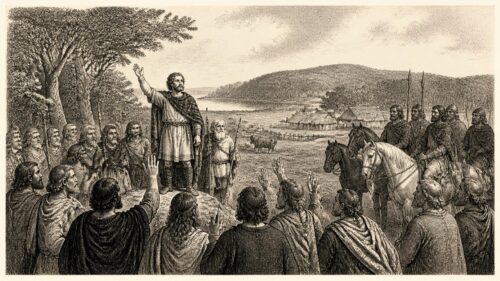
FitzGeoffrey now brought together troops from Meath and Leinster and crossed at Athlone into Síl Muiredaig, the Ó Conchobair heartland in modern County Roscommon. Mac Muiris approached from the other side with men from Munster and Connacht. The two forces met at Elphin after devastating Síl Muiredaig along their route. They then elevated Toirrdelbach, son of Áed and grandson of Cathal Chrobdeirg, as king in place of Fedlimid. This was not a constitutional transfer of power; it was kingship imposed under military protection, exploiting a dynastic alternative already available within the ruling kindred.
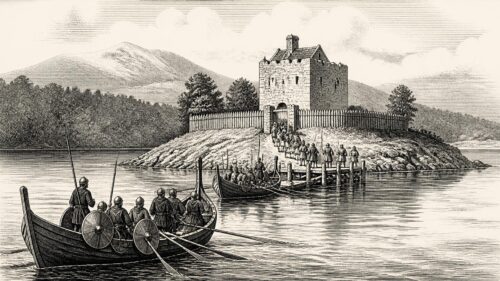
The army remained in Síl Muiredaig for either twenty nights, as the Annals of Loch Cé says, or three weeks, as Annála Connacht has it. The difference is minor; both convey a prolonged occupation marked by systematic plunder. Loch Cé and its islands, including the Rock, were raided, while Breifne was also despoiled and its herds carried away. The lake’s islands had long offered places of lordly residence, ecclesiastical life and refuge. Their plundering shows that water was no guarantee of safety when attackers had boats, local knowledge or control of the shores.
The assault on Athenry
Later in the year, the Connacht princes made a large hosting against Áth na Ríogh, Athenry, intending to burn and plunder it. The annals date the attack to the feast of Mary “in mid-autumn”: the Feast of the Assumption, 15 August. Athenry was then a strategically important Anglo-Norman settlement at a ford, protected by its castle and probably by earlier earthwork defences rather than the surviving stone town walls, which mostly date from later decades. It was a settlement where lordship, trade, roads and military control converged.
Toirrdelbach and Áed, both sons of Áed Ó Conchobair, were among the leaders. The sheriff of Connacht, Jordan de Exeter, was inside the town with many troops. The defenders asked for a truce in honour of Mary’s feast; the attackers refused, and the annals add that Toirrdelbach himself opposed the assault. Whether this detail records a genuine command dispute or serves later political interpretation, it shows that the Connacht force was not a single obedient army.
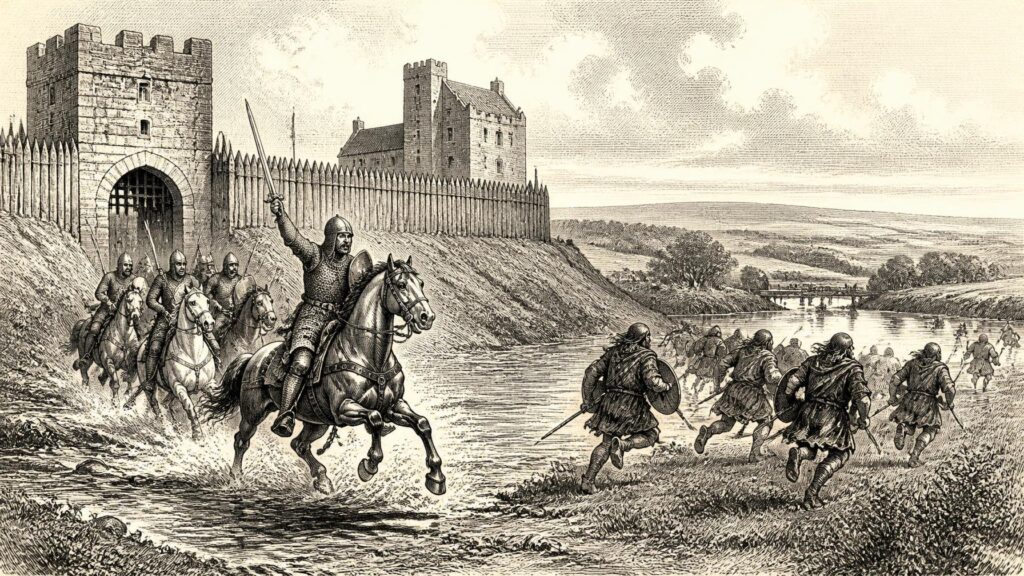
Jordan and his force then rode out. The chronicler presents the outcome as a miracle of the Virgin: the sight of mail-clad horsemen produced terror, and the attackers fled. Behind that devotional explanation lies a material military contrast. Armoured cavalry making a coordinated sortie from a defended town could be decisive against a force caught in the open, especially if its leadership was divided. Áed son of Áed Ó Conchobair was killed, along with named allies from several Connacht and midland lineages, and many others. A short Dominican annal simply calls it the “slaughter of Athenry”. For Connacht, it was both a battlefield loss and a blow to a contested royal family.
Church, learning and the limits of certainty
Amid the fighting, the annals also mark deaths that illuminate religious and intellectual life. Tadc Ó Manacháin, king of Uí Briúin na Sinna, died on 6 June and was buried at Kilmore. Conn Ó Flannacáin, prior of Kilmore, died later that month. In the winter, shortly before Christmas, Máel Muire Ó Lachtnáin died. He was archbishop of Tuam and “master in canon law”, and was remembered as a pilgrim who had travelled to the River Jordan. His death is independently noted in the Dominican annals, underlining its importance beyond his own church province.
Máel Ciaráin Ó Léanacháin, archpriest of Tumna, died while travelling to hear a sermon at Ardcarne on the Friday before Lammas. He was buried on Trinity Island in Loch Cé. The account commends him for maintaining clerics and people of rank in his household, and for keeping an open guesthouse for scholars and strangers. This was more than private generosity: hospitality sustained clerical travel, learned exchange and the social standing of ecclesiastical households.
Finally, one apparent natural event should not be forced into this year. The Annals of Inisfallen places a great earthquake in Ireland and Wales under 1249, but modern seismic study identifies this as the major Welsh earthquake of 20 February 1247, misdated in that annal’s chronology. Its presence in the record is valuable evidence of how extraordinary disturbances travelled through historical memory; it is not sound evidence for an Irish earthquake in 1249 itself. The firmer picture of 1249 is already dramatic enough: punitive expeditions, a coerced change of kingship, plunder across central Connacht, and a failed assault on Athenry whose consequences echoed through the province.
Primary Sources
- Annála Connacht: Annal 1249
- Annála Connacht: Annal 1249 (Irish text)
- Annals of Loch Cé: Annal 1249
- Annals of the Four Masters: Annal 1249
- Annals of the Four Masters: Annal 1249 (Irish text)
- Annals of Inisfallen: Annal 1249
- Mac Carthaigh’s Book: Annal 1249
- Annales Dominicani de Roscoman: Year 1249
- Annales Dominicani de Roscoman: CELT edition and introduction
- John FitzGeoffrey, Dictionary of Irish Biography
- Annála Connacht: Annal 1248
- Annála Connacht: Annal 1247
- Annals of the Four Masters: CELT project edition
- Annals of Inisfallen: CELT bibliographical record
- Annála Connacht: CELT edition
- Athenry Town Walls Conservation and Management Plan
- County Galway Urban Archaeological Survey: Athenry
- Irish Walled Towns Network
- Chartered Towns
- The 1247 Welsh Earthquake and Medieval Irish Annalistic Dating