Fenagh’s Ransom Bell1244 CE
In 1244, Connacht experienced intertwined political, ecclesiastical and social crises. Cú Chonnacht Ó Raghallaigh blinded and emasculated the captive dynast Tadc Ó Conchobair, prompting King Fedlimid’s large retaliatory hosting into Breifne. At Fenagh, troops accidentally caused a foster-child’s death; compensation disputes ended when Magnus son of Muirchertach died during a flooded retreat, followed by payments in horses and silver measured by the Bell of the Kings. Tadc’s brothers died, while lords, clerics and poet Donnchad Mór Ó Dálaigh also perished. Tuam burned, Elphin’s episcopal election divided, and Dublin officials audited treasury accounts, illustrating Ireland’s overlapping Gaelic, ecclesiastical and Anglo-Irish authorities.

Dateline
A Connacht Crisis
The surviving record for 1244 is unusually concentrated in Connacht and its eastern borderlands. It does not describe a single island-wide turning point. Instead, it preserves a sequence of closely connected calamities: the mutilation of a royal hostage, a retaliatory hosting into Breifne, the accidental killing of a nobleman at Fenagh, fires and drownings among church communities, contested episcopal elections, and the deaths of a lord and a celebrated poet. Taken together, these events show how politics, kinship, religion and material wealth were inseparable in thirteenth-century Ireland.
Chronology needs care. Annála Connacht, the fullest narrative source, explicitly opens its entry with the calendar details for the year. The Annals of Ulster and Annals of the Four Masters independently record several of the principal deaths. Yet the annals were compiled from earlier material and sometimes differ in wording or detail. The events below can responsibly be placed in 1244, but their vivid narrative form should not be mistaken for a modern eyewitness report.
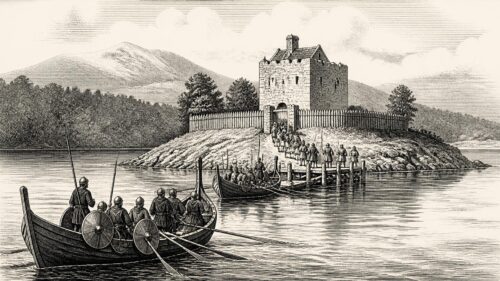
The immediate political crisis concerned Tadc Ó Conchobair, son of Áed and grandson of Cathal Crobderg, the former king of Connacht. Tadc had been held by Cú Chonnacht Ó Raghallaigh of Breifne since the previous feast of St Martin. At the feast of St Berach in 1244, on Inis na Connire in Lough Allen, Ó Raghallaigh had him blinded and emasculated. The Four Masters add that he was hanged; Annála Connacht, while unequivocal about the blinding and emasculation, does not say that he was executed. The secure conclusion is therefore that Tadc suffered a deliberately disabling assault, aimed at removing a dangerous dynastic claimant rather than merely winning a battlefield advantage.
This was not an isolated act of cruelty detached from politics. Tadc was both kinsman and foster-son to Fedlimid mac Cathail Chrobdeirg, king of Connacht. Fosterage made bonds of obligation as consequential as blood descent, while a captive prince could become a bargaining counter among rival kindreds. Cú Chonnacht had earlier acted with Fedlimid’s approval in taking Tadc into custody, but the treatment of the prisoner ruptured that alignment. The conflict also belonged to a wider Connacht in which the descendants of Cathal Crobderg ruled only part of the province, amid the continuing pressure of Anglo-Irish landholders and the legacy of Richard de Burgh’s royal grant of Connacht.
Fedlimid’s March into Breifne
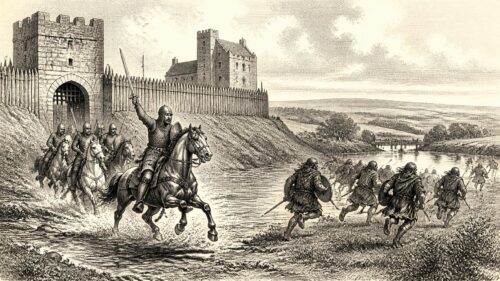
Fedlimid responded by leading what the annalist calls an immense hosting eastwards into Breifne against Ó Raghallaigh. The wording establishes a large armed mobilisation, but no battle or decisive territorial settlement is recorded. It would be misleading to turn the expedition into a conquest. Its stated purpose was vengeance for Tadc, and its best-documented episode occurred not in combat but at Fenagh, a church settlement in what is now County Leitrim.
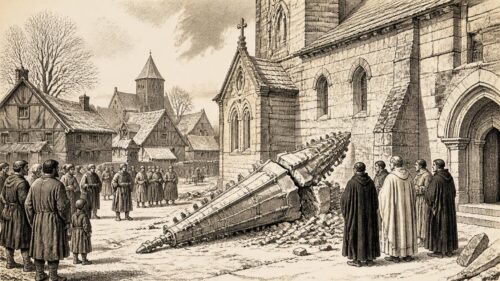
The army spent a night at Fenagh when, according to Annála Connacht, the church had no roof and its coarb, or hereditary ecclesiastical successor, was away. Soldiers, acting without their leaders’ permission, set fire to huts and tents inside the church. A foster-child in the coarb’s care died in the smoke. The annal embeds this in a miraculous story: the child was said to have been found upon a stone and to have had no known parents. Whether or not that devotional detail is accepted literally, the account is exceptionally revealing. A roofless church was still a place of sanctuary and storage; a military encampment could endanger its dependants; and damage done by troops created a claim for compensation that even a king had to address. Fenagh’s long-standing association with St Caillin, its relics and its bell helps explain why its coarb possessed such moral and political authority.
The coarb demanded an éraic, or blood-payment, from Fedlimid: not money alone, but the best man in the host. Fedlimid nominated Magnus, son of Muirchertach Muimnech; Magnus resisted the designation, saying that the host’s leader, rather than he, should bear the penalty. The dispute followed the departing army to Áth na Cuirre on the Yellow River. Floodwater made the ford impassable. In order to cross, the host dismantled the nearby spital-house of St John the Baptist and used its timbers as a bridge.
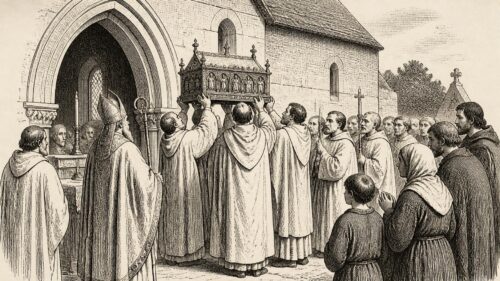
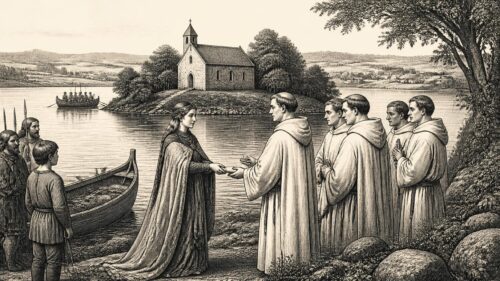
There, the story took its fatal turn. While helping with the demolition, Magnus was struck on the head by a falling timber and killed. He was buried by the doorway of Fenagh church. The annal reports an offering of thirty horses and silver measured three times by the capacity of the Bell of the Kings. Such figures should not be converted into modern currency, but they make plain that horses, silver and prestigious ecclesiastical objects could be invoked together in public settlement. The coarb was represented as having obtained satisfaction at last. The later destruction of Magnus’s carved stone monument and cross by the Uí Ruairc, also noted in the annal, suggests how even a memorial could remain implicated in territorial hostility.
Deaths in a Divided Royal Kindred
While Fedlimid marched, Tadc’s immediate family suffered further losses. His brother Ruaidrí drowned in the Shannon at Curreen near Ballyleague on 9 March and was buried honourably at Cloontuskert. Another brother, Conchobar, died towards the end of the following month of spring. These were not merely private bereavements. In a royal lineage already fractured by competing claims, the death, mutilation or disappearance of adult male kinsmen narrowed political options and altered the balance among branches of the Ó Conchobair family. The annals do not claim that either death caused a succession settlement, and none should be inferred; their importance lies in the accumulation of vulnerability around Tadc’s kin.
Another powerful Connacht lord also died that year. Cormac, son of Tomaltach Mac Diarmata, had ruled all Clann Máil Ruanaid—Magh Luirg in northern Roscommon—for twenty-six years and part of another, according to Annála Connacht. He died in the habit of a Grey Friar at Boyle monastery. His burial and religious profession demonstrate that lordship and monastic life were not separate worlds: major families endowed, protected and used monasteries as spiritual centres, places of burial and arenas of prestige. Boyle’s importance is underlined again by the burial there of Donnchad, bishop of Elphin, and of Donnchad Mór Ó Dálaigh.
Church, Learning and Loss
Donnchad, bishop of Elphin, died on Inishcloghran shortly before May; the Four Masters give 23 April, while Annála Connacht places the death a week before 1 May. The discrepancy cautions against asserting an exact day. What followed is clearer: the cathedral clergy divided over the election of a successor. One substantial party chose Tomás Ó Cuinn, a Franciscan friar; named senior clerics preferred Johannes, an archdeacon, while junior canons elected Comarba Commain Ó Conchobair. An election held at Athlone therefore produced competing candidates rather than a settled outcome. The dispute exposes a church in which diocesan custom, cathedral hierarchy, local kin influence and the newer mendicant orders all had claims upon authority.
The death of Donnchad Mór Ó Dálaigh was a cultural loss of a different kind. The annalist called him a master of poetry beyond compare; modern scholarship identifies him as one of the early thirteenth century’s most important bardic poets. Much of the poetry attributed to him is devotional, though he also wrote for secular patrons. His death as a monk at Boyle is a reminder that learned families worked across courtly and ecclesiastical settings, and that Irish-language poetic learning remained central to elite culture even as Anglo-Irish institutions expanded elsewhere on the island.
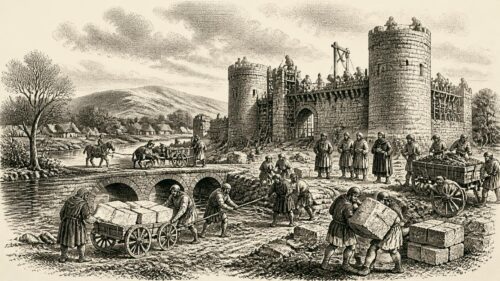
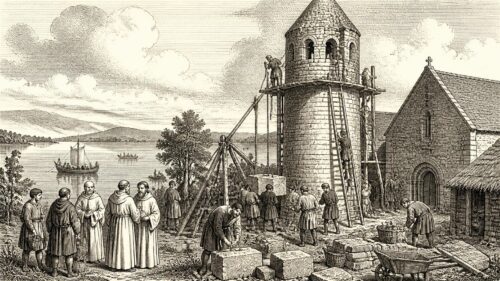
Tuam endured a more immediate catastrophe: it was burned, with its four churches and all its houses. The annal neither names those responsible nor identifies the cause, so it cannot safely be presented as a raid by any particular force. Still, the wording conveys destruction on an urban and ecclesiastical scale. The drowning of Tuam’s archdeacon in the Glaislinn of Cluain added another clerical loss. In the same year, Fergal Mac Thacadan was treacherously killed on Inisfree in Lough Gill, while the Annals of Ulster noted stone roofing work at Domnach-Maighean castle. The record thus moves between fire, water, assassination and construction: instability did not prevent investment in fortified places.
The Wider Lordship
Beyond Connacht, 1244 also offers a restrained glimpse of the English royal administration in Ireland. On 16 June, a patent-roll entry recorded the examination of the Irish treasury accounts by Archbishop Luke of Dublin, Maurice FitzGerald, justiciar of Ireland, and Roger le Waleys of the Knights Templar. The audited balance was £155 8s 5½d. This is not a complete statement of Irish wealth, nor evidence that every region was directly controlled from Dublin. It does show, however, an operating exchequer in which senior ecclesiastical, governmental and military-religious figures participated in the scrutiny of royal finance.
That administrative note belongs beside, not above, the Connacht annals. Ireland in 1244 was not governed through one uniform system. Royal officials and an Anglo-Irish exchequer functioned in the lordship; Gaelic kings led hostings, pursued kin obligations and negotiated compensation; bishops, canons, friars and hereditary church officers competed for spiritual and temporal authority. Fenagh’s ransom—paid amid a military retreat, river flood and church damage—captures the year’s defining reality: power depended upon relationships that crossed the boundaries between lordship, law, sanctity and force.
Primary Sources
- Annála Connacht: Annal 1244
- The Annals of Ulster: Year U1244
- Annals of the Four Masters: Part 8
- Annals of the Four Masters: Irish Text, Part 8
- CELT Project: Annála Connacht
- CELT Project: Annals of Ulster otherwise Annala Senait, Annals of Senat
- FitzGerald, Maurice fitz Gerald
- O'Reilly (Ó Ragallaig), Cathal
- Ó Dálaigh (O'Daly), Donnchadh Mór
- Burgh, Richard de
- Ua Conchobair, Ruaidrí
- Ó Dálaigh, Muireadhach Albanach
- O'Donnell (Ó Domnaill), Domnall Mór
- Patent Rolls: 1244-06-16
- Trinity Historians Reconstruct Thousands of Medieval Documents Bombed in the Four Courts in the Civil War
- Administering the Irish Fines, 1199–1254: The English Chancery, the Dublin Exchequer and the Seeking of Favours
- The Book of Fenagh
- Fenagh
- Exploring the Irish Annals
- CELT Project: Annals of the Four Masters
- CIRCLE: A Calendar of Irish Chancery Letters, c.1244–1509
- The Past as a Bucket of Ashes? CIRCLE: A Calendar of Irish Chancery Letters, c.1244–1509