Sligo’s Hanging Hostages1246 CE
In 1246, newly built Sligo Castle became a focus of conflict between Maurice FitzGerald’s expanding Anglo-Irish power and Máel Sechlainn Ó Domhnaill of Tír Chonaill. After attackers burned Sligo’s enclosure but failed to seize the castle on 1 November, its garrison hanged two hostages, Ó Domhnaill’s foster-father and foster-brother. FitzGerald also sought to reshape northern politics through Cormac Ó Conchobair and hostage-taking. Elsewhere during that turbulent year, John Fitz Geoffrey became justiciar; Connacht dynastic prisoners escaped, were recaptured, or were killed; bishops changed at Elphin and Armagh; Drumlane burned; Oriel suffered violence; and a stranded whale enriched coastal Sligo communities.

Dateline
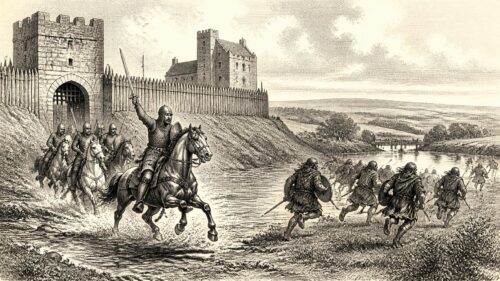
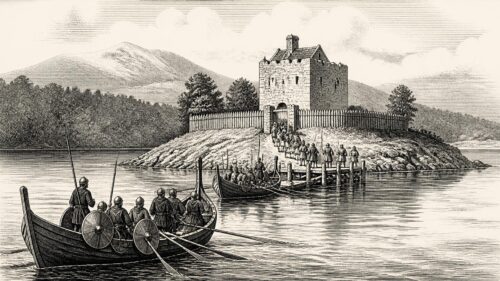
The sharpest image from Ireland in 1246 is not a crowned king or a formal treaty, but hostages displayed at a new frontier castle. On 1 November, according to the Annals of Connacht, Máel Sechlainn Ó Domhnaill and leading men of Tír Chonaill reached Sligo, burned the town’s bawn or outer enclosure, and attempted to take the castle. They failed to break in. The garrison then hanged the hostages held inside where the besiegers could see them: Ó Mianáin, foster-father of Ó Domhnaill, and Ó Domhnaill’s foster-brother. It was a calculated act of terror at a newly fortified point of contact between the expanding Anglo-Irish lordship and the Gaelic north-west.
That episode must not be treated as the whole of Irish life in 1246. The annals also record an administrative handover, rivalries within Connacht, episcopal changes, a killing in Oriel, the burning of Drumlane, and a whale stranded on the coast of Sligo. Together, these notices show an island in which royal government, Gaelic lordships, churches, fortified towns, kinship and natural resources all mattered, often at the same time.
Sligo and the Northern Frontier
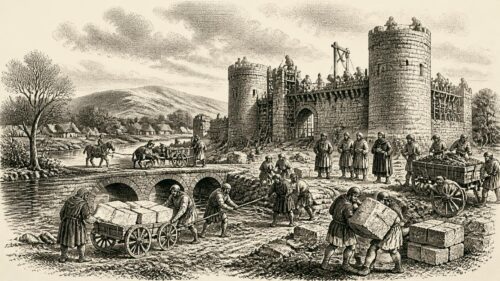
Sligo Castle had been erected by Maurice FitzGerald in 1245, just one year before the siege. Its position gave the lord of Offaly and former justiciar a base from which to press northwards towards Tír Chonaill, while also strengthening Anglo-Irish control in north-west Connacht. The castle was not simply a defensive building. It was an instrument for collecting supplies, housing a garrison, keeping prisoners and projecting authority across a contested region. The settlement around it was consequently exposed: in 1246 the attackers could burn the bawn yet could not master the stone stronghold.
FitzGerald’s campaign that year was more than a raid for cattle or plunder. The annals say that he entered Tír Chonaill, assigned one half of the country to Cormac, son of Diarmait and grandson of Ruaidrí Ó Conchobair, and took hostages from Ó Domhnaill for the other half. This was a bid to reorder power through a client ruler as well as force of arms. Cormac’s appointment offered the FitzGerald interest a dependent claimant on the northern edge of Connacht; hostage-taking was intended to guarantee Ó Domhnaill’s compliance.
Hostages in medieval Ireland were political securities, but they were also people embedded in households and obligations. The identification of the two victims as a foster-father and foster-brother is especially revealing. Fosterage created durable bonds between elite families, and Ó Mianáin was not an anonymous captive. The killing was designed to humiliate and intimidate Ó Domhnaill personally, while demonstrating that the castle’s defenders would turn political guarantees into lethal punishment. The annal gives no exact date for FitzGerald’s initial incursion, but it firmly dates the assault on Sligo to All Saints’ Day, 1 November.
The immediate outcome was inconclusive in one sense: Tír Chonaill’s men had damaged the settlement but not captured the castle. In a larger sense, however, the crisis was only postponed. Events in 1247, directly connected to the struggle begun in 1246, brought a much larger FitzGerald expedition to Assaroe and the killing of Máel Sechlainn Ó Domhnaill at Ballyshannon. That later catastrophe should not be folded into 1246, but it clarifies why Sligo’s hostage episode mattered: it marked an escalation in a contest for the political future of the north-west.
A New Justiciar, an Old Ambition
In the same year John Fitz Geoffrey came to Ireland as justiciar, replacing Maurice FitzGerald in the central royal office. The royal appointment had been made in late 1245, but the Irish annals record his arrival and FitzGerald’s displacement in 1246. A justiciar was the English king’s chief governor and judicial representative in Ireland, responsible for royal administration, revenue, justice and military direction within the lordship. The change did not remove FitzGerald from politics. Freed from office, he retained his extensive landed power and pursued his northern designs from Sligo.
That distinction is important. The English crown’s lordship in Ireland was neither a uniform state nor a simple opposition between ‘English’ and ‘Irish’. John Fitz Geoffrey represented royal authority centred on Dublin; FitzGerald was an Anglo-Irish magnate with private interests and military followings; Cormac Ó Conchobair was a Gaelic prince used in FitzGerald’s settlement; and Ó Domhnaill led resistance from Tír Chonaill. Alliances could cross linguistic and political boundaries. The struggle of 1246 was therefore both a frontier conflict and a competition among rulers for clients, tribute, land and recognition.
Captivity in Connacht
Connacht’s own dynastic divisions supplied another layer of instability. In autumn Toirrdelbach, son of Áed Ó Conchobair, escaped from a crannog at Loch Leisi, where he had been held. The annals report that he drowned his three guards—Cormac Ó Muiredaig and two members of the Uí Ainmirech—and escaped. A crannog, an artificial or adapted island dwelling, could function as a residence, refuge or prison; in this case its watery setting did not prevent a dramatic flight.
Toirrdelbach’s freedom was brief. He was captured again while under the protection of the bishop of Clonfert, handed over to the Galla, or ‘Foreigners’ of the annals, and confined in Athlone Castle. The record is unusually pointed in noting the bishop’s protection. It indicates that ecclesiastical guarantees formed part of political practice, even if they could be overridden by armed power. Athlone, controlling an important Shannon crossing, was an especially formidable place of detention and a key royal stronghold on the Connacht frontier.
These incidents belonged to a deeper conflict within the Ó Conchobair dynasty, not merely to an external conquest. The sons of Áed had challenged the position of Fedlimid Ó Conchobair, king of Connacht, while FitzGerald’s advances in the north-west sharpened their choices. Another annal records the capture and plundering of Áed, son of Áed Ó Conchobair. In the same year Máel Sechlainn, a descendant of Muirchertach Muimhnech Ó Conchobair, was killed by Muirchertach Ó Dubda, who was then banished overseas. Such terse notices expose a political world in which imprisonment, confiscation, exile and killing were recognised means of settling—or worsening—claims within ruling kindreds.
Churches, Lordships and Local Shock
Church affairs were equally entwined with regional society. Eoin Ó Mugróin, bishop of Elphin and son of the comarba, or hereditary successor, of St Mochua, died at Rahugh in 1246. His death opened a vacancy in a diocese at the heart of Connacht politics. Tomaltach Ó Conchobair was elected or raised to the see that year, though his consecration belongs to January 1247. This is a useful reminder that medieval episcopal succession was a process: local election, ecclesiastical approval and consecration might fall in different calendar years.
At Armagh, Albert Suerbeer, the German archbishop, left the Irish primacy for a new appointment in Prussia, Livonia and Estonia in 1246. The Annals of Ulster also note that the bishop of Rathluraigh was chosen for Armagh. The change linked Irish church government to papal and continental networks, rather than isolating it within the island. Yet ecclesiastical institutions were also vulnerable on the ground. Drumlane was burned in 1246; the annal does not identify the attackers or describe the damage, so the event should not be embellished beyond that stark fact.
In Oriel, the Annals of Ulster place the killing of Murchad Ó hAnluain, king of the Airthir, in 1246, saying it occurred on the direction of Brian Ó Néill. Modern biographical discussion has connected the order to 1245, so the precise year of the decision or killing remains uncertain. What can responsibly be said is that the episode belongs to the immediate 1245–46 consolidation of Brian Ó Néill’s power in Ulster, and that it illustrates the lethal pressure exerted upon smaller neighbouring lordships.
A Whale at Cúil Irra
One of the year’s most human notices comes from the coast. A whale stranded at Cúil Irra in Carbury, near Sligo, and the Annals of Loch Cé say it brought prosperity and joy to the whole district. The chronicle does not tell us its species, size or the precise form of benefit. It does, however, preserve an important glimpse of everyday material life. A stranded whale could provide a remarkable quantity of meat, oil, bone and other useful materials, and its arrival was understood as an extraordinary windfall for coastal communities. Beside castles, prisoners and raids, the entry recalls how sustenance and good fortune could arrive from the sea.
Thus 1246 was not a year of one decisive national turning point. Its strongest thread runs from Sligo Castle to Tír Chonaill: a new fort, a punitive expedition, hostages and a failed siege. But the same calendar year also saw a new justiciar, the imprisonment of a Connacht prince at Athlone, turnover in Elphin and Armagh, pressure on Oriel, and a memorable coastal bounty. Ireland’s political map remained plural, contested and intensely local—yet the events at Sligo showed how quickly a newly built castle could alter the lives and calculations of people far beyond its walls.
Primary Sources
- Annála Connacht
- CELT Project: Annála Connacht
- The Annals of Ulster
- Annals of Loch Cé
- Annals of the Four Masters, Part 8
- Irish Historic Towns Atlas: Sligo
- FitzGerald, Maurice fitz Gerald
- O'Connor (Ó Conchobair), Fedlimid
- O'Donnell (Ó Domnaill), Maelsechlainn
- O'Neill (Ó Néill), Brian
- Suerbeer, Albert (Albertus, Albrecht)
- John fitz Geoffrey (c. 1206–1258), justiciar of Ireland and baronial leader
- Calendar of Documents, Relating to Ireland: 1171–1251
- Sligo Castle
- 'Divid_e and Rule': Factionalism as Royal Policy
- Colonisation and Conquest in Medieval Ireland
- Exploring the Irish Annals
- Table of Contents: Annals of the Kingdom of Ireland
- Letters Patent of the Lord Edward Granting Seisin of the Lands of John Fitz-Geoffrey to His Son John, 28 December 1258
- A History of the Irish Dominicans, Volume I