Derry’s Fallen Pinnacle1250 CE
In 1250, Ireland experienced interconnected regional conflicts rather than a single national crisis. Feidlimid Ó Conchobair returned to Connacht with northern support, regained kingship through negotiation with English authorities, and expelled a rival, while Connacht hostages were blinded at Athlone. In Ulster, an expedition failed to secure Ó Néill submission; Niall Ó Canannáin was captured and killed, and Cecilia Mac Lochlainn, wife of Brian Ó Néill, died. In Desmond, Fíngen Mac Carthaig was killed after a peace breach. Derry’s church pinnacle collapsed on 8 February. Episcopal and monastic deaths further underscored institutional uncertainty during that year amid violent, contested lordship.

Dateline
For Ireland, 1250 is best understood not as a single national story but as a year in which several regional crises were recorded side by side. The annals provide unusually vivid notices from Connacht and Ulster, while Munster supplies a separate killing with political consequences. Their yearly headings do not always prove that every death occurred between 1 January and 31 December: medieval annalists sometimes entered news retrospectively or used differing chronological systems. Yet the movements of armies, the negotiated restoration of a king, the blinding of hostages and the collapse of a church pinnacle make this a sharply defined year of contested lordship.
Feidlimid Returns to Connacht
The most consequential development was the return of Feidlimid Ó Conchobair, king of Connacht. His recovery followed the reverses of 1249. In that preceding year, the justiciar’s forces and Maurice FitzGerald had driven Feidlimid from the province and installed his rival, Toirdelbach Ó Conchobair, in his place. The events entered under 1250 were therefore a counterstroke in an already bitter dynastic conflict, one inseparable from the expanding power of the English lordship in western Ireland.
The Annals of Connacht give the fullest account. Feidlimid emerged from the north with a large army drawn from Cenél nEógain. He moved south through Bréifne and the Tuatha, accompanied by Conchobar, son of Tigernán Ó Ruairc, before entering Tír Maine in eastern Connacht. The route mattered. It demonstrates that a Connacht king deprived of his own territory could obtain armed support and safe passage through the network of Gaelic lordships beyond the Shannon. Political authority in thirteenth-century Ireland was not confined within neat provincial frontiers; it depended on kinship, fosterage, alliance, military reputation and the ability to protect allies’ interests.
Toirdelbach fled before Feidlimid and sought refuge among the Galls, the annalists’ usual word in this context for the English or Anglo-Norman settlers and rulers of the lordship. Feidlimid then gathered the “trains” or movable wealth of Connacht and led them beyond the Curlew Mountains. This was not merely baggage. Such trains could include cattle, horses, dependants, stores and portable household goods: resources that sustained an army, preserved a lord’s following and denied supplies to an enemy. The movement conveys the insecurity facing ordinary people attached to a ruling household, whose safety and livelihood could be tied to the progress of a host.
Before matters developed into a longer campaign, messengers from the English side reached Feidlimid and a peace was made. His kingship was restored. The settlement was a success, but not an uncomplicated victory. It showed that neither Feidlimid nor the colonial administration could effortlessly impose its preferred ruler on Connacht. Feidlimid had proved that he remained a formidable regional king; the English administration had shown that recognition from its officers could still be indispensable to stabilising a disputed province.
The price of this settlement was starkly displayed at Athlone. The annals report that Connacht hostages were blinded by the English there. Hostages were a central instrument of medieval politics, handed over as guarantees for peace, obedience or alliance. Their mutilation was therefore more than private cruelty: it was a public warning about the consequences of defiance and a permanent injury to the human bonds between ruling families. The notice does not identify all the victims or provide a precise date, so their individual stories cannot be recovered. It does, however, expose the coercive reality beneath the language of peace.
Feidlimid also made a major raid against Cathal Ó Conchobair and expelled him from Connacht. This second removal indicates that restoration did not end rivalry within the wider Ó Conchobair kindred. A kingship could be regained in negotiation with the lordship and still have to be defended against near relatives with claims, followers and local power of their own. Connacht in 1250 was not simply divided between “Irish” and “English”: its crisis was shaped by Gaelic succession struggles in which English intervention was decisive but not exclusive.
Pressure in the North
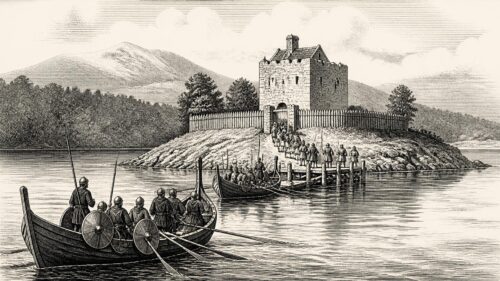
Events in Ulster reveal comparable uncertainty. Maurice FitzGerald, Cathal Ó Raigillig and Cú Chonnacht Ó Raigillig, together with other Uí Briúin leaders, led a host into Tír Eógain. They stayed for three nights at Tullaghoge, a place closely associated with the kingship of the northern Uí Néill. The expedition endured hardship and inflicted damage, but obtained neither pledges nor hostages from the Ó Néills. Its failure to secure submission is important: an army’s presence, even at a ceremonial and political centre, did not automatically translate into durable control.
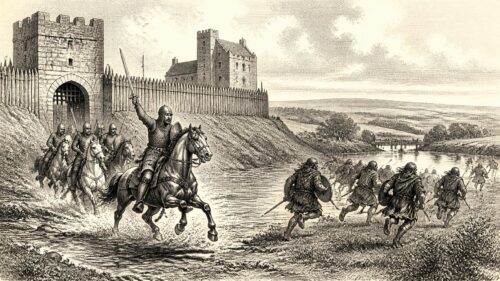
On the return journey through Tír Chonaill, FitzGerald captured Niall Ó Canannáin, king of Tír Chonaill, despite the protection of Bishop Ó Carolan. The Annals of Ulster record Niall’s killing under 1250; the Annals of the Four Masters add that he was killed while attempting escape. Even allowing for the brevity and differing emphases of the sources, the episode shows how fragile clerical protection could be when powerful armed interests intervened. It also removed a ruler who had only taken the kingship in 1249, sharpening instability in the north-west.
Another Ulster notice records the death of Cecilia, daughter of Mac Lochlainn, described as queen of the north of Ireland. She was the wife of Brian Ó Néill, ruler of Tír Eógain, and her marriage had linked the ascendant Ó Néill line with the defeated Mac Lochlainn dynasty. Her death did not itself decide the contest for northern lordship, but it reminds us that marriage was political infrastructure. Elite women connected competing dynasties, brought claims and prestige into households, and could help turn a military victory into a more defensible settlement.
A Killing in Desmond
Munster’s record is briefer but no less revealing. The Annals of Inisfallen place the killing of Fíngen Mac Carthaig under 1250, saying that he was slain in breach of a peace by the de Cogans and by Domnall Cairprech Mac Carthaig, his own paternal uncle. The Annals of the Four Masters similarly record the death of Fineen Florence Mac Carthy at the hands of the English of Desmond. Neither source supplies a secure day or month, and later annalistic traditions differ in their placement of related events; it is therefore safest to retain the annals’ year rather than impose a more exact date.
The killing encapsulates the mixed political world of Desmond. A Gaelic dynastic dispute intersected with the interests of the de Cogans, a settler lordly family. Peace agreements, protections and negotiated relationships existed, but their breach could be fatal. Fíngen’s death was not a simple frontier clash between separate peoples. It was a conflict in which Gaelic kinship, Anglo-Norman lordship and personal alliances were entangled.
Churches, Offices and Loss
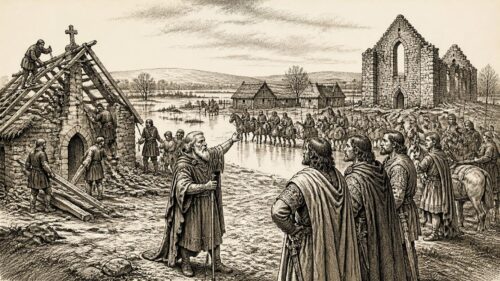
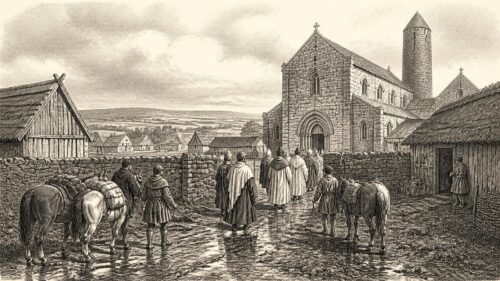
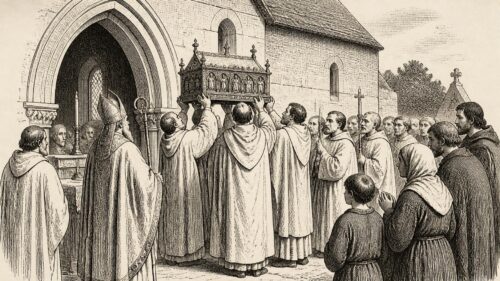
Religious life was also marked by loss. The most precisely dated Irish notice of the year comes from Derry: on 8 February, the pinnacle of the great church of Daire Coluim Chille, the church of St Columba, fell. The annal gives no cause. It should not be turned into evidence for a storm, earthquake or attack. Still, the collapse of a prominent architectural feature would have been conspicuous to the clerics, tenants, pilgrims and visitors attached to a major Columban church. It points to the material vulnerability of even important ecclesiastical sites, whose roofs, towers and stonework demanded continued resources and skilled maintenance.
Several ecclesiastical deaths were entered under 1250. Thomas Ó Meallaigh, bishop of Annadown, died; so did the bishop of Emly, Congalach Mac Cinnéide, bishop of Kilmore in Bréifne, and Turlough, prior of the church of Saints Peter and Paul. The Annals of Ulster also record the death of Máel Muire Ó Lachtáin, archbishop of Tuam. Other episcopal evidence places his death before Christmas 1249, which is a useful warning against reading an annal heading as a modern death certificate. What can responsibly be said is that his death was recorded in the 1250 annalistic cycle, and that Tuam’s metropolitan see was in transition during a year when Connacht itself was politically unsettled.
These notices reveal the breadth of the Irish church. Annadown stood on Lough Corrib; Emly retained its ancient Munster importance; Kilmore served Bréifne; Tuam was an archiepiscopal centre; Derry commanded exceptional Columban prestige. Bishops and priors were not detached observers of politics. They held lands, acted as protectors and intermediaries, maintained communities of clerics and participated in the social networks that sustained lordship. The capture of Niall Ó Canannáin despite episcopal protection makes that political role painfully clear.
A Restored but Violent Order
The surviving evidence does not support a sweeping claim that 1250 transformed all Ireland. It does support a more precise conclusion. In Connacht, Feidlimid Ó Conchobair regained his position, but only after mobilisation across provinces and negotiation with the English lordship; the blinding at Athlone showed the violence behind that settlement. In the north, a major expedition failed to win Ó Néill submission while the king of Tír Chonaill was captured and killed. In Desmond, a peace-breaking killing exposed divided authority. And at Derry, the fallen pinnacle provided a memorable material image of a year in which institutions, alliances and structures alike could prove insecure.
Primary Sources
- Annála Connacht: Annal 1250
- Annála Connacht
- The Annals of Ulster: Year U1250
- Annala Uladh: Year U1250
- Annala Uladh: Part 6
- Annals of the Four Masters: Part 8
- Annals of the Four Masters
- Annals of the Four Masters, Irish Text
- Annals of Inisfallen: Part 77
- Annals of Inisfallen
- O'Connor (Ó Conchobair), Fedlimid
- O'Neill (Ó Néill), Brian
- MacLoughlin (Mac Lochlainn), Domnall
- CELT: The Online Resource for Irish History, Literature and Politics
- A Chronology of Ireland
- Ireland c.1250–1500: Gaelic Revival
- Gaelic Society and Economy
- The Crusades to 1291 in the Annals of Medieval Ireland
- High Tide of the Colony (1250–1333)
- Background: Chronology of Key Events 1169 to 1799
- From Boom to Bust: The Lordship of Ireland and the European ‘Commercial Revolution’
- Irish History Online: Economy and Town in Anglo-Norman Ireland