Kilcrea Friary1465 CE
In 1465, Ireland experienced severe frost, snow and delayed spring growth, causing acute scarcity, especially recorded in Connacht. Political instability compounded hardship as Ó Conchobair and Mac Diarmata successions provoked battles, killings, raids and disputed lordships. Elsewhere, family conflict and territorial seizures occurred in Breifne, while dynastic connections and rivalries remained active across Leinster and Ulster. In the English lordship, Earl Desmond governed despite opposition and a proposed replacement, while parliament legislated on security, cultural conformity, maritime regulation and Cork’s finances. Meanwhile, Cormac Láidir MacCárthaig founded Kilcrea Friary, combining Franciscan observance, dynastic commemoration and regional ambition during a troubled year.
Dateline
For Ireland, 1465 was remembered not for one kingdom-wide battle or royal proclamation, but for the collision of weather, hunger and intensely local politics. The surviving records are uneven: the Dublin administration left statutes and appointments, while Irish annals preserve sharp reports from Connacht, Ulster, Breifne and Munster. Together they show a country of many lordships and jurisdictions, linked by churchmen, kinship, trade and warfare, but exposed to sudden failures of food and authority.
A Winter That Would Not End
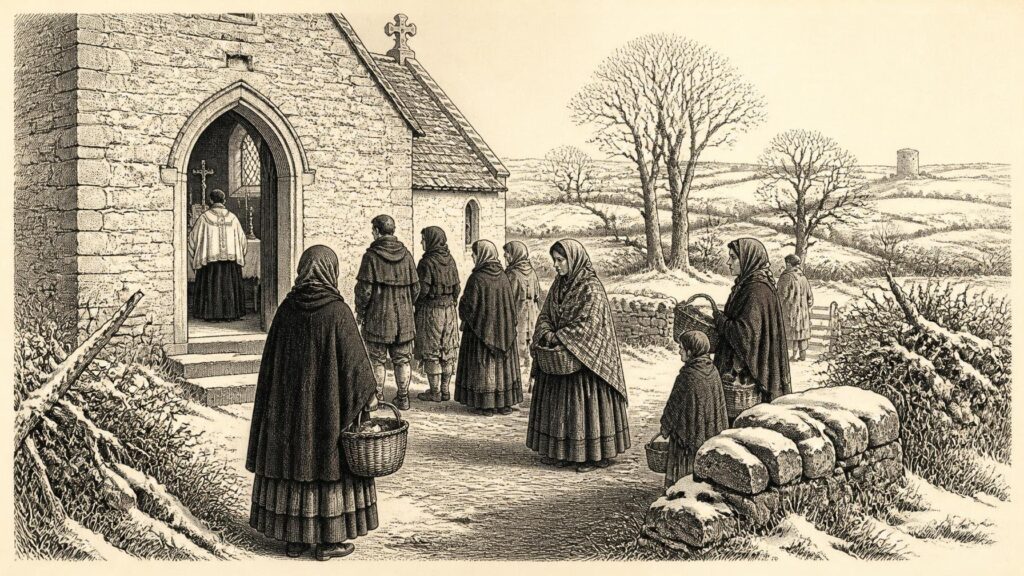
The most striking contemporary notice comes from the Annals of Connacht. They record “exceeding great frost and snow and stormy weather” in 1465. The chronicler says that no herb grew and no tree put forth leaves until the feast of St Brendan, 16 May in the medieval calendar. This was not merely an observation about an unpleasant season. It describes a spring in which pasture failed to revive, fodder was scarce and the normal growth on which people and livestock depended was dangerously delayed.
The annalist’s most alarming image is set in a church: a stronger person might seize food from a priest even while he held the consecrated Host and wore Mass vestments. Such language is morally charged, and it cannot tell us how often this happened or in which parish. Yet its inclusion is important. It presents hunger as a force capable of overturning both customary restraint and the sacred protection of the altar. In a predominantly rural society, where winter stores, dairy produce, grain, grazing and seed corn were all closely connected, a late spring could press hardest on households with the least reserve.
It would be unsafe to turn this single annal into a national harvest statistic. The entry does not quantify deaths, prices or the geographic reach of the hardship. Nor should it be assumed that every part of Ireland suffered in precisely the same way. But the reference to failed vegetation, snow and storms supports a firm conclusion: early 1465 brought severe environmental stress, and contemporaries regarded the scarcity it produced as extraordinary. The background to political action that year was therefore not simply rivalry among elites, but a season in which food itself could become a contested resource.
Connacht Without Settlement
That pressure unfolded amid a fractured Connacht. After the death of Tadhg Ó Conchobair, rival branches of the wider Ó Conchobair kindred spent, according to the annalist, eight weeks and a day without one acknowledging another’s authority. This was not a vacancy in the modern constitutional sense. Kingship and lordship were negotiated within powerful descent groups, where eligibility, military following, fosterage and clerical support all mattered. Nevertheless, the report captures a real interval of uncertainty in the political centre of Síol Muiredaig, the Ó Conchobair heartland.
By the end of March, that uncertainty had become open conflict. Descendants of Ó Conchobair Ruadh and Brian Ballach, accompanied by gallowglass soldiers and other fighting men, attacked at Nadnaveagh and were pursued towards Doonard. Cathal Ruadh Ó Conchobair was killed by close maternal and paternal relatives. The annalist dates the violence to the Saturday before Palm Sunday, the last day but one of March, and adds that neither ollav nor bishop was respected among the Síol Muiredaig. An ollav was a learned professional of high status: the remark therefore signals not only battlefield disorder but the failure of persons normally entitled to honour and protection to restrain it.
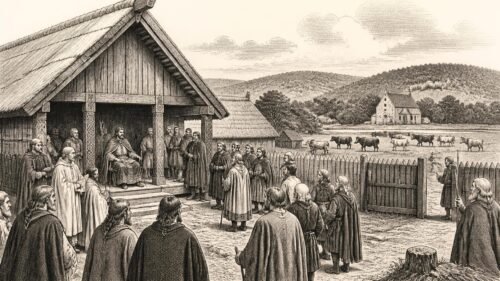
At Moylurg, around modern north Roscommon, the death of Áed Mac Diarmata produced another contested succession. Conchobar Óg Mac Diarmata was installed by the laymen and clergy of the territory, while the sons of Ruaidhrí Mac Diarmata withheld assent. The wording matters. Clerics were participants in the public recognition of lordship, not detached witnesses standing outside it. Their support could help validate a new ruler; their absence, or that of a rival lineage, revealed the limits of consensus.
A meeting intended to manage the dispute instead became a fight. Ó Conchobair Donn and Donnchad Ó Cellaig stood with the dissident Mac Diarmata faction; Ó Conchobair Donn was defeated, Diarmait son of Ruaidhrí was killed and prisoners were taken. A child with his foster-father and many kern were among the casualties or losses reported. Fosterage, a central institution binding families across lordships, appears here in the immediate human geography of war. The later retaliatory raid cost the Mac Diarmatas Tomaltach Mac Diarmata. In a year of climatic difficulty, such fighting meant more than changing rank: it endangered cattle, stores, dependants and the labour needed to recover from a bad spring.
Violence, Succession and Possession
Other entries show the same harshly local character of political change. Maelsechlainn Ó Birn, chief of Uí Briúin na Sinna, and his young son were killed and burned by his brothers and their own followers on the Sunday before Hallowmas. A second son, Cairpre, was killed a fortnight later. The annals do not offer a full explanation, and responsible history should not supply one. What can be said is that lordship rested on relationships that could be violently renegotiated within a family and territory, not merely contested between clearly separate “Irish” and “English” blocs.
In Breifne, Mac Con Snama and his son were killed by Domnall Ó Ruairc and his sons, who then occupied their land. The sequence is stark: killing and possession. Elsewhere, the annals note deaths of men associated with learned, ecclesiastical and military offices, including Cú Chonnacht Mac Rithbertaigh, an ollav to the Maguires in poetry, and Ruaidhrí Óg Mac Domnaill, described as a renowned constable. Their notices remind us that a lordship was sustained by specialists as well as by a chief and his immediate kin: poets, clerics, legal and administrative experts, household officers and armed retainers.
Ulster’s annalist also records the death of Gormlaith Kavanagh, daughter of Mac Murchadha, king of Leinster, and wife of Henry Ó Néill. Her marriage joined leading dynasties across a large part of the island. Its notice demonstrates the political significance of aristocratic women, even though the sources say far less about their own choices and activity than about male warfare. In the same year, Conn son of Aodh Buidhe Ó Néill killed John, son of Alasdair, of the Mac Domnaill Mór kindred, shortly before Michaelmas. The surviving evidence does not justify treating these separate deaths as parts of one coordinated island-wide war; it does show that old kinship networks and regional rivalries remained active from Leinster through Ulster.
Dublin Authority and Its Limits
Within the English lordship, Thomas fitz James FitzGerald, earl of Desmond, continued as deputy lieutenant. His position was already politically fraught. He had sought to widen the effective reach of Dublin government and had dealings with Gaelic powers, but men of the Pale, prominently associated with William Sherwood, bishop of Meath, distrusted him. In May, Edward IV appointed John Tiptoft, earl of Worcester, as deputy lieutenant in what appears to have been preparation to replace Desmond. Tiptoft did not come to Ireland in 1465, however, and Desmond remained in office.
Desmond’s second parliament of the deputyship met amid worsening relations between his administration and Pale interests. The statutory record associated with 5 Edward IV illustrates its priorities. Measures dealt with robbery, bows and arrows, local constables and archery butts. Another required Irish people resident in the counties of Dublin, Meath, Uriel and Kildare to adopt English names and dress. Such legislation was an assertion of cultural as well as political control at the lordship’s core; it should not be mistaken for proof that the policy was successfully imposed on daily life.
The same parliamentary business also concerned the sea and towns. Foreign ships fishing in Irish waters without licence were regulated, while the mayor and commons of Cork received relief from the city’s fee-farm burden and a grant connected with customs and the cocket, the official certification of customs entries. These provisions point to a government attentive to maritime revenue, fisheries and urban commerce. Cork’s civic community was not a remote afterthought: it was an established corporate body whose fiscal health mattered to both local merchants and the crown’s Irish administration.
Franciscans at Kilcrea
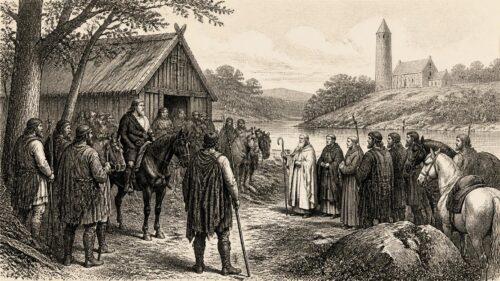
Amid scarcity and conflict, a significant religious foundation was made in Muskerry, west of Cork. Kilcrea Friary was founded in 1465 by Cormac Láidir MacCárthaig, lord of Muskerry, for the Observant Franciscans. The Annals of the Four Masters record that the MacCarthys established the house and made an honourable tomb there for their gentlemen and chieftains. This was an act of devotion, but also of dynastic planning. A friary offered prayers, burial, prestige and a durable focus for lordly memory.
The choice of Observant Franciscans connected a local Gaelic lordship to a wider late-medieval movement for stricter religious observance. Its importance should not be exaggerated into a sudden transformation of Irish religion: the foundation was one development within a long-established and varied ecclesiastical landscape. Still, the new house shows that patronage, building and religious renewal continued even in a year remembered for weather crisis and bloodshed.
Thus 1465 reveals Ireland as neither politically inert nor neatly divided. Severe weather exposed the vulnerability of ordinary provisioning; contested successions made that vulnerability worse in parts of Connacht; and Dublin’s statutes proclaimed authority whose reach was disputed beyond the Pale. At Kilcrea, meanwhile, a new Franciscan community gave material form to aristocratic piety and regional ambition. The year’s records are fragmentary, but their combined picture is unusually vivid: unopened spring growth, contested lordships, hungry people, legislative assertion and a friary rising beside the Bride.
Source References
Hover over a number to see the source. Select it to open the source.

- [1] Annála Connacht
- [2] Annála Connacht (Irish text)
- [3] The Annals of Ulster
- [4] Annals of Ulster otherwise Annala Senait, Annals of Senat: Year U1465
- [5] Annals of the Four Masters: Annal M1465
- [6] Annals of the Four Masters (Irish text): Annal M1465
- [7] FitzGerald, Thomas fitz James
- [8] Tiptoft, John
- [9] English Lordship of Ireland and the Irish Sea World: Re-assessing the Origins of the Kildare Ascendancy, c.1390–c.1513
- [10] Medieval Irish chronicles reveal persistent volcanic forcing of severe winter cold events, 431–1649 CE
- [11] Medieval Irish Chronicles Reveal Persistent Volcanic Forcing of Severe Winter Cold Events, 431–1649 CE
- [12] Understanding whether environmental conditions can provoke violence
- [13] Exploring the Irish Annals
- [14] Kilcrea Franciscan Friary
- [15] Kilcrea (Co. Cork)
- [16] A History of the Franciscan Order in Ireland
- [17] A History of the Franciscan Order in Ireland: Kilcrea
- [18] Archaeological Heritage of County Cork
- [19] Europe and the County of Cork: A Heritage Perspective
- [20] Statute Law Revision Act 2007, Schedule 2
- [21] Acts of the Pre-Union Parliament of Ireland
Primary Sources
- Annála Connacht
- Annála Connacht (Irish text)
- The Annals of Ulster
- Annals of Ulster otherwise Annala Senait, Annals of Senat: Year U1465
- Annals of the Four Masters: Annal M1465
- Annals of the Four Masters (Irish text): Annal M1465
- FitzGerald, Thomas fitz James
- Tiptoft, John
- English Lordship of Ireland and the Irish Sea World: Re-assessing the Origins of the Kildare Ascendancy, c.1390–c.1513
- Medieval Irish chronicles reveal persistent volcanic forcing of severe winter cold events, 431–1649 CE
- Medieval Irish Chronicles Reveal Persistent Volcanic Forcing of Severe Winter Cold Events, 431–1649 CE
- Understanding whether environmental conditions can provoke violence
- Exploring the Irish Annals
- Kilcrea Franciscan Friary
- Kilcrea (Co. Cork)
- A History of the Franciscan Order in Ireland
- A History of the Franciscan Order in Ireland: Kilcrea
- Archaeological Heritage of County Cork
- Europe and the County of Cork: A Heritage Perspective
- Statute Law Revision Act 2007, Schedule 2
- Acts of the Pre-Union Parliament of Ireland