Bundrowes and the Trading Ship1420 CE
In 1420, Irish political life combined warfare, negotiation, trade and royal administration. Brian Ó Conchobair built Bundrowes Castle beside the Drowes, provoking Ulster opposition and fighting around Assaroe, where Domnall Ó Domhnaill was killed and Niall Garbh escaped aboard a trading ship. Kinship disputes in Connacht brought murders, raids, captivity and settlements secured through lordly protections. Granard Castle was briefly seized, then demolished by Ó Fearghail. Dublin officials collected customs and administered justice and finance. Death notices linked leading families to churches, while violence reached sacred spaces. Annals also recorded wolves killing many people, revealing environmental danger amid political instability.

Dateline
In 1420, the most sharply recorded Irish events clustered around contested strongholds, river crossings and the movement of mounted warbands. The year’s evidence is uneven: the Irish annals preserve dramatic notices from Connacht, Ulster and the midlands, while Irish chancery records illuminate the smaller but durable machinery of royal government in Dublin. Some occurrences can be dated precisely; many others are assigned only to the year, or to a season. Taken together, they show an island of several political worlds, linked by trade, kinship, hostage-taking and ecclesiastical institutions, yet divided by local rivalries and shifting military power.
A Castle at the Drowes
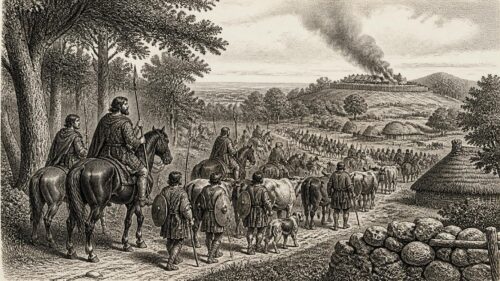
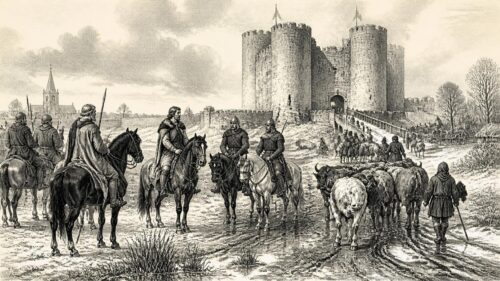
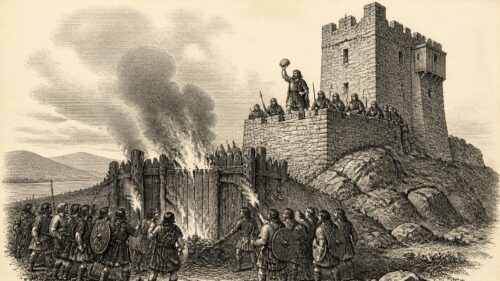
The year’s central northern episode was the building of Bundrowes Castle by Brian Ó Conchobair, son of Domnall. The annals explicitly place its construction in 1420. Bundrowes stood by the River Drowes, close to the approaches to Ballyshannon and Assaroe, where routes between north-west Connacht and Tír Chonaill converged. A castle here was not merely a residence. It was a declaration that its builder intended to command a strategically valuable corridor: roads, river traffic, neighbouring pasture and access towards the sea.
The reaction demonstrates why the work mattered. The Annals of Ulster say that a host of the province came to prevent construction, while Annála Connacht calls it the whole army of Ulster. Yet this formidable force did not cross westward over the Urscathach watercourse. That hesitation allowed Brian’s work to continue. It is a useful corrective to any picture of late medieval warfare as a simple contest of large armies: terrain, crossings, supply and the willingness to risk an attack all mattered. The ability to assemble men did not guarantee an advance.
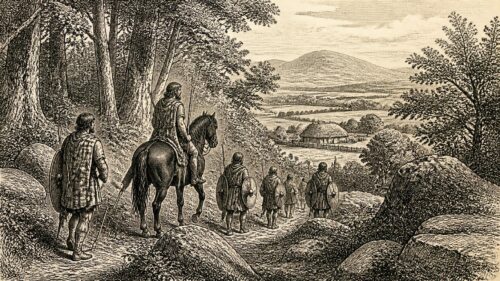
The castle’s construction was immediately followed by mobile fighting. A large force of Cenél Conaill lay around Assaroe Bay, while Niall Garbh, Domnall and Nechtain, sons of Ó Domhnaill, entered Magh Éne with cavalry. Brian Ó Conchobair’s sons sent a mounted scouting party towards Ballyshannon. There it was overtaken and defeated. Seoan, Brian’s son, was killed, as were Aodh Buí Mac Donnchadha, Cathal Ó Conchobair and Aodh Ó Dubhda. These named deaths matter because they reveal that a reconnaissance was not an inconsequential skirmish: such encounters could remove kinsmen and retainers on whom a lord’s authority rested.
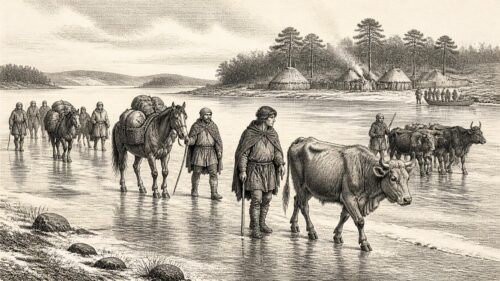
Five nights later, the conflict turned again. Eoghan, son of Domnall, and Toirdelbach Carrach led horsemen beyond the falls at Assaroe in a night attack against the Ó Domhnaill party at the harbour. Domnall Ó Domhnaill, described by Annála Connacht as a prince of standing within Cenél Conaill, was killed. His brother Niall escaped by swimming into the harbour and boarding a trading ship lying there. The annal gives no nationality, cargo or destination for the vessel, and none should be invented. Its presence is nevertheless unusually revealing. Assaroe’s military geography was also commercial geography: a harbour able to shelter merchant shipping could, in an emergency, offer an escape route to a defeated lord.
The episode was not a final settlement. It instead shows the fragility of power around the Drowes. Brian’s new castle stood, but he had lost a son; the Ó Domhnaill kindred had lost Domnall; and a ship in harbour had briefly altered the fate of Niall Garbh. Fortification, cavalry raids and maritime traffic were all active parts of the same borderland contest.
Violence, Protection and Settlement
Elsewhere, 1420 brought killings whose immediate cause lay inside lordly kindreds. At the beginning of spring, Cathal Mac Flannchaidh, chief of Dartry, was treacherously killed in his own house by kinsmen named Tadhg, Muiris and Enri. Aodh Buí Mac Flannchaidh was killed at the same time. The annal’s language stresses betrayal, but it does not provide enough evidence to reconstruct a full succession dispute. What can responsibly be said is that political insecurity reached into domestic space: the house of a chief did not ensure safety where rival relatives were prepared to act.
Another Connacht dispute demonstrates how violence and negotiation could be intertwined. The descendants of Seán Ó hEaghra raided the eastern branch of the family alongside the sons of Mac Muiris na mBrig, taking cattle and killing people. Eoghan Ó Conchobair, who was protector of his son-in-law Seán Buí Ó hEaghra, pursued them. He first demanded the return of the prey under the obligations of friendship and safeguard. Only after refusal did battle follow. The raiders were defeated; Uilliam Mac Muiris was captured, while several prominent men were slain.
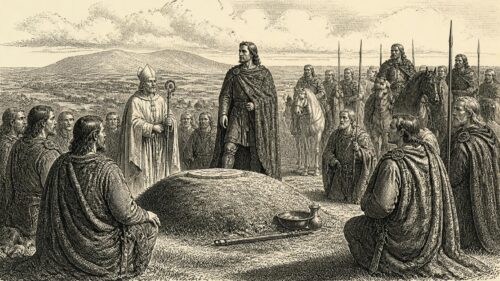
Yet the aftermath was not an unbroken cycle of revenge. Mac Muiris was taken to Sligo, and Seán Buí was escorted under successive protections: first by Eoghan Ó Conchobair, then by Ó Ruairc, then by Mac Diarmata, whose drovers conveyed him to Mac William Burke. Peace was made between the Ó hEaghra groups, and Mac Muiris was released without ransom in the company of Brian Ó Conchobair. This careful chain of escorts exposes a political culture in which personal guarantees, hospitality and kinship could restrain conflict. Protection was not abstract principle; it was exercised through people, journeys and the reputations of lords.
Captivity likewise remained a negotiable political instrument. Cathal Ó Conchobair and Donnchadh Ó Ceallaigh, prisoners since earlier battles, were released in exchange for one another. The Annals of Ulster additionally records a wider mutual liberation involving Cathal Ó Conchobair, an Ó Ceallaigh prisoner and another Ó Conchobair held by Mac William of Clanricarde. Hostages and captives could be vital bargaining assets, but 1420 shows them returning home through reciprocal arrangements rather than simple payment alone.
Granard and Dublin Authority
On Ireland’s eastern midland frontier, Granard Castle in Cairbre Gabra was taken from Uilliam Ó Fearghail by forces the annalist calls the Galls, a term commonly used for English or Anglo-Irish people. Their occupation was brief: they abandoned the castle, after which Ó Fearghail demolished it to prevent a renewed seizure. The entry records a hard-headed defensive decision rather than a spectacular victory. A damaged or removed stronghold might be preferable to leaving an enemy a ready-made base. Granard’s long-established motte-and-castle landscape made it a significant point in the contested zone between Gaelic lordship and the lordship’s eastern institutions.
Dublin offers a contrasting register of power. On 28 April, Stephen Taylor and Richard Bone were appointed collectors of royal customs in the port. Their commission expressly covered leather, hides, wool, lead and other merchandise liable to duty. It is a compact but important indication of the commodities through which the Crown sought revenue and of the continued commercial importance of Dublin’s harbour. The record does not permit a calculation of trade volume, but it does show routine fiscal administration operating while warfare reshaped other regions.
Royal justice and finance were also being serviced. On 13 July, an order sought payment of substantial arrears to Stephen Bray, chief justice of pleas before the King in Ireland. Twelve days later, Hugh Bavent was appointed treasurer of Ireland and sworn in before the lieutenant and council on 26 July. James Butler, fourth earl of Ormond, attested both records as lieutenant. These documents should not be mistaken for evidence that Dublin government controlled the whole island. Rather, they show an administration able to appoint officers, audit arrears and collect customs within the areas where its authority and records functioned.
Church, Death and Everyday Fear
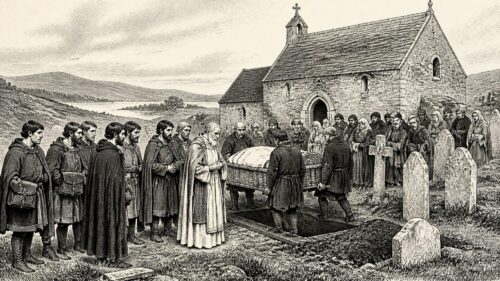
Religion appears in 1420 not as a separate sphere but as part of social order, memory and practical life. Eoghan, son of Ruaidhrí Ó Conchobair, died on Wednesday 28 February and was buried at Clonmacnoise, an important ecclesiastical centre on the Shannon. Mór, daughter of Ó Duirnín and wife of Tomaltach Ó Birn, died on 15 May. Geoffrey Ó Daimhín died on 19 June and was buried beside the altar at the monastery of Lisgoole; Master Matthew Ó Bánáin, parson and erenagh of Derrybrusk, died on 8 September. Such notices preserve both elite genealogy and the standing of hereditary church officers who managed ecclesiastical lands and obligations.
The annals also report a grim episode at Michaelmas. Magnus and Domnall, sons of Fedlimid of Athenry, went to a church at a place called Odelb to recover armour stored there. They were attacked; Domnall entered the church and was burned inside, while Magnus was subsequently killed. The account is brief and offers no basis for deciding whether the church itself was deliberately targeted or simply became a fatal refuge. It does, however, show a sacred building entangled in worldly conflict and used to store valuable military equipment.
For ordinary people, the most alarming annual notice is also the shortest: Annála Connacht states that wolves killed many people in 1420. It provides neither places nor numbers, so the scale cannot be measured and the victims cannot be identified. The entry should be treated as an annalist’s stark record, not expanded into an imagined nationwide catastrophe. Even so, it preserves a rare glimpse of environmental danger alongside human warfare. In a year remembered for castles, raids and prisoners, wild animals also entered the historical record as a source of lethal insecurity.
Thus 1420 was not defined by one all-Ireland event. Its surviving evidence instead follows several connected worlds: Ó Conchobair expansion at Bundrowes; the perilous politics of Tír Chonaill and Connacht; the tactical destruction of a castle at Granard; the collection of customs and appointment of officers in Dublin; and churches that remained places of burial, administration, refuge and, sometimes, danger. The trading ship at Assaroe and the customs officers at Dublin together suggest a further truth: amid conflict, Ireland’s coasts and ports continued to connect local struggles to wider routes of movement and exchange.
Primary Sources
- The Annals of Ulster: Year U1420
- CELT Project: The Annals of Ulster
- Annála Connacht: Annal 1420
- CELT Project: Annála Connacht
- Annals of the Four Masters, Volume 4 (AD 1373–1500)
- Annals of the Four Masters: Text and Editorial Information
- Irish Script on Screen: MS A 13, Annals of the Four Masters
- Irish Script on Screen: MS 23 P 6, Annals of the Four Masters
- Patent Roll 8 Henry V (1420–1421), Item 32
- Patent Roll 8 Henry V (1420–1421), Item 43
- Close Roll 8 Henry V (1420–1421), Item 6
- The Annals of Ulster: Year U1419
- Note 98 for The Irish Charters in the Book of Kells
- County Longford Urban Archaeology Survey
- Appendix 13.5: National Monument Descriptions
- Archaeological Features of County Longford
- Historical Features of County Longford
- Exploring the Irish Annals
- The Resurgence of Gaelic Power in Ireland and Scotland and its Wider Impact, c.1350–1513
- Medieval Ireland, Clare Downham