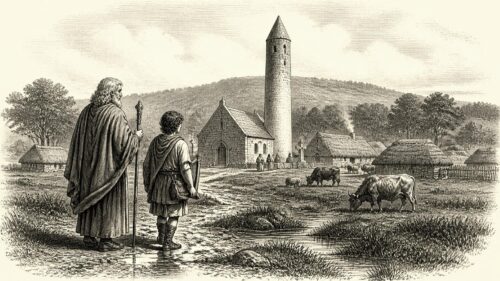
Baile-Locha-Deacair Reckoning1356 CE
In 1356, Áed son of Toirrdelbach Ó Conchobair was killed at Baile Locha Deacair after allegedly abducting Donnchad Carrach Ó Cellaig’s wife, prompting allied retaliation by Ó Cellaig, Clann an Bhaird and Uí Maine. Áed son of Feidlim claimed full kingship of contested Connacht amid further dynastic deaths. Killings and successions elsewhere, including Tír Chonaill, reflected fragmented lordship. In Dublin, Justiciar Maurice fitz Thomas FitzGerald died, and Gearoidín Tyrrell was publicly executed. The deaths of Armagh’s primate, Clogher’s bishop and relic-keeper Solam Ó Melláin marked ecclesiastical losses. Sources document political violence but cannot establish precise circumstances or wider economic conditions.

Dateline
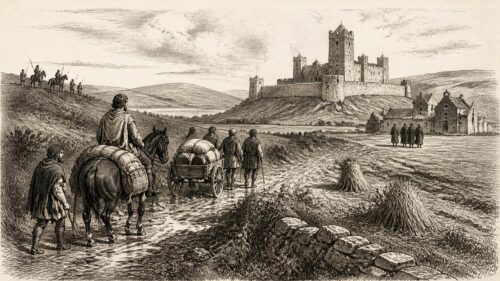
In Connacht, 1356 brought a sudden and violent change at the summit of regional politics. Áed, son of Toirrdelbach Ó Conchobair, was killed at Baile Locha Deacair, named in the annals as Balloughdacker. The killing was not represented as the outcome of a set-piece battle between great armies. Rather, it emerged from a personal grievance with major political consequences: Áed was said to have carried off the wife of Donnchad Carrach Ó Cellaig, a daughter of Seoinín Burke. Donnchad, the Clann an Bhaird and the Uí Maine acted together against him. Afterwards, Áed son of Feidlim Ó Conchobair took what the Annals of Connacht calls the “full kingship” of Connacht.
A King Killed in Connacht
The annal gives no day or month for Áed’s death, and Baile Locha Deacair cannot safely be treated as the scene of a precisely reconstructable engagement. Yet the report is unusually revealing. It names the killers, their Uí Maine backing, and the grievance that prompted the attack. In a society where marriage forged alliances, determined inheritances and linked ruling kindreds, the seizure of a noblewoman could become much more than a domestic offence. It touched the standing of her husband, her natal family and their allies. The language of the source also cautions against easy assumptions: it records an abduction or elopement, but does not allow the modern reader to recover the woman’s wishes or experience.
Áed’s fall mattered because Connacht was not a settled kingdom under a single uncontested dynasty. The Ó Conchobairs supplied its kings, but different branches of that family competed for authority, while the Burkes, Mac Diarmatas, Ó Kellys and many other lordly lineages commanded their own territories, clients and fighting men. The restoration of Áed son of Toirrdelbach to power in 1352 had already shown that a claimant might regain the “government” of Connacht despite opposition from both Irish and English-descended rivals. His death in 1356 therefore reopened, rather than resolved, a wider contest over who could speak for the province.
The accession of Áed son of Feidlim should not be imagined as a modern transfer of office. “Full kingship” expressed a claim to superiority over Connacht, sustained through submission, alliances, tribute and the capacity to reward followers. It was a political fact that had to be made good in practice. The same year’s obituary notices underline the vulnerability of competing branches. Toirrdelbach, son of Áed Brefnech Ó Conchobair, was killed by Clann Donnchada; Domnall, another son of Áed Brefnech, died; and Ruaidrí, son of Áed Ó Conchobair, also died. These were not interchangeable names in a chronicle. They were men belonging to the dynastic networks from which rival claimants and their supporters could be drawn.
Alliance, Feud and Local Power
The killing at Baile Locha Deacair was followed by another death within the Ó Kelly kindred: Conchobar, son of Tadc Ó Cellaig, was killed by Tadc son of Diarmait Ó Cellaig. This does not prove that every death formed one continuous feud, but it shows how little separation there was between provincial politics and disputes within powerful families. The Uí Maine, whose lordship lay east of the Shannon in what is now south Galway and east Roscommon, were important neighbours of the Connacht kings. Their support for retaliation against Áed demonstrates that a king’s conduct towards allied houses could alter the balance of the whole province.
Nor was violence confined to Connacht. In the south-west, Diarmait Mac Carthaig and his son were killed by Uí Shúilleabháin. In Thomond, Donnchad Mac Conmara, described in the annals as an outstanding son of a chieftain, was killed by the Ó Briains. In the north, Muirchertach, son of Seoan Ó Néill, was killed by Pilip Mag Uidir. Such terse notices do not provide campaign narratives, troop numbers or a map of frontiers. They do, however, register a political landscape in which lordship was continually defended and renegotiated through kinship, fostered loyalties, cattle and land claims, hostage-taking, raiding, arbitration and armed retaliation.
One further succession is recorded by the Annals of the Four Masters: Felim, lord of Tír Chonaill, was killed by John, son of Conchobar Ó Domhnaill, who then assumed the lordship without opposition. This is valuable evidence, but it needs careful handling. The Four Masters were compiled in the seventeenth century from earlier materials, whereas the surviving annalistic traditions do not always agree in chronology or detail. It is responsible to say that the source places the killing and succession in 1356; it is not responsible to supply an exact date, battlefield or motive which it does not preserve.
Dublin’s Fragile Government
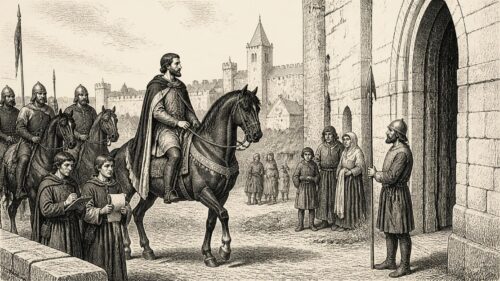
Events in the English lordship of Ireland added another layer of uncertainty. Maurice fitz Thomas FitzGerald, first earl of Desmond and justiciar of Ireland, died in Dublin Castle on 25 January 1356. He had held the justiciarship only since the previous summer. The office made him the king of England’s chief governor in Ireland, responsible for administration, justice and defence, but the justiciar’s reach was uneven. Crown power was strongest in and around the towns, lordships and marcher districts under Anglo-Irish control; it depended elsewhere upon negotiation with magnates whose interests did not necessarily coincide with those of Dublin or Westminster.
Maurice’s death was especially consequential because he was no mere official sent from England. He was a great Munster lord whose career had included rebellion, imprisonment, rehabilitation and renewed royal favour. His appointment had tied a formidable regional magnate to the king’s government. The Annals of Connacht notes that the justiciar of Dublin died in this year; read beside administrative and biographical evidence, this is best understood as a reference to Desmond. Maurice fitz Thomas, earl of Kildare, acted as justiciar for much of the remainder of 1356, illustrating the reliance of the Dublin administration on great local lords.
Another Dublin notice was grimmer. Gearoidín Tyrrell was executed on the green of Dublin by the king of England’s people. The annals use the severe language of being “drawn”, while the Four Masters simply state that he was put to death. The charge, legal process and exact date are not supplied. What can be said is that execution in such a public setting displayed royal jurisdiction before an urban audience. It was a reminder that the lordship possessed courts and coercive authority, even while its governors faced a fragmented political world beyond the city.
Church Offices and Learned Custodians
Church life also experienced important losses. Farrell Mac Rannall, primate of Armagh and “representative of St Patrick” in the language of the Four Masters, died during the year. The phrase was not ornamental. It expressed Armagh’s claim to primacy through Patrick, and situated its archbishop within a sacred as well as administrative hierarchy. Nicholas Mac Cathasaigh, bishop of Clogher since 1320, likewise died in 1356. His passing ended a long episcopate in a diocese extending across a politically complex borderland of modern Tyrone, Fermanagh, Monaghan, Donegal, Cavan and Louth.
Most evocative is the death of Solam Ó Melláin, keeper of the Bell of the Testament and, according to the annalist, general guardian of Ireland’s learned people. The Bell of the Testament was a revered Patrician relic associated with ecclesiastical authority and oaths. Its custody was not simply devotional. Hereditary keepers of such relics could occupy honoured positions in religious, legal and social life, while learned families depended on patronage from churches and lords. The annalist’s praise of Ó Melláin therefore offers a rare glimpse of the institutions that upheld scholarship, memory and sacred prestige beyond royal courts and battlefields.
What the Year Does Not Tell Us
The evidence for 1356 is rich in deaths, killings and successions, but poor in information about harvests, prices, weather, shipping, building or ordinary household routines. No securely dated Irish record consulted for this year permits a confident claim of famine, plague, a major environmental disaster or a nationwide economic shift. That silence matters. Warfare undoubtedly imposed burdens on tenants, dependants and religious communities, but the annals do not allow those burdens to be measured for this calendar year.
What 1356 does reveal is the human scale of power. A Connacht king could be brought down through an alliance formed around a dynastic wrong; a new claimant could proclaim full kingship immediately afterwards; a lord of Tír Chonaill could be replaced within his own family; and the king of England’s justiciar could die in Dublin while royal officers staged punishment in public. Meanwhile, the deaths of bishops, a primate and a relic-keeper show that political change unfolded alongside the continued work of ecclesiastical and learned institutions. In Ireland, authority was plural, local and intensely personal—and in 1356 it proved dangerously contingent.
Primary Sources
- Annála Connacht: Annal 1356
- Annals of the Four Masters: Annals M1352–M1360
- The Annals of Ulster
- Annala Uladh: Annals of Ulster otherwise Annala Senait, Annals of Senat
- Annála Connacht
- CELT Project: Annals of the Four Masters
- Annals of the Kingdom of Ireland: Library Catalogue Record
- FitzGerald, Maurice fitz Thomas
- FitzGerald, Maurice fitz Thomas, 4th Earl of Kildare
- St Paul, John of
- FitzGerald, Gerald fitz Maurice (‘Gearóid Iarla’)
- Bishops of Clogher
- The Relic Cult of St Patrick between the Seventh and Twelfth Centuries
- The Administration of Ireland 1172–1377
- Patentee Officers in Ireland 1173–1826, including High Sheriffs, 1661–1684 and 1761–1816
- Calendar of Ormond Deeds, Volume II, 1350–1413
- Inquisitions and Extents of Medieval Ireland
- The English Government of Ireland in the Fourteenth Century
- Dictionary of National Biography: Rokeby, Thomas de
- Dictionary of National Biography: Fitzgerald, Maurice