Cluain Immorrais and Carnfree1406 CE
In 1406, Ireland’s fragmented political order was shaped by disease, warfare, ritual and succession. Plague killed several Leinster men eligible for lordship, potentially affecting dynastic calculations. In Offaly, Murchadh Ó Conchobhair Fáilghe defeated a mixed Meath, Connacht and mercenary force at Cluain Immorrais, inflicting heavy losses and capturing the prestigious Buacach Phádraig relic. In Connacht, Toirdhealbhach Óg Ó Conchobhair Donn, joint king for twenty-two years, was killed by rivals and Burke allies, prompting Cathal Ó Conchobhair Donn’s inauguration at Carnfree around year’s end. Dublin retained limited military and civic capacity, while elite deaths and monastic burials underscored lordship’s religious networks.
Dateline
Ireland in 1406 was not governed from any single centre. The English crown’s effective authority was concentrated around Dublin and in lordships linked to the colony, while Gaelic dynasties and increasingly Gaelicised families exercised power across much of the island. The year’s surviving notices are consequently regional and uneven. Yet they give an unusually vivid view of political life: plague took members of leading Leinster lineages; an armed encounter in Offaly exposed the unstable connections between Meath, Connacht and the midlands; and the killing of a co-ruler of Connacht opened a fierce contest for provincial kingship. These were not disconnected episodes. They show authority being maintained through kinship, mounted followings, mercenary service, religious prestige and the possession of places.
A Plague Noted in Leinster
The Annals of Connacht, echoed closely by the Annals of Loch Cé, records that four men died of plague during the year: Laigsech Ó Nualláin, an eligible prince of Forth; Aodh Ó Tuathail, eligible prince of the Uí Máel; Bran Ó Broin, eligible prince of the Uí Fháeláin; and Domnall, son of Tomás Mac Murchadha. Their territories lay in or beside the politically divided lands of Leinster. The notice is important precisely because it is brief. It establishes an outbreak serious enough to be remembered among dynastic deaths, but it neither identifies the disease in modern medical terms nor supplies numbers, duration or particular local effects. It would be unsafe to turn this into a claim for an island-wide epidemic, or to assume that it was a recurrence of the mid-fourteenth-century Black Death.
Still, the loss of several men described as eligible for lordship mattered. In Gaelic political language, eligibility denoted membership of the ruling kindred from whom a successor might be chosen. Death by disease could therefore alter calculations of alliance and succession even where no battle followed. The annals preserve the names of aristocrats, not those of households, tenants or labourers who may also have suffered. For everyday people, the record is silent; it can only be said that 1406 brought disease into regions already shaped by military exactions and fractured lordship.
Offaly’s Victory at Cluain Immorrais
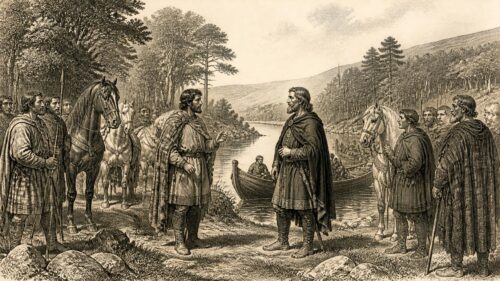
The most fully narrated event of the year occurred in Uí Fhailghe, broadly central Offaly. On Saturday, 10 July, according to the dating supplied by the Connacht annalist, Murchadh Ó Conchobhair Fáilghe, king of Offaly, defeated an opposing force described as the Foreigners of Meath, Eoghan son of the abbot Ó Conchobhair, and hired fighting men from Connacht. Murchadh’s force included his sons and household. With him were Cathal Dubh and Tadhg, sons of the king of Connacht, who had come to Offaly on a visit with a small mounted party. Their presence demonstrates that a visit between ruling families could swiftly become a military alliance.
The encounter was not a simple contest between supposedly separate ‘Irish’ and ‘English’ worlds. The attacking party joined Meath settlers or lords, a member of an Ó Conchobhair ecclesiastical family, and Connacht mercenaries; the victors included the Offaly dynasty and princes from Connacht. Terms such as Gall, translated as ‘Foreigner’, are politically useful in the annals but do not describe a neat ethnic frontier. Late medieval Irish warfare moved through overlapping lordships, clientages and paid service. The reference to retained kerns is especially revealing: armed manpower could be maintained for a lord’s purposes, rather than assembled solely from his immediate kindred.
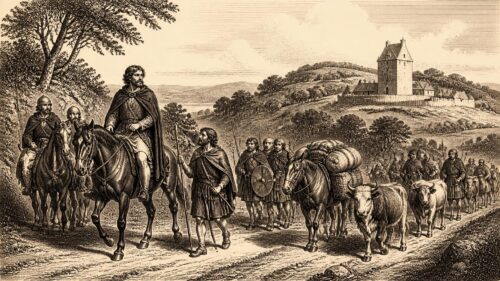
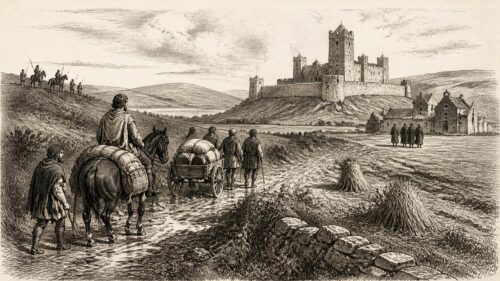
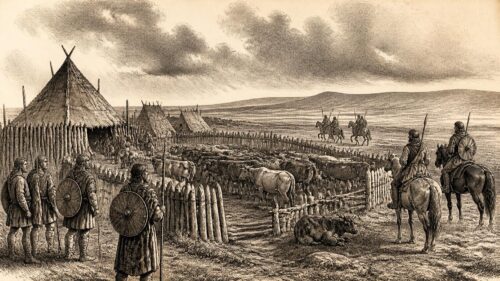
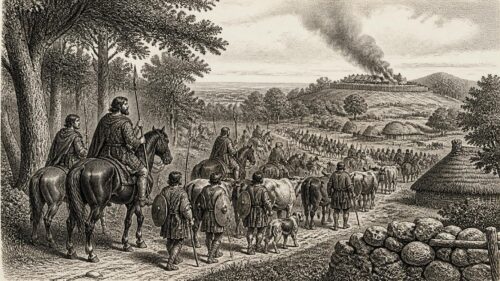
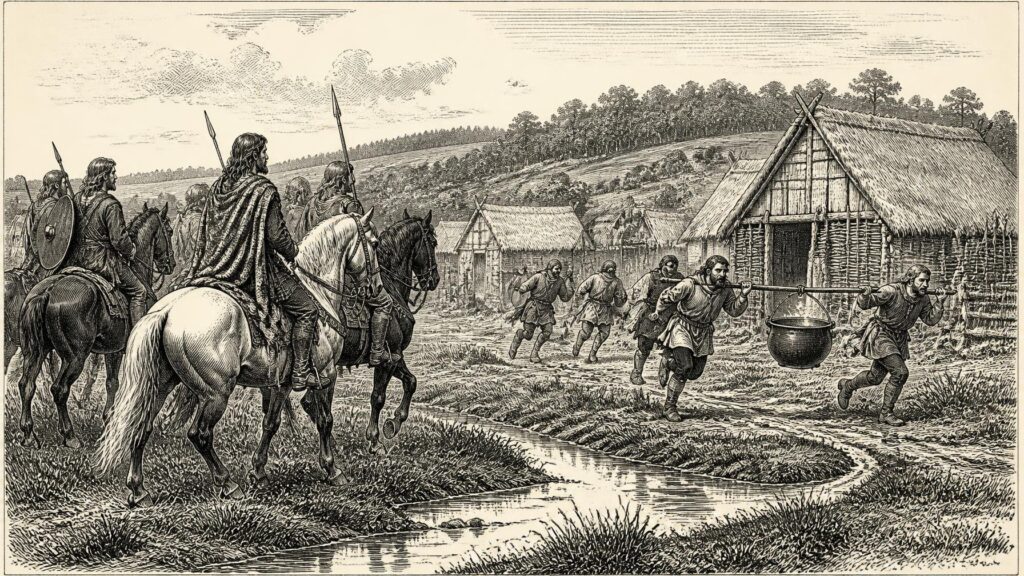
Both armies entered Upper Geashill. Eoghan and his force then went to Cluain Immorrais, to the settlement of Gilla Buide Mac Maoil Chorra, apparently to gather booty. The annalist preserves a memorable detail. Calbhach, Murchadh’s son, arrived with Cathal Dubh and only six horsemen. Gilla Buide recognised Calbhach’s brewing cauldron among the raiders’ baggage and called attention to it; a stone struck the vessel, creating a noise that, the account says, panicked the plunderers. The story is too shaped by anecdote to be treated as a tactical report, but it captures the material texture of a raid: household goods, beer-making equipment, livestock and movable property were prizes and burdens.
The pursuit that followed was lethal. The annalist states that Eoghan was killed north of the settlement and that no fewer than 300 people died between Cluain Immorrais and Cloonany in Críoch na gCéadach. Such figures in medieval narrative cannot be independently checked and may magnify victory, but there is no reason to doubt that the defeat was severe. The same account says that the victors seized the Buacach Phádraig, a relic formerly kept at Elphin and called the chief relic of Connacht. Its capture joined war to religion: a sacred object could be a focus of local prestige, a valuable possession and a public sign that its former protectors had been humbled.
Connacht’s Co-King Killed
Violence within Connacht itself proved still more consequential. Toirdhealbhach Óg Ó Conchobhair Donn had ruled for twenty-two years in joint sovereignty with Ó Conchobhair Ruadh. On Thursday, 9 December, the Annals of Connacht places his killing at Cregan near Fidicen in Clann Chonmhaigh. He was at the house of Richard, son of Seán Buidhe Burke, when Cathal Dubh, son of Ó Conchobhair Ruadh, attacked with Seán, son of Edmund Burke, and Diarmait Ó Tanaíde. The Annals of Ulster independently records the killing under 1406, calling Toirdhealbhach a joint king of Connacht and dating it a fortnight before Christmas.
The killing was not the work of one dynasty alone. Cathal Dubh belonged to the rival Ó Conchobhair Ruadh line, while the Burke participants came from a family of Hiberno-Norman descent long embedded in Connacht politics. The annalist adds that Toirdhealbhach killed Seán Burke with a single sword-stroke at the same place. Whatever the immediate provocation, the episode shows how a ruler’s security depended on the reliability of hosts, kinsmen and allies. The annalist also remembered Toirdhealbhach as the third king of Connacht killed in Clann Chonmhaigh, treating the landscape as a place marked by repeated dynastic violence.
Succession followed quickly, but its exact chronology requires care. Modern scholarly reference work places the installation at Carnfree in 1406 of Cathal, son of Ruaidhrí Ó Conchobhair Donn, as king of Connacht, with Brian Ó Conchobhair of Carbury acting as inaugurator. The Annals of the Four Masters, however, enters the inauguration in its annal for 1407 and refers to it as having occurred on an earlier occasion. The safest conclusion is that Toirdhealbhach’s death in December 1406 triggered Cathal’s elevation at or around the turn of the year; it should not be represented as a securely dated December ceremony. Carnfree, near Tulsk, was more than a meeting place: inauguration there asserted a claimant’s right to provincial rule through ritual as well as force.
Dublin, Lordship and Limited Reach
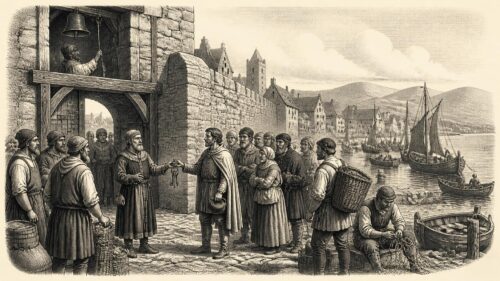
Within the English lordship, Gerald FitzGerald, fifth earl of Kildare, served as justiciar until the autumn of 1406, when Stephen Scrope replaced him. His replacement points to the continuing importance of office, council and royal appointment, but it does not imply a government capable of directing events across Ireland. A later Dublin civic annal reports that on Corpus Christi the city’s citizens marched out with nearby country people, routed an unnamed Irish force, captured two standards and displayed the heads of the slain on the city gates. The notice makes clear that Dublin could mobilise armed townsmen and cultivate public ritual around victory. It does not identify the enemy or location, so the episode cannot responsibly be tied to any named Leinster lord.
Some nineteenth-century histories assign to 1406 a campaign by Art Mac Murchadha in which Wexford castles were taken. The contemporary annals consulted for this year do not provide an equivalent, securely dated narrative. Art was undoubtedly the dominant Gaelic ruler in much of Leinster during this period, and conflict between his following and the colonial communities was a persistent condition; nevertheless, the particular sequence of captures should remain a later attribution rather than a firm event of 1406.
Death, Burial and What the Record Cannot Say
Other notices place the year within networks of lordship and religion. Máel Ruanaid Mac Donnchadha, king of Tír Oilealla, died at home after receiving unction and penance and was buried at Boyle monastery. Tadhg Ó Beirn, chief of Tír Briuín na Sinna, died on the Wednesday before St Martin’s feast, 10 November. The language of a ‘good death’ and monastic burial reflects ideals of penitence and commemoration, while also showing monasteries as burial places for secular elites. Yet 1406 offers no dependable evidence for a general harvest, price, trade or environmental trend. Its surviving sources instead illuminate a year in which disease, raiding, sacred objects and violent succession gave local events wider political weight.
Primary Sources
- Annála Connacht, Annal 1406
- Annals of Loch Cé, Annal LC1406
- The Annals of Ulster
- Annals of the Four Masters, Volume 4
- Annals of Dublin from 1173 to 1500
- FitzGerald, Gerald fitz Maurice
- O'Connor Don (Ó Conchobhair Donn), Toirdhealbhach Óg
- O'Connor (Ó Conchobhair), Domhnall
- MacMurrough Kavanagh (Mac Murchadha Caomhánach), Art Mór
- Patent Roll 7 Henry IV (1405–1406), Item 133
- Extracts from Memoranda Rolls of Exchequer and Patent and Close Rolls of Chancery of Ireland, 1280 to 1461
- The Medieval Irish Chancery
- A Medieval Irish Roll with Hidden Grievances
- Exploring the Irish Annals
- How to Use the Gallowglass Database
- Annals of Clonmacnoise, Being Annals of Ireland from the Earliest Period to A.D. 1408
- Some Earthworks in Co. Wexford
- Art MacMurrough (2), Story of Ireland
- Art MacMurrough, Irish Biography
- The Annals of Loch Cé: A Chronicle of Irish Affairs from A.D. 1014 to A.D. 1590