Anealoen’s Heavenly Leaf887 CE
In 887, annalistic records describe a Connacht victory over the foreigners of Limerick, though details and dating remain uncertain. The defeat may have destroyed an early Shannon longphort, disrupting Scandinavian power without ending it. Notices also record the pilgrim Anealoen bringing the Law of Sunday and a divinely authorised leaf, alongside reforms concerning hair and tonsure. Deaths of abbots demonstrate monastic influence, while the obituary of Máel Mura of Othain marks the loss of Ireland’s chief poet-historian. Together these sparse entries reveal a society shaped by warfare, religious reform, learning, and interconnected political, ecclesiastical, and maritime worlds across the island.
Dateline
A Year of Sparse but Significant Notices
The surviving record for 887 CE is brief, but it brings together unusually revealing threads: a blow against the foreigners of Limerick, the arrival of a pilgrim bearing a stringent religious message, the deaths of important churchmen, and the passing of Ireland’s foremost poet-historian. These were not necessarily parts of one connected sequence. The annals preserve them as separate notices, usually without dates, places or explanations. Yet together they show an Ireland in which warfare, monastic authority, learning and the movement of people across the Irish Sea remained closely intertwined.
Caution is especially necessary with this year. Chronicon Scotorum and the Annals of Inisfallen place the pilgrim’s arrival in 887, while Chronicon Scotorum also dates a Connacht victory over the foreigners of Limerick to that year. The Annals of Ulster preserve related material beneath their annal 887, but their internal chronological notation points to 886. The much later Annals of the Four Masters assign further events to 887, including attacks on Kildare and Clonard. They are valuable witnesses to lost material, but their dating cannot automatically be treated as contemporary precision. For 887, the safest approach is to distinguish securely annalised notices from broader context and later chronological traditions.
The Connachtmen and Limerick
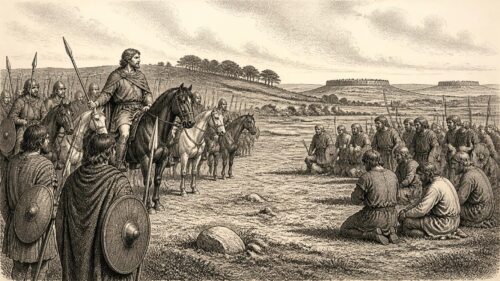
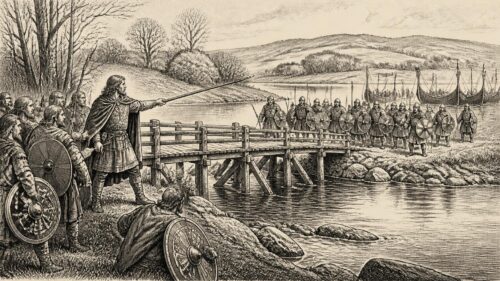
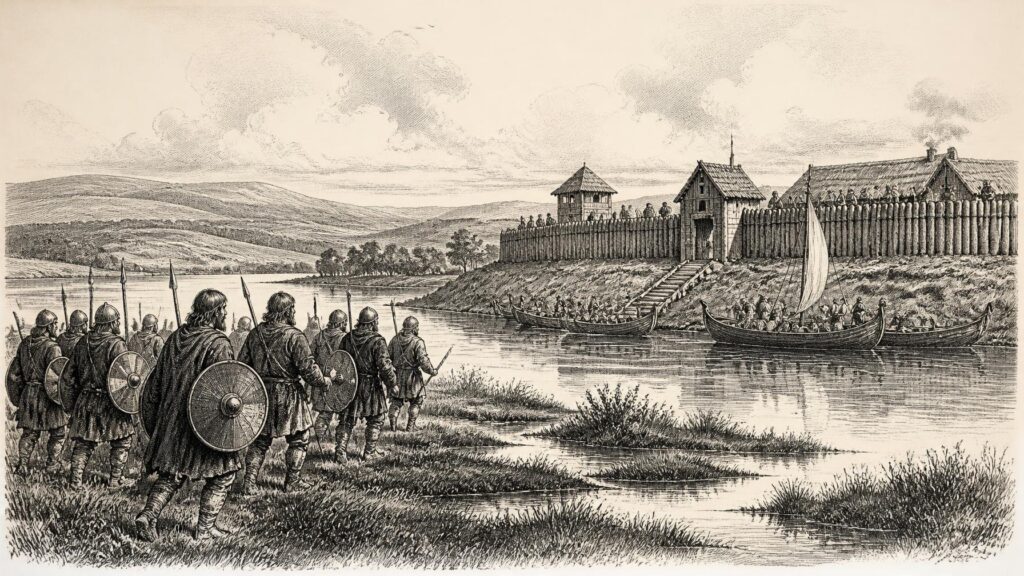
The most consequential military entry is terse: Chronicon Scotorum records “a slaughter of the foreigners of Limerick at the hands of the Connachta”. It names neither a battlefield nor a leader, gives no numbers, and says nothing explicit about the fate of Limerick itself. It would therefore be wrong to turn the notice into a detailed campaign or to claim an exact date within the year. What can be said is that a Scandinavian-associated force based in, or identified with, Limerick suffered a serious defeat at the hands of men from Connacht.
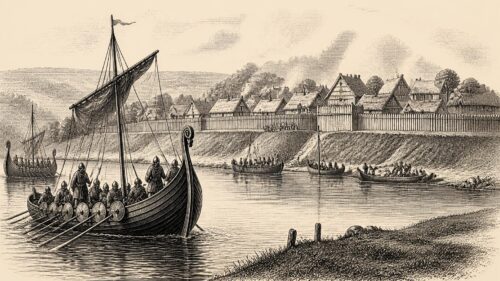
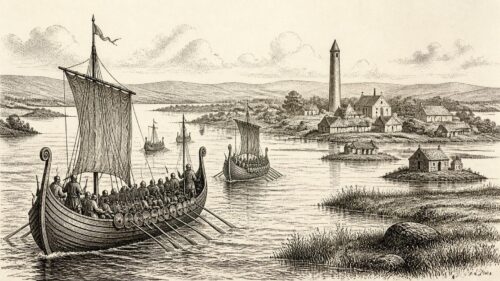
This was important because the lower Shannon had long been a strategic corridor. Viking forces had operated on the Shannon since the middle decades of the ninth century, using its waters to penetrate the interior and to threaten ecclesiastical and royal centres. Modern historical and archaeological work identifies a longphort, or defended ship-camp, near Athlunkard above the later medieval city of Limerick. The Royal Irish Academy’s historical atlas interprets the Connacht success recorded for 887 as the destruction of that early Limerick base. That conclusion is persuasive but remains an interpretation of the very compressed annalistic notice, rather than a detail supplied by the annalist.
The episode should not be imagined as a simple contest between an Irish population and wholly external raiders. By 887, Scandinavian groups in Ireland were embedded in regional politics, coastal exchange and warfare. Earlier annals show Irish rulers making alliances with foreign forces as readily as fighting them. A longphort could support ships, crews, craftworkers and traders as well as armed expeditions. Its destruction, if that is indeed what followed the Connacht attack, would have disrupted a local centre of power and movement on the Shannon; it did not end Scandinavian activity in Ireland.
Flann Sinna’s Uneven Authority
Flann Sinna of Clann Cholmáin was king of Tara in 887, exercising the most prestigious kingship available to an Irish ruler. His authority, however, rested on tribute, hostages, alliances and repeated displays of force rather than on a modern territorial state. The political map remained a patchwork of overkingdoms, lesser dynasties, church territories and foreign-controlled settlements. Connacht’s independent action against the Limerick foreigners is a useful reminder that a victory in the west need not have been directed by Tara.
The annals do not credit Flann with a role in the Connacht attack, and there is no reason to invent one. A later compilation calls 887 his eleventh regnal year and says that he celebrated the fair of Tailtiu, the great assembly traditionally held near Teltown in Mide. The fair was a powerful royal institution, joining commerce, legal business, games, proclamation and political theatre. But Máel Mura’s surviving poetry is associated with Flann’s Tailtiu celebration in 885, and the dating of the later notice is uncertain. Tailtiu belongs to the political setting of Flann’s reign; its celebration in the calendar year 887 cannot be stated with the same confidence as the entries in Chronicon Scotorum.
Likewise, the Annals of the Four Masters attribute a killing of Osraige men by the Déisi to 887, naming Braenán, son of Cerball of Osraige, among the dead. Cerball was a formidable regional ruler whose kingdom lay in the Nore valley between Munster and Leinster. Since the notice lacks early independent confirmation in that exact year, it is best treated as a later annalistic assignment, not as the central, firmly dated event of 887.
The Pilgrim’s Sunday Law
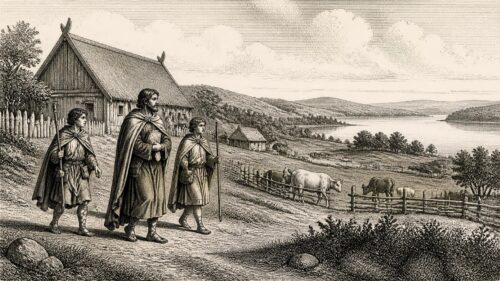
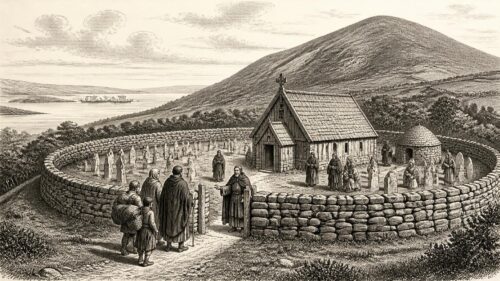
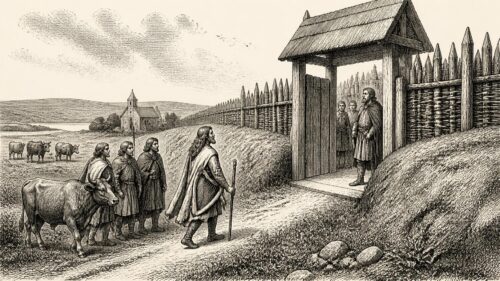
The year’s most striking religious notice concerns a pilgrim. Chronicon Scotorum says that a pilgrim arrived in Ireland with the Cáin Domnaig, or Law of Sunday, other good teachings, and a leaf “given from heaven”. The Annals of Inisfallen supplies the pilgrim’s name, Anealoen, and adds that the wearing of long hair was abolished and tonsures were accepted. These accounts plainly present the visitor and his document as bearers of religious authority, but their language is shaped by wonder and exhortation. The heavenly leaf need not be understood as a literal report; it signals the sacred legitimacy claimed for the teaching.
The Law of Sunday belonged to a wider Christian tradition that treated Sunday observance as a matter not merely of devotion but of social discipline. Irish versions and legal treatments laid down restrictions on work and travel, while prescribing penalties and exceptions. The arrival recorded in 887 may represent the transmission, renewed promotion or enforcement of such teaching rather than its first appearance in Ireland. The annals do not tell us where Anealoen came from, which community received him first, or whether every cleric and lay household accepted his programme.
The reference to hair and tonsure is equally revealing but should not be overstated. Tonsure marked clerical identity, discipline and communal affiliation. The Inisfallen notice demonstrates that outward religious practice could still be framed as a matter requiring correction or public acceptance. It does not prove that Ireland had lacked tonsured clergy until 887, nor does it permit a detailed reconstruction of the rite that Anealoen advocated. What it does show is that reforming teachers, pilgrimage and written religious authority could become matters worthy of national annalistic record.
Monasteries, Memory and Learning
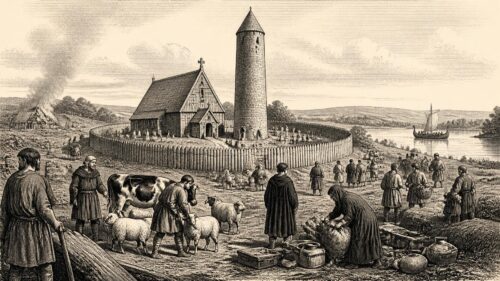
Several obituaries illuminate the church’s institutional landscape. Chronicon Scotorum records the deaths of Máel Ruain, abbot of Dísert Diarmata, Cell Achaid and Tech Telle; Cú Chenn Máthair, abbot of Imlech Ibuir; and Áedán son of Rechtada, abbot of Ros Cré. Multiple churches under one abbot demonstrate that ecclesiastical leadership was not confined to isolated prayer houses. Such communities held land, received patrons, trained clerics, preserved books and acted as centres of local authority.
The death of Máel Mura of Othain, probably Fahan Mura in what is now County Donegal, gives 887 a wider cultural importance. The annals call him the learned poet of the Gaels and chief poet of Ireland; the Annals of Ulster append an elegiac praise of him as an exceptional keeper of tradition. He was not simply a court entertainer. Máel Mura was an ecclesiastic scholar whose poetry connected biblical history, imagined Gaelic origins and the succession of Irish kings. Works attributed to him include Can a mbunadas na nGáedel?, an extended account of the origins of the Gaels, and verse addressed to Flann Sinna.
His obituary captures a central feature of ninth-century Irish culture: historical knowledge, vernacular poetry and Christian learning were deeply entangled. Monasteries were not apart from secular politics. They could provide rulers with genealogies, praise-poems and accounts of the past, while royal patronage helped sustain ecclesiastical communities. The loss of a chief poet in 887 was therefore also a loss to the intellectual machinery through which dynasties understood and advertised their place in Ireland.
A Vulnerable Religious Landscape
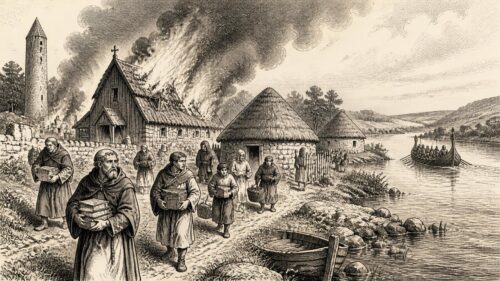
The churchmen commemorated in 887 lived amid real insecurity. The immediately preceding entry in Chronicon Scotorum, placed under 886, reports that the foreigners plundered Kildare and carried off 280 people, including its vice-abbot. The later Annals of the Four Masters connect the plundering of Kildare and Clonard with 887 instead. The disagreement is precisely why the raid should not be presented as an unquestionably dated event of this calendar year. Nevertheless, it forms the immediate background to 887: wealthy monasteries, with people and portable resources as well as sacred prestige, remained exposed to seizure.
That vulnerability did not mean cultural collapse. The notices for 887 record teaching brought from abroad, a Connacht counterstroke against the Limerick foreigners, the continued operation of major monasteries and the death of a scholar whose work shaped Irish historical memory. The year is best understood not as a single turning point, but as a sharply glimpsed moment in a society negotiating violence, authority and learning along the same rivers, roads and sea-routes.
Primary Sources
- The Annals of Ulster, Year U887
- Chronicon Scotorum, Annal CS887
- Chronicon Scotorum, Irish Text, Annal CS887
- Annals of Inisfallen, Annal AI887
- Annals of the Four Masters, Annal M887
- CELT Project: Annals of the Four Masters
- CELT Project: Annals of Inisfallen
- CELT Project: Chronicon Scotorum
- The Annals of Tigernach
- CELT Project: Fragmentary Annals of Ireland
- Vikings in Irish Chronicles, 794–902: Data
- Máel-Mura
- Flann Sinna
- Cerball
- Ímar (Ívaar)
- Máel-Sechnaill
- Dúnlaing
- High Crosses
- Limerick: Irish Historic Towns Atlas Essay
- The Vikings in Ninth-Century Ireland: Sources and Settlements
- Vikings’ Settlements in Ireland Before 1014
- The Céli Dé and Ecclesiastical Government in Ireland
- The Language of History-Writing in the Ninth Century: An Entangled Approach
- Whence the Origin of the Gaels? Remembering the Past in Irish Pseudohistorical Poems