Cairbre’s Treacherous Death1290 CE
In 1290, Irish politics saw several local struggles for authority. Cairbre Ó Máelsechlainn, king of Meath, was treacherously killed by Mac Cochlain and the Delbhna amid overlapping Gaelic and colonial lordships. Domnall Ó Néill expelled Niall Ó Néill and seized Tír Eógain, while Toirdelbach Ó Domhnaill, supported by maternal kin and galloglasses, deposed his brother Áed in Tír Chonaill. William Mac Fheorais assumed effective possession of Tuam’s archbishopric, and Kilmacduagh’s bishop died. Edward I appointed William de Vesci justiciar; he arrived in Ireland, combining royal office with Kildare lordship. A Carmelite friary at Kildare was plausibly founded about this time.
Dateline
The surviving record for 1290 is unusually concentrated on changes of leadership. In Meath, the king Cairbre Ó Máelsechlainn was killed; in Tír Eógain, Domnall son of Brian Ó Néill displaced a rival; and in Tír Chonaill, Toirdelbach Ó Domhnaill overthrew his brother Áed. These were not signs of a single, island-wide war. Rather, they reveal several political worlds in motion at once: Gaelic dynasties fought over kingship and territory, while the English crown refreshed its administration in the lordship of Ireland by appointing William de Vesci justiciar. The year’s annals are terse, but their combination gives a vivid impression of authority being won, lost and contested through force, kinship and patronage.
What Can Be Dated Securely
The Annals of Loch Cé and Annals of Connacht place their notices under 1290, although, as with medieval annals generally, this establishes the year rather than a precise day or sequence for most events. A separate administrative record allows greater precision for one important development: Edward I appointed William de Vesci justiciar of Ireland on 12 September 1290, and Vesci had arrived in the lordship by 11 November. The contrast is revealing. Gaelic annalists framed the year through deaths, depositions and successions; royal records preserve the formal transfer of governmental office. Both forms of evidence concern power, but they viewed it from very different institutions.
The Killing of Meath’s King
The clearest Irish political event recorded for the year was the killing of Cairbre Ó Máelsechlainn, described as king of Meath. The Annals of Loch Cé say that Mac Cochlain and the Delbhna killed him “in treachery”; Annals of Connacht uses the same accusation. The wording matters. It does not describe a set-piece battle or a lawful settlement, but a killing judged dishonourable by the annalist. Yet it supplies no location, method or immediate succession, and those details should not be invented.
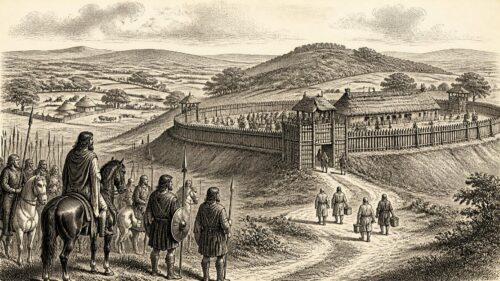
Cairbre belonged to the Ó Máelsechlainn dynasty, whose ancestors had once supplied high-kings of Ireland and whose authority remained important in parts of Midhe. By 1290, however, Meath was a politically divided region. Large areas were subject to the English lordship and to Anglo-Irish magnates, while Gaelic rulers, including the Ó Máelsechlainn, Mac Cochlain and the peoples called Delbhna, retained or contested power in other districts. Cairbre’s death therefore illustrates not the simple disappearance of Gaelic Meath, but a landscape of overlapping lordships in which local alliances could be decisive.
A shorter Latin annal adds a related notice: it reports that Ó Máelsechlainn was killed by Mac Cochlain and records a defeat of William de Burgh and other Englishmen at a place rendered as Delon. This may preserve part of the same wider confrontation, but its compressed wording and uncertain place-name make a full reconstruction unsafe. What can responsibly be said is that violence around Meath involved both Gaelic competitors and men connected with the colonial lordship. The political consequences extended beyond one royal household: killing a king could redistribute cattle, dependants, tribute and claims to land as well as prestige.
Domnall Ó Néill’s Seizure of Tír Eógain
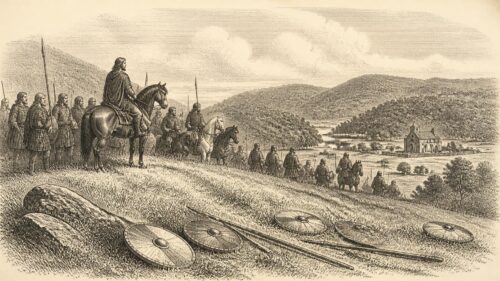
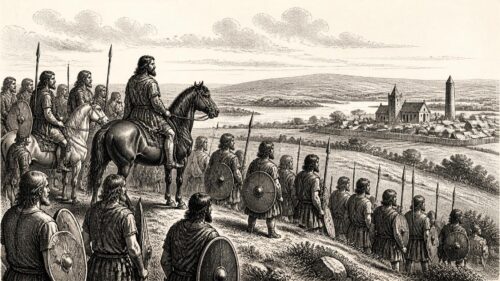
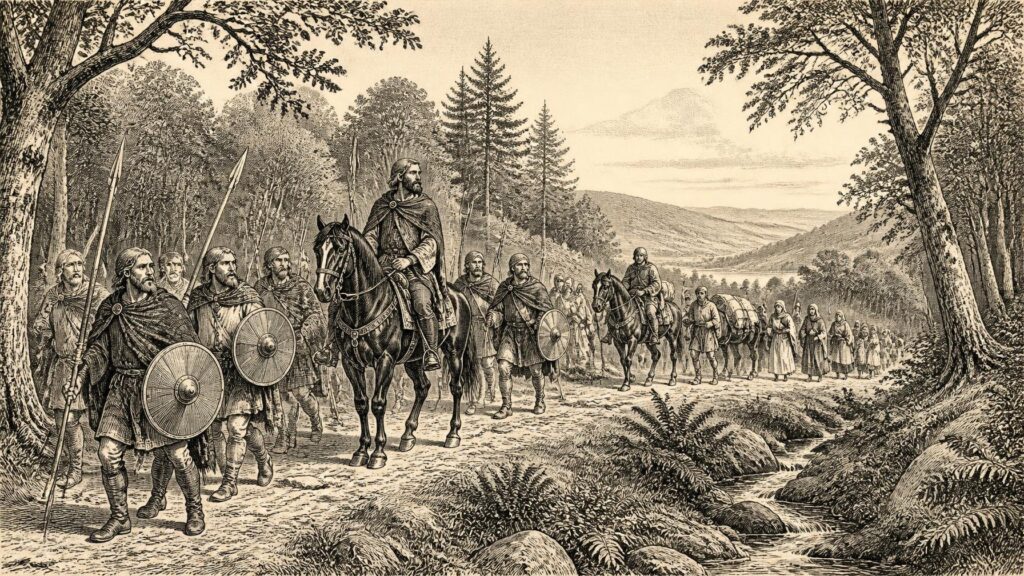
In the north, Domnall Ó Néill, son of Brian, led a hosting into Cenél nEógain, expelled Niall Ó Néill and took the kingship “by the might of his hand”, according to Annals of Connacht. The formula is starkly military. A hosting was not merely a raid by a few retainers, but an organised armed mobilisation of a ruler’s following and allies. Such forces depended upon the ability to call out kinsmen, tenants and clients, to provide food and horses, and to maintain loyalty during movement through contested country.
The entry also shows that the kingship of Tír Eógain was not automatic inheritance. Competing branches of the wider Ó Néill kindred could advance rival candidates, and practical command of armed support was essential. Domnall had previously been removed from power by Richard de Burgh, earl of Ulster, whose lordship extended over much of the north-east. His return in 1290 was thus a direct challenge to a regional order in which the earl expected influence over neighbouring Gaelic kings.
The following year confirms the fragility of Domnall’s success without allowing later events to be projected back into 1290. In 1291 de Burgh entered Tír Eógain, deposed Domnall and installed another candidate; further killings and interventions followed. That sequel makes clear why the 1290 coup mattered. Tír Eógain was not an isolated upland kingdom beyond outside concern, but a central arena in which Ó Néill dynastic politics and the military power of the earls of Ulster repeatedly met.
Gallowglasses and the Donegal Coup
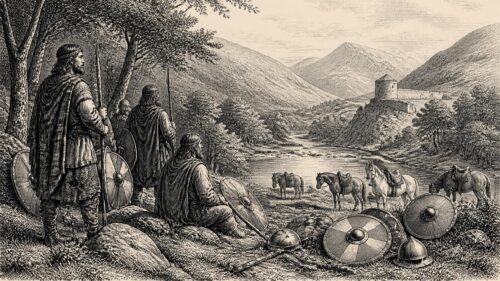
Another fraternal overthrow took place in Tír Chonaill, broadly the region of modern Donegal. Áed Ó Domhnaill was deposed by his brother Toirdelbach, who took the kingship with the backing of his mother’s kin, Clann Domhnaill, and “many other” galloglasses. This is one of the most significant details in the Irish evidence for 1290. It identifies maternal kinship as an active political resource and names professional or semi-professional heavily armed warriors as instruments of a successful change of ruler.
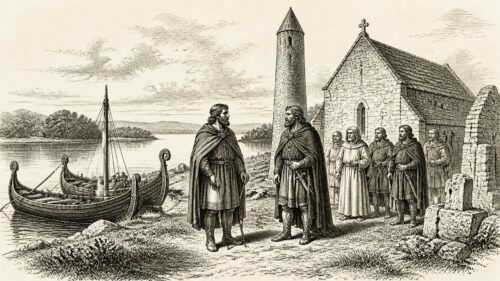
The annal does not name a battle, count casualties or specify where Áed was seized or driven out. It does, however, show that the Ó Domhnaill succession was connected to the wider Irish Sea world. Clann Domhnaill had roots in the Hebrides and western Scotland, and galloglass service linked maritime Scotland and Ireland through kin ties, military employment and seaborne mobility. The word galloglass itself was still relatively new in Irish written evidence. Its appearance here should not be treated as proof that every army had suddenly changed character, but it does mark the growing importance of such forces in the calculations of Gaelic rulers.
The settlement did not last. In 1291, the annals say, Áed recovered his kingship and Toirdelbach was expelled. This later reversal underlines a basic condition of politics in 1290: a deposition could establish control for a season without settling the dynastic dispute. Kingship depended on more than descent. It required the continuing consent, fear or material support of powerful kin-groups and fighting men.
Church Office in Connacht
Church affairs also register prominently. The annals state that William Mac Fheorais assumed the archbishopric of Tuam, while Bishop Ó Setacháin of Kilmacduagh died. “Assumed” is safer than saying that William was first elected in 1290: other documentary evidence places his election to Tuam in 1288 and papal confirmation in 1289. The annalistic notice most likely records his taking effective possession or public assumption of the office in Ireland during 1290.
William Mac Fheorais, or William de Bermingham, was a son of the lord of Athenry. His career demonstrates the closeness of aristocratic family influence and ecclesiastical advancement in western Ireland, but also the limits of any simple ethnic division. His surname appears in Irish form in the annals, while his family was of Anglo-Norman descent; his archbishopric encompassed communities of varied language, legal custom and political allegiance. Tuam was not merely a spiritual centre. Its archbishop controlled patronage, exercised jurisdiction, received revenues and could become an important actor in provincial politics.
The death of the bishop of Kilmacduagh, in south Galway, similarly reminds us that the church’s local structure mattered alongside the great contests for kingship. A vacant see could set in motion elections, negotiations over temporalities and rivalry among patrons. The sources do not preserve those details for Kilmacduagh in 1290, so the death should be allowed to remain what it is: a firmly placed change in diocesan leadership, not an occasion for invented drama.
A New Justiciar
While northern and western rulers fought for local supremacy, Edward I made a decisive administrative appointment. On 12 September he named William de Vesci justiciar of Ireland, the crown’s chief representative in the lordship. Vesci had inherited the liberty and lordship of Kildare earlier that year after his mother’s death, making him both a major landholder and the king’s governor. By 11 November he was in Ireland.
The office did not make Vesci ruler of the whole island. Royal government was strongest in and around the towns, shires, castles and estates of the lordship, and depended on cooperation from magnates, churchmen and officials. Beyond those areas, it negotiated with, fought against and sometimes worked through Gaelic rulers. Vesci’s initial business was an inquiry into serious allegations against Nicholas de Clere, the treasurer of the Irish exchequer. This was a reminder that governance involved accounts, revenue and official conduct as much as armies.
Vesci’s appointment nevertheless altered the political balance. His Kildare inheritance gave him an established territorial base in Leinster; his justiciarship gave him authority to summon service and act in the king’s name. The conflicts that later engulfed him and John fitz Thomas FitzGerald had not yet become open in 1290, and should not be treated as an event of this year. But the conjunction of office, landed power and competing regional ambitions helps explain why his arrival mattered.
Kildare and a Friary
Tradition within the Carmelite community associates 1290 with William de Vesci’s gift of a friary at Kildare, later known as the White Abbey and dedicated to the Virgin Mary. Other local reference works cautiously date the foundation to around 1290, and some give a later year. The responsible conclusion is that the friary belongs securely to Vesci’s early Kildare lordship and plausibly to this year, but that its precise foundation date is not beyond doubt.
Even with that qualification, the development is historically meaningful. Mendicant friars lived among lay communities rather than in remote monasteries, preaching, hearing confession and relying on alms and patronage. A Carmelite house near Kildare added to a town already shaped by St Brigid’s ancient ecclesiastical prestige, markets, lordship and the nearby Franciscan foundation. It also shows that, amid coups and killings, religious patronage remained a means by which powerful families expressed devotion, secured prayers and strengthened their standing in a busy settlement.
Thus 1290 was a year of sharp but localised ruptures. Cairbre Ó Máelsechlainn’s killing disrupted Meath; Domnall Ó Néill and Toirdelbach Ó Domhnaill seized contested kingships; William Mac Fheorais entered the effective possession of Tuam; and William de Vesci arrived to govern the English lordship. Taken together, these developments reveal an Ireland of several political systems, closely connected yet never reducible to one chain of command.
Primary Sources
- Annals of Loch Cé, Part 13
- Annála Connacht
- Annales Hiberniae
- Annales Breves Hiberniae
- Annals of the Four Masters, Part 13
- Calendar of Documents Relating to Ireland, Volume 3, 1285–1292
- Calendar of Documents Relating to Ireland, Volume 3, Item 660
- Calendar of Documents Relating to Ireland, Volume 3, Item 818
- Parchment Conquest, 1171–1307
- Vescy (Vesci), William de
- Burgh, Richard de
- O'Neill (Ó Néill), Domhnall
- Bermingham (Mac Fheorais), William
- Clere, Nicholas de
- FitzGerald, John fitz Thomas
- Kildare History – Carmelites
- Kildare, Irish Historic Towns Atlas Text
- The Medieval Walled Towns of Kildare
- Gallógláigh Thuadhmhumhain
- Calendar of Documents Relating to Ireland: National Library of Ireland Catalogue