Cúán and Flann Feórna741 CE
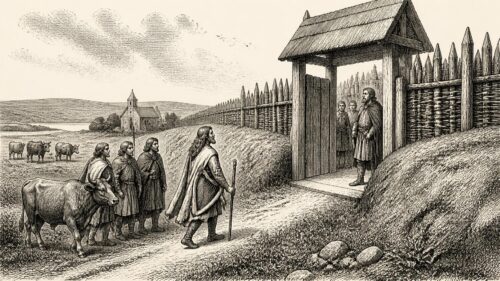
In 741, the Annals of Inisfallen record the death of Cúán, abbot of Ferna, probably Ferns in County Wexford, and Flann Feórna son of Colmán, king of Ciarraige Luachra in western Munster. These brief notices reveal the importance of ecclesiastical and local royal leadership in early medieval Ireland. Ferns was a significant religious and economic community, while Ciarraige Luachra was a petty kingdom within Munster’s layered political order. The entries provide no details of succession or circumstance. They instead demonstrate how annalists preserved selected deaths within Christian chronology, reflecting a rural, hierarchical society shaped by churches, kinship and regional kingship.
Dateline
In 741 CE, the surviving Irish record is strikingly spare: the Annals of Inisfallen place in this year the repose of Cúán, abbot of Ferna, and the death of Flann Feórna son of Colmán, king of Ciarraige Luachra. These are not dramatic notices, but they illuminate two institutions at the heart of early medieval Ireland: a great church community in south-east Leinster and a small kingship in the south-west. The entries do not describe causes of death, successors, ceremonies or disputes. Their importance lies precisely in what their titles reveal: abbots and local kings were major public figures, and their passing mattered sufficiently to enter a written chronological record.
A Year of Two Obits
The annalistic wording must be handled carefully. Cúán is said to have reached repose, the conventional Christian language for death, while Flann Feórna is identified through father, rank and people: son of Colmán and king of Ciarraige Luachra. Neither notice supplies a day or season. Nor should the compact entries be enlarged into a supposed succession crisis, royal burial or monastic reform. Nothing in the entry demonstrates such events. What can be said securely is that the compiler regarded the deaths as memorable within the annal’s framework of religious and political history.
There is also a chronological warning. Medieval Irish annals were copied, continued and synchronised over centuries; their year headings do not always align perfectly between manuscripts or modern editions. The Annals of Inisfallen explicitly assign Cúán and Flann Feórna to 741. Other annalistic traditions preserve related notices under neighbouring headings and sometimes differ in names, offices or sequence. For an article tied to this calendar year, the Inisfallen notice is therefore the firm dated anchor, while wider context must remain just that: context, rather than a claim that every nearby event occurred in 741.
Ferna and Ecclesiastical Authority
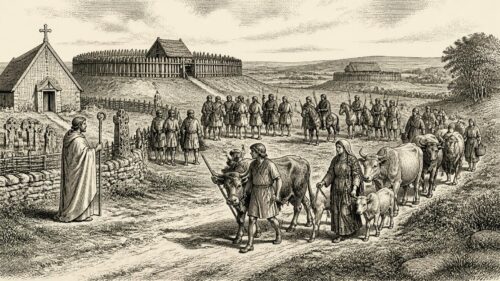
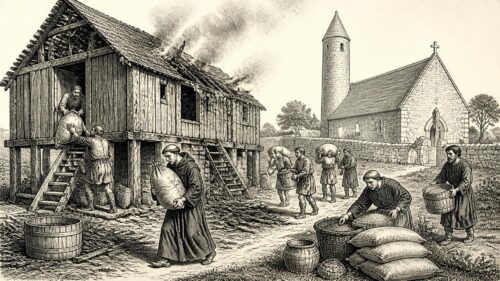
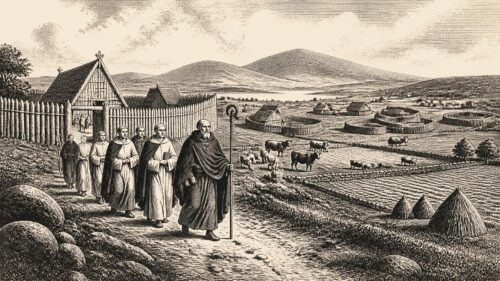
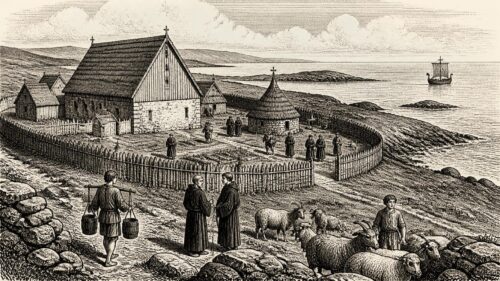
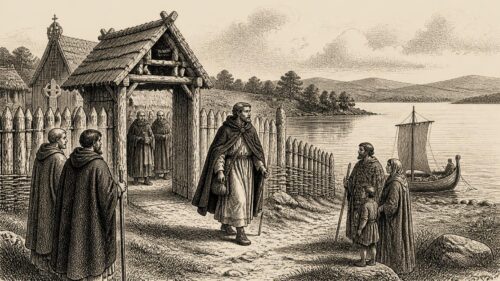
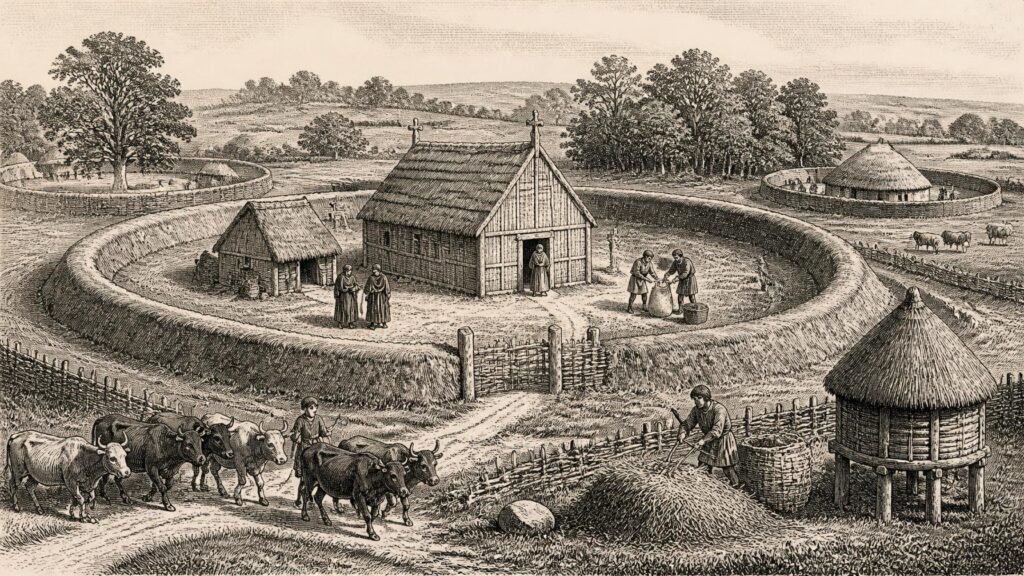
Ferna is generally understood as Ferns, in present-day County Wexford. Its ecclesiastical foundation was associated in later tradition with Máedóc or Aidan, and by the eighth century it belonged to the network of influential Irish churches whose estates, learning and sacred associations made them regional powers. Calling Cúán an abbot does not mean that Ferns was a secluded community detached from lay society. Irish monasteries were commonly substantial settlements. Their churches, cemeteries, dwellings, workshops, storehouses, cultivated land and livestock were embedded in the life of surrounding kin-groups and client communities.
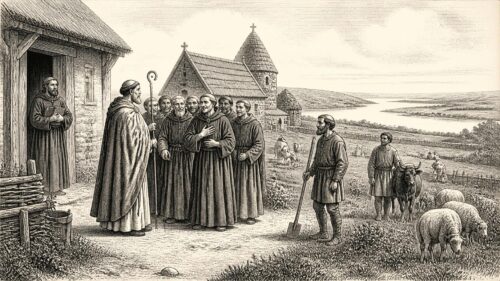
The abbot’s role was correspondingly broad. He was a religious superior, but also a manager of people and property, a guardian of a church’s rights and a participant in relationships with kings and aristocratic families. Bishops, priests, scribes, anchorites and abbots appear separately in the annals because ecclesiastical status mattered; yet their functions could overlap in an Irish church not organised principally around urban diocesan centres. Cúán’s obituary gives no account of his career, learning or family. It nevertheless indicates that Ferns possessed sufficient standing for its leader’s death to be remembered far beyond an individual household.
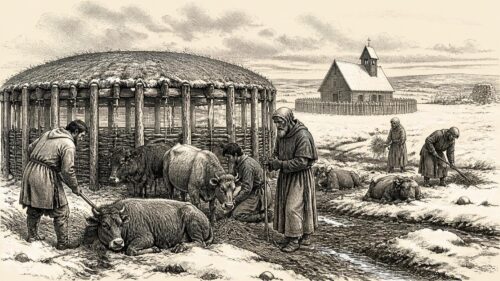
For ordinary people connected with such a church, the year’s rhythm was more immediate than annalistic commemoration. Most lived in a rural landscape of dispersed farmsteads, often within ringforts or comparable enclosed settlements. Cattle were central to wealth, food, renders and social rank; tillage supplied grain, while dairying, pigs, woodland resources, fishing and seasonal labour diversified subsistence. Church estates participated in this economy. Produce and service sustained clergy and dependants, supported hospitality, and made it possible for religious centres to commission metalwork, maintain buildings and preserve books.
None of this permits a claim that Ferns built a particular church, copied a particular manuscript or hosted a specific gathering in 741. The evidence does, however, make the notice of an abbot intelligible. A monastic community was not merely a place of prayer. It was an organised religious and economic community in a predominantly rural society, and its leadership formed part of the governing fabric of the region.
A King of Ciarraige Luachra
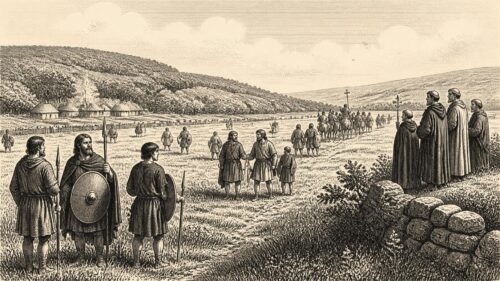
Flann Feórna’s designation is equally revealing. Ciarraige Luachra was a regional people and petty kingdom of western Munster, associated broadly with north Kerry and the Sliabh Luachra country extending towards Cork and Limerick. It was not an independent kingdom in the modern sense, bounded by fixed frontiers and ruled through a permanent bureaucracy. Like other Irish túatha and lesser kingdoms, it was a community defined by kinship, territory, lordship and customary obligations. Its king exercised authority within a layered political world, owing or contesting obligations with more powerful neighbours.
Flann’s death in 741 is the earliest point at which the Inisfallen annal gives him this precise royal identity. The record does not say how long he had ruled, whether he died peacefully, or who followed him. It does show that the kingship of Ciarraige Luachra was sufficiently established for its ruler to be named in a southern Irish chronicle. The patronymic, “son of Colmán”, mattered because political legitimacy was articulated through descent. A king’s capacity to lead depended not simply on personal force but on recognition by kindred, subordinate groups, allies and ecclesiastical partners.
Ciarraige Luachra lay within the wider orbit of Munster, where the Eóganachta of Cashel were the most prominent overkings. Their authority was real but uneven. Munster contained numerous lesser peoples and dynasties, each with its own interests, churches and local bases of power. Later legal and political texts connected with the region preserve arguments about the reciprocal obligations of overkings and client kings. They should not be treated as a verbatim report of 741, but they help explain why the death of a ruler such as Flann Feórna was politically meaningful. Kingship involved exactions and military support, but also protection, hospitality, settlement of disputes and the confirmation of status.
The wider island was similarly plural. Ireland was not ruled by a central state. Powerful dynasties such as the Uí Néill in the north and midlands, the Eóganachta in Munster, and leading kindreds in Leinster and Connacht competed for precedence, tribute and hostages. Claims to the kingship of Ireland were assertions of superior overlordship, not evidence of a unified administration. At the local level, political life was conducted through assemblies, kin alliances, fosterage, marriage, ecclesiastical relationships and the threat or use of armed followings.
Munster Before Cathal’s Death
In 741, Cathal son of Finguine remained the dominant ruler of Cashel and Munster in the background to Flann Feórna’s obituary. His long career had included conflicts with Leinster and the Uí Néill, and he was remembered by later southern tradition as a ruler of exceptional stature. Yet it would be wrong to place a campaign, agreement or intervention by Cathal in this particular year without evidence. The annals record his death under 742, not 741, and the titles attached to him differ between sources. His continued presence in 741 nevertheless helps locate Ciarraige Luachra within a Munster in which local kings had to accommodate, resist or collaborate with an ambitious overking.
That political setting did not make every lesser king a passive official. The geography of Munster—mountains, river valleys, coasts and peninsulas—favoured strong regional identities and local centres. Routes by land and water connected communities, but travel was slow and authority depended on personal presence. A ruler of Ciarraige Luachra could command local followers and resources while still operating within the larger prestige order of Cashel. Flann Feórna’s inclusion in the annals is a small but valuable reminder that early Irish history was made in such regional polities, not only at the courts of the most celebrated kings.
Writing Memory into Time
The form of the evidence is itself one of the year’s most important historical features. Annals reduced complex lives to short notices, arranged beneath year headings and framed by Christian understandings of time. Their compilers selected deaths, battles, ecclesiastical appointments, natural phenomena and political violence as matters worth preserving. Silence is not proof that nothing else happened in 741. It means that the surviving record has not transmitted other events, or that they were not judged suitable for inclusion in the annalistic tradition.
Learning was essential to that process. Latin literacy, the calculation of calendars and Easter tables, Irish genealogical knowledge, and the copying of manuscripts enabled communities to connect local memory with universal Christian chronology. An abbot’s death at Ferns and a king’s death in Ciarraige Luachra could thus be placed in the same annual sequence. The annal did not create their importance from nothing; it recorded the standing that ecclesiastical and political office already carried.
741 CE is therefore best understood not as a year of a recorded national turning point, but as a sharply focused glimpse of early medieval Ireland. Cúán’s repose marks the loss of a church leader at Ferns. Flann Feórna’s death marks the loss of a king in Ciarraige Luachra. Around those sparse facts stood a rural, cattle-rich and hierarchically ordered society, in which monasteries and kingships were intertwined, regional identities were powerful, and written memory preserved only selected moments. The restraint of the evidence is not a weakness to conceal; it is the key to seeing the year honestly.
Primary Sources
- Annals of Inisfallen, AI738–AI748
- Annals of Inisfallen
- The Annals of Ulster
- Annals of Tigernach, Part 13
- Chronological Synchronisation of the Irish Annals: Introduction
- Chronological Synchronisation of the Irish Annals
- Exploring the Irish Annals
- Irish Texts at CELT
- Irish Society c. 700: I. Communities
- The Powers of Kings
- Religion and Society in Ireland
- Monastic Identity in Early Medieval Ireland
- The Idea of the Three Orders of Society and Social Stratification in Early Medieval Ireland
- Agriculture, Settlement and Society in Early Medieval Ireland
- Early Christian Monasteries
- Patrician and Early Christian Architecture
- Rathbeagh Ringfort, Co Kilkenny
- The Rural Settlement Pattern
- Ferns Church, Cathedral, Crosses and Abbey
- Contributions Towards the Political History of Munster, 450–800 A.D. (Concluded)
- Studies in West Munster History: I. The Regnal Succession in Ciarraighe Luachra, 741–1165. II. Alltraighe
- Kerry Archaeological and Historical Society Journal 2022
- Skellig Michael Excavations: A Summary of Recent Archaeological Research
- Aed Allán and Cathal mac Finguini at Tír dá Glás, AD 737