Domnach Pátraic’s Six Captives746 CE
In 746, Irish annals recorded the violation of sanctuary at Domnach Pátraic, where six unnamed captives were hanged, exposing the religious and political weight of ecclesiastical protection. They also noted local warfare, including deaths among rival leaders, defeat of the Conmaicne, slaughter among southern Uí Briúin, and kin-slaying at Les Mór. Obits of abbots, bishops and rulers reveal a dispersed network of churches and regional powers. The Four Masters record fire damage to half Clonard’s granary, highlighting institutional resources and vulnerability. Notices concerning Domnall Midi’s era and dragons seen in the sky further convey a fragmented, unsettled Ireland in transition.
Dateline
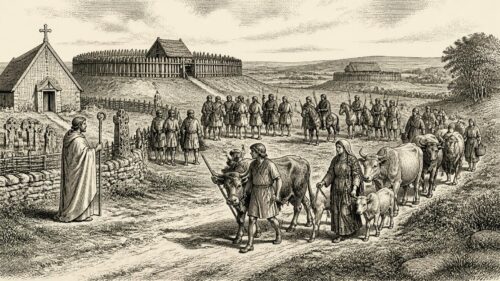
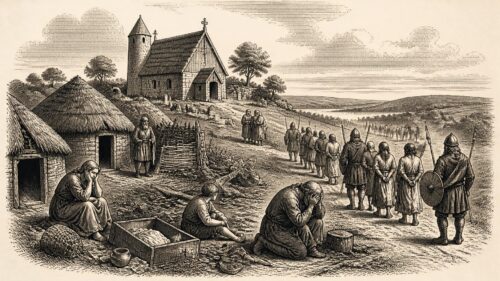
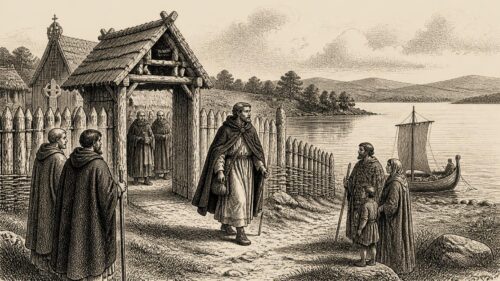
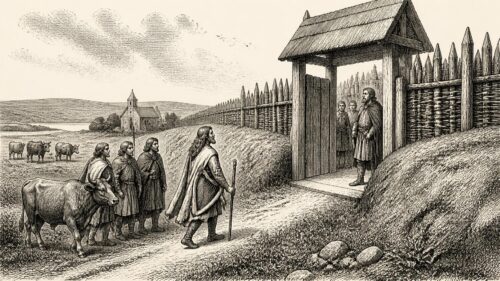
In 746 CE, Irish annals place a troubling breach of ecclesiastical protection beside a series of deaths, local killings and political reverses. The Annals of Ulster record that sanctuary was violated at Domnach Pátraic and that six captives were hanged. It is a short notice, offering neither the captors’ names nor the captives’ identities, yet its inclusion is significant. A church’s protection was not merely devotional language: it was a recognised public claim, bound up with law, status and the authority of the saint whose community occupied the site. To violate it was therefore an act with religious, social and political consequences.
A Record of Violence and Protection
The entry gives no narrative of how the six people came to be prisoners, whether they were taken in a raid, held as hostages or seized after a local dispute. Nor does it say whether they were killed within the sanctuary itself or removed from it. That silence matters. Early Irish annals are not court records; they preserve striking outcomes rather than the arguments, bargains and fears that led to them. Nevertheless, the wording makes clear that the offence was remembered not simply as an execution but as a violation of refuge. Domnach Pátraic’s sacred status had been overridden.
In a society divided among many small kingdoms and lordships, churches could offer places of assembly, protection, arbitration and commemoration. They also possessed land, dependants, livestock and stored food. Their leaders were involved in the secular world as well as the religious one. A breach of sanctuary could thus challenge a community’s security and its claims to honour. The annal does not tell us that any punishment followed in 746, and it would be wrong to invent one. Yet the act was grave enough to be entered into a historical tradition that otherwise often compresses an entire year into a few lines.
Fighting Among Kindreds
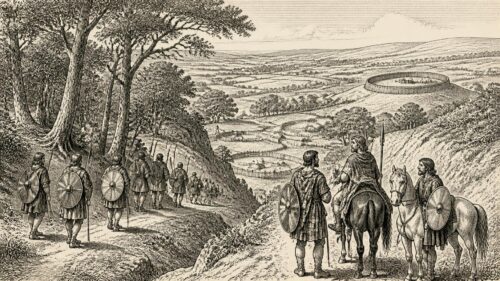
The same annal heading records a clash in which Dúngal Féile and Muirchertach son of Cathal fell “by one another”. The phrase suggests a direct encounter, but it does not identify a battlefield or explain the dispute. The entry adds that the Conmaicne were defeated and that Forgus escaped after losing. The Conmaicne were not a single kingdom in the modern sense but a people whose branches held territories in the west and midlands. Their appearance demonstrates how warfare in Ireland could involve regional groupings, kin-networks and rulers whose power was intensely local.
Another notice records a slaughter of the southern Uí Briúin by a man named Fergus. Again, the scale, place and motive are absent. The Uí Briúin were an important Connacht dynastic grouping, but the phrase “southern Uí Briúin” points to the internal geography and fragmentation of power rather than to a simple contest between two large blocs. Political authority rested on control of people, cattle, land and alliances; it could be expanded through hosting, raiding, hostage-taking and marriage, but it could be undone just as quickly by a killing within one’s own kindred.
That last danger is explicit in the annal’s notice of kin-slaying at Les Mór, or Lismore. The source offers no names and no explanation. It should not be inflated into a known feud, nor should it be assumed to concern the famous ecclesiastical centre alone. Still, its recording is a reminder that violence crossed the boundaries between royal, aristocratic and ecclesiastical landscapes. A killing among relatives threatened the social order because kinship was the framework through which protection, compensation, inheritance and political following were organised.
Churches in a Changing Year
Death notices make up much of the surviving record for 746. The Annals of Ulster note Beóchall of Ardachadh, Mael Anfaid of Cell Achaid Droma Fata, Dub dá Bairenn, abbot of Cluain Eóis, Aengus son of Tipraite, abbot of Cluain Fhata, and Ciall Tróg, abbot of Glas Naíden. These spare entries do not supply biographies, but they reveal a dense ecclesiastical landscape. Religious communities existed not as a single centrally governed Irish Church but through numerous churches, monasteries and saintly federations, each with its own lands, patrons, learned personnel and local connections.
The later Annals of the Four Masters, under their heading for 746, preserve a different cluster of obits and events. They include Maelimarchair, bishop of Eachdruim; Cuangus, abbot of Liath Mór; Colmán “of the Britons”, abbot of Sláine; Nuada, abbot of Cluain Eóis; Fursa, abbot of Leacain in Mide; and several figures associated with Cill Toma, Daimhinis and Lismore. Such material cannot simply be combined with the Ulster notices as if every entry had been independently and precisely dated to the same twelve months. Irish annals were compiled, copied and synchronised over centuries, and their eighth-century year-numbering sometimes differs. They are strongest when used with their chronological cautions visible.
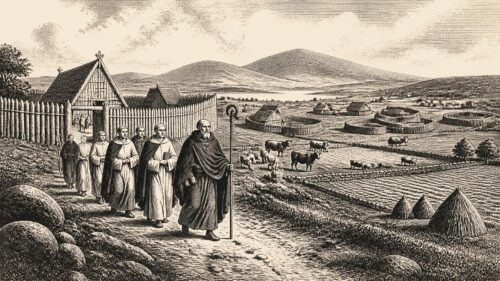
Even so, the pattern is revealing. In 746’s annalistic record, ecclesiastical offices were important enough to be named across the island: in the midlands, the north-east, the south and the west. An abbot was not necessarily a secluded figure. He might oversee a community of clerics and tenants, manage food and stock, receive gifts, negotiate with lay rulers, foster scholarship and represent the interests of a saint’s church. Bishops likewise appear within this landscape, but episcopal rank did not yet imply the later territorial diocesan structure. Church organisation was plural, local and interwoven with secular society.
The Granary at Clonard
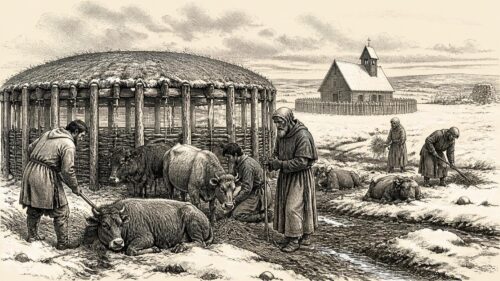
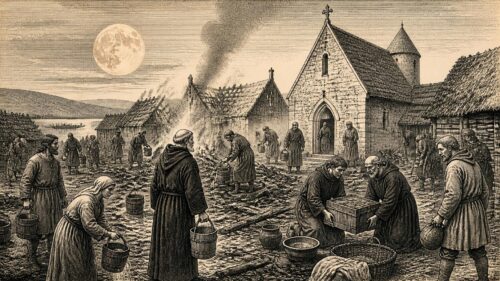
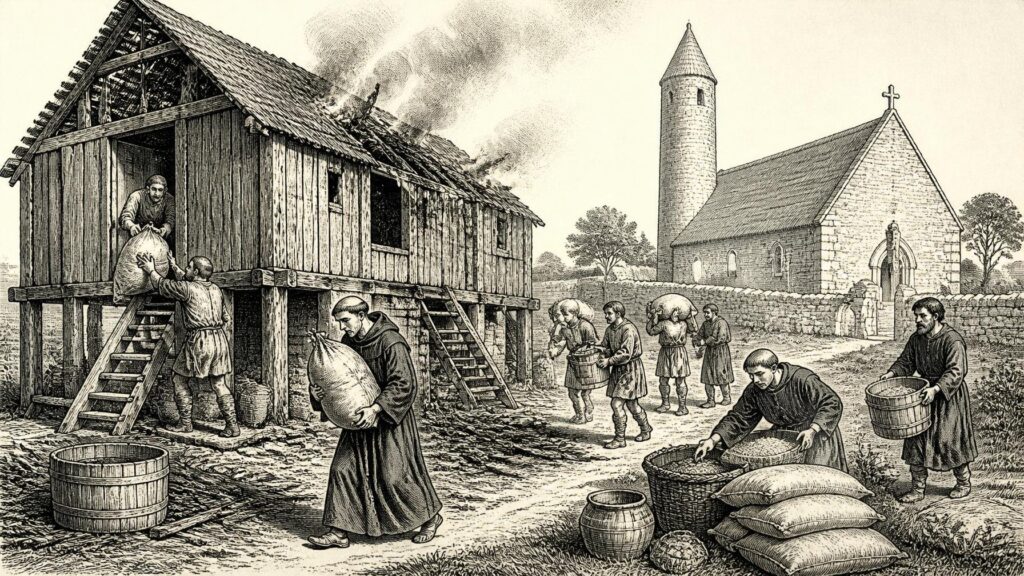
The most materially vivid notice in the Four Masters is the burning of half the granary at Cluain Iraird, Clonard. It is not possible to establish the cause from the annal. The fire may have been accidental; it may have spread from another building; the terse wording does not say. Nor does “half” permit a modern calculation of quantities lost. What it does establish is that Clonard possessed a granary substantial enough for partial damage to merit commemoration.
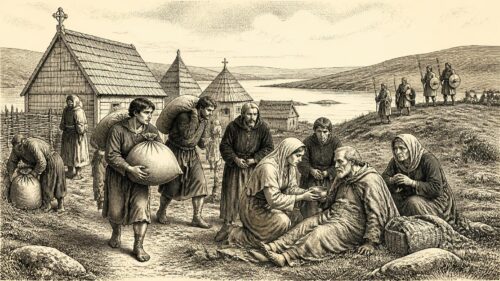
That detail opens a window onto everyday vulnerability. Grain was essential food, seed for the next agricultural cycle and a resource from which a major community could feed residents, guests and dependants. It required harvesting, drying, transport, storage and protection against damp, animals and fire. Early Irish legal material also shows the close connection between household wealth, labour, cattle and stored produce. A damaged storehouse therefore mattered beyond the monks or clerics immediately responsible for it. Loss could affect workers, tenants, travellers and clients whose subsistence depended upon the institution’s reserves.
Clonard had long been remembered as a major church of learning, but the 746 notice should not be treated as proof of a particular schoolroom, population or building plan. It is firmer evidence for storage and for the risks faced by a well-provisioned ecclesiastical settlement. Timber buildings, thatched roofs, open flames and dry stores made fire a persistent hazard. The annal’s economy of words perhaps reflects the familiarity of such conditions: it records the loss, not the alarm, rebuilding or negotiations that must have followed.
Rulers and Regional Losses
The Four Masters also place 746 in the eighth year of Domnall. In the political context of the mid-eighth century, Domnall Midi of Clann Cholmáin was a leading southern Uí Néill ruler whose wider authority rested on alliance, military strength and recognition rather than on a state with fixed borders. The annal does not report a great national assembly, treaty or campaign for this year. Its political evidence instead lies in the deaths of regional leaders: Flann grandson of Congal of Uí Fhailge, Feargus son of Fogartach of southern Brega, Muirghius son of Feargus of the Déisi, and Flann Foirtre of Corcu Loígde.
These notices show why Ireland cannot be described as a unified kingdom in 746. Brega, Uí Fhailge, the Déisi and Corcu Loígde were distinct political communities, each shaped by local dynasties and rivalries. An obit did not automatically mean peaceful succession. The death of a lord could produce accommodation, competition or violence, but the annals here do not state which occurred. The responsible conclusion is narrower: several regional elites were in transition, while the year’s surviving notices preserve conflict in Connacht-related territories and a serious challenge to church protection at Domnach Pátraic.
Dragons in the Sky
Finally, the Annals of Ulster report that “dragons were seen in the sky”. This should be read as a medieval observation, not as evidence that literal creatures flew above Ireland. Such language could describe an extraordinary celestial or meteorological phenomenon, or it could record an omen understood through inherited religious and literary ideas. Modern readers cannot securely identify what was seen. The annal does not connect the spectacle to the year’s killings, defeat or sanctuary violation, so it should not be turned into a prophecy after the fact.
What survives from 746 is therefore fragmentary but unusually textured: captives denied refuge, local warfare, a kin-killing, the deaths of churchmen and rulers, a damaged granary, and an unsettling sight in the heavens. Together they show an Ireland in which sacred places were centres of both belief and material life, where political power remained regional and personal, and where a brief annal entry could preserve the memory of a crisis long after its participants had disappeared.
Primary Sources
- The Annals of Ulster
- The Annals of Tigernach
- Annals of the Four Masters, Volume 1
- Part 57 of Annals of the Four Masters
- Part 58 of Annals of the Four Masters
- Chronicon Scotorum
- The Annals of Inisfallen
- Cáin Lánamna
- Lebor na Cert
- Women and the Law in Early Ireland
- Marriage in Early Ireland
- Land Use and Economy AD 500–1100
- Religion and Society in Ireland
- Ireland To 1170
- The Church and the World in Early Christian Ireland
- Reassessing the Irish ‘Monastic Town’
- Ecclesiastical Settlement in Ireland in the Early Medieval Period
- Regional Variation in Irish Pre-Romanesque Architecture
- A Major Monastic Centre? Rethinking Lismore’s Place in the Ecclesiastical Landscapes of Early Medieval Britain
- Transformation: Early Medieval Ireland, c.400–c.1100
- The King, the Poet and the Sacred Tree
- Money in Early Christian Ireland According to the Irish Laws