Cúan Cam and Deep Snow747 CE
In 747, Ireland experienced exceptionally deep snow, widespread cattle mortality and subsequent drought, shocks that endangered a rural economy dependent on livestock for food, labour, tribute and status. The annals do not establish famine or population loss, but attest severe island-wide disruption. Political life continued: Indrechtach of the Ciannachta and Queen Muirenn died, while Congal of the Airthir was slain. Suanach’s grandson’s law operated in Leth Cuinn, indicating public legal or ecclesiastical authority. Obituaries recorded abbots, anchorites and scholars, including Cúan Cam. Munster sources noted fighting at Cúil Géisi. Together, the entries reveal interconnected environmental, political, legal and religious pressures.
Dateline
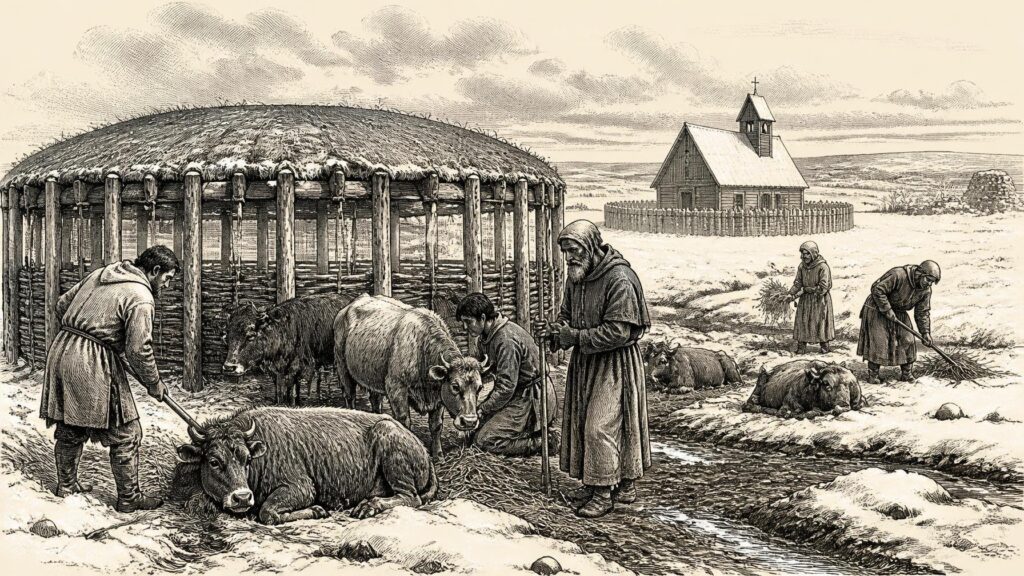
In 747 CE, Ireland endured a sequence of environmental shocks severe enough for the Annals of Ulster to preserve in exceptional terms: unusually deep snow, the death of almost all cattle across the island, and then an unaccustomed drought. Medieval annals are terse and their language can be emphatic, so this is not a statistical report from which a precise loss can be calculated. Yet it is firm evidence that contemporaries regarded the weather as extraordinary, widespread and socially damaging. In a predominantly rural society where cattle were vital to food, farming, status, tribute and exchange, the combination of winter mortality and subsequent dryness was far more than an unpleasant season. It threatened the resources through which households, churches and kings sustained themselves.
A Winter Remembered
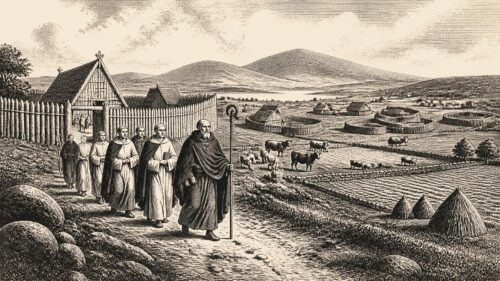
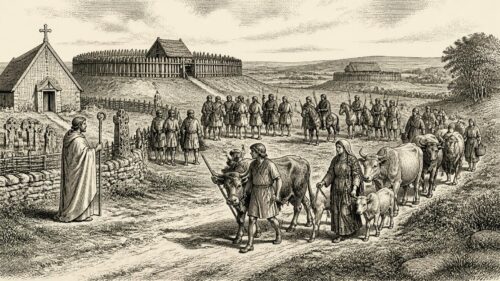
The annalist’s sequence matters. First came snow of unusual depth; afterwards, the land was parched by drought. Deep snow could bury pasture, impede movement and make it difficult to reach animals or carry fodder. The following dryness could diminish grazing and make recovery harder for surviving herds. Ireland’s mixed economy included crops, sheep, pigs, fishing and woodland resources, but cattle held an especially prominent place in law, lordship and everyday calculation. They supplied milk and dairy produce, meat, hides, traction and manure; they also figured in payments, fines, gifts and political exactions. A major loss therefore reached from the byre and field into the obligations binding tenants, religious communities and rulers.
That does not permit a confident reconstruction of famine, prices or population loss in 747. The annal does not explicitly record a famine, epidemic, rebellion or migration caused by the weather, and none should be invented. It does, however, make clear why a later shortage of food, seed, dairy produce, animal power or tribute would have been feared. Cattle were slow wealth: a cow lost in one hard season represented not merely meat gone, but future calves, milk, labour and the capacity to meet social obligations. The entry is consequently a rare glimpse of environmental pressure operating at an island-wide scale within early medieval Ireland.
Power After Loss
The deaths and killing recorded for the same year show that political life continued amid this strain. Indrechtach grandson of Conaing, king of the Ciannachta, died. The Ciannachta were one of the important populations of the north-eastern midlands and Brega region, where control of land, routes and client peoples mattered greatly to larger dynasties. Indrechtach had appeared in an earlier annal as victor at the battle of Dam Derg. His death in 747 is reported without a cause and without a named successor, but the notice marks the removal of a local king whose family had recently demonstrated military weight.
Another death carried dynastic resonance. Muirenn, daughter of Cellach of Cualu and queen of Írgalach, died. The annal identifies her through both her natal and marital connections, a reminder that elite women belonged to the political record not only as individuals but as links between kindreds. It gives no account of Muirenn’s actions, property or burial, and it would be unsafe to manufacture one. Still, her designation as a queen preserves the continuing importance of marriage alliances and remembered descent in a political order composed of many competing kingdoms rather than a centrally administered state.
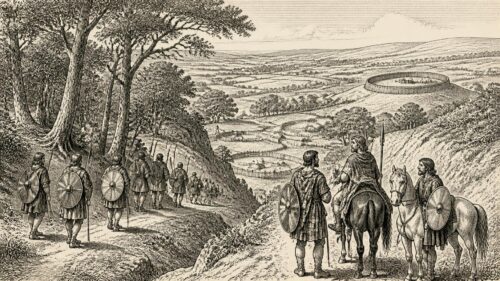
Violence was equally local in scale but not trivial in consequence. Congal son of Éicnech, king of the Airthir, was slain at Ráith Escla. A parallel annal identifies his killer as Donn Bó son of Cú Bretan. The Airthir were a people of the north, in the wider orbit of Airgialla and Ulaid. The sources do not explain the dispute, identify all participants or describe a battle. What they preserve is a targeted killing of a king at a named royal settlement or fort. In a world in which political authority was personal, the death of such a ruler could immediately alter the balance of alliances, hostage relationships and claims to tribute.
Suanach’s Law in Leth Cuinn
One of the year’s briefest notices is also among its most suggestive: “the law of Suanach’s grandson” was in force in Leth Cuinn, the traditional northern half of Ireland. The wording should not be expanded into a modern statute book. The annals do not state what the law required, who Suanach’s grandson was, where it was first promulgated, or how compliance was secured. Nor does the phrase prove that every community within Leth Cuinn followed identical rules. It does show that a named legal or ecclesiastical authority could be remembered as extending a cáin, a law or enforced settlement, across a broad political sphere.
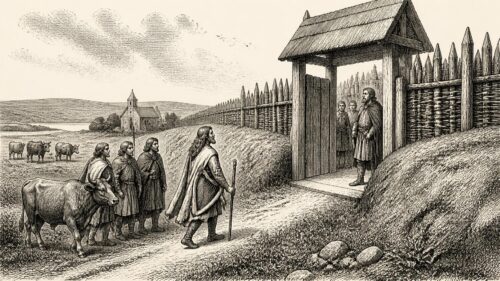
Such laws belonged to the meeting ground of kingship and church. Early Irish rulers relied upon relationships with ecclesiastical communities for literacy, prestige, counsel and the sacral language of order; churches in turn required protection for people, livestock, land and rights. The recording of Suanach’s law beside royal deaths, a killing and weather catastrophe is revealing. The annalist considered its enforcement a public event, not a private devotional matter. In a difficult year, rules capable of regulating obligations or protecting recognised interests may have acquired particular urgency, although the specific connection cannot be demonstrated from the surviving text.
Churches, Scholars and Anchorites
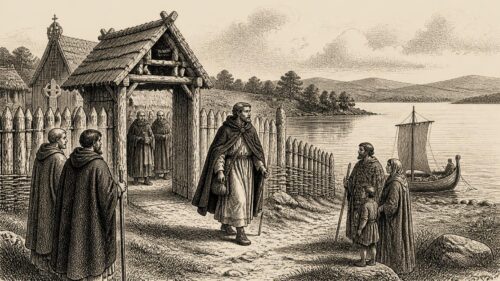
The religious notices of 747 range across the island’s connected ecclesiastical landscape. Arascach, abbot of Muicinis Riaguil, drowned. Cúan Cam, described simply as “the learned”, died. Do-Dímóc, an anchorite and abbot of Clonard, died, as did Do-Chumae, a learned man associated with Kildare. Flann Foirbthe son of Fogartach and Cuan, anchorite of Lilcach, are also entered among the dead. Their compressed obituaries demonstrate the range of roles recognised by Irish monastic culture: abbots who managed communities and estates; anchorites pursuing a more withdrawn religious vocation; and learned men valued for scholarship.
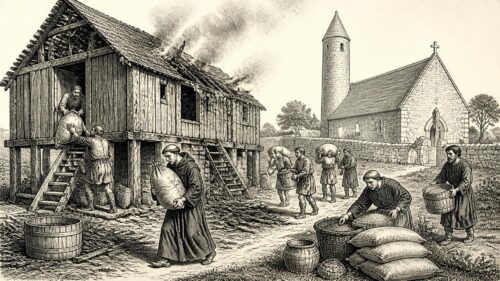
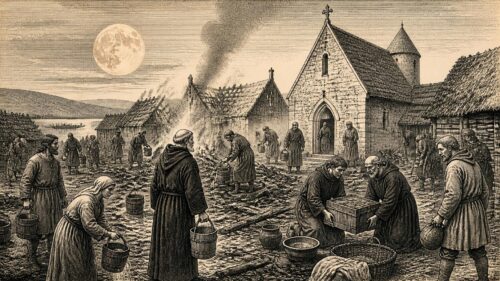
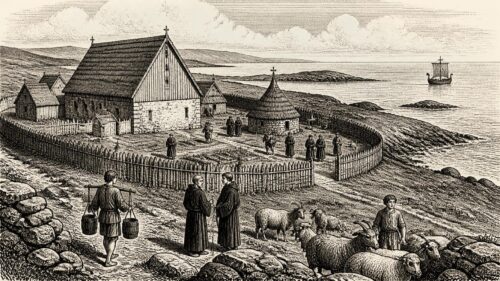
These were not isolated hermitages detached from society. Major churches such as Clonard and Kildare were religious centres, landholders and places of teaching, manuscript production and hospitality. Their communities depended upon labour, crops, animals and patronage, while their scribes and scholars helped to preserve the Latin and Irish learning through which annals, law and genealogy could be maintained. The weather crisis therefore had implications for monasteries as well as secular households. Yet the notices do not say that any church failed, starved or lost stock in 747; they record personnel and reputation, not institutional balance sheets.
The Annals of Inisfallen, compiled in the southern ecclesiastical world, add a distinct perspective under 747. They record a Munster victory at Cúil Géisi in which Cairpre son of Cú Dínisc fell, together with the deaths of Ruamán and Cú Chuimne “the learned”. The account supplies no cause for the conflict and gives no licence to identify Cúil Géisi with other similarly named places or battles. Its value lies in showing that Munster’s own political and intellectual concerns were moving alongside the northern and midland developments recorded elsewhere. Ireland in 747 was not a single arena with one story, but an island of overlapping regional histories.
What the Record Can Tell Us
The surviving record of 747 is unusually rich in consequences but poor in narrative explanation. It names a devastating climatic sequence, the death of kings and queens, a royal killing, a law in force over Leth Cuinn, and the passing of abbots, anchorites and scholars. It does not disclose the experience of every farmstead, the choices made by herders in the snow, or the terms by which communities recovered. Those silences matter. They caution against turning a few annalistic lines into a fully documented national disaster.
Even so, the year’s entries belong together. Deep snow and drought exposed the vulnerability of a cattle-centred economy; political succession and violence continued among regional dynasties; legal authority was publicly asserted; and churches remained central institutions of learning, memory and material life. The death of Cúan Cam, remembered specifically for learning, sits beside the loss of cattle remembered on an immense scale. Together they capture a society in which knowledge, law, lordship, religion and the practical survival of herds were inseparable parts of Ireland’s eighth-century world.
Primary Sources
- The Annals of Ulster, Year U748 (AD 747)
- CELT Project: The Annals of Ulster
- The Annals of Tigernach
- CELT Project: The Annals of Tigernach
- Annals of Inisfallen, Part 30
- CELT Project: Annals of Inisfallen
- Annals of the Four Masters, Part 58
- CELT Project: Annals of the Four Masters
- Chronicon Scotorum, Part 85
- CELT Project: Chronicon Scotorum
- CELT Project: Fragmentary Annals of Ireland
- Early Christian Monasteries
- Patrician and Early Christian Architecture
- Christian Ireland 5th – 8th Centuries
- The Church and the World in Early Christian Ireland
- The Powers of Kings
- Animals and the Economy of Medieval Ireland: A Zooarchaeological Analysis of the Faunal Remains from Caherconnell Cashel, Co. Clare
- Changing Human-Cattle Relationships in Ireland: A 6000-Year Isotopic Perspective
- Pastoral Mobility in Medieval and Early Modern Ireland: Perception Versus Practice
- Raiding and Warring in Monastic Ireland
- Earlymedieval Ireland 431–1169
- From Bible to Law in the Early Middle Ages: Adaptations of the Old Testament in the Collectio Hibernensis and King Alfred’s Law-Book