Sliab Fúait’s Northern Victory711 CE
In 711, Fergal son of Máel Dúin of Cenél nÉogain defeated Uí Méith at Sliab Fúait in south Armagh, killing their king Tnúthach and Cú Raí of the Brega-based descendants of Áed Sláine. The victory strengthened Fergal’s authority in a contested borderland, though it did not establish national rule. Annals also record Cenn Fáelad, abbot of Fore, illustrating churches’ economic and political importance. Across the Irish Sea, Dál Riata defeated Britons at Lorg Ecclet, reflecting maritime connections. Annalistic date differences require caution, but together these notices portray competing kingdoms, religious communities and interconnected Irish Sea politics in early medieval Ireland.
Dateline
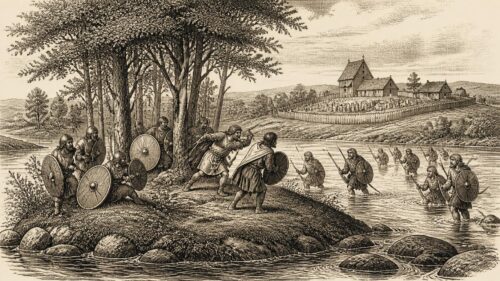
In 711 CE, the clearest securely dated Irish event was a northern victory at Sliab Fúait, the broad upland district of south Armagh later associated with the Fews. The Annals of Tigernach record that Fergal son of Máel Dúin was victorious there over Uí Méith, and name two men who fell: Tnúthach son of Mochloinges, king of Uí Méith, and Cú Raí son of Áed son of Dlúthach. The entry is brief, as annals usually are, but it exposes a great deal about Ireland in this year: a newly established Uí Néill ruler was extending armed influence close to the northern approaches to Ulster, while a local king and a member of a Brega dynasty died in the same encounter.
A Battle in the Fews
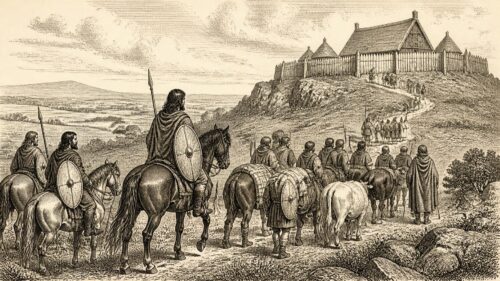
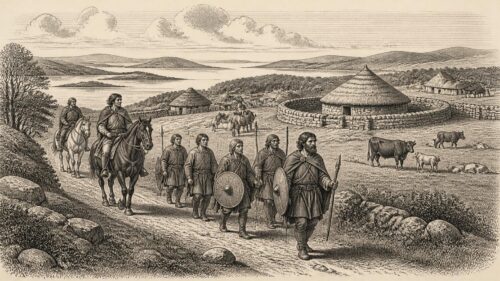
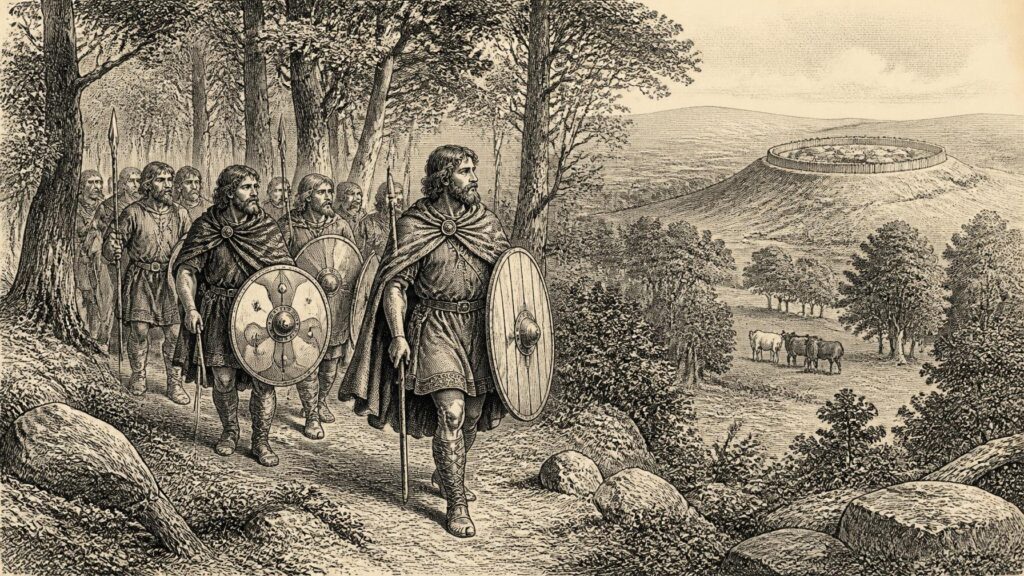
Sliab Fúait was not a single mountain in the modern sense but a named expanse of rough, elevated country. Its position mattered. It lay on routes between the Uí Néill heartlands of the north-west, the ecclesiastical and political centres around Armagh, and the kingdoms of the north-east. Armies could move through such country, but local knowledge of passes, woodland, grazing and water made the district especially important to nearby rulers. A victory there did not make Fergal master of all Ireland. It did, however, demonstrate that he could bring a force into a contested borderland and defeat opponents of royal rank.
Tnúthach’s death is the most straightforward political consequence recorded by the annalist. Uí Méith occupied territory around the Armagh–Monaghan borderlands, between larger powers whose interests frequently crossed their lands. The killing of its king created an immediate problem of succession, alliance and security for his people. Cú Raí’s presence reveals a wider contest. He belonged to the descendants of Áed Sláine, a powerful southern Uí Néill kindred based in Brega, north of the lower Liffey and Boyne. His death alongside the Uí Méith king suggests that the engagement involved more than an isolated local quarrel, although the annals do not explain whether he was an ally, a raider, or a leader with an independent claim.
Fergal’s Expanding Authority
Fergal had begun to rule in the preceding annalistic year. He was a member of Cenél nÉogain, the northern branch of the Uí Néill, and later sources treat him as king of Tara or king of Ireland. Such titles should not be mistaken for kingship over a unified state. Ireland in 711 consisted of many competing kingdoms, each held together by kinship, clientship, tribute, fosterage, hostages and the threat of armed action. A ruler’s wider authority depended on whether neighbouring kings accepted his superiority in practice, not merely on a title preserved by later writers.
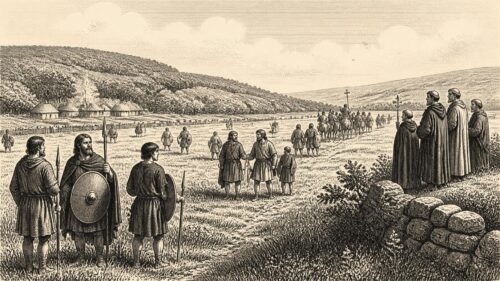
The fighting at Sliab Fúait therefore belongs to the opening phase of Fergal’s effort to make that superiority effective. His opponents included a regional king and a man from a rival Uí Néill line. The two were not necessarily fighting for the same purpose, and the surviving record does not permit a reconstruction of the battlefield or of the numbers involved. What can responsibly be said is that the victory removed two politically significant figures and strengthened Fergal’s standing in a strategically sensitive zone. In a society where royal authority rested on relationships as much as territory, a public victory could win submissions, cattle-render and military support without leaving a permanent garrison behind.
The annal’s economy also cautions against turning 711 into a campaign of national conquest. It gives no place for negotiations, hostages, tribute, or a settlement after the battle. Nor does it report widespread devastation. Those absences matter. Warfare was common in early medieval Ireland, but it was generally conducted between particular peoples and dynasties rather than between fixed national sides. The battle of Sliab Fúait was important because of those killed and because Fergal won it; its larger consequences must be inferred with restraint.
Fore and the Recorded Church
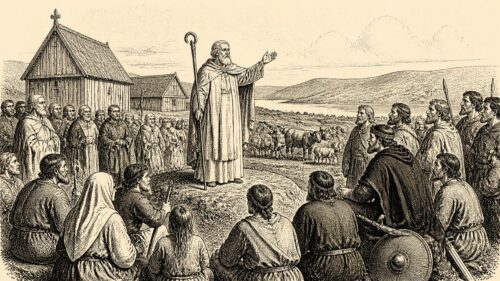
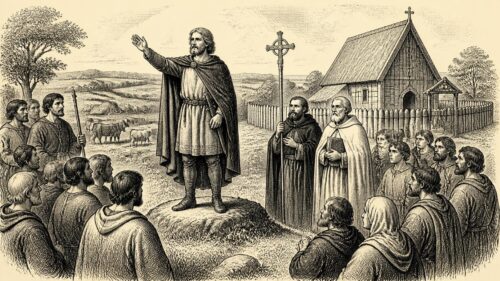
The same annalistic year records the death of Cenn Fáelad, abbot of Fobar, now Fore in County Westmeath. This is a small notice, but it reminds us that political history and religious life were interwoven. Fore was among the ecclesiastical communities of the midlands, a region situated between the northern Uí Néill world of Fergal and the competing powers of Brega and Mide. An abbot was not merely the head of prayers and worship. He oversaw land, tenants, food renders, hospitality, buildings, books and the community’s dealings with secular patrons.
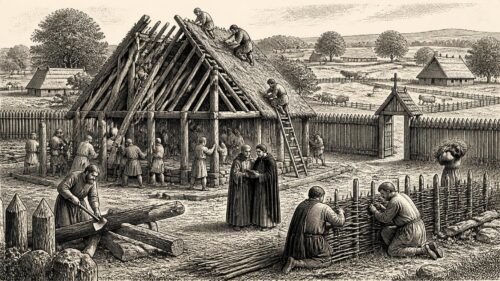
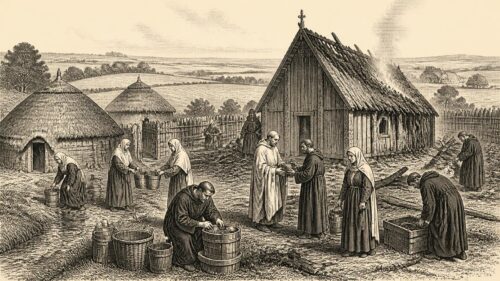
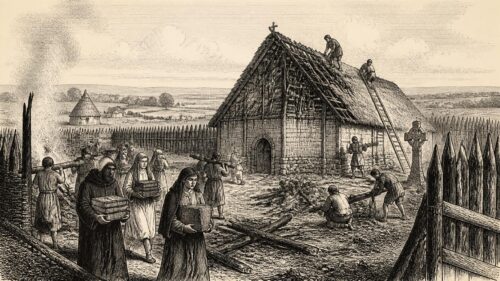
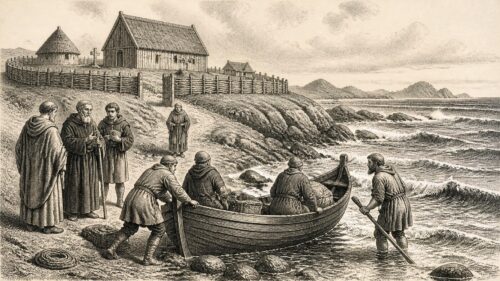
Churches and monasteries were not isolated stone institutions set apart from ordinary life. In 711, most buildings at many religious settlements were timber structures within enclosures; communities depended on surrounding farms, livestock, grain, mills and craftworkers. Clerics, students, dependants and visiting travellers lived alongside people whose work supplied food, clothing, fuel and materials. The death of an abbot could therefore matter to a wide household and to the families who had endowed, protected or expected services from the church. Yet the annals preserve no detail of Cenn Fáelad’s successor or of Fore’s affairs. The obituary is evidence of the community’s recognised status, not a licence to invent a crisis there.
Across the Narrow Sea
Another notice placed under 711 in the Annals of Tigernach tells of an encounter between Britons and Dál Riata at Lorg Ecclet, won by Dál Riata. The site cannot be identified with confidence, and the entry does not state which Britons took part or why they fought. Its relevance to Irish history lies in the nature of Dál Riata itself: an Irish-speaking polity whose territories and relationships linked north-east Ireland with western Scotland. The Irish Sea was a corridor, not a frontier. People, churchmen, goods, news and armed parties crossed it regularly when weather, vessels and political circumstances allowed.
For Irish communities, events on the Scottish coast could have direct repercussions. Kinship ties joined Dál Riata to northern Irish dynasties, while Columban religious networks connected Iona with churches in Ireland. The same annal also notes conflict between Picts and Saxons in the region of Manau. Ireland was not a passive observer of such northern British struggles: Irish ecclesiastics travelled there, and Irish rulers had reason to watch changes that might affect sea routes, allies and rival powers. Still, the evidence does not show Irish troops at Lorg Ecclet, nor does it allow the battle to be claimed as an Irish victory. It is better understood as a nearby conflict within an interconnected Gaelic maritime world.
Learning, Memory and Dates
The annals themselves are among the most revealing products of this world. Their short entries were copied and reshaped over centuries, drawing ultimately on records maintained in ecclesiastical centres. They preserve kings, abbots, battles, deaths and unusual natural events because these were considered worth remembering by learned communities. Their chronology, however, is not mechanically reliable. The early Irish annals sometimes differ by one or more years, and later compilations can place the same event differently. The battle of Sliab Fúait is assigned explicitly to 711 by the Annals of Tigernach; the Annals of Ulster, in contrast, place a parallel entry beneath an annal headed AD 710.
This is not a reason to discard the record, but it is a reason to state dates carefully. Modern scholarship on annalistic synchronisation has shown that the inherited systems of kalends, weekdays and later AD headings could become displaced in transmission. For 711, the agreement of the Annals of Tigernach with the usual modern dating makes the battle the year’s firm centrepiece. Other notices close to it should not be casually pulled into this calendar year. For example, the death of Coeddi, bishop of Iona, is entered under 712 in both the Annals of Tigernach and the translated Annals of Ulster; it illuminates the same Irish Sea church network, but should not be presented as a death of 711.
That disciplined distinction is especially valuable for the intellectual history of the period. Irish and British religious communities were deeply engaged with Latin learning, biblical chronology and the calculation of Easter. The annals’ interest in dates reflects that culture of computation. But an annalistic notice associating Bede with a “great book” occurs in a neighbouring, not a securely 711, entry and cannot override the independently known dates of his works. The year is best seen not as a blank interval between larger stories, but as a point at which armed kingship, monastic record-keeping and Irish Sea connections are all plainly visible.
A Year of Demonstration
For ordinary people, the battle’s immediate significance lay less in grand titles than in practical consequences. A defeated king’s followers could lose protectors; victors could demand food, cattle, labour or military service; movement through contested country became more dangerous. Farmers and herders continued the seasonal work on which every household and monastery depended, but warfare could interrupt grazing, harvests and travel. No source records a famine, plague or exceptional weather event in Ireland specifically for 711, so none should be imposed upon the year. Its documented character is political and institutional rather than environmental.
What survives is enough. At Sliab Fúait, Fergal’s victory announced northern Uí Néill power in a vulnerable borderland and cost Uí Méith its king. At Fore, the death of an abbot marks the continuing importance of a midland church community. Across the sea, conflict involving Dál Riata confirms that Irish political and religious horizons extended well beyond the island’s shores. Together these notices offer a sharply bounded portrait of 711: not a year of an Irish nation acting as one, but a year in which rulers, churches and seaways bound many local societies into a wider early medieval world.
Primary Sources
- The Annals of Tigernach: Editorial Information
- The Annals of Ulster
- Annals of the Four Masters
- Annals of Inisfallen, Part 27
- CELT: Corpus of Electronic Texts — Irish Texts
- The Annals of Ulster: Bibliography and Editorial Information
- Chronological Synchronisation of the Irish Annals
- The Chronology and Sources of the Early Irish Annals
- Cóeti of Iona
- Early Mechanisms of Abbatial Succession: The Case of Iona (563–704)
- The Early Irish Grammaticus
- The Metrical Dindshenchas: Sliab Fúait
- Cáin Adomnáin
- Excavations at Knowth: Historical Knowth and its Hinterland, Volume 4
- Farming and Archaeology
- Waterway Corridor Study: River Shannon, Lanesborough to Shannonbridge
- Discover the Walled Towns of Ireland
- Saint Moling’s Millrace, St Mullins, County Carlow
- De temporum ratione (725)
- De natura rerum