Tulach Árd672 CE
In annalistic year 672, Dúngal of Cenél Bógaine was defeated and killed by Loingsech at Tulach Árd, while Cenn Fáelad of Síl nÁedo Sláine succeeded his murdered brother as king of Tara. Armagh suffered a poorly explained fire, illustrating the vulnerability of an important ecclesiastical and political centre. An abundant mast crop suggested productive woodland resources, particularly for pig feeding, although it cannot indicate general prosperity. The annals also recorded upheaval in the Hebrides, the expulsion of Drost and the burning of Bangor of the Britons, reflecting Ireland’s connections across the Irish Sea.
Dateline
In 672 CE, Ireland’s annalistic record places a local northern battle, a royal succession, a destructive fire at Armagh and an unusually plentiful woodland harvest within the same year. None of these notices offers a full narrative, and none is dated to a particular month or day. They are brief entries preserved in chronicles copied much later, whose year-numbering is not perfectly uniform: the Annals of Ulster’s entry conventionally assigned to 672 even carries an internal AD 671 heading. The safest conclusion is therefore that these events belong to the annalistic year 672, rather than that their exact modern calendar dates can be recovered. Even so, together they show an Ireland in which regional lordship, ecclesiastical centres and the Irish Sea world were tightly entangled.
A Battle in Cenél Bógaine
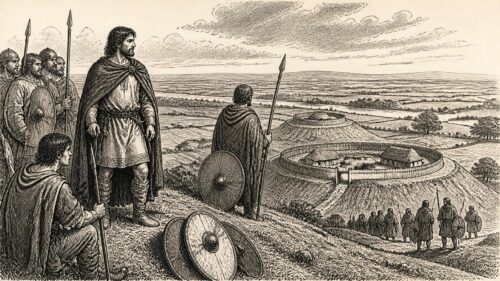
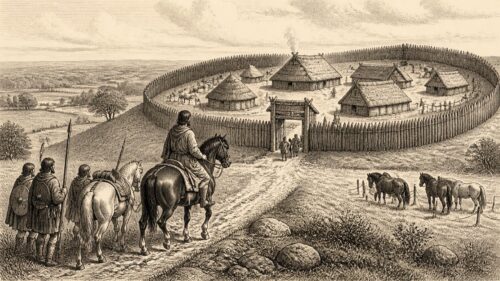
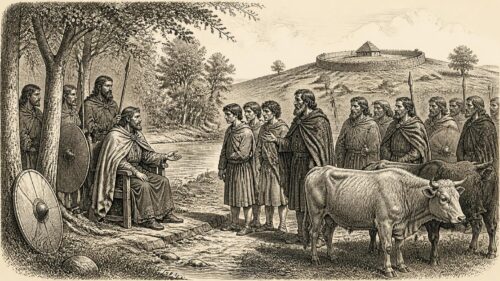
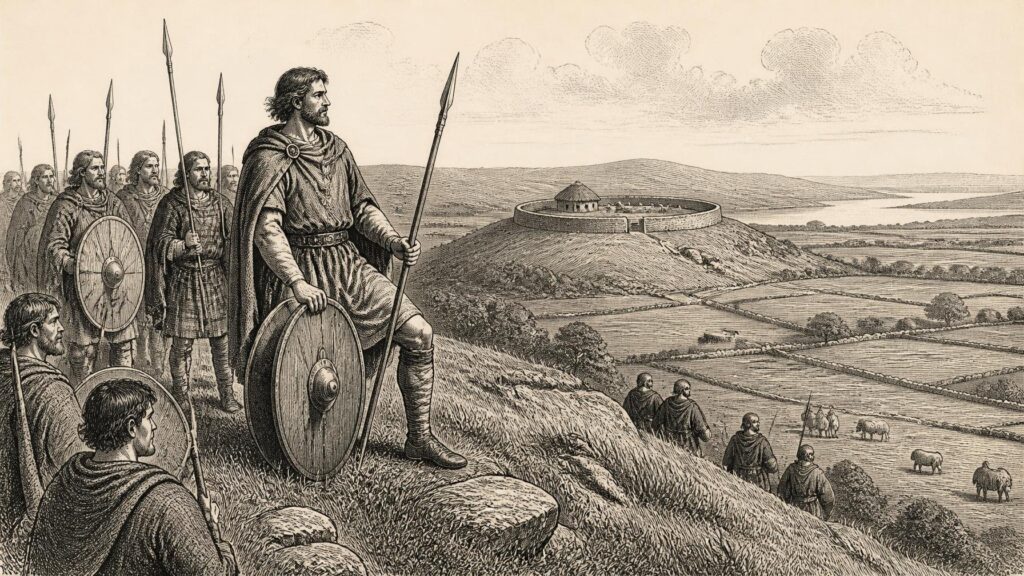
The sharpest political event recorded for the year was the battle in which Dúngal son of Máel Tuile, ruler of Cenél Bógaine, was defeated and killed by Loingsech. The Fragmentary Annals name the site as Tulach Árd, while the Annals of Tigernach describe Dúngal explicitly as king of Cenél Bógaine. This people occupied territory in what is now south County Donegal. The encounter was thus not an all-Ireland battle, despite the later importance of the victor, but a struggle within the northern world of the Uí Néill and their neighbouring kindreds.
Loingsech was associated with Cenél Conaill, the powerful northern Uí Néill dynasty whose ancestral lands lay largely in Donegal. His victory over Dúngal was the first securely recorded episode in his career. Later generations remembered Loingsech as a king of Tara, but that later eminence should not be projected back uncritically into 672. The contemporary-style annalistic notice says only that he won and Dúngal fell. It does not state why the two sides fought, how large their forces were, whether Tulach Árd was a planned battlefield or a contested meeting place, or whether Loingsech immediately took Dúngal’s authority for himself.
Nevertheless, the killing mattered. Early medieval Irish political life was organised through overlapping kin-groups, clientships and local kingdoms rather than a centrally administered national state. The death of a regional ruler could alter control of tribute, cattle, land and military followings, while also reshaping access to churches and learned households. A victory in Cenél Bógaine may have strengthened Cenél Conaill’s position in Donegal; it certainly announced Loingsech as a figure able to prevail in armed competition. Yet the evidence does not permit a claim that he conquered all of Cenél Bógaine, still less that he was already supreme across the north.
A New King of Tara
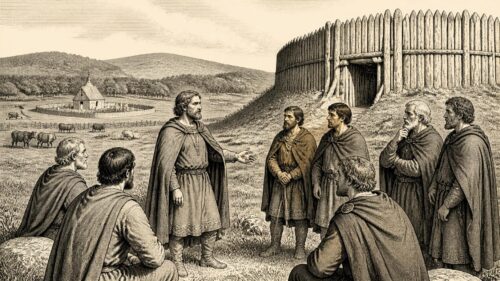
In the same annalistic year, Cenn Fáelad son of Blathmac “begins to reign”. He was the brother of Sechnassach, whose killing at the beginning of winter in 671 had abruptly removed the previous ruler. Both belonged to Síl nÁedo Sláine, a southern branch of the Uí Néill centred on Brega, the fertile region around the lower Boyne and Blackwater. Their father Blathmac, and his brother Diarmait, had earlier held the kingship of Tara. Cenn Fáelad’s accession therefore represented dynastic continuity after a violent interruption, rather than the foundation of a new political order.
“King of Tara” or “king of Ireland” is a useful conventional description, but it can conceal the limits of seventh-century power. Tara was a potent royal and ceremonial symbol; it was not the capital of a unified kingdom with officials governing every province. Cenn Fáelad’s position depended on the standing of his Brega kindred, on relationships with other Uí Néill branches, and on the readiness of rulers in Leinster, Ulster, Connacht and Munster to recognise claims when it suited them. The annalists’ formula marks a succession, not a demonstration of universal obedience.
The speed with which Cenn Fáelad followed his brother also suggests the importance of maintaining a family’s hold on pre-eminence. But stability should not be exaggerated. His reign lasted only a few years: he was killed in 675 by his cousin Fínshnechta Fledach. That later outcome does not make the accession of 672 insignificant; rather, it reveals how vulnerable even the most prestigious kingship remained to rivalry within the same extended dynasty. In 672, the succession solved an immediate vacancy, but it did not end the competition for Brega and Tara.
Armagh Burned
The burning of Ard Macha, Armagh, is the year’s most striking ecclesiastical notice. The Annals of Ulster pair it with the burning of the house of Taille son of Ségéne; the Annals of Tigernach render the second name differently as Tehelly. Neither source identifies the people responsible, explains whether the two fires were connected, or tells how much of Armagh was damaged. It would be unsafe to present the event as a raid by a named king, an attack on a particular church, or the destruction of the whole settlement.
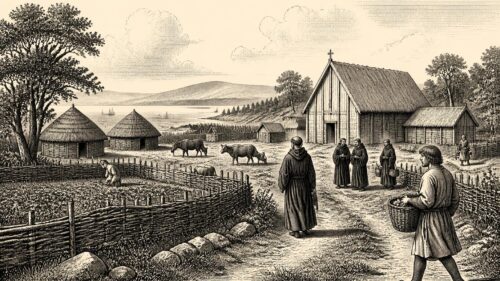
Its importance lies in what Armagh already represented. By the seventh century, its community was vigorously advancing its connection with Patrick. The Book of the Angel, probably composed around 640, is an early witness to Armagh’s claim to be Patrick’s church and to possess a special primacy. Later seventh-century Patrician writings associated with the community show that Armagh was not merely a rural church: it was a place where religious authority, political patronage and literary activity met. A fire there could damage homes, storehouses, workshops and timber ecclesiastical buildings, as well as disrupt a community of clerics, dependants and visitors. What cannot be known is whether books or relics were lost, rebuilt, moved or protected.
The incident also cautions against imagining monasteries as secluded settlements apart from secular affairs. Major churches accumulated land, food renders, livestock, skilled workers and influential contacts. They could be protected by kings, but that protection made them relevant to political struggles. The terse notice records destruction, not motive. Armagh’s prominence makes the event memorable; the silence surrounding it is equally important evidence of the limits of our knowledge.
Woodland Plenty and Rural Life
One unusual notice in the Annals of Ulster records an “abundance of mast”. Mast meant the seasonal crop of woodland nuts and seeds, especially valuable as fodder for pigs and as a sign of productive woods. The entry is not a harvest survey and cannot prove a uniformly prosperous year across Ireland. Nor does it tell us which trees yielded most heavily, who controlled woodland access, or whether the bounty reached poorer households. Its very inclusion, however, indicates that the condition of the natural world could be historically meaningful.
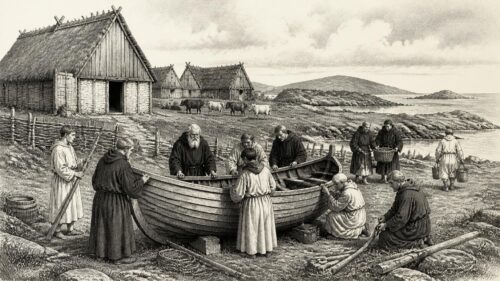
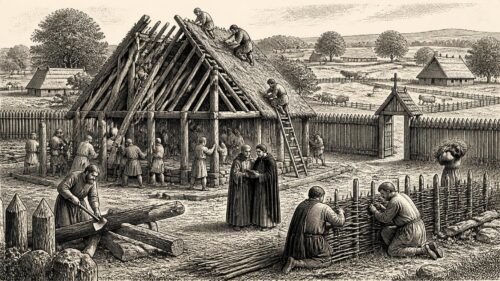
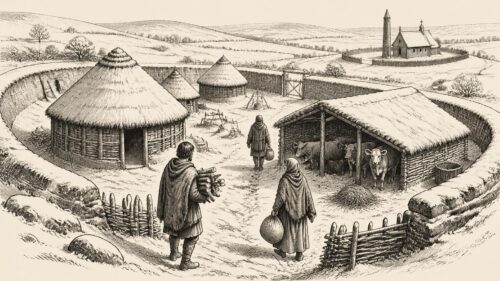
For most people, life in 672 was shaped more by the management of animals, grain and fuel than by named kings. Early medieval farmsteads were commonly enclosed ringforts or, in stonier districts, cashels. Their inhabitants lived in timber, wattle-and-daub or stone buildings, kept cattle and pigs, grew cereals, dried and ground grain, and practised crafts including textile work, leatherworking and ironworking. Cattle were central to wealth and exchange, but woodland resources mattered too: grazing and pannage, timber for structures and fires, and raw materials for tools and everyday objects all connected households to their local landscape.
The plentiful mast recorded in 672 should therefore be read as a narrow but revealing environmental observation. It may have eased the feeding of swine and helped sustain stores of meat and fat for households able to exploit woodland rights. It does not erase the risks of disease, raiding or a poor cereal crop. The annals preserve no general famine, epidemic or weather catastrophe for Ireland in this year. Their silence cannot prove that hardship was absent, but it prevents the historian from inventing it.
An Irish Sea Horizon
The Annals of Ulster also look beyond Ireland. They record that the Hebrides were devastated, that Drost was expelled from kingship, and that “Bangor of the Britons” was burned. These were events in northern Britain and Wales, not events demonstrably caused by Irish forces. The chronicle supplies no attackers, motives or detailed consequences. Bangor of the Britons is generally identified with the important British ecclesiastical community at Bangor-on-Dee, but the annalistic phrase itself is all that can securely be used here.
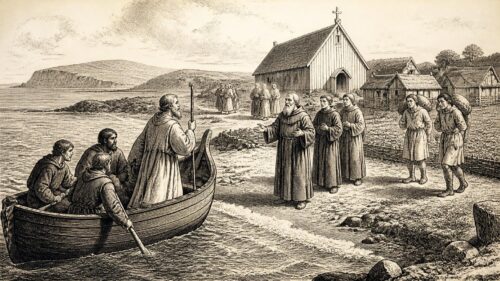
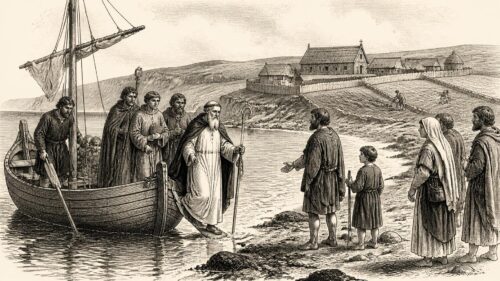
These notices are directly relevant to Irish history because the sea was a route, not an insurmountable frontier. Iona, founded by Colum Cille from Ireland in 563, stood within a Columban network spanning Ireland and northern Britain. It was readily reached by boat and was a centre of worship, learning and political connection. In 672 it was governed by Failbe, who had succeeded Cumméne Find after the latter’s death in 669. The devastation of the Hebrides and political upheaval among the Picts occurred within the wider maritime setting in which Irish churchmen, rulers and travellers moved, even though no surviving source says that Iona itself was attacked that year.
The year also includes the death of Cumascach son of Rónán. Unlike Dúngal or Cenn Fáelad, he is given no title in the principal notices. It is possible that contemporaries knew exactly who he was; modern readers do not. His commemoration is a reminder that the annals selected individuals from networks now only partly visible, and that absence of explanation should not be filled with conjecture.
A Year of Brief Notices
What survives for 672 CE is not a continuous history but a sequence of carefully retained fragments: Dúngal’s death at Tulach Árd; Cenn Fáelad’s accession; the burning of Armagh; a rich mast season; and turmoil across the Irish Sea. Their unevenness is revealing. Kings and battles appear because power was personal and contested. Armagh appears because churches were institutions of wealth, memory and authority. Mast appears because environmental plenty affected real livelihoods. Northern British events appear because Ireland belonged to a connected seaway world. Taken together, the records make 672 a year in which local conflict, dynastic succession, sacred prestige and seasonal resources all left their marks, however faintly, on the historical record.
Primary Sources
- The Annals of Ulster, U672
- The Annals of Ulster
- The Annals of Tigernach, T672
- The Annals of Tigernach
- Chronicon Scotorum
- Fragmentary Annals of Ireland, Part 3
- Cenn-Fáelad
- Loingsech
- Blathmac
- Adomnán
- Colum Cille (Columba)
- Cumméne (Cummíne, Cummian) Find
- Exploring the Irish Annals
- St Patrick
- History and Stories: Iona Abbey
- St Mary's Abbey, Iona, Monastic Settlement (SM12968)
- Early Medieval Farmsteads
- Irish Field Monuments
- Farming and Archaeology: The Irish Historic Landscape
- Traditional Buildings on Irish Farms: The Farmyard
- Doon Fort, County Donegal
- St. Deiniol’s Church, Church Lane, Bangor-is-y-Coed