Fáilbe’s Iona Succession679 CE
In 679, the death of Fáilbe, abbot of Iona, brought Adomnán to leadership of the Columban network linking Ireland and western Britain. The annals also note the death of Cenn Fáelad, remembered as a learned man, though later stories of his scholarship cannot be accepted uncritically. Fínnechta Fledach, king of Tara, defeated Bécc Bairrche of Dál Fiatach at Tailtiu, demonstrating the reach but not the supremacy of Uí Néill power. Leinster’s kingship remained contested. These notices reveal a rural, cattle-centred society shaped by rival dynasties, churches and learned culture.
Dateline
In 679 CE, Ireland’s annalists record a year defined less by a single island-wide crisis than by the passing and testing of influential people and institutions. The securely dated core consists of the death of Fáilbe, abbot of Í or Iona; the death of Cenn Fáelad, styled “the learned”; and a clash in which Fínnechta Fledach, the dominant Uí Néill king of Tara, defeated Bécc Bairrche. These concise notices are unusually revealing. Together they show a country of many competing dynasties, in which armed expeditions, ecclesiastical leadership and learned reputation all carried political weight.
A Year in Difficult Calendars
The year needs careful handling because the surviving Irish annals do not always preserve their material under the same numbered year. Copying, omitted calendar headings and later systems of dating created divergences between the Annals of Ulster, Annals of Tigernach, Chronicum Scotorum, Annals of Inisfallen and the much later Annals of the Four Masters. Modern chronological synchronisation places the relevant cluster of entries in 679 CE. The difference matters: the Four Masters, for example, give these events under 677, while their wording preserves valuable detail, including the place-name Tailtiu and Fáilbe’s date of death. It is therefore responsible to use the synchronised date of 679 while acknowledging that medieval chronicles were not modern annual newspapers.
No source describes a general famine, epidemic, climatic disaster or major constitutional settlement for this particular calendar year. Nor should the silence of the annals be turned into evidence that ordinary life was calm. Their compilers selected deaths, conflicts and occurrences meaningful to religious and political elites. The record for 679 is best read as a narrow but important window onto networks of lordship and learning, rather than as a complete account of everybody who lived through the year.
Fáilbe and the Columban Network
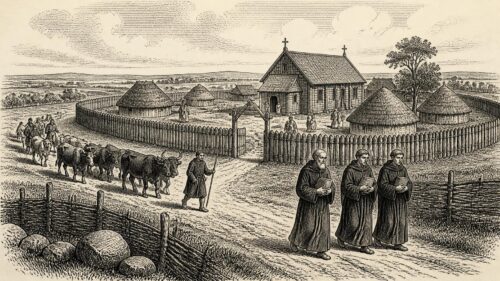
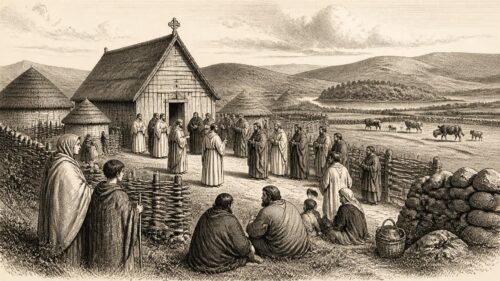
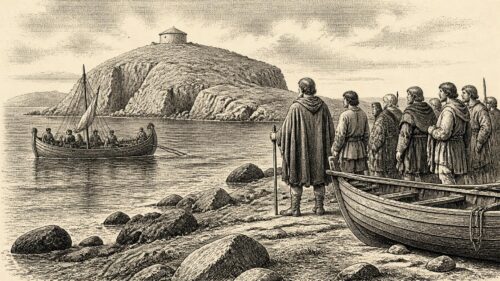
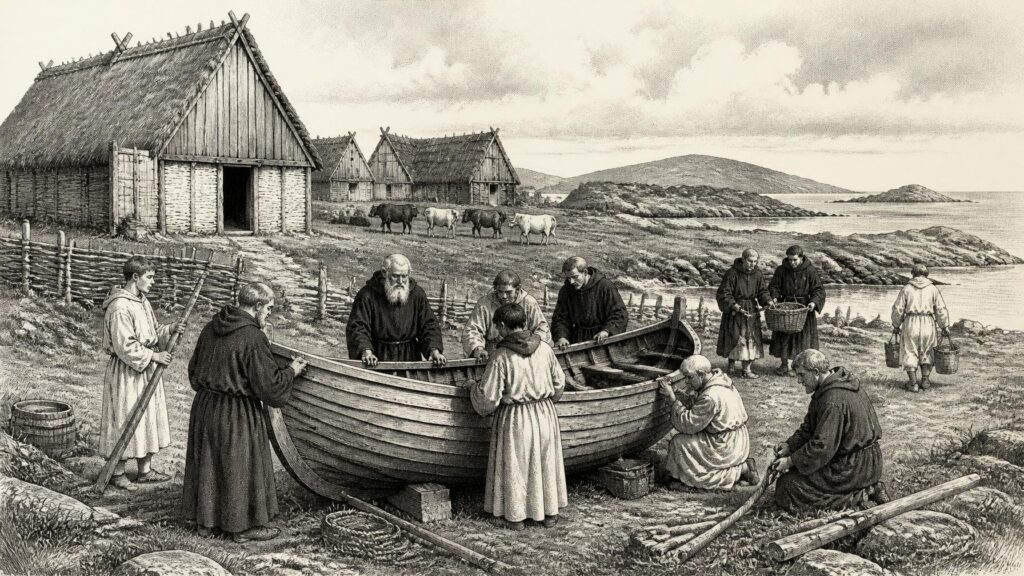
Fáilbe mac Pípáin, abbot of Iona, died in 679. A later annalistic tradition gives the date as 22 March, and modern reference scholarship accepts both his death year and his place as the eighth abbot of the community founded by Colum Cille. Though Iona lies off the west coast of present-day Scotland, its abbot belonged centrally to Irish history. The island stood within a Columban ecclesiastical network extending across the North Channel and deep into Ireland, especially among the Cenél Conaill and their associated churches.
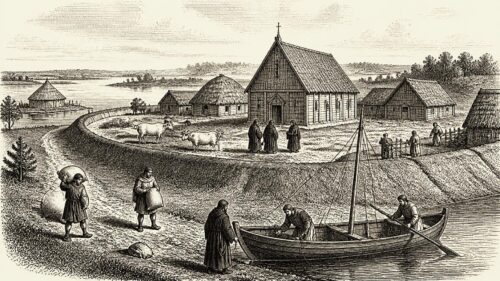
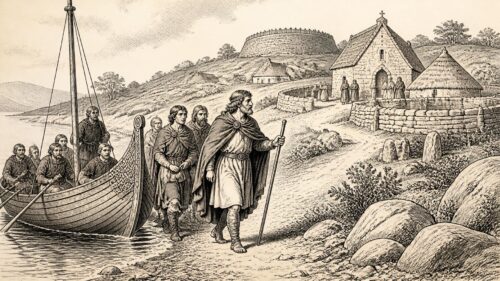
Fáilbe had been abbot since 669 and had spent much of his adult life within Iona’s community. He was not simply the manager of an isolated monastery. Earlier annals report his journey to Ireland in 673 and return in 676, evidence of an abbot travelling through the wider paruchia, the community of dependent or associated churches. Such journeys required sea crossings, hospitality, messengers and local alliances. They demonstrate enduring maritime communication between Ireland and western Britain, but they do not, by themselves, prove a specific commercial voyage or political mission in 679.
His death brought Adomnán into the abbacy, conventionally dated from 679 to 704. This was a consequential succession, though it must not be loaded with achievements that belong to later decades. Adomnán would become the author of the Vita Columbae, a powerful advocate of Columban interests, and a major ecclesiastical figure in Ireland and Northumbria. In 679, however, the immediate fact is a change of leadership at a community with long-standing Irish royal connections. Recent study of Iona’s abbots suggests that Fáilbe belonged to a succession shaped by kinship and by links to the Cenél Conaill; Adomnán’s accession altered that internal balance by bringing in someone associated with the royal line itself.
Fáilbe also mattered as a bearer of memory. Adomnán later named him as a source for stories about Colum Cille, including information conveyed by people who had known earlier generations of the community. The death of a senior abbot therefore meant the loss of a living archive as well as a leader. The traditions he transmitted were not yet fixed merely because Fáilbe died: the surviving Vita Columbae is a carefully shaped literary work, not a transcript of seventh-century conversation. Yet his remembered testimony helps explain how Iona could cultivate authority through ancestry, sanctity, travel and controlled recollection.
The Learned Man’s Death
The annals also record the “repose” of Cenn Fáelad son of Ailill son of Báetán, adding the exceptional description sapiens, a learned man. In a year otherwise marked by high politics and ecclesiastical succession, that designation is significant. It indicates that learning itself could be sufficiently prestigious to warrant a memorial notice alongside kings and abbots. Cenn Fáelad’s death is firmly placed in 679 by the synchronised annalistic evidence; much else attached to his name requires greater caution.
Later learned tradition made him a model scholar. A preface to the legal tract Bretha Étgid, composed centuries after his lifetime, says that he was wounded at Mag Rath in 637 and taken to Tuaim Drecain, where he encountered schools of Latin learning, native law and poetry. It further supplies the famous explanation that a head wound removed his “brain of forgetfulness”, giving him extraordinary memory. This vivid story cannot be treated as a straightforward biography of a seventh-century casualty. Modern scholarship stresses that little independently verifiable information survives about the historical Cenn Fáelad and that the tale is an explanation of how Irish learned culture imagined its own origins.
Even so, the legend is historically valuable for what it reveals about intellectual ideals. It presents Latin book-learning, fénechas or native legal learning, and filidecht, the discipline of poets, as connected rather than mutually exclusive worlds. Cenn Fáelad has consequently been associated in later tradition with grammatical, legal and literary material, including the Auraicept na n-Éces, or The Scholar’s Primer. Authorship of the text in its surviving form cannot securely be assigned to him, and the extant work cannot simply be dated to his lifetime. The annal’s modest but powerful label, “the learned”, is the evidence closest to 679; the elaborate scholarly persona is a later construction built upon it.
Tailtiu and Northern Power
The principal conflict recorded for 679 was the battle of Fínnechta against Bécc Bairrche. The terse annals do not give a detailed narrative, but the Four Masters locate it at Tailtiu, now Teltown in County Meath. Fínnechta Fledach had ruled Tara since 675 and represented the Síl nÁedo Sláine branch of the southern Uí Néill. Bécc was an important figure of Dál Fiatach in eastern Ulster, not yet overking of Ulaid but already a dynast capable of challenging Tara’s ruler. The encounter ended in Fínnechta’s favour.
That result was more than an isolated battlefield success. Tailtiu lay in the heartland of southern Uí Néill power, making Bécc’s strike an ambitious intrusion into territory associated with royal assembly and authority. Fínnechta’s victory advertised his ability to defend the midlands against northern as well as Leinster threats. It did not destroy Bécc: he remained politically significant, eventually becoming overking of the Ulaid in 692. The prudent conclusion is therefore not that 679 settled Ulster’s politics, but that Fínnechta had successfully repelled a serious challenger without permanently removing him from the field.
The battle also illustrates the limits of calling Fínnechta a national monarch. Ireland was divided among numerous small kingdoms and overkingdoms. The king of Tara could exercise formidable influence, extract submissions and win victories at prestigious places, but his position depended on military success, kin alliances and negotiation. The named opponents in 679 belonged to different dynastic worlds: southern Uí Néill in the midlands and Dál Fiatach in the north-east. Their collision is direct evidence of political connections across the island, but not of a unified Irish state.
Leinster’s Uncertain Record
The Fragmentary Annals add that Fiannamail son of Máel Tuile “began to reign over the Laigin” in 679. This notice should not be used to assign him a certain accession date. Other evidence, including Leinster king-lists and modern reconstruction, suggests that Fiannamail had been recognised as Leinster’s overking from about 666 or 667. The 679 entry may reflect a particular restoration, recognition or annalistic rearrangement rather than his first assumption of power. What is secure is the wider setting: Fiannamail’s Uí Máil dynasty was contending with rival Leinster lineages and with Fínnechta’s pressure from the north.
This uncertainty is itself instructive. Kingship was not always transferred in a single, universally acknowledged act. Provincial authority could be challenged, shared, interrupted or retrospectively reordered by later genealogists. Fiannamail’s position was precarious: he had already faced Fínnechta near Loch Gabor in 677, and he would be killed in 680 by a kinsman, according to the annals, in circumstances linked by later tradition to Fínnechta. For 679, it is safer to see Leinster as contested territory than to claim a clean new reign.
The Country Beyond the Notices
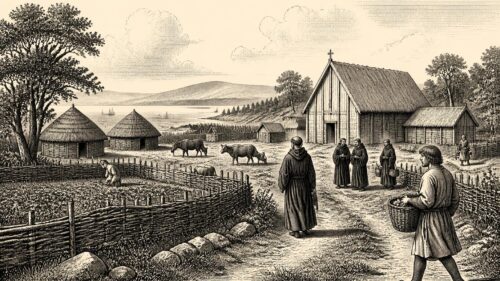
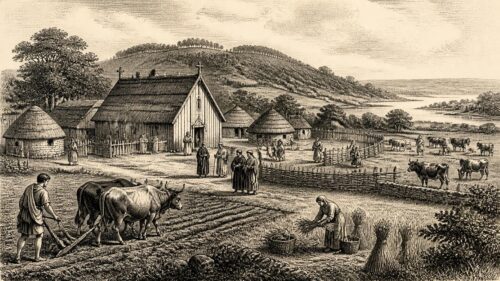
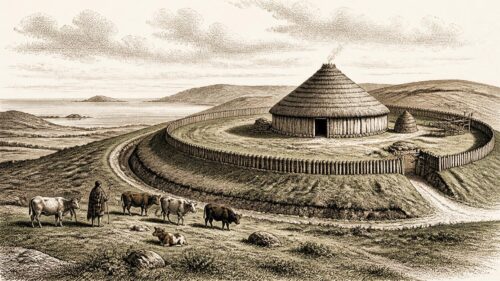
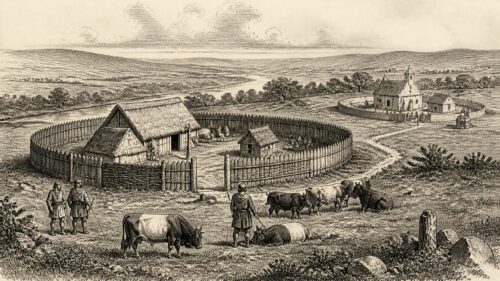
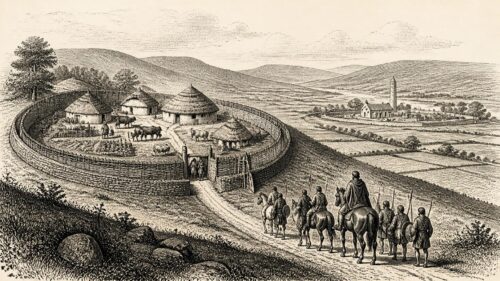
The people absent from the annals lived largely in dispersed rural settlements: enclosed farmsteads, crannógs, coastal places and communities around churches. Cattle were a principal measure of wealth and status, while cultivation supplied household needs. Archaeology shows a varied landscape rather than a country of towns. Important ecclesiastical sites could possess enclosures, workshops, metalworking, imported goods, grain-processing and surrounding dependent households, but they should not be casually described as cities in 679. They were religious centres embedded in agricultural and political landscapes.
The year’s notices bring that wider society into focus. A battle at Tailtiu presupposed the mobilisation and feeding of armed followers. An Iona abbot’s authority rested on communities, estates, boats and relationships on both sides of the sea. A scholar’s renown rested on teachers, manuscripts, oral performance and patrons. Yet none of this permits precise claims about harvest levels, population, prices or trade in 679. The responsible picture is one of a rural, cattle-centred society in which churches and dynasties concentrated labour, learning and influence.
Thus 679 CE was a hinge year in several connected histories. Fáilbe’s death opened Adomnán’s abbacy at Iona; Cenn Fáelad’s death marked the passing of a figure who became an emblem of Irish learning; and Fínnechta’s victory at Tailtiu defended the reach of Tara’s kingship. Their coincidence does not make 679 a dramatic national turning point in the modern sense. It does, however, show the institutions that shaped early medieval Ireland: mobile ecclesiastical federations, competitive dynasties, and a learned culture able to preserve names long after the details of individual lives had faded.
Primary Sources
- The Annals of Ulster
- Part 10 of The Annals of Tigernach
- Chronicon Scotorum
- Annals of Inisfallen
- Part 4 of Fragmentary Annals of Ireland
- Part 51 of Annals of the Four Masters
- Chronological Synchronisation of the Irish Annals: AD 679–694
- Chronological Synchronisation of the Irish Annals
- The Chronology and Sources of the Early Irish Annals
- Fáilbe
- Bécc Bairrche
- Fiannamail
- Early Mechanisms of Abbatial Succession: The Case of Iona (563–704)
- The Life of Columba, Written by Adamnan
- Í > Ioua > Iona – Iona’s Namescape
- The Learning of Ireland in the Early Medieval Period
- The Scholar’s Primer
- The Narrative Setting of Baile Chuinn Chétchathaig
- Agriculture, Settlement and Society in Early Medieval Ireland
- Early Medieval Archaeology Project: Report 2.1
- Early Medieval Ireland: Archaeological Excavations, 1930–2009
- Exploring the Irish Annals