Mag Luinge673 CE
In 673, sparse Irish annals record the killing of Domangart, king of Dál Riata, the burning of Mag Luinge, the capture of named men, Cormac son of Máel Fothartaig’s death, and Abbot Fáilbe’s journey from Iona to Ireland. The evidence does not explain motives, locations or consequences in detail. Mag Luinge was probably a Columban monastery on Tiree, though this remains uncertain. Fáilbe’s visit demonstrates Iona’s active connections with Irish churches. Together, the notices reveal contested authority, vulnerable ecclesiastical communities and the importance of sea routes linking Ireland, Dál Riata and the Hebrides.
Dateline
In 673 CE, the Irish annals conventionally group together a small but revealing set of notices: the killing of Domangart, king of Dál Riata; the burning of Mag Luinge; the capture of two named men; the death of Cormac son of Máel Fothartaig; and the voyage to Ireland of Fáilbe, abbot of Iona. None is supplied with a month, day or full narrative. Even the year requires care: the Annals of Ulster preserve these entries under their annal 673 while displaying an Anno Domini equivalent of 672, whereas the Annals of Tigernach place the closely corresponding material under 673. Modern discussion commonly treats the cluster as belonging to 673, but it cannot responsibly be narrowed to particular dates within the calendar year. What survives is not a chronicle of all Ireland, but a set of brief records which illuminate the sea-linked political and ecclesiastical world in which Ireland stood.
A Year of Sparse Records
The sparseness matters. Seventh-century Irish annals did not aim to describe ordinary life from one New Year to the next. They selected deaths, killings, burnings, travels and major changes in rule, usually in phrases short enough to fit beside Easter tables. Silence does not mean peace, prosperity or inactivity. It means only that no surviving annalistic notice records such matters. Conversely, a terse entry such as “the burning of Mag Luinge” should not be inflated into a detailed raid, massacre or political campaign. The record does not identify the attackers, say whether the fire was deliberate, name casualties, or describe what was destroyed.
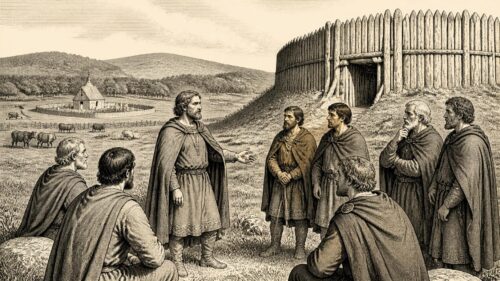
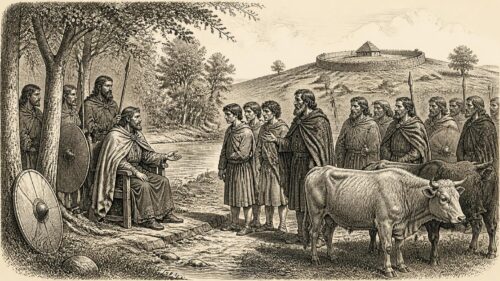
There is also no securely dated battle in Ireland recorded for 673 itself. The political background was nevertheless unsettled. Cenn Fáelad, of the Síl nÁedo Sláine dynasty of Brega, had recently emerged as a leading claimant to the kingship of Tara after the killing of Sechnassach, his kinsman. Such high kingship was not government over a united territorial state in the modern sense. Authority rested on alliances, tribute, military followings, hostages and acknowledged precedence among numerous regional dynasties. A ruler’s position could be formidable without being uniform across the island.
For communities outside royal centres, the practical face of politics was more local: the demands of a nearby king or lord, the security of cattle and grain, kin obligations, and the protection available through a church or monastery. The annals’ concern with named captives is a reminder that imprisonment and seizure were recognised instruments of power. Under the year in question, the Annals of Ulster note the capture of Elén son of Corp and, less certainly because of a damaged or ambiguous reading, Conamail son of Cano. The text gives neither place nor captor. It demonstrates the practice, not the circumstances.
Domangart and the Sea Kingdom
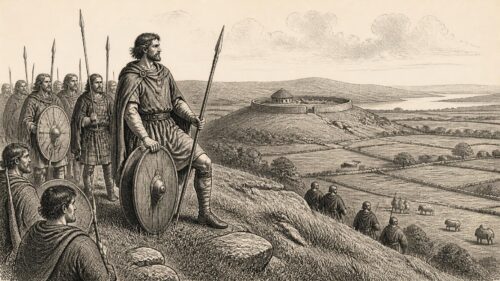
The most explicitly political notice is the slaying of Domangart son of Domnall Brecc, called king of Dál Riata. Dál Riata was directly relevant to Ireland even though much of its later-known heartland lay in western Scotland. It was an Irish Sea polity, bound by kinship, language, ecclesiastical connections and regular movement across the narrow waters between north-east Ireland, the Hebrides and Argyll. Its royal kindreds had roots on both sides of the channel, and Irish annalists treated its rulers as figures within their own wider historical horizon.
Domangart’s father, Domnall Brecc, had been deeply involved in the politics of northern Ireland before his death three decades earlier. The son’s killing in 673 therefore marked another blow to a dynasty already shaped by warfare and shifting alliances. Yet the annal supplies no battlefield, opponent or successor. It is unsafe to present the death as the decisive end of a regime, or to assign a motive such as Pictish aggression, internal feud or Irish intervention. What can be said is that a king’s violent death exposed the fragility behind royal titles. In a sea-facing world, instability in Dál Riata affected the same maritime networks through which Irish churches, travellers and political information moved.
This is one reason why events in western Scotland belong in an Ireland year-by-year account. The waters between Ireland and Britain were routes rather than barriers. Religious personnel, learned traditions, relics, goods and royal exiles crossed them. The political vocabulary of the annals likewise crossed them: a killing in Dál Riata could be entered alongside an abbot’s voyage to Ireland because both concerned communities that Irish writers understood as connected.
Fáilbe Comes to Ireland
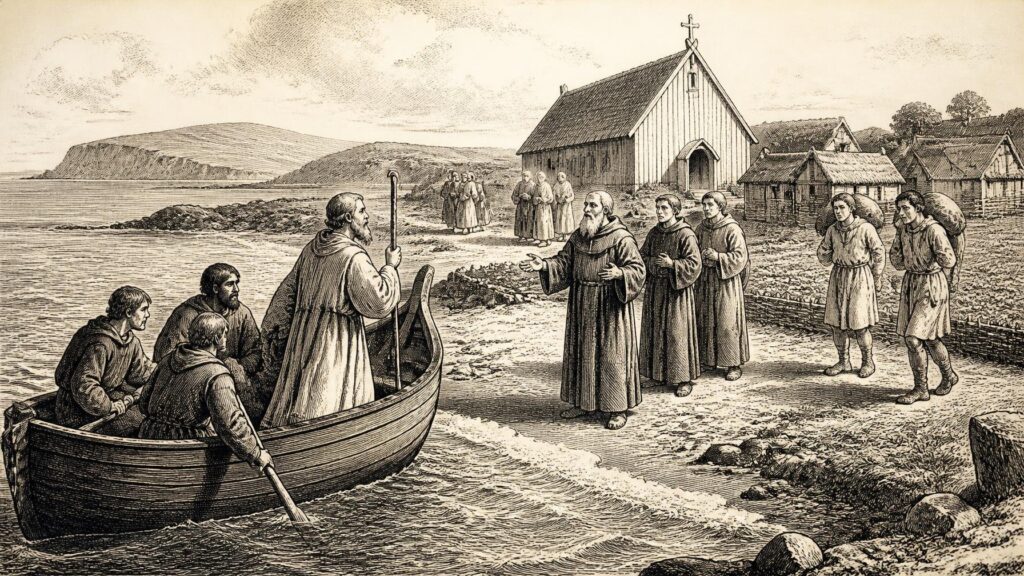
Fáilbe, abbot of Iona, provides the clearest Irish development of the year. The Annals of Ulster call it his voyage “to Ireland”; the Annals of Tigernach preserve a divergent reading that sends him to Spain, an implausible destination in this context and one rejected by the stronger Iona and Irish evidence. Fáilbe’s Irish visit is also supported by the later record of his return after three years. The safest conclusion is that he travelled from Iona to Ireland in or about 673 and remained away from Iona for a substantial period, conventionally dated 673–676.
His journey was important because Iona was not an isolated island house. Founded by Colum Cille in the previous century, it headed a far-reaching Columban paruchia: a network of associated churches, communities, properties and personal relationships extending through Ireland and across the Irish Sea. An abbot’s presence among Irish houses could reinforce authority, settle business, maintain friendships among powerful families, supervise clergy and bind communities together through worship and commemoration. None of those specific purposes is stated for Fáilbe’s journey, so none can be asserted as fact. But the journey itself is firm evidence that the superior of Iona’s community was expected to be mobile within its wider Irish sphere.
Fáilbe’s absence also offers a human glimpse of monastic organisation. A major monastery did not stop functioning when its abbot travelled. Senior brethren managed worship, hospitality, food stores, boat traffic, estate labour and discipline. Later tradition associates the young Adomnán, Fáilbe’s eventual successor, closely with this period of Iona’s history. Adomnán stated in his Life of Columba that he received information from Fáilbe. That personal chain of recollection linked the generation of Colum Cille with the learned world that would produce one of early medieval Ireland’s greatest Latin works.
The Burning of Mag Luinge
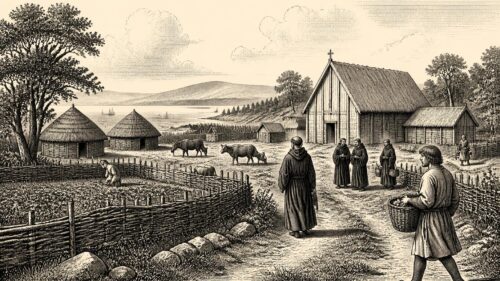
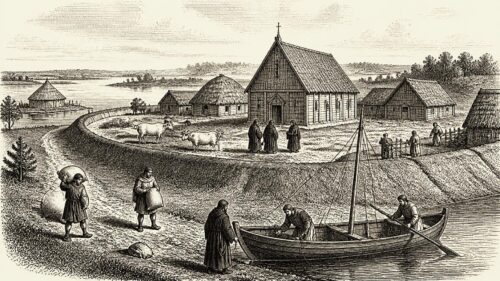
The burning of Mag Luinge is the year’s most evocative but most difficult Irish-Sea notice. A strong scholarly case identifies Mag Luinge with Campus Lunge, a Columban monastery on Tiree in the Inner Hebrides, mentioned in Adomnán’s account of Columba. The identification is probable rather than mathematically certain, because similar Irish place-names existed and the annal gives no geographical explanation. Its placement among other Dál Riata and Iona-related items, however, makes Tiree a persuasive setting.
If that identification is correct, the fire struck a dependent community in the same Columban world as Fáilbe’s Irish journey. The coincidence should not be made into a causal story. The annals do not say that Fáilbe left Iona because Mag Luinge burned, that he travelled there, or that the fire was connected with Domangart’s death. It is possible only to observe that 673 brought both disruption at a Columban-associated foundation and the abbot’s movement into Ireland.
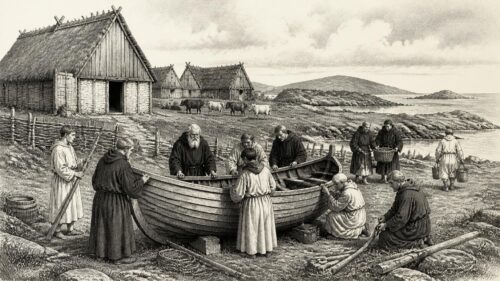
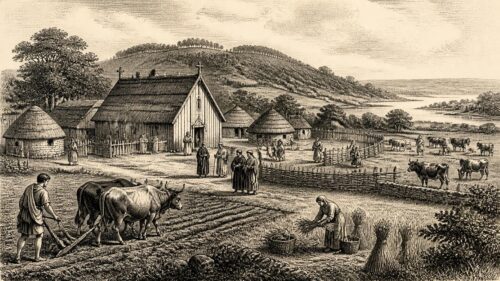
Archaeological and environmental research on Tiree gives useful wider context, not a dated reconstruction of the fire. Evidence points to a productive seventh-century agricultural landscape near proposed locations for Mag Luinge, including cereal cultivation. Such communities depended on fields, grazing, stored food, timber buildings and labour from both religious and lay households. A fire at an ecclesiastical settlement could therefore threaten more than an oratory: it might destroy accommodation, tools, food reserves, manuscripts or boatshed materials. Whether any of these were lost at Mag Luinge remains unknown. The annal’s single word preserves the event, not its material scale.
Households, Churches and Memory
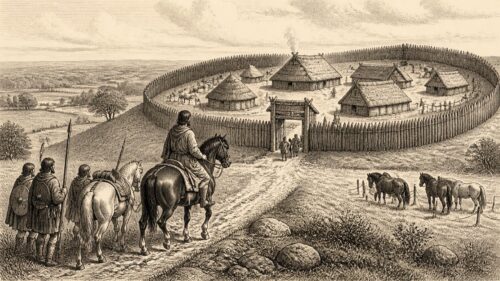
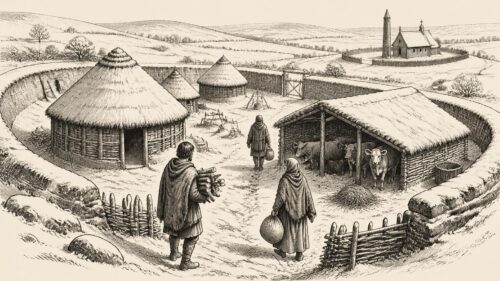
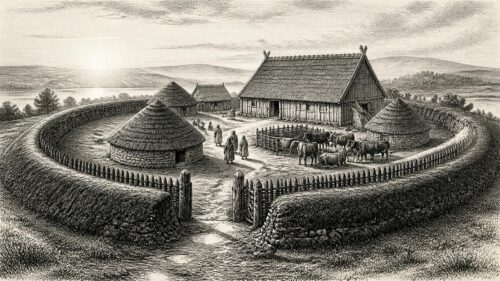
Most people in Ireland in 673 lived in dispersed rural settlements rather than towns. Ringforts and stone cashels, constructed principally during the early medieval period, enclosed farmsteads with houses, livestock pens and working space. Cattle were central to wealth and food, while cereals, dairying, craftwork and seasonal labour sustained households. Monasteries were part of this countryside, not places apart from it: they needed tenants, cultivation, artisans, visitors and transport. Their churches also offered burial, patronage, literacy and routes into wider political networks.
The annalists preserved the names of kings, abbots, captives and the dead because people and institutions mattered to their communities. Cormac son of Máel Fothartaig, whose death is entered alongside the captives, remains otherwise shadowy. He may have been significant to the annalist’s local milieu, but the text does not give him a title. It would be wrong to manufacture one. His brief obit is instead a reminder of how much seventh-century Ireland has lost: countless lives appear only as a name, while still more were never written down.
Thus 673 is best understood not as a year dominated by one Irish battle or royal settlement, but as a moment in a connected archipelago. Dál Riata lost a king; Mag Luinge suffered a fire; named individuals were captured or died; and Fáilbe crossed to Ireland to engage with Iona’s larger ecclesiastical world. The surviving evidence is narrow, yet it reveals the essentials of the age: contested authority, vulnerable communities, mobile church leadership and a sea that joined Ireland to its neighbours.
Primary Sources
- The Annals of Ulster
- The Annals of Ulster: TEI Header
- The Annals of Tigernach, Part 10
- The Annals of Tigernach
- Annals of Tigernach: Irish and Latin Text
- Annals of Inisfallen, Part 3
- Fragmentary Annals of Ireland, Part 3
- Annals of the Four Masters
- Chronicon Scotorum
- The Life of Columba, Written by Adamnan
- Life of St. Columba
- Life of St Columba by Adomnán: Manuscripts and Editions
- Fáilbe
- Í > IOUA > IONA – Iona’s Namescape
- Adomnán’s Vita Columbae and the Early Churches of Tiree
- The Iona Chronicle, the Descendants of Adomnán and the ‘Celtic’ Church
- Early Mechanisms of Abbatial Succession: The Case of Iona (563–704)
- Farmers, Monks and Raiders: Exploring Cultural and Environmental Transitions During the 1st Millennium AD on the Island of Tiree
- Irish Field Monuments
- Earthen Banks and Broken Walls: Archaeology of the Irish Countryside