Grellach Dollaig’s Broken Kingship695 CE
In 695, Fínsnechtae Fledach, king of Tara, and his son Bresal were killed at Grellach Dollaig by rivals from related Síl nÁedo Sláine branches in Brega. The annals provide few details, but the deaths disrupted Brega’s leadership and opened the way for Loingsech of the northern Cenél Conaill to claim kingship. Later tradition praised Fínsnechtae for remitting cattle tribute, reflecting the economic and political importance of livestock. The annals also record the death of Menn Bairenn, abbot of Aghaboe, illustrating the close connection between royal power, kinship, rural economy and ecclesiastical institutions.
Dateline
In 695 CE, the most securely placed Irish development was the killing of Fínsnechtae Fledach, king of Tara, and of his son Bresal at Grellach Dollaig. The Annals of Tigernach and Chronicon Scotorum assign the event to this year, naming the killers as Áed son of Dlúthach and Congalach son of Conaing. Their terse record calls it a battle, but supplies neither day nor season, nor a narrative of manoeuvres or troop numbers. It nevertheless marked a decisive rupture in the leadership of Brega and in the wider overkingship which Fínsnechtae had exercised for about two decades.
An Annalistic Date, Carefully Used
The date needs a word of caution. Irish annals were compiled and copied over centuries, and their year-numbers do not always align exactly. The Annals of Ulster place Fínsnechtae’s death in their entry U695, immediately after a heading calibrated to AD 694, while the later Annals of the Four Masters put the same killing under 693. The convergence of the Annals of Tigernach, Chronicon Scotorum, and modern prosopographical scholarship supports 695 CE as the most responsible calendar year for the event, but it does not permit a more precise date. This is a useful reminder that an annal entry is evidence preserved through a textual tradition, not a contemporary newspaper report.
The Fall of Fínsnechtae
Fínsnechtae, whose byname Fledach is commonly understood as “of the feasts” or “bountiful”, belonged to Síl nÁedo Sláine, a powerful southern Uí Néill kindred rooted in Brega, the rich lowland region around the Boyne and the Blackwater. The annals style him king of Temair, or Tara. That title expressed an exceptional claim to overlordship and precedence, rather than rule over a centrally administered Irish kingdom. Late seventh-century Ireland remained a landscape of many small and middling kingdoms, bound by shifting clientships, tribute, marriage, fosterage, church alliances and armed pressure. A king of Tara had to sustain influence continually; no permanent state apparatus could make that authority automatic.
His own career showed both the reach and the vulnerability of such power. Fínsnechtae had gained the kingship in 675 after defeating and killing his cousin Cenn Fáelad. He subsequently struck north against Ailech, met Leinster forces near Loch Gabair, and fought opponents connected with Ulster. He also briefly entered clerical life in 688 before returning to kingship. These were not distant episodes in an abstract national struggle: they were contests among dynasties whose territories lay near one another, whose genealogies overlapped, and whose rulers could be allies in one season and enemies in the next. By 695, Fínsnechtae’s authority had survived external challenges but not rivalry within the very dynasty that underpinned it.
The named victors underline that point. Áed son of Dlúthach was king of Fír Chúl, a Brega people, and his ancestry also ran back to Áed Sláine. Congalach son of Conaing belonged to another branch of the same wider Síl nÁedo Sláine inheritance. The killing of Fínsnechtae and Bresal was therefore not simply an invasion of Brega from outside. It was a violent reordering of its ruling kin. Bresal’s death mattered politically as well as personally: removing a king and an adult or near-adult son could disrupt an immediate line of succession and leave followers, clients and ecclesiastical partners to recalculate their allegiances.
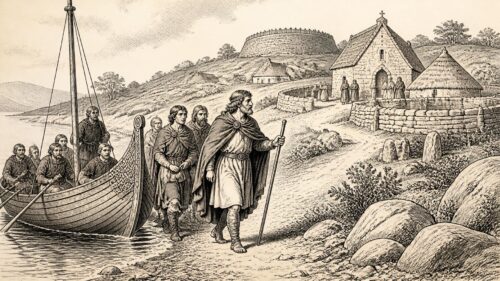
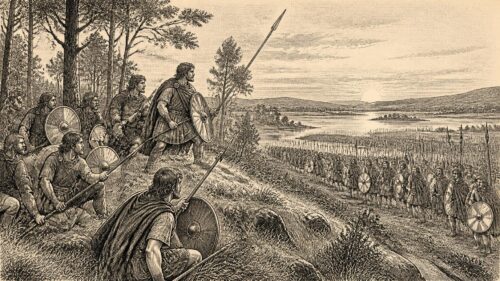
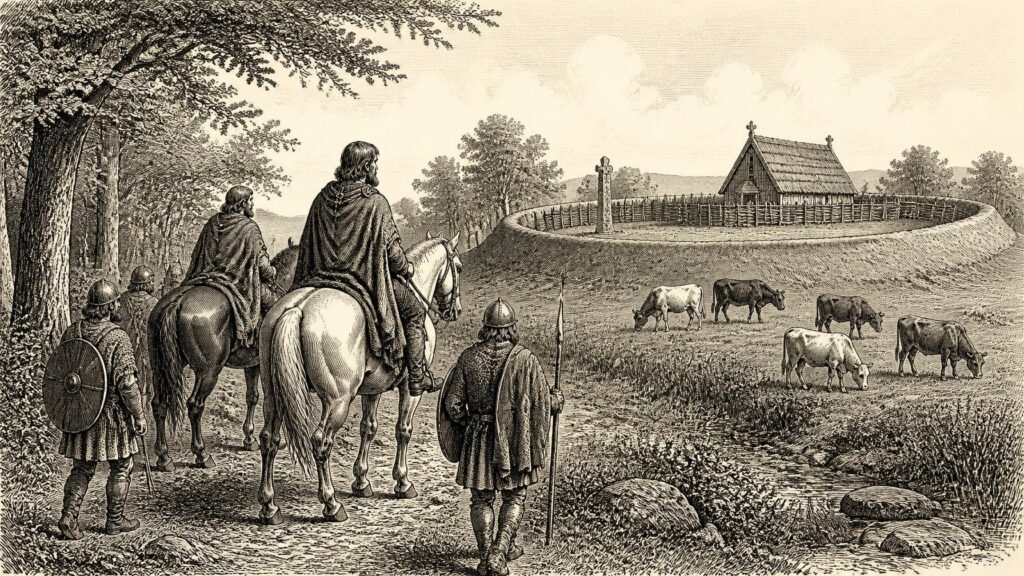
Grellach Dollaig itself should not be embellished beyond the evidence. Its name denotes a place, probably a clearing or pass, but the sources do not securely identify it in the modern landscape. Nor do they tell whether Fínsnechtae was surprised, defeated in open fighting, betrayed, or trapped while travelling. Later Irish historical writing sometimes enlarges such moments into dramatic scenes; the contemporary annalistic core does not. What can be said is enough: in 695 a royal father and son were killed by identified rivals, and the kingship associated with Tara was abruptly opened to new claimants.
Loingsech’s Opening
The Annals of Tigernach and Chronicon Scotorum add a compact but important notice: Loingsech son of Óengus “began to reign”. Loingsech came from Cenél Conaill, the northern Uí Néill dynasty associated with north-western Ireland, rather than from Fínsnechtae’s Brega branch. His accession demonstrates that the collapse of one dominant lineage could create an opportunity well beyond the immediate battlefield. Yet it would be misleading to picture a settled transfer of an Irish crown. Congalach, one of Fínsnechtae’s slayers, was still an important figure and died only in the following annalistic year in the Annals of Ulster. The evidence points to a contested political field in which claims could coexist, rather than to a single ceremonial succession.
For people living under these rulers, the consequences were practical. Kingship brought expectations of protection, judgment, hospitality and gift-giving, but also military service and renders. A change at the top could alter who collected food-rents, cattle, labour and hostages, which church received royal favour, and which local lord had reason to fear a raid. The sources do not record a general campaign across Ireland in 695, and one should not invent such an upheaval. Even so, the elimination of Fínsnechtae and Bresal would have made Brega’s political relationships unusually uncertain, especially along the routes and estates through which livestock, food and people moved.
Cattle, Tribute and Memory
Fínsnechtae’s death was quickly framed in moral as well as political terms. The Annals of Tigernach preserve verses attributed to Mo-Ling of Luachair and Adomnán of Iona. Mo-Ling hopes that the dead king may receive heavenly reward “for forgiving the tribute”; Adomnán’s verse associates him with a remission involving great quantities of cattle and calves. These stanzas are valuable because they show how royal reputation could be attached to an act of fiscal mercy. They should not, however, be treated as a verbatim record spoken at Grellach Dollaig, or as proof that every detail of the later story was known in 695.
The tribute in question became the subject of the much later Bórama Laigen, a narrative centred on the cattle-tribute supposedly owed by Leinster. That text makes Mo-Ling’s intervention a memorable encounter between saint and king. It preserves an important medieval political memory, but its surviving form cannot simply be read back as straightforward seventh-century reportage. The secure point for this year is narrower and revealing: the annalists attached Fínsnechtae’s salvation and fame to the remission of a cattle levy. In an economy where cattle were a principal measure of wealth, status and obligation, that was no small praise.
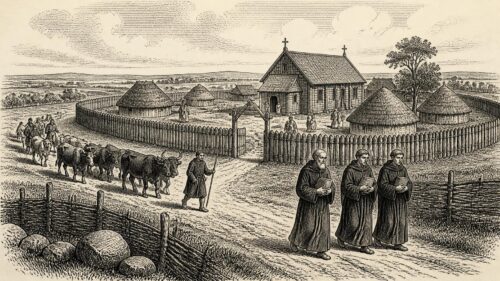
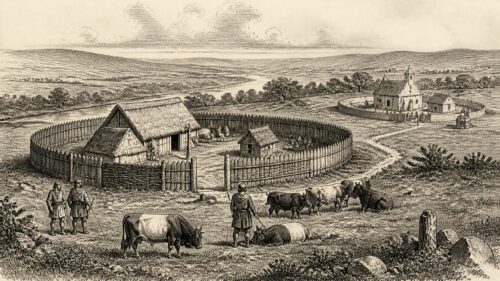
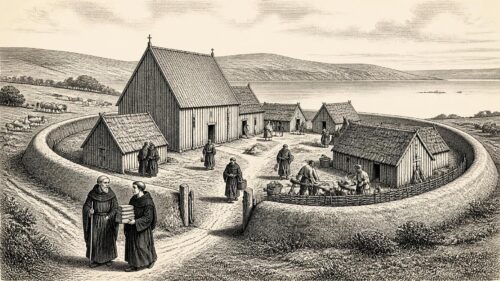
Cattle were more than food animals. They supplied milk, meat, hides, dung and traction, while their ownership underpinned credit, compensation and social rank. Stock could be transferred in bridewealth, fosterage arrangements, fines and tribute; its seizure could punish an opponent without permanently occupying land. The royal crisis of 695 therefore touched an agrarian world in which political authority was experienced through herds, seasonal labour and reciprocal obligations. This is broader context for the year, not an assertion that a particular tribute was collected or remitted in 695 itself. Archaeology and early legal material together indicate a predominantly rural society in which enclosed farmsteads, pasture, crops and household production shaped ordinary life.
A Church in Public Life
Religion appears in the year’s record not as a separate sphere but as part of public authority. The annals record the death of Menn Bairenn, abbot of Achad Bó, modern Aghaboe in Ossory, and the killing of Tadc son of Failbe in Glenn Geimin, in the north. The annals offer no explanation for either notice, so it would be unsafe to connect Tadc’s death to the killing at Grellach Dollaig or to give Menn Bairenn a role in the succession. Their inclusion nevertheless shows the breadth of annalistic attention: political violence, monastic leadership and deaths within regional elites belonged to the same historical register.
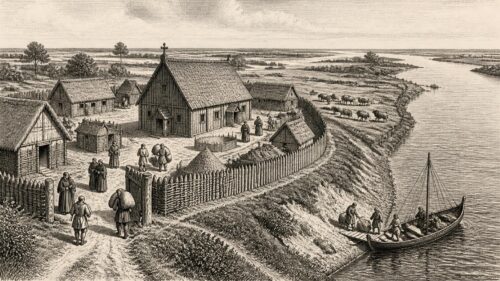
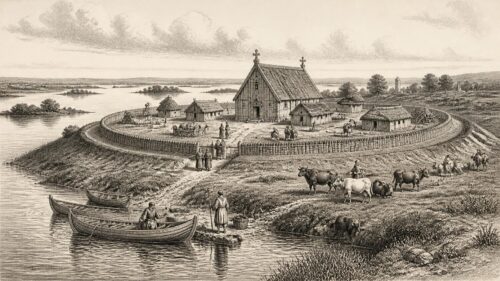
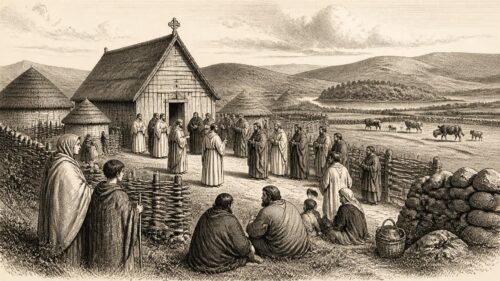
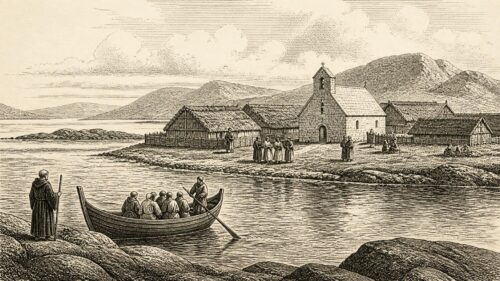
Aghaboe was a religious foundation with roots in the sixth century. In 695 its abbot’s death would have concerned a community that was at once spiritual, landed and social: a place of worship and burial, but also a centre requiring food, livestock, buildings, labour, learning and links with patrons. Monasteries did not stand apart from the rural economy. Archaeological work shows early medieval ecclesiastical settlements as significant economic centres, sometimes with evidence for craft activity and imported goods, while the surrounding countryside was filled with raths, crannógs, fields and routeways. The death of an abbot thus mattered to more people than the clerics immediately within an enclosure.
The verses on Fínsnechtae also reveal the authority that saints and churchmen could claim over kings in historical memory. Mo-Ling and Adomnán were presented as judges of a ruler’s generosity, capable of placing political conduct within a Christian account of reward. That does not mean churchmen controlled kingship, nor that Irish warfare had become less severe. Rather, royal power increasingly needed ecclesiastical language, patronage and commemoration. In 695, the violent end of a king could be remembered simultaneously as a dynastic struggle and as an occasion to praise the remission of burdens.
What the Year Does Not Show
It is tempting to turn 695 into a turning point for all Ireland. The sources do not warrant that. They do not record a nationwide assembly, a lawmaking synod, a famine, a plague, a major foreign expedition, or a general war between the island’s larger provinces in this calendar year. Events sometimes associated with this period must remain where the evidence places them: Adomnán’s Law of Innocents belongs to the following year in the principal annalistic sequence, and the wasting of Mag Muirtheimne by Britons and Ulaid is also later. Keeping those developments separate makes the year clearer, not thinner.
What 695 CE does show is the fragility of high status in early medieval Ireland. Fínsnechtae had ruled long enough to leave a political and literary reputation; his rule had reached across dynastic frontiers and been remembered through stories of generosity. Yet he and Bresal could still be killed by kinsmen at a place whose precise location is now uncertain. Loingsech’s recorded accession immediately follows, while an abbot’s death at Aghaboe reminds us that religious communities continued their institutional lives amid elite violence. The surviving notices are brief, but together they capture a society in which kingship, cattle, church authority and kinship were inseparably entangled.
Primary Sources
- The Annals of Ulster
- The Annals of Tigernach
- Part 11 of The Annals of Tigernach
- Chronicon Scotorum, Part 70
- Annals of Inisfallen, Part 25
- Fragmentary Annals of Ireland, Part 8
- Annals of the Four Masters, Part 52
- Fínshnechtae Fledach
- Fín˙nechtae Fledach mac Dúnchada: (d. 695), high-king of Ireland
- CELT Project: Fragmentary Annals of Ireland
- Irish Sagas: Bóroma Text
- Agriculture, Settlement and Society in Early Medieval Ireland
- Early Medieval Archaeology Project: Early Medieval Agriculture and Economy
- EMAP Report 2.1: The Early Medieval Church
- The Economy of Early Medieval Ireland
- Early Medieval Ireland: Archaeological Excavations, 1930–2009
- Early Medieval Rural Settlement and Infrastructure Archaeology Across Europe
- Ireland, 400–800
- Ireland in the Middle Ages
- Aghaboe Abbey