Tarachin’s Irish Refuge698 CE
In 698, Irish annals record Tarachin’s journey to Ireland and an unexplained battle associated with Fiannamail son of Oiséne. Chronological variation requires caution: Tarachin may have been connected with the deposed Pictish ruler Taran, but neither identity nor motives are certain. His crossing nevertheless illustrates Ireland’s maritime links with Dál Riata, Pictland and western Britain, and its potential role as refuge for displaced elites. Fiannamail’s battle reflects localised violence within a fragmented political landscape under Loingsech’s influence. Churches, rural production and literate communities supported authority and preserved selective memories. Ireland was connected, decentralised, and politically active, not unified or isolated.
Dateline
In 698 CE, Ireland appears in the surviving annals as a place of arrival as well as a place of its own small-scale conflict. The most securely calendar-dated notice is terse: “Tarachin proceeds to Ireland.” In the same annal year, the record names a battle involving Fiannamail son of Oiséne, but gives neither its location nor its outcome. These scraps do not permit a dramatic narrative of national crisis. They do, however, offer a valuable view of Ireland’s position at the centre of the northern Irish Sea world: a country divided among many kingships, linked by sea-routes to western Scotland and Pictland, and capable of receiving an important traveller from across the water.
A Date That Needs Care
The year requires unusually careful handling because the Irish annals do not all align their headings with modern calendar years in the same way. The Annals of Ulster place the battle of Fiannamail and Tarachin’s journey under their annal U699, explicitly equated in the modern edition with AD 698. Other chronicles preserve related material under slightly different headings, while later compilations can shift events further. The event most responsibly attached to calendar year 698 is therefore Tarachin’s arrival in Ireland, alongside the otherwise unexplained battle of Fiannamail. This is not a defect peculiar to Irish history: early medieval annalists worked with inherited chronological systems, later copyists, and local records whose dating could drift by a year or more.
That uncertainty matters because it sets limits on what can be claimed. There is no reliable evidence for the exact harbour at which Tarachin landed, for the Irish ruler who received him, or for the route he took after arrival. Nor does the annal say that Tarachin was a king, an exile, a prisoner, or a pilgrim. Modern historians have plausibly connected him with Taran, a Pictish ruler who had recently lost power, but the names are not identical and the Irish entry itself does not explain the connection. The safer conclusion is significant enough: a man called Tarachin crossed to Ireland in 698, and his journey was considered noteworthy by the chronicle behind the later annals.
A Refuge Across the Sea
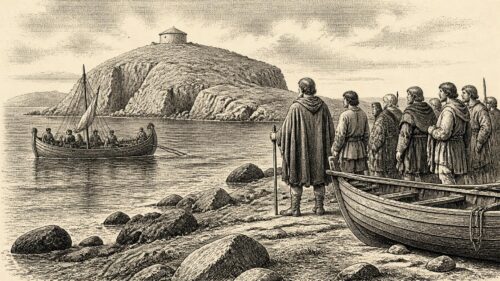
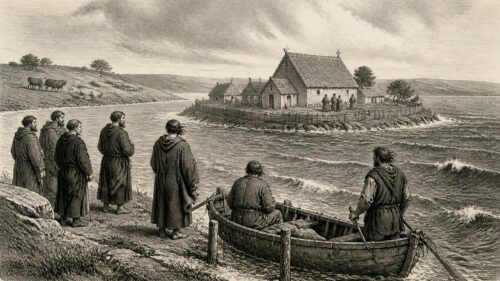
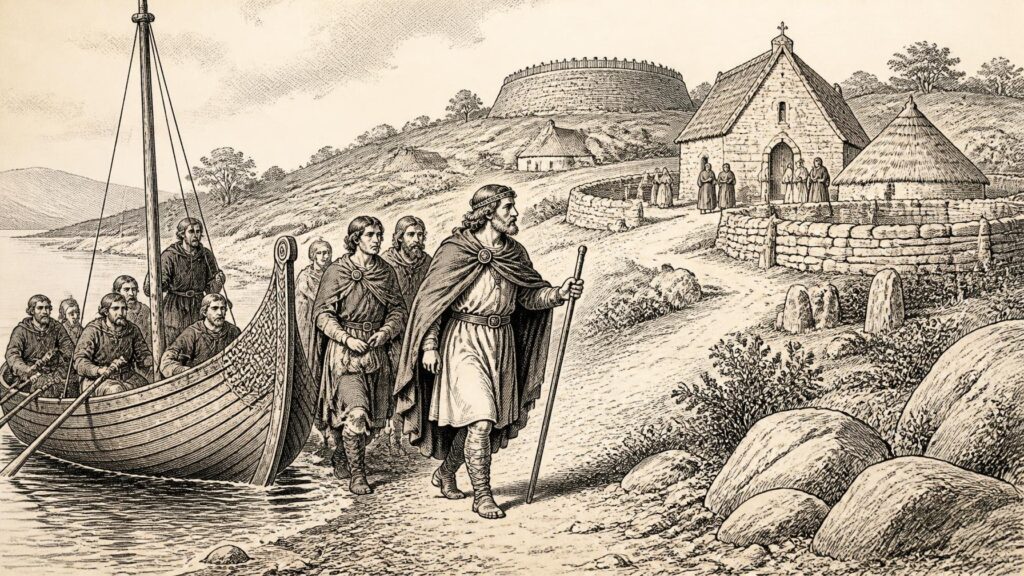
For people on either side of the North Channel, Ireland and western Britain were not distant worlds. Dál Riata stretched across the sea between north-east Ireland and western Scotland; religious communities maintained contacts from Iona to Irish churches; kinship, kingship, warfare and ecclesiastical travel all crossed the water. A voyage from Pictland or Dál Riata to Ireland was hazardous in an open boat, dependent on weather, crews and knowledge of coasts, but it was familiar rather than extraordinary. Tarachin’s recorded move therefore belongs to a political geography based on sea-lanes as much as on roads.
His arrival also suggests the practical value of Irish refuge. A displaced person of standing could seek security among allies, kin, churchmen or rival dynasties beyond the immediate reach of opponents. Such hospitality was not necessarily disinterested. Receiving a foreign claimant might create obligations, bring intelligence, strengthen a diplomatic relationship, or provide leverage in disputes across the sea. Yet the annal supplies none of these motives. It would be wrong to turn Tarachin’s single recorded journey into proof of an Irish intervention in Pictish affairs. What it firmly demonstrates is movement: the political disturbances of northern Britain could send people to Ireland, and Irish chroniclers saw that movement as part of their own history.
The context immediately around the entry sharpens this picture without turning neighbouring events into events of 698 itself. In the preceding annal year, the Annals of Ulster record the expulsion of Ainbcellach son of Ferchar from the kingship of Dál Riata and his removal to Ireland; they also record a burning at Dún Ollaig. Those notices are assigned by the modern Ulster chronology to AD 697, not 698. They should not be re-dated casually. Still, they show that the Irish Sea zone was politically unsettled at precisely the time Tarachin came to Ireland. Ireland was not insulated from that instability; it was one of the places to which displaced leaders could go.
The Battle of Fiannamail
The other Irish annalistic notice for 698 is more frustrating: “The battle of Fiannamail son of Oiséne.” The phrasing does not tell us whether Fiannamail won, lost, commanded one side, or merely gave his name to the encounter. No place-name survives with it, and the opposing force is omitted. Medieval Irish annals often preserve just such compressed memorials, particularly where an underlying notice was brief or where later compilers no longer knew the fuller circumstances. It is possible that contemporaries understood immediately what the name meant; for modern readers, it is a reminder of how much historical experience escaped the written record.
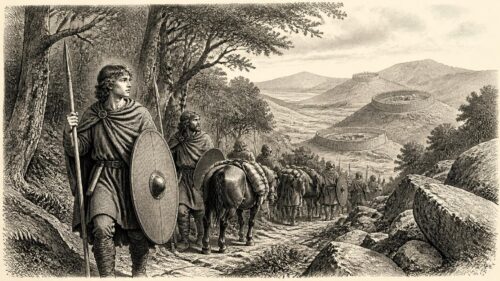
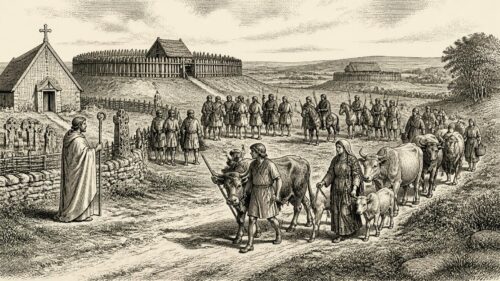
Even so, the notice is meaningful. A battle was serious enough to enter a chronological record in a society where armed followings were central to political authority. Kings and local rulers depended on clients, retainers, tribute and reputation. Raids, cattle seizures, disputes over succession and competition for territory could all produce fighting without creating a single island-wide war. Ireland in 698 was not a unified kingdom governed from one capital. The title often rendered “high king” expressed real prestige and claims to wider overlordship, but local power remained dispersed among numerous túatha, larger provincial groupings and kindreds.
Loingsech son of Óengus, of the northern Uí Néill and Cenél Conaill, stood at the apex of this political order. Later annalistic tradition counted 698 as the fifth year of his rule. That dating should not imply that he directed every conflict in Ireland or that the battle of Fiannamail was necessarily connected with him. Rather, it locates the year in a period when Uí Néill dynastic influence was particularly strong across much of the north and midlands, while Leinster, Munster, Connacht, Ulaid and many smaller polities retained their own rulers, interests and rivalries. The smallness of the 698 record fits that decentralised reality.
Churches, Law and Memory
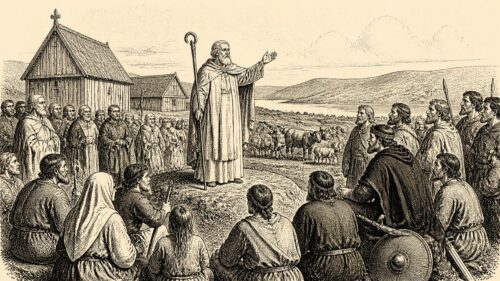
No ecclesiastical foundation, saint’s death or church fire can be securely assigned to 698 from the principal early annals. The religious background was nevertheless fundamental to the year. Only the previous year, 697, Adomnán of Iona had promulgated the Cáin Adomnáin, or Law of the Innocents, in Ireland. The decree is associated with protection for women, children, clerics and other non-combatants, and was guaranteed by an impressive assembly of secular and ecclesiastical leaders. It must remain a firmly dated event of 697, not be represented as newly issued in 698. But in 698 it was part of the immediate political and moral landscape within which warfare, hospitality and authority were understood.
The contrast between that law and the battle notice is revealing. The law did not abolish conflict; nor did it claim to do so. Instead, it asserted that violence had moral limits and that rulers could be bound publicly to uphold them. Its existence indicates close cooperation between churchmen and kings in framing authority. Tarachin’s arrival in Ireland, whether he was a Pictish political refugee or another traveller entirely, likewise took place in a world where monasteries could offer lodging, learning, contacts and sanctuary, even though the record does not identify any church as his destination.
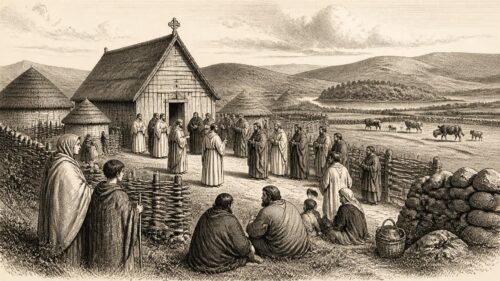
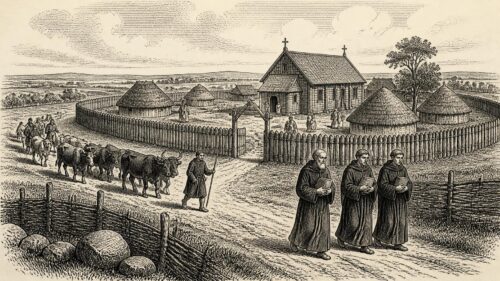
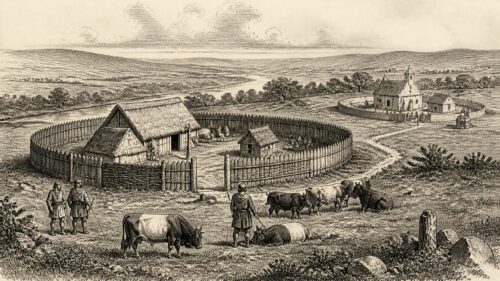
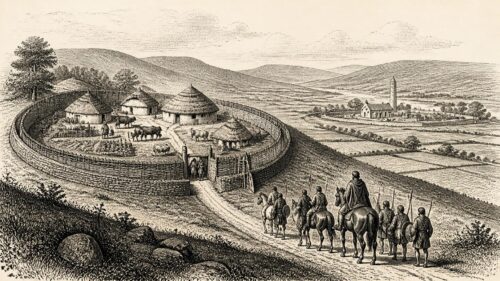
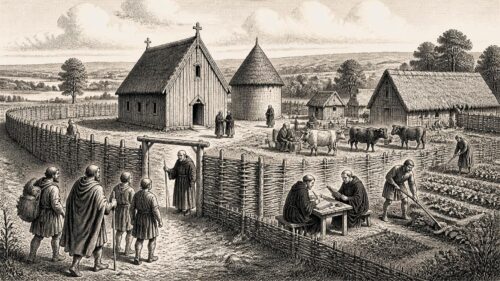
Church communities were also economic and social settlements. Their enclosed spaces could include churches and burial grounds, but also dwellings, workshops, stores, grazing and cultivated land. Cattle were central to wealth and exchange, while grain-growing, dairying, livestock management and craft production sustained both lay and ecclesiastical households. Most people in 698 lived in rural settlements and farmsteads rather than towns: Ireland had no urban network of the later Viking age. The annals’ attention to kings, abbots and battles should not obscure the unrecorded labour that kept these communities functioning through the agricultural year.
An Island of Many Connections
Learning, too, gave Ireland a role beyond its shores. By the late seventh century, Irish churches were centres of Latin study, manuscript production and the preservation of legal, genealogical and historical knowledge. The annals themselves are evidence of this literate culture, although their surviving manuscripts are much later than the events they record. Their plain entries should not be mistaken for complete reports. They are selected records, shaped by ecclesiastical and dynastic interests, and sometimes affected by chronological dislocation. Yet their economy of language can be powerful: in a few words, they place a battle, a traveller and an island within a larger world.
Nothing in the reliable evidence allows us to describe the weather, harvest, prices, trade volume or health of Ireland specifically in 698. Later entries tell of cattle disease, famine and pestilence, but those belong to later years and must not be pulled back into this one. Nor can Tarachin’s passage prove commercial traffic on any particular route. What can be said is more modest and more secure. Coastal travel made political contact possible; rural production underpinned lordship and church life; and Ireland’s learned institutions maintained records capable of registering events beyond the island as relevant to Irish affairs.
A Sparse but Connected Year
Thus 698 CE should not be inflated into a year of sweeping transformation. Its surviving evidence is narrow: an obscure battle and the arrival of Tarachin. But those facts illuminate a great deal. The battle points to the persistent, localised violence of a politically fragmented society. Tarachin’s crossing points to the maritime connections that tied Ireland to Dál Riata and Pictland. Behind both stood the institutions that made early medieval Ireland work: kingships built on personal allegiance and resources, churches embedded in settlement and landholding, and literate communities able to preserve selected memories of a complicated world. In 698, Ireland was neither isolated nor unified. It was a network of competing territories, religious centres and sea-linked relationships, visible for a moment in the concise language of the annals.
Primary Sources
- The Annals of Ulster: Year U699 (AD 698)
- The Annals of Ulster: Year U698 (AD 697)
- The Annals of Ulster: Year U700 (AD 699)
- The Annals of Ulster: Year U701 (AD 700)
- The Annals of Tigernach
- The Annals of Tigernach: CELT Project Record
- Chronicon Scotorum: Annals CS694–CS698
- Chronicon Scotorum: Annals CS692–CS696
- Annals of the Four Masters: Annals M697–M704
- Fragmentary Annals of Ireland: Annals FA141–FA150
- Annals of Inisfallen: Annals I671–I725
- Annals of Inisfallen: CELT Bibliographical Record
- Exploring the Irish Annals
- Early Christian Ireland
- Ireland in the Seventh Century: A Tour
- Innovation and Experimentation in Late Seventh-Century Law
- Origin Myths, Churches, and Kings
- Lex Innocentium (697 AD): Adomnán of Iona – Father of Western Jus in Bello
- The Church and the World in Early Christian Ireland
- Early Christian Monasteries
- Churches and Ecclesiastical Enclosures
- Patrician and Early Christian Architecture
- The Cambridge History of Irish Literature: Chronology