Annals Obituaries659 CE
The annals for 659 chiefly record deaths rather than major events, including Colmán of Glendalough, Fínán of Lindisfarne, Daniél of Kingarth, Echaid son of Blathmac, Conall Crandomna of Dál Riata and Eóganán son of Tóthalán. Differing annalistic chronologies make exact dates uncertain, particularly for Fínán. The notices reveal links between Irish churches, Iona, Northumbria and western Scotland, alongside dynastic losses in Brega and Dál Riata. They do not establish causes of death or political consequences. Although ordinary life centred on farming settlements and local labour, the surviving record offers no evidence of famine, epidemic or island-wide warfare.
Dateline
In 659 CE, Ireland’s surviving annalistic record is unusually quiet about battles, harvests and royal assemblies, but it is not empty. The Annals of Ulster, in an entry whose calendar heading explicitly identifies the year as AD 659, records a cluster of deaths: Bishop Fínán son of Rímid, Colmán of Glendalough, Daniél bishop of Cenn Garad, Echaid son of Blathmac, Conall Crannamna, and Eóganán son of Tóthalán. This is firm evidence for what the annalist chose to commemorate, rather than a complete record of all that happened. It offers a revealing cross-section of the Irish world: an important Leinster church, a ruler’s son in Brega, religious communities linked across the Irish Sea, and a Gaelic king whose career belongs to the intertwined histories of Ireland and western Scotland.
An Annal and Its Dates
The first caution is chronological. Early Irish annals preserve year headings produced through complicated systems of calculation and later copying; their dates sometimes differ from modern reconstructions and from one another. The Ulster entry is headed “AD 659”, while the parallel material in the Annals of Tigernach and Chronicon Scotorum falls under their annal 660. Later historians commonly place the death of Fínán of Lindisfarne in 661. None of this makes the notice worthless. Rather, it defines what can responsibly be said: an annalistic year identified as 659 preserves these obits, while the exact modern calendar date of every death cannot be assumed to be equally secure.
The entry’s form is itself significant. Annals are not diaries. Their compressed notices reflect what clerical compilers, drawing on earlier records, judged worth retaining: the passing of bishops, prominent churchmen and men of ruling families. Silence about a raid or a local dispute does not prove tranquillity, just as an obituary does not tell us how an individual died, who succeeded him, or how ordinary people responded. For 659, the responsible historical picture is therefore one of recorded transitions, not of a single dramatic national event.
Colmán at Glendalough
Colmán of Gleann Dá Locha, Glendalough in County Wicklow, is the most immediately Irish of the ecclesiastical figures named. The annal merely says that he “rested”, the conventional Christian wording for death; it does not call him abbot, bishop or founder. A later recension, Chronicon Scotorum, styles him bishop, but that title should not be used to construct an elaborate biography that the contemporary evidence does not supply. What is secure is that Colmán’s name was important enough to be carried in the annalistic tradition alongside bishops of wider Irish Sea significance.
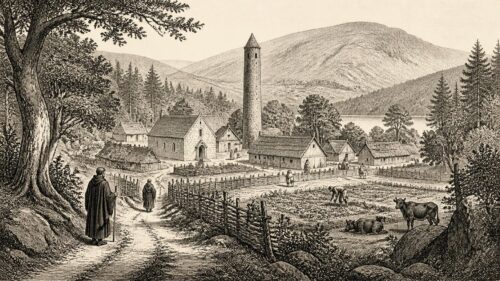
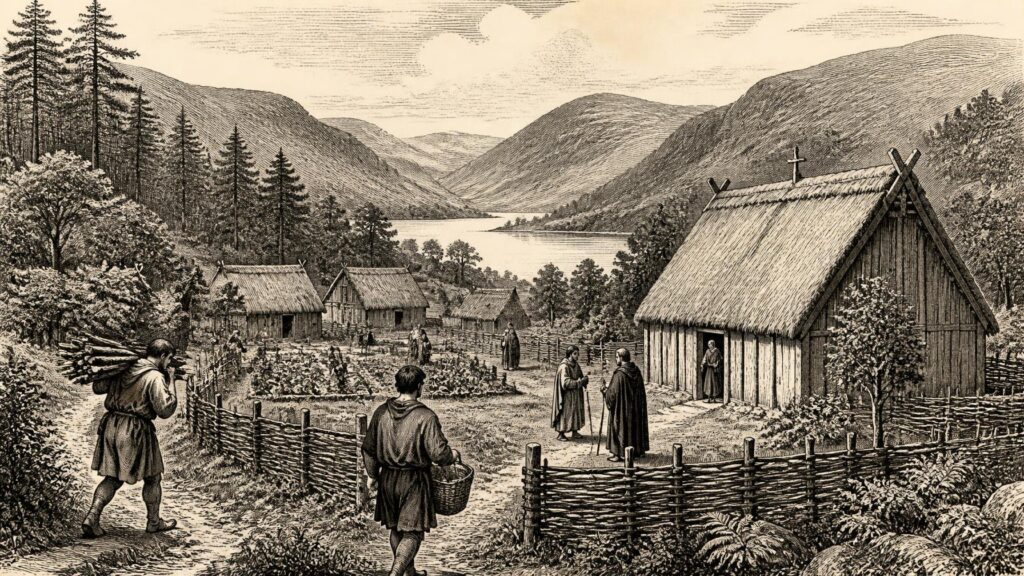
Glendalough had been established in the early seventh century, traditionally under the patronage of Cóemgen, or Kevin, who died some decades before this annal. In 659 it was not the picturesque landscape of later surviving stone churches, the round tower, and elaborate gateways familiar today. Early Irish churches and dwellings were commonly built of timber, post-and-wattle and clay; those materials have largely vanished. Yet the valley’s lakes, wooded slopes and relative seclusion made it a potent setting for religious retreat, burial, hospitality and the organisation of land and labour. Colmán’s recorded death shows that Glendalough’s community had already acquired sufficient standing to be visible in the island’s historical memory.
Such a church was not detached from society. A monastic settlement required food, fuel, buildings, clothing and books; it depended upon cultivators, herders, craftspeople, patrons and visitors as well as clergy. Prayer and learning were central to its identity, but so were practical arrangements for maintaining people within a demanding upland environment. We cannot identify a particular building project, manuscript or school at Glendalough in 659. We can, however, see the community as one participant in the expanding network of ecclesiastical sites through which authority, commemoration and resources were channelled in early medieval Ireland.
Churches Across the Sea
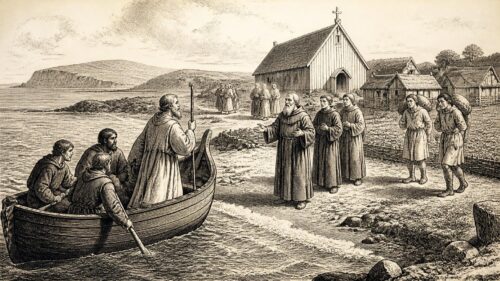
The same entry records Fínán son of Rímid and Daniél, bishop of Cenn Garad. Fínán is very probably the Irish-born monk of Iona who became bishop of Lindisfarne in Northumbria after Aidan. Bede describes him as sent from the Columban community and notes that he built Lindisfarne’s episcopal church in an Irish manner, of hewn oak and thatch. His career demonstrates that Irish religious influence was not confined to the island. Clerics, teachings, books and institutional habits moved along sea routes joining Ireland, Iona, Northumbria and the western Scottish islands.
Nevertheless, Fínán’s case shows why the annal’s date must be handled carefully. Bede’s sequence and later scholarly chronologies place his death around 661, whereas the Irish annal’s heading equates its notice with 659. It is safest to say that the 659 annalistic dossier preserves his obituary, not that his death can be fixed without qualification to a particular day or even, with complete confidence, to that modern calendar year. The discrepancy is a useful reminder that early medieval chronology is evidence to be interpreted, not merely a list to be copied.
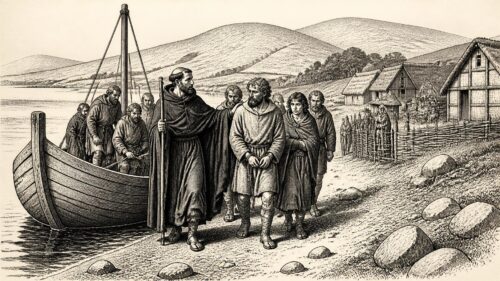
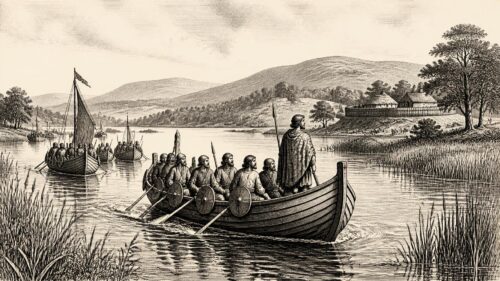
Daniél’s designation, bishop of Cenn Garad, connects the notice to Kingarth on Bute. Archaeological and historical work identifies Kingarth as an early ecclesiastical centre in the Gaelic-speaking maritime zone. Its appearance beside Glendalough and Fínán’s Lindisfarne connection gives 659 a distinctly insular horizon. The Irish Sea was not a barrier at the edge of Irish history. It was a route: travelled by clergy, messengers, patrons and perhaps traders, and crossed by communities whose political loyalties might be local but whose religious relationships were wider.
Brega and Dál Riata
The secular names in the annal point to two different political worlds. Echaid was a son of Blathmac, one of the Síl nÁedo Sláine rulers of Brega and, with his brother Diarmait Ruanaid, a king counted in later regnal tradition among the kings of Tara. Their power rested not on a unitary Irish state but on kinship, military followings, tribute, alliances and control of strategically valuable territories in the midlands and east. The annal supplies no cause of Echaid’s death. A later biographical synthesis regards it as violent and dates it near 660, but the 659 notice itself does not explain it. Its safest significance is dynastic: the ruling family of Brega lost a son while its leading figures still shared pre-eminence.
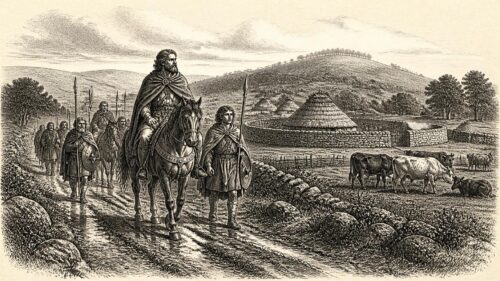
Conall Crannamna’s death was also important beyond the locality of a single church. He is generally identified with Conall Crandomna, a king of Dál Riata. This Gaelic polity linked northern Ireland with Argyll and neighbouring western Scottish territories, though its political centre in Conall’s time lay chiefly across the channel. His notice belongs in Irish history because Dál Riata’s ruling kindreds, churches and sea-lanes were bound closely to Ireland. Even so, the brief obituary does not securely reveal whether Conall died peacefully, who immediately prevailed after him, or what change his death produced. It marks a transition in a connected Gaelic kingship, not a licence to invent a succession crisis.
Eóganán son of Tóthalán is more elusive still. The annal records his death but gives neither office nor place. It would be tempting to attach him to one of the powerful dynasties of the north or midlands, but the entry does not warrant it. His inclusion is evidence of remembered status, not a usable biography.
Life Beyond the Obits
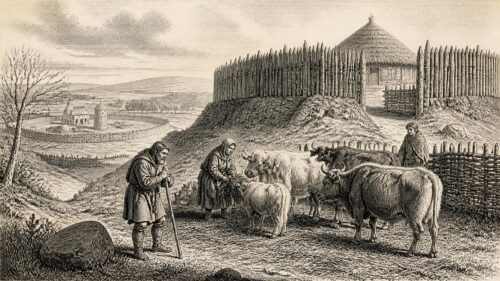
For most people in 659, life was shaped less by named deaths than by the annual work of mixed farming. Across Ireland, many households lived in enclosed farmsteads now known as ringforts, raths, duns or cashels. Circular houses with thatched roofs, animal pens, storage buildings, hearths and working areas supported routines of food preparation, dairying, grain processing, weaving, leatherwork and ironworking. Larger, more strongly defended enclosures may reflect households of higher rank, but the landscape was not divided simply between kings and monks. Farmers, dependent clients, skilled workers, religious dependants and travelling specialists all sustained the societies from which kingship and churches drew their resources.
No surviving annal for this year records a general famine, epidemic, exceptional weather event or island-wide campaign. It would be wrong to manufacture one from the silence. The obituaries instead reveal a society in which local households and settlements supported institutions capable of reaching beyond their immediate districts. Glendalough’s standing, the memory of Kingarth’s bishop, the Irish career behind Lindisfarne, and the fortunes of Brega and Dál Riata all depended on networks of movement and obligation that crossed mountains, rivers and sea channels.
A Year of Recorded Passing
Thus 659 is best understood as a year preserved through memorial notices. Its annal does not offer a sweeping tale of conquest or catastrophe. It records Colmán of Glendalough at an early and formative stage in that community’s history; it points to the Irish-born Fínán and the reach of Columban Christianity; it remembers Daniél of Kingarth in the western maritime world; and it notes losses within the dynastic spheres of Brega and Dál Riata. The evidence is slender, but not slight. Properly read, it shows early medieval Ireland as a landscape of many regional powers and communities, held together not by a single government but by kinship, church, travel, patronage and the enduring practice of remembrance.
Primary Sources
- The Annals of Ulster: Year U660 (AD 659)
- The Annals of Ulster
- The Annals of Tigernach: Annals T649–T669
- CELT Project: The Annals of Tigernach
- Chronicon Scotorum: Annals CS659–CS662
- CELT Project: Chronicon Scotorum
- Annals of the Four Masters
- CELT Project: Annals of the Four Masters
- Blathmac
- Fínán
- Colmán Rímid
- Finan of Lindisfarne
- St Blane’s, Kingarth, Bute
- Bute, St Blane’s Church
- Glendalough: History
- Glendalough
- Early Medieval Farmsteads
- Earthen Banks and Broken Walls
- Waterway Corridor Study: River Shannon, Lanesborough to Shannonbridge
- Bede, Ecclesiastical History, Book III, Chapter 17
- Bede, Ecclesiastical History, Book III, Chapter 25
- Political Organisation in Dál Riata
- The Chronicle of Ireland: Then and Now