The Sixty Captives686 CE
In 686, Adomnán, abbot of Iona, brought sixty former captives back to Ireland, probably following the Northumbrian raid on Brega in 684. Although the annals do not identify the captives or explain their release, the episode demonstrates links between Ireland, Iona and Northumbria, and the role of clerical diplomacy across the Irish Sea. The deaths of abbots at Glendalough and Corcach Mór, and of Bishop Oiséne, also reflect established religious communities. Ireland remained politically fragmented under regional rulers, including Fínshnechtae Fledach of Tara. Later-dated battles should not be assigned to 686.
Dateline
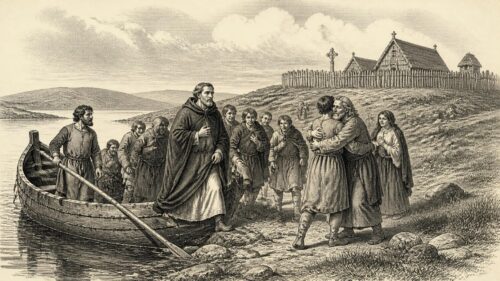
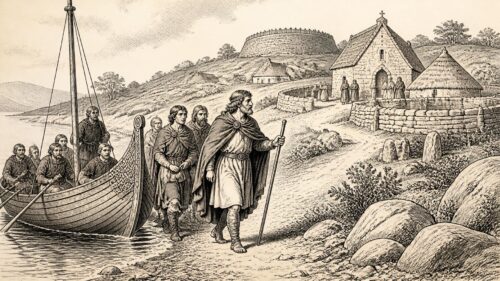
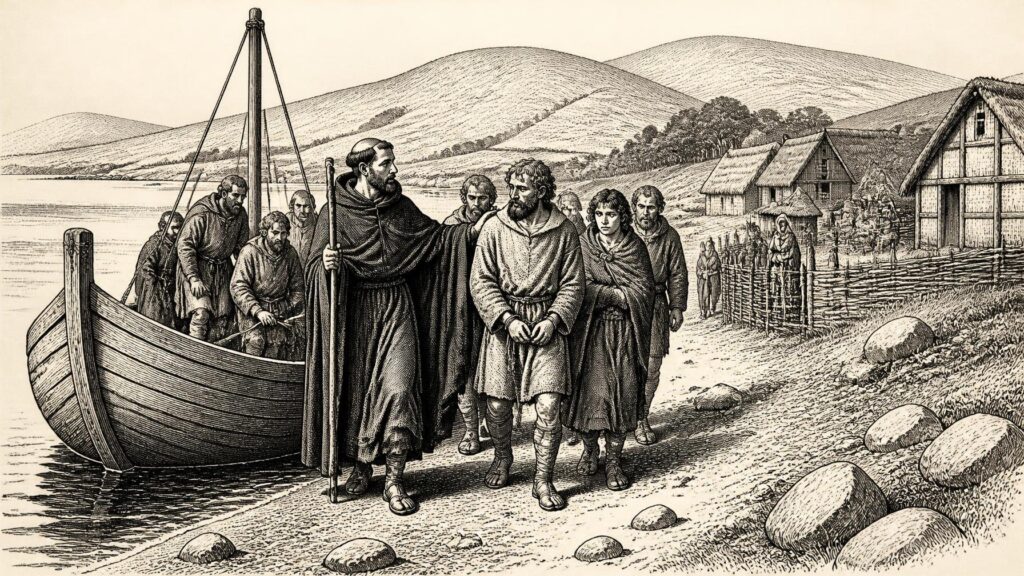
In 686 CE, the clearest securely dated Irish development was an act of return rather than a battle: Adomnán, abbot of Iona, brought sixty former captives back to Ireland. The notice in the Annals of Ulster is exceptionally brief, naming neither the people released nor their home districts, the port at which they landed, or the terms on which freedom was obtained. Yet its precise number and its place amid notices of deaths and killings make it one of the most human records preserved for this year. It also reveals an Ireland connected, and vulnerable, across the Irish Sea.
A Recorded Return
The annal does not say that Adomnán freed the captives, only that he “brought back” sixty former captives to Ireland. That wording matters. It records the completion of a journey and an outcome visible to Irish observers: people who had been absent were again on Irish soil. Their recovery was probably linked to the Northumbrian attack on Mag Breg, the rich plain of Brega, recorded for June 684. The earlier annal states that “the Saxons” devastated Mag Breg and many churches. A later annalistic compilation expands the account, saying that hostages and other spoils were carried away to ships. The two notices strongly connect warfare in the Irish midlands with the return recorded in 686, though the names of individual captives remain unknown.
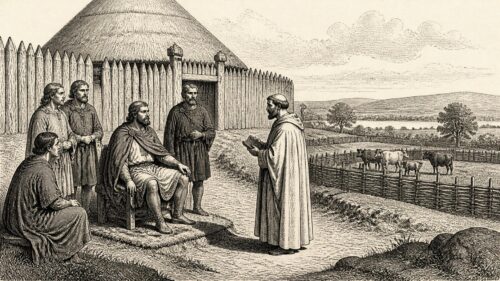
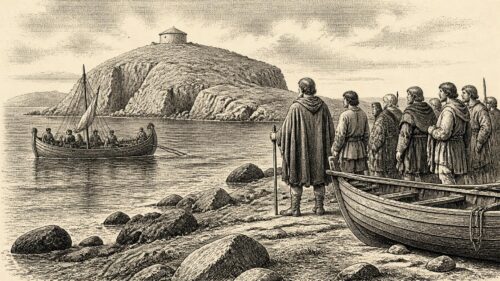
The political setting makes Adomnán a plausible intermediary. He had been abbot of Iona since 679, presiding over a Columban community whose relationships stretched across Ireland, western Britain and Northumbria. Iona lay off the west coast of what is now Scotland, but its founder Colum Cille was an Irish saint, and its ecclesiastical network crossed rather than respected the sea. Adomnán could move within this world as a senior cleric, a learned Latin writer and a figure with connections among powerful families. His later biographical tradition and modern historical scholarship associate the mission with Aldfrith, who succeeded his half-brother Ecgfrith as king of Northumbria after Ecgfrith’s death in 685.
That association should nevertheless be stated carefully. Bede, writing later, confirms that Adomnán visited Aldfrith on a mission from his own people and spent time in Northumbria. He does not describe the sixty captives in that passage. The Irish annals report the captives but do not name Aldfrith. Combining the evidence makes a diplomatic journey to the Northumbrian court highly likely; it does not allow the reconstruction of a speech, a ransom payment, a royal treaty, or even the exact day on which the travellers embarked. The achievement was real, but the surviving record leaves its practical mechanics in silence.
Captivity, Kinship and the Sea
For the sixty people themselves, return cannot have erased what had happened. They had been removed from Ireland in the aftermath of a raid that struck territory, churches and communities in Brega. The word translated as “captives” tells us that they had been held under compulsion, but it does not establish whether every person had been enslaved, kept as a hostage, pressed into service, or detained in some other way. Early medieval warfare commonly produced captives, and people could be valued as labourers, dependants, political pledges or saleable property. In this case the sources preserve neither age nor sex, status nor family connection. They should not be imagined as a uniform group.
The number sixty is striking precisely because early Irish annals normally compress large human experiences into a few words. It may represent a group gathered from more than one settlement, perhaps from places touched by the raid on Mag Breg. Some may have had kin able to press their claims; others may have depended on the standing of kings and churchmen. Their return would have mattered beyond the individuals concerned. In a society where land, cattle, labour, fosterage and marriage bound households together, the disappearance or recovery of a person affected obligations, inheritance, protection and memory. The annal’s short sentence therefore points to many reunions, and possibly to absences that were not repaired.
The voyage itself was part of the normal geography of power. The Irish Sea was a difficult and dangerous waterway, not a barrier at the edge of an isolated island. Clerics, rulers, traders, migrants and raiding parties travelled its coasts and channels. Ships had brought Northumbrian attackers to Brega; vessels also enabled captives to come home. Adomnán’s recorded return shows that maritime movement could be used for restitution as well as violence. It is a useful corrective to any picture of seventh-century Ireland as politically enclosed or culturally cut off from neighbouring kingdoms.
Churches Marked by Loss
The same annalistic year records the deaths of several churchmen. Do-Chuma Conoc, abbot of Glenn dá Locha—Glendalough in County Wicklow—died, as did Roiséne, abbot of Corcach Mór, and Oiséne, bishop of the monastery associated with Fintan son of Finnguine. These entries supply no biographies and do not tell us how each community chose a successor. Still, they show that religious institutions were sufficiently organised, connected and remembered for their leading figures’ deaths to enter chronological record.
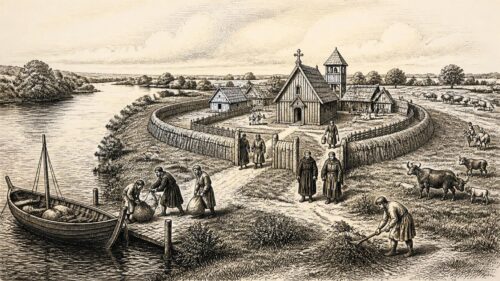
Glendalough was already an established religious foundation in a wooded valley of the Wicklow mountains. It should not be pictured in 686 as the later stone-built “monastic city” familiar today: much of the visible fabric belongs to subsequent centuries. Its importance in this year lies instead in the death of an abbot, evidence of an enduring community with leadership, property and ritual responsibilities. Corcach Mór is less securely identified in the modern landscape, which is a reminder that annals preserve places whose physical settings and institutional histories are not always recoverable. The bishop Oiséne’s notice likewise demonstrates episcopal status within a monastic environment without revealing the scale of his church.
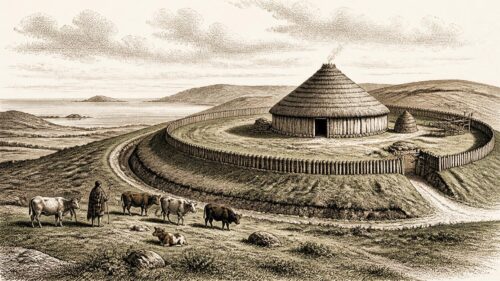
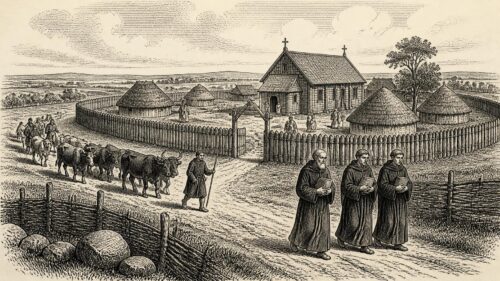
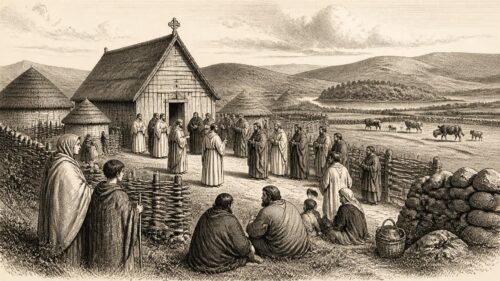
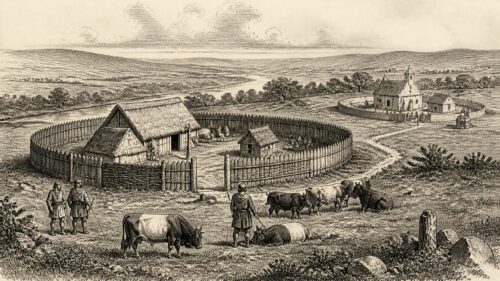
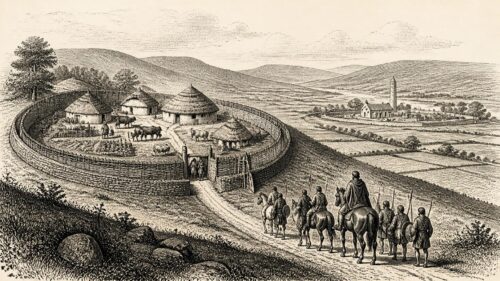
These obits belong beside Adomnán’s mission. Monasteries were not remote enclaves existing apart from lay society. They depended on food, labour, craftwork, land and patronage, while offering prayer, burial, literacy and places where political relationships could be expressed. Communities of clerics and lay dependants managed livestock and crops, received guests and travellers, copied and used books, and maintained links with ruling families. The ordinary population, meanwhile, lived overwhelmingly in dispersed rural settlements, commonly enclosed farmsteads known today as ringforts. That is broad archaeological context rather than a description of a particular harvest or household in 686, for the sources record no weather, famine or economic crisis in Ireland during this calendar year.
Fínshnechtae’s Ireland
Ireland was not a single kingdom administered from a capital. It was a patchwork of peoples, dynasties and overkingships, with church federations woven through the same political landscape. Fínshnechtae Fledach of the Síl nÁedo Sláine held the kingship of Tara in this period and exercised influence in the midlands, including Brega. His epithet, commonly understood as “of the feasts” or “the bountiful”, reflects the political language of generosity: a successful ruler was expected to distribute food, protection and rewards as well as lead in war. Yet authority was negotiated among kindreds rather than imposed through a central bureaucracy.
The return of the captives had significance in this setting. The Northumbrian raid had exposed the inability of local power to prevent an attack from the sea. Their recovery offered a different demonstration of status: clerical influence, diplomacy and personal connections could repair at least part of the damage. It would be too much to call the episode a formal peace settlement between Ireland and Northumbria. No surviving source records such an agreement. But it does show that relations after violence could include negotiation, gift-giving and the recognition of claims made across kingdoms.
Keeping the Year in Focus
Chronology requires particular care for 686. The much later Annals of the Four Masters assigns the battle of Imlech Pich, involving Niall son of Cernach Sotal and Congalach son of Conaing, to this year; it also places the death of Ségéne of Armagh here. Earlier annalistic witnesses, however, place these events later, and modern scholarship generally dates the battle of Imlech Pich to 688. It was an important conflict within Brega, but it should not be presented as an event of 686 simply because one later compilation attached it to that date. Likewise, Ségéne’s death belongs later than the securely dated record considered here.
What can responsibly be said of 686 is already substantial. In the wake of a destructive Northumbrian raid, sixty people returned to Ireland under the escort of one of the island world’s most influential abbots. At Glendalough and other religious houses, senior churchmen died and their communities continued. The year’s evidence is fragmentary, but its central episode is unusually vivid: diplomacy and seaborne travel restored people to homes from which war had taken them. That return, more than any uncertain battle date, gives 686 its distinct place in Irish history.
Primary Sources
- The Annals of Ulster: Year U685
- The Annals of Ulster: Year U687
- The Annals of Ulster: Year U688
- Chronicon Scotorum: Annals CS684–CS688
- Annals of the Four Masters: Annals M677–M701
- The Annals of Ulster
- Chronicon Scotorum: Introduction
- The Annals of Tigernach: Part 12
- Adomnán
- Aldfrith
- Fínshnechtae Fledach
- Írgalach
- Fogartach
- Adomnán, Two Saint
- The Northumbrian Attack on Brega in A.D. 684
- The Life of Columba, Written by Adamnan
- Life of St. Columba: English Translation
- Adamnan’s De Locis Sanctis
- Bede’s Ecclesiastical History of England: Book V, Chapter 15
- Early Medieval Collections
- Ringforts
- Early Christian Monasteries
- Glendalough Monastic Site and Visitor Centre