Henry II’s Dublin Court1172 CE
In 1172 Henry II held a winter court at Dublin, asserting royal control over Strongbow’s Anglo-Norman venture and receiving submissions from Irish rulers, though Ruaidrí Ua Conchobair remained independent. He secured Dublin, Waterford and Wexford, encouraged Bristol settlement, and linked conquest to commerce. The Council of Cashel promoted ecclesiastical order, building upon Irish reforms, while Gaelic church and political authority persisted elsewhere. Henry departed in April, granting Meath and Dublin’s custody to Hugh de Lacy. His forces devastated communities, and Tigernán Ua Ruairc was killed. Papal backing strengthened Henry’s claims, but Ireland remained divided between competing Gaelic and Angevin lordships.
Dateline
In 1172 Ireland stood at the centre of a political experiment whose consequences were not yet clear. Henry II of England had crossed to Waterford in October 1171, the first reigning English king to enter Ireland, and remained through the winter. His immediate purpose was not simply to conquer Gaelic Ireland. He also intended to bring Richard de Clare, better known as Strongbow, and the other Anglo-Norman adventurers under royal control. By the opening of 1172 Henry had established an imposing court at Dublin, but his authority remained strongest in the south-eastern ports and territories already occupied by his followers.
The King’s Winter Court
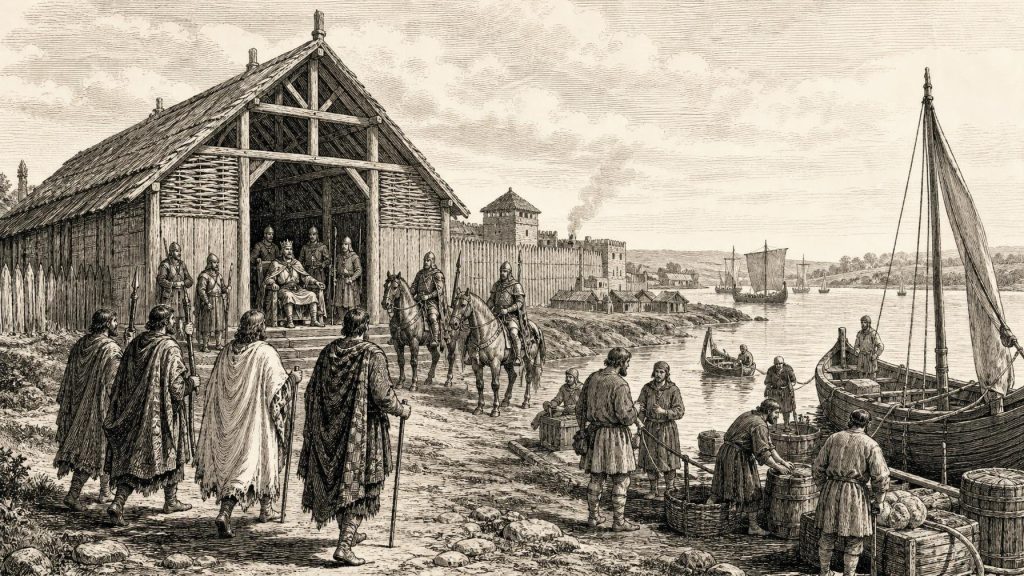
Henry spent the early part of the year in and around Dublin. Contemporary descriptions place his temporary residence outside the existing town, probably because the fortified Hiberno-Norse settlement could not comfortably accommodate the king’s large household, soldiers, horses and stores. The resulting complex was remembered as a substantial structure of timber or wattles rather than a permanent stone palace. It formed a stage upon which Henry could display the wealth, ceremony and administrative power of the Angevin monarchy.
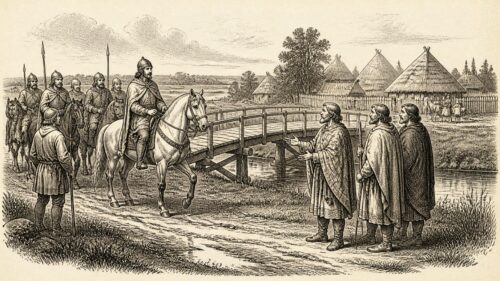
Several Irish rulers had already approached Henry during his progress from Waterford, while others attended him at Dublin. These submissions should not be understood as the surrender of a unified Irish state. Gaelic politics rested upon layered relationships between local kings, provincial rulers and overkings, expressed through hostages, tribute, personal submission and negotiated protection. Henry could therefore present the attendance of Irish kings as recognition of his supremacy, while those rulers might regard it as a practical accommodation with a powerful newcomer.
Ruaidrí Ua Conchobair, king of Connacht and claimant to the high-kingship of Ireland, did not personally submit. He remained the greatest independent power in the island, particularly west of the Shannon. Henry’s court nevertheless attracted rulers from Meath, Bréifne, Airgialla, Ulaid and parts of Leinster. Strongbow also acknowledged the king’s authority. Henry thereby transformed what had begun as a private military intervention on behalf of the late Diarmait Mac Murchada into an enterprise supervised by the English Crown.
Dublin and the Royal Ports
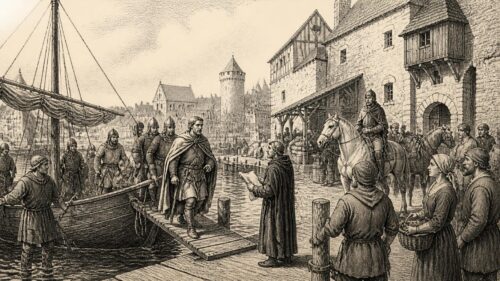
Henry treated Dublin, Waterford and Wexford as possessions of particular royal importance. These were not merely fortified bases. Their harbours connected Ireland with Wales, western England, the Isle of Man and wider Irish Sea commerce. Whoever controlled them could move soldiers, receive supplies, collect revenues and influence both inland kingdoms and maritime politics.
A surviving charter, datable to 1171–72, granted Henry’s men of Bristol the right to inhabit Dublin. The wording does not prove that the older population was immediately expelled or that an entirely new municipality appeared overnight. It does show deliberate encouragement of settlement by merchants and townspeople already linked to the Irish Sea trade. Bristol had helped finance Henry’s expedition, and the charter tied Dublin’s commercial future to a community with ships, capital and established trading connections.
For Dublin’s inhabitants, 1172 therefore brought both continuity and disruption. The town remained a busy harbour inhabited by people of Scandinavian, Irish and increasingly English or Welsh background. Craftspeople, sailors, labourers, clerics and traders still depended upon the river, surrounding farmland and imported goods. Yet political authority had shifted sharply. Dublin was becoming a royal centre from which English officers, garrisons and law would gradually spread, even though its institutions remained incomplete in 1172.
Cashel and Church Reform
The second Synod or Council of Cashel is generally placed in early 1172, although no exact day can safely be assigned. It was summoned at Henry’s request and presided over by Gilla Críst Ua Conairche, bishop of Lismore and papal legate. The principal surviving narrative is that of Gerald of Wales, an interested Anglo-Norman writer; the gathering is notably absent from the Irish annals. Its proceedings must consequently be treated with care.
Seven reported decrees addressed marriage within prohibited degrees, preparation for baptism, payment of tithes, protection of church lands from secular demands, clerical liability in compensation for homicide, the making of wills and proper Christian burial. These rules concerned ordinary life as much as ecclesiastical administration. Marriage shaped inheritance and alliances; tithes supported parish clergy; burial and wills affected families at moments of death; and exemption from forced hospitality sought to protect church communities from the costly burden of feeding royal households or armed retinues.
Gerald presented Cashel as bringing Irish practice into conformity with the English Church. Modern scholarship is more cautious. Ireland had undergone substantial reform for decades, creating dioceses, metropolitan provinces and new monastic communities before Henry’s arrival. Nor can Cashel securely be credited with suddenly introducing the Use of Sarum or replacing a single, separate ‘Celtic rite’. The council was both a continuation of Irish reform and an opportunity for Henry to associate his lordship with papal ideals of ecclesiastical order.
A different gathering took place at Tuam within the sphere of Ruaidrí Ua Conchobair. The Irish annals record a synod of clergy and laity convened by Ruaidrí and Cadla Ua Dubthaig, archbishop of Tuam, at which three churches were consecrated. This was not necessarily a simple rival council, but it demonstrates that Gaelic kingship and the reformed Irish hierarchy continued to act independently beyond Henry’s immediate reach. Gelasius, archbishop of Armagh and successor of Patrick, also completed another visitation of Connacht, reinforcing Armagh’s claim to primacy.
Henry Leaves Ireland
Henry could not remain indefinitely. Affairs in his continental dominions and negotiations arising from the murder of Thomas Becket required his return. Irish annals state that he departed after Mass on Easter Sunday, while the reconstructed royal itinerary conventionally places his sailing from Wexford on Easter Monday, 17 April 1172. The discrepancy is a reminder that even major movements are not always recorded with identical precision.
Before leaving, Henry arranged a balance of power among his followers. Strongbow retained a great lordship in Leinster, but as the king’s vassal rather than an independent prince. Henry granted Meath to Hugh de Lacy, to be held by the service of fifty knights, describing the territory by reference to the former kingship of Murchad Ua Máel Sechlainn. He also entrusted de Lacy with custody of Dublin and left a royal garrison there. The grant was impressive on parchment, but much of the land remained under Irish rulers who had neither been defeated nor consulted.
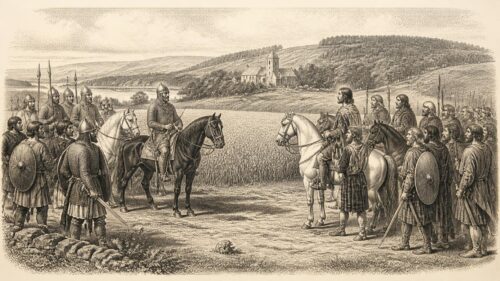
Meath gave de Lacy a lordship capable of counterbalancing Strongbow’s Leinster. It also placed him directly across the ambitions of Tigernán Ua Ruairc, the powerful king of Bréifne, who claimed authority in northern Meath. Anglo-Norman lordship was thus not inserted into empty country. It competed with existing dynasties, church estates, local communities and networks of tribute.
War in the Midlands
The annals describe de Lacy’s troops moving from Dublin towards Fore, where they consumed local provisions for a fortnight and burned the settlement. At nearby Cell Achaid they plundered a church, killed inhabitants and burned the site. Other fighting occurred around Kildare, while forces associated with the newcomers and their Irish allies raided Annaly and Ardagh, carrying away cattle and captives. Domnall Ua Fearghail, a leading ruler in the midlands, was killed by the king of England’s men.
Such entries reveal the practical experience of conquest. Armies survived by taking food from the countryside. Cattle represented sustenance, portable wealth and political power, so their seizure could weaken a community long after soldiers had departed. Captives might be ransomed, exchanged or subjected to servitude. Burning churches and settlements damaged both sacred authority and local systems of storage, hospitality and protection.
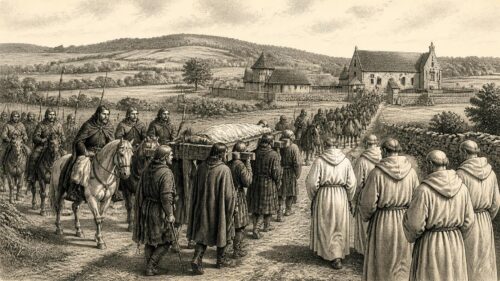
Later in the year Tigernán Ua Ruairc met his enemies at Tlachtga, the Hill of Ward near Athboy. The encounter ended in his death. Irish and Anglo-Norman accounts disagree over who began the violence and even over the principal participants. Some annals blame de Lacy and an Ua Ruairc kinsman; another names members of Strongbow’s following; Gerald of Wales claimed that Ua Ruairc attempted treachery and was killed in the ensuing struggle. What is secure is that Ua Ruairc was slain, decapitated and his remains displayed at Dublin. The treatment was calculated to intimidate, and his death removed one of the strongest obstacles to de Lacy’s expansion in Meath.
An Ireland Beyond Dublin
Events elsewhere underline the limits of Henry’s achievement. Cenél Conaill defeated Cenél nEógain in the north-west, while disputes among the Ulaid ended with guarantors enforcing judgement against Donn Sléibe Mac Duinn Shléibhe after a killing committed under protection. In Ossory, rival kings and branches of the Mac Giolla Phádraig dynasty continued their own contests. These conflicts followed Irish political rhythms that neither began nor ended with the English king’s visit.
The annals also record the deaths of important churchmen and scholars, including Gilla Aeda Ua Muigin, bishop of Cork; Tigernach Ua Máel Eóin, successor of Ciarán at Clonmacnoise; and Gilla Asalta, historian of Ruaidrí Ua Conchobair and celebrated sage. Their notices offer a glimpse of a learned culture sustained by monasteries and royal courts, where historians, poets, clerics and legal specialists preserved genealogy, memory and political legitimacy.
Papal Approval and an Unsettled Future
On 20 September Pope Alexander III issued letters supporting Henry’s position and urging Irish rulers and bishops to recognise his authority. Whatever judgement is made about the disputed text known as Laudabiliter, Alexander’s correspondence in 1172 shows that the papacy accepted the political reality created by Henry’s expedition and associated it with continued church reform.
Yet 1172 did not mark the completion of a conquest. Henry departed, Ruaidrí remained powerful, and most communities continued under Gaelic rulers and Irish law. What changed was the scale and legitimacy of the foreign presence. Royal ports, merchant settlement, papal approval and the great territorial grant to Hugh de Lacy gave the newcomers foundations for expansion. Ireland ended the year not as a fully governed Angevin province, but as an island in which competing forms of kingship and lordship had become permanently entangled.
Primary Sources
- The Annals of Ulster: Year U1172
- The Annals of Tigernach
- Annals of Loch Cé
- Annals of the Kingdom of Ireland by the Four Masters
- The Annals in Cotton MS Titus A XXV
- Mac Carthaigh’s Book
- Annales Breves Hiberniae
- Annals of Roger de Hoveden, Volume I, Part 27: 1171–1172
- Henry II
- Lacy, Hugh de (I)
- Ua Conchobair, Ruaidrí
- Ua Ruairc, Tigernán
- Charter of Henry II: 1171–2
- Henry II, the Council of Cashel and the Irish Bishops
- What Did They Sing at Cashel in 1172? Winchester, Sarum and Romano-Frankish Chant in Ireland
- The Transformation of the Irish Church in the Twelfth Century
- From Kingdom to Colony: Framing the English Conquest of Ireland
- Overlord Becomes Feudal Lord, 1172–85
- A Transnational Magnate: 1166–74
- The Zooarchaeology of Medieval Ireland
- Derbforgaill: Twelfth-Century Abductee, Patron and Wife
- Henry II, the Council of Oxford and Angevin Overlordship in Leinster, 1177–85
- Henry II’s Grant of Meath to Hugh de Lacy
- County Meath Urban Archaeology Survey