Awbeg Reindeer Signal31772 BCE
Around 31,772 BCE, Ireland lay within the climatically unstable Marine Isotope Stage 3, before the Last Glacial Maximum, but no evidence permits reconstruction of a single year. Calibrated deposits at Derryvree and Greenagho in Fermanagh show intermittent non-glacial environments, including cold wetlands with mosses, sedges and northern insects. Castlepook Cave above County Cork’s Awbeg Valley preserves a diverse, time-averaged fauna, including reindeer, mammoth, giant deer, predators and small cold-adapted mammals. A cut-like mark on a reindeer femur may indicate Upper Palaeolithic butchery, yet cannot prove settlement. Later ice erased evidence; no established human community, polity or culture is securely known.
Dateline
“31,772 BCE” is a modern chronological label, not a recoverable year in Ireland’s Ice-Age record. There are no written records, settlements, human burials or artefact sequences that can be assigned to a particular twelve-month interval so far back. In calendar terms, the label falls roughly 33,700 years before AD 1950, within the later part of Marine Isotope Stage 3 (MIS 3), a climatically unstable interval of the Last Glacial Period. The responsible history of Ireland at this point must therefore use calibrated ranges, sediment sequences and animal remains, while distinguishing firmly between what those materials demonstrate and what they merely suggest.
A Date Within Ranges
Radiocarbon years are not the same as calendar years. The amount of radioactive carbon in the atmosphere has varied through time, so a radiocarbon measurement must be calibrated against independently dated records. At c. 34,000 calendar years ago the resulting spans can be broad, and refinement of dating methods has altered the chronology of Irish cave faunas more than once. A numbered BCE year can be useful for arranging an archive, but it should not imply a precision that the evidence cannot supply.
The best environmental range that includes this nominal date comes from Derryvree near Maguiresbridge, County Fermanagh. Organic-rich freshwater silts there lie between two deposits of glacial till. Their radiocarbon result has been calibrated to approximately 36,900–31,700 calendar years before present. That range includes the point represented by 31,772 BCE, but does not prove that every plant, insect or sediment particle at Derryvree formed in that particular year. At nearby Greenagho, organic material beneath later till has produced an older calibrated range of roughly 37,200–35,700 calendar years before present. Together, the sites show that parts of northern Ireland retained non-glacial environments during portions of MIS 3 before later ice covered or disturbed them.
Not Yet the Ice-Sheet Maximum
Ireland was already in an Ice Age, but it was not yet at the Last Glacial Maximum. Recent reconstructions of the British–Irish Ice Sheet indicate a major phase of growth from about 31,000 to 26,000 years ago, followed by maximum ice volume around 23,000 years ago. Onshore and offshore evidence also indicates that the expansion of ice across Ireland was uneven: some areas remained ice-free longer than others, while glaciers advanced across other districts and continental shelves.
For around 31,772 BCE, then, it is misleading to imagine either a green modern island or a single, motionless blanket of ice. The available evidence supports a changing mosaic of cold environments, with local ice margins, open ground, wetlands, rivers and exposed rock. The later advance of the ice sheet is itself one reason the record is so thin. Ice eroded old land surfaces, reworked deposits and covered others beneath till. Acid soils further reduce the survival of bone and organic materials. Caves and protected sediment pockets are disproportionately important because they preserved fragments that most of the landscape did not.
Sea level was lower than today because vast quantities of water were held in northern ice sheets, but low sea level should not automatically be translated into a simple land bridge from Ireland to Britain or continental Europe. The changing Irish Sea basin, ice cover, local uplift and relative sea level make the routes available to animals and people difficult to reconstruct. Irish Pleistocene mammals prove that some dispersal occurred over long periods; they do not identify a particular crossing route, season or population movement at this date.
Fermanagh’s Cold Wetlands
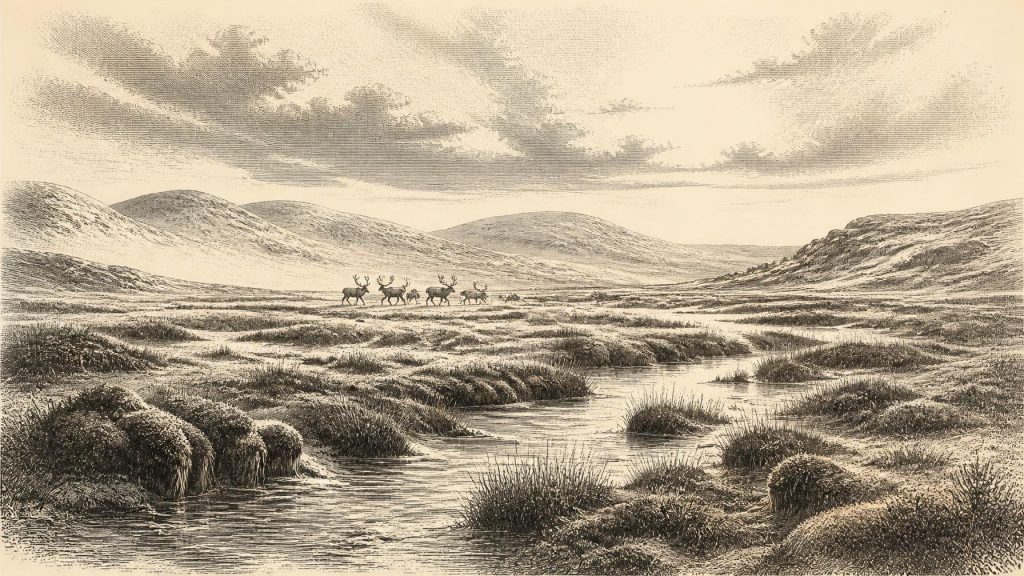
Derryvree provides the clearest glimpse of the kind of local setting that can be responsibly connected to this broad time. Plant macrofossils include freshwater mosses and sedges, while the insect fauna has been interpreted as one of cold northern character. Earlier syntheses described the landscape as treeless muskeg: wet, peaty ground broken by shallow water, moss and sedge communities, and subject to severe frost and marked seasonality. This was not necessarily a uniform scene across Ireland. It was a particular lowland record, preserved beneath later glacier-laid sediments.
The wider implication is important. Ireland contained habitats capable of sustaining cold-adapted plants and animals during intervals before the maximum glaciation. Open, herb-rich ground may have existed in suitable areas, but the evidence does not permit a detailed national vegetation map for the nominal year. Nor should pollen, beetles and mosses be made to carry a human story that they do not contain. Derryvree is evidence for environment and climate, not for a camp beside its waters.
Animals at Castlepook
The most significant southern Irish archive is Castlepook Cave, also called Mammoth Cave, near Doneraile in north County Cork, above the Awbeg Valley. It is Ireland’s richest known cave assemblage for vertebrate life in the period leading towards the Last Glacial Maximum. Excavations in the early twentieth century recovered a remarkable collection; later research has reassessed both the individual bones and the difficult history of their deposition. Water movement, carnivores, excavation methods and disturbance mean that the cave is a time-averaged archive rather than a sealed snapshot.
Its fauna includes remains attributed to reindeer, woolly mammoth, giant deer, brown bear, wolf, Arctic fox, mountain hare, lemmings and spotted hyaena. These species make clear that Ireland’s Pleistocene animal world was once far richer, and more cold-adapted, than the island’s later historic fauna. Yet they must not be assembled into an invented herd at 31,772 BCE. Improved radiocarbon dating has shown that some Castlepook specimens are substantially older than earlier dates suggested. Research indicates, for example, that giant deer and spotted hyaena may have disappeared locally around 40,000 calibrated years ago, well before the date considered here. Species lists establish presence across broad episodes, not simultaneous companionship.
Reindeer are especially relevant. Their grazing ecology is compatible with open, cold landscapes, and Castlepook preserves a reindeer femur that has become central to discussion of Ireland’s earliest possible human activity. The bone is an animal remain with a date in the broad period represented by this article; it is not a named historical event. Nevertheless, its surface carries a deep linear modification that zooarchaeologist Ruth Carden has interpreted as a cut or chopping mark made with a sharp stone edge while the carcass was fresh.
The Meaning of One Mark
If that interpretation is upheld, the implication is considerable but limited: one or more people may have processed a reindeer in Ireland during the Upper Palaeolithic, perhaps taking meat, hide, sinew or marrow. It would show practical contact with the Irish landscape, not the foundation of a settled community. The mark does not establish whether people killed the animal or encountered it after death; whether they came once or repeatedly; where they came from; or whether the bone entered the cave immediately after processing.
The qualifications matter because Castlepook’s early collections lack the full stratigraphic recording expected of a modern excavation. No securely associated hearth, stone-tool assemblage, dwelling surface, grave, art or human bone of this age has yet been published from Ireland. The National Museum of Ireland accordingly still describes clear evidence for Palaeolithic human presence on the island as absent. That caution is not a dismissal of the femur. It is a distinction between a promising, specialist interpretation of a single modified bone and the much stronger evidence required to demonstrate enduring occupation.
Recent excavations at Castlepook have sought undisturbed, stratified deposits in areas including Elephant Hall and Hyaena Land. Their value lies precisely in the possibility that future micromorphology, dating and faunal analysis may connect bones to securely recorded sediments. Until those results are fully available, the reindeer femur should be treated as evidence of possible human visitation, not as licence to populate Ireland with a known Palaeolithic society.
No Polities, No Proven Settlements
Political affairs, diplomacy and organised conflict cannot be recovered for Ireland around this date. There were no kingdoms, tribes, leaders, boundaries or alliances that archaeology can name. Nor is there evidence for farming, stock-keeping, pottery, metalworking, trade networks, permanent houses, monuments, ritual sites or formal learning. It would be an error to project the institutions of later prehistoric or historic Ireland backwards into this landscape.
Culture is similarly elusive. If people did reach Ireland, they would have belonged to wider Upper Palaeolithic worlds known elsewhere in Europe, in which stone technology, mobile hunting and sophisticated symbolic practices existed. But no Irish object of c. 31,772 BCE can securely demonstrate such practices here. The most defensible economic inference is correspondingly narrow: the possible cutting of a reindeer limb suggests the use of animal resources. It cannot prove a local hunting economy, an annual migration route, food-sharing customs, religious beliefs or exchange.
An Interrupted Human Possibility
The period’s greatest historical importance lies in possibility rather than continuity. Ireland was not an empty abstraction beyond history: its wetlands, caves and open cold-country habitats supported living communities of plants and animals, while its position at Europe’s north-western edge made access difficult and episodic. If the Castlepook incision is anthropogenic, people briefly entered that world. Later ice-sheet growth then transformed much of the island and likely erased or buried much evidence of any such visits.
For 31,772 BCE, therefore, the evidence supports a cautious picture: a cold and changing Ireland before the glacial maximum; freshwater environments in Fermanagh within a broad calibrated range; a notable Pleistocene fauna documented especially in north Cork; and one reindeer bone that may register human butchery. It does not support an exact annual narrative, a permanent population or a first Irish society. The Awbeg reindeer signal is powerful precisely because it is so slight: a fragmentary trace, preserved against the odds, asking future research to decide how far Ireland’s human story truly reaches into the Ice Age.
Primary Sources
- A Reconsideration of the Radiocarbon Dating of the Marine Isotope Stage 3 Fauna from Southern Ireland
- The Irish Quaternary Fauna Project
- CastlePook Cave, County Geological Site Report
- Prehistoric Details
- 32564: Castlepook Cave, Castlepook South, Cork
- Archaeological Heritage of County Cork
- Heritage Artefacts of County Cork
- Trimlines, Blockfields and the Vertical Extent of the Last Ice Sheet in Southern Ireland
- Late Pleistocene Chronostratigraphy and Ice Sheet Limits, Southern Ireland
- Growth and Retreat of the Last British–Irish Ice Sheet, 31,000 to 15,000 Years Ago: the BRITICE-CHRONO Reconstruction
- Growth and Retreat of the Last British–Irish Ice Sheet, 31,000 to 15,000 Years Ago: the BRITICE-CHRONO Reconstruction
- Maximum Extent and Dynamic Behaviour of the Last British–Irish Ice Sheet West of Ireland
- Character of Advance and Retreat of the Southwest Sector of the British-Irish Ice Sheet During the Last Glaciation
- Stratigraphic and Palaeo-Geomorphological Evidence for the Glacial-Deglacial History of the Last British-Irish Ice Sheet in the North-Western Irish Sea
- Early Midlandian–Middle Midlandian, Pleistocene, Northern Ireland
- Middle Midlandian Interstadial Deposits at Greenagho, Near Belcoo, County Fermanagh, Northern Ireland
- The Subdivision of the Quaternary Period in Ireland
- Palaeoecology
- Could Brown Bears (Ursus arctos) Have Survived in Ireland During the Last Glacial Maximum?
- New Insights on the Fauna of Ireland's Younger Dryas and Early Holocene from Alice & Gwendoline Cave
- The Problem of a Late Quaternary Landbridge Between Britain and Ireland
- The Island of Ireland: Drowning the Myth of an Irish Land-bridge?
- The IntCal20 Northern Hemisphere Radiocarbon Age Calibration Curve (0–55 cal kBP)
- Episodic Speleothem Deposition Tracks the Terrestrial Impact of Millennial-Scale Climate Variability During Marine Isotope Stage 3