Fermanagh Silts, Cork Fauna31773 BCE
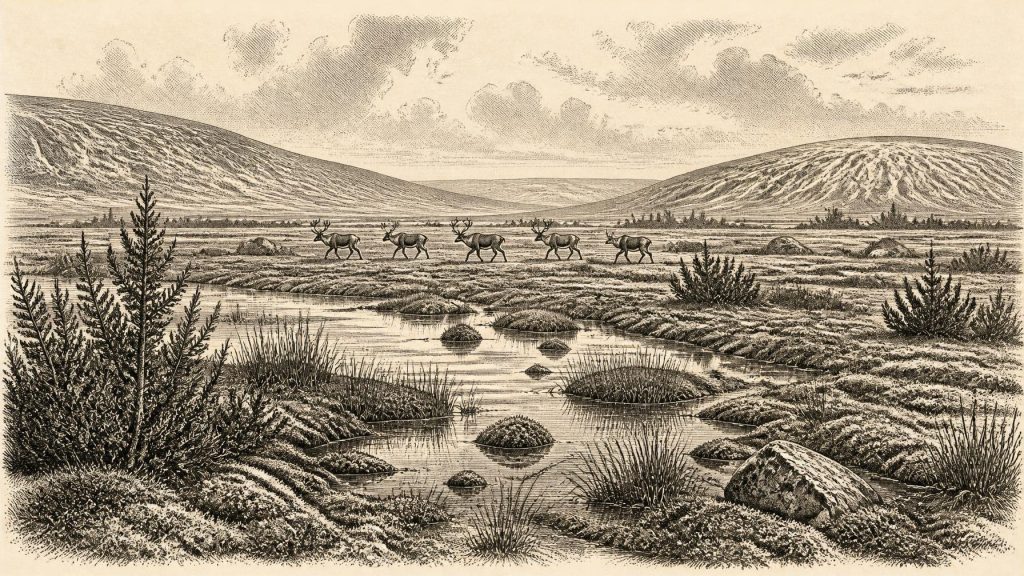
31,773 BCE is a modern chronological label within unstable MIS 3, not a recoverable Irish year. Derryvree, County Fermanagh, preserves freshwater silts between tills, dated broadly to later MIS 3, showing cold, treeless, periglacial wetlands existed between glacial episodes. Castlepook Cave, County Cork, contains a long, mixed record of Ice-Age mammals, including mammoth, reindeer, giant deer, bear and hyaena, rather than a single contemporaneous fauna. A marked reindeer femur may indicate human carcass processing, but no associated tools, settlement or population evidence survives. Lower seas altered access, while major ice expansion later covered much of Ireland during subsequent glacial maximum.
Dateline
The label 31,773 BCE is a modern device for arranging deep prehistory, not a date that can be recovered from an Irish record of events. No people in Ireland then kept a calendar of numbered years; no written source, annual sediment sequence or securely dated settlement permits a history of one particular year. In the archaeological convention of years before AD 1950, it lies roughly 33.7 millennia ago. The responsible frame is a broad one: the later part of the Late Pleistocene, within Marine Isotope Stage 3 (MIS 3), an unstable interval of the last Ice Age. Ireland can be illuminated here through cave bones, plant remains, insects, freshwater silts and glacial deposits. These sources reveal changing environments and animal communities; they do not provide a named people, polity or episode.
Dates, Deposits and Uncertainty
Deep-time dating needs careful language. Radiocarbon results are measured in radiocarbon years before present, with “present” conventionally fixed at AD 1950. They are not direct calendar dates, because atmospheric carbon-14 levels have varied. Scientists calibrate determinations against independently dated records, but at this antiquity the resulting calendar ranges can still extend across centuries or millennia and may change as methods improve. A date range therefore locates a sample within a broad environmental phase; it does not identify the day, season or year in which an animal died or a sediment layer formed.
The strongest Irish evidence relevant to this nominal date comes from Derryvree, near Maguiresbridge in County Fermanagh. Roadworks in 1969 exposed a remarkable succession in a drumlin: freshwater silts and fine sands containing organic material lay between two separate sheets of till, the sediment deposited by glacier ice. The order of those layers is more important than any attempt at false precision. Ice had affected the locality; an ice-free freshwater environment later developed; then a subsequent advance or renewal of glacial conditions sealed the deposits beneath more till. Ireland was therefore not a single, permanently frozen block throughout the period.
The Derryvree organic horizon yielded a conventional radiocarbon age of 30,500 years BP, with a substantial published uncertainty of roughly a millennium. In calibrated discussion, the deposit has been placed broadly within about 36,900–31,700 calibrated years BP. That wide interval encompasses the modern chronological point represented by 31,773 BCE, but it cannot prove the precise conditions at Derryvree in that numbered year. It does, however, provide unusually direct evidence that north-central Ireland supported a cold, non-glacial wetland landscape during part of later MIS 3, before later ice covered it.
A Periglacial Freshwater World
The Derryvree remains describe a severe but living environment. Its flora and fauna indicate open tundra vegetation and a periglacial regime: ground shaped by frost, seasonal thaw and cold conditions at the edge of glaciated regions. Grasses, sedges, juniper, herbs and mosses point to treeless country rather than woodland. Plant macrofossils include bogbean and mountain avens, while the insects and aquatic evidence suggest wet, moss-rich ground with open pools and abundant plant matter. This was not necessarily a uniform plain. Watercourses, shallow basins, sheltered slopes and exposed ridges would have created different local habitats, especially across a landscape repeatedly altered by ice and meltwater.
It would be misleading to turn this evidence into a familiar modern scene. “Tundra” is a useful shorthand, but Derryvree was not an exact counterpart of any one present-day Arctic place. Temperature, precipitation, seasonality, snow cover and the proximity of ice changed over long periods. Nor can the Fermanagh deposit describe all of Ireland. It is a local archive, valuable precisely because later glacial deposits protected it, rather than a weather report for Cork, the western coast or every upland valley. Its chief historical importance is negative as well as positive: it rules out a simple story in which the whole island was continuously buried beneath ice at this horizon.
Castlepook’s Long Animal Record
For the animal world of southern Ireland, Castlepook Cave near Doneraile in north County Cork is the crucial site. Also known as Mammoth Cave, its limestone passages produced more than 2,000 bones during excavations in the early twentieth century. Modern reassessment and radiocarbon dating show that the cave accumulated remains over a very long span, rather than representing a single moment. Individual dates extend broadly from about 45,700 to 19,950 years BP. Its deposits are consequently a record of changing Ice-Age faunas, not a census of animals alive together in 31,773 BCE.
Even with that caution, Castlepook demonstrates that Ireland was connected to the wider north-west European world of cold-stage mammals during portions of MIS 3. The assemblage includes woolly mammoth, reindeer, giant deer, brown bear and spotted hyaena; other material from the wider cave record includes lemmings, Arctic fox and wolf. The mixture is striking. Large grazing or browsing animals could use open country, while predators and scavengers followed prey or exploited carcasses. Spotted hyaena is particularly significant because the cave appears to have served, at least in part, as a carnivore repository. Bones in caves may have been carried in by animals, redistributed by water, disturbed by later digging or mixed across long intervals. Their presence proves that a species reached Ireland; it does not automatically show where it lived, died or hunted.
At the broad time represented here, reindeer are especially plausible inhabitants of suitable open habitats, but one must not assume annual mass migrations across the exact modern landscape. Animal populations expanded, contracted and shifted as vegetation, snow conditions, ice margins and access routes altered. Giant deer and hyaena, for example, belong to parts of the broader Castlepook sequence but need not have been contemporaries at every point within it. The evidence supports a dynamic fauna, not a frozen tableau.
The Reindeer Femur and People
A reindeer femur from Castlepook raises the most consequential question about human presence. It has been reported as bearing a deep linear mark interpreted by zooarchaeologist Ruth Carden as a cut or chopping trace made with a sharp stone tool during carcass processing. County Cork heritage material associates the bone with approximately 31,000 BC. If the mark is correctly identified and the dating and association are sustained, it may indicate that people handled a reindeer in Ireland during the Upper Palaeolithic, far earlier than the formerly accepted post-glacial evidence.
The distinction between evidence and interpretation is essential. The bone itself is evidence: an animal lived in the wider Irish landscape and its remains reached Castlepook. Its radiocarbon age dates the animal tissue, not a named hunter or the duration of a visit. The identification of the incision as a stone-tool mark is a specialist interpretation. The proposed behaviour—carcass processing—is a reasonable inference if that interpretation holds. It cannot establish whether people killed the reindeer, scavenged it, removed meat, hide, marrow or sinew, or worked the bone elsewhere before carnivores or natural processes brought it into the cave.
There is still no securely associated stone-tool assemblage, hearth, dwelling floor, burial, artwork, ornament or human bone from Ireland at this age. Recent excavation at Castlepook has sought surviving Pleistocene sediments, but its 2022 report recorded no cultural artefacts. Accordingly, permanent settlement, continuous occupation and a resident population remain unproven. The most defensible conclusion is modest but important: brief human incursions into Ireland around this wider period are possible, and the marked femur may preserve one such episode.
No Polities, No Proven Trade
There is no evidence for political affairs, diplomacy, organised warfare, named leaders or territorial institutions in Ireland at this depth of time. There is likewise no basis for reconstructing religion, formal ritual, language, teaching, art or collective identities. The absence is not a judgement about the capacities of any people who may have visited; it reflects the absence of securely identified human contexts. A single modified bone cannot be made to carry a social history.
Nor can an Irish economy or trade network be demonstrated. If people entered the island, they would have depended on mobility, practical knowledge of cold landscapes and the careful use of animal and plant resources, as hunter-gatherers elsewhere in Upper Palaeolithic Europe did. But that is comparative interpretation, not direct Irish proof. There is no Irish evidence from this horizon for camps, stores, exchange goods, boats, harbours or repeated seasonal routes. At most, the animal record indicates that terrestrial movement into and out of Ireland occurred at favourable times.
Coasts, Ice and Regional Change
Modern Ireland’s coastline is a poor guide to this world. Global sea levels were lower during the glacial period, while local land levels and coastlines were affected by ice loading and later rebound. Exposed shelf, changing shorelines and narrowed or altered marine channels may have affected access, but lower sea level did not automatically create a simple, permanent land bridge. The geography of passages between Ireland and Britain changed over millennia, and the timing of routes available to people and animals remains a matter for palaeogeographical reconstruction rather than certainty.
The larger direction of change is clearer. MIS 3 was climatically volatile, with marked North Atlantic shifts, and the later Last Glacial Maximum brought a far more extensive British–Irish Ice Sheet. Evidence from Ireland and the surrounding seas indicates that major growth of ice lay ahead of this nominal date, with much of the island covered during the maximum several millennia later. Derryvree’s silts and Castlepook’s fauna therefore preserve a precarious interval: a land of open wet ground and cold-adapted animals before later ice reworked, buried or erased many traces.
What This Year Can Mean
The history of Ireland around 31,773 BCE is not a sequence of annual happenings. It is the history of evidence surviving against formidable odds. Fermanagh preserves freshwater life caught between glacial episodes. A Cork cave preserves bones from a changing community of mammals, and perhaps one trace of human action. Together they show that Ice-Age Ireland was neither empty scenery nor a settled prehistoric nation. It was an environmentally unstable northern landscape, intermittently accessible to animals and possibly to small groups of people, whose stories are almost wholly lost because the surviving record is ecological rather than historical.
Primary Sources
- Middle Midlandian Freshwater Series at Derryvree, Maguiresbridge, County Fermanagh, Northern Ireland
- A Reconsideration of the Radiocarbon Dating of the Marine Isotope Stage 3 Fauna from Southern Ireland
- The Irish Quaternary Fauna Project
- Pleistocene Vertebrates in the British Isles
- Irish Cave Exploration
- Cork County Geological Site Report: Castlepook Cave
- 2022:564 – Castlepook Cave, Castlepook South, Cork
- Figure 6: The Subdivision of the Quaternary Period in Ireland
- Radiocarbon Constraints on the Age of the Maximum Advance of the British–Irish Ice Sheet in the Celtic Sea
- Late Pleistocene Chronostratigraphy and Ice Sheet Limits, Southern Ireland
- Ice Sheet Extension to the Celtic Sea Shelf Edge at the Last Glacial Maximum
- Advance and Retreat of the Marine-Terminating Irish Sea Ice Stream into the Celtic Sea During the Last Glacial: Timing and Maximum Extent
- Growth and Decay of a Marine Terminating Sector of the Last British-Irish Ice Sheet: A Geomorphological Reconstruction
- Growth and Retreat of the Last British–Irish Ice Sheet, 31,000 to 15,000 Years Ago: the BRITICE-CHRONO Reconstruction
- Exploring Controls of the Early and Stepped Deglaciation on the Western Margin of the British Irish Ice Sheet
- The IntCal20 Northern Hemisphere Radiocarbon Age Calibration Curve (0–55 cal kBP)
- Fast and Slow Components of Interstadial Warming in the North Atlantic During the Last Glacial
- New Insights on the Fauna of Ireland's Younger Dryas and Early Holocene from Alice & Gwendoline Cave
- Karst of Ireland
- Heritage Artefacts of County Cork 2021