Aghnadarragh’s Arctic Beetles31770 BCE
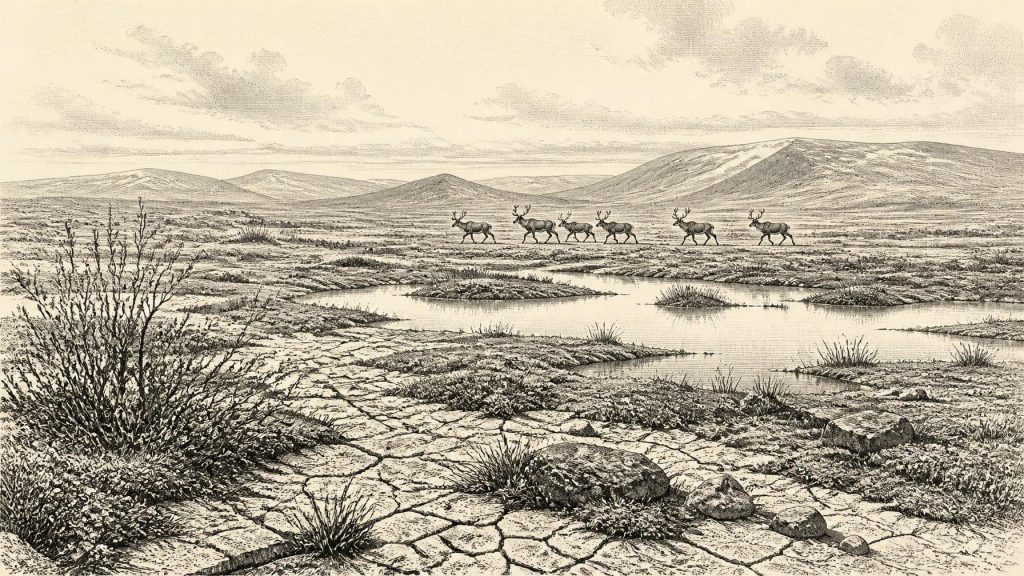
About 31,770 BCE, Ireland lay in the climatically unstable Late Pleistocene, although archaeological dating cannot identify conditions in a single year. Fermanagh sediments, including Aghnadarragh beetles, indicate cold, treeless tundra-like mosaics of grasses, shrubs, wetlands and seasonal pools, with severe winters and brief summers. Ireland was not necessarily fully ice-covered: the British–Irish Ice Sheet was expanding but had not reached its later maximum. Castlepook Cave preserves time-averaged remains of mammoth, reindeer, bear, hyaena and other fauna. A possibly cut-marked reindeer bone suggests early human activity, but cannot demonstrate settlement. Evidence supports environmental reconstruction, not claims about societies, routes or polities.
Dateline
The label 31,770 BCE is useful for organising a year-by-year chronology, but it must not be mistaken for a date that archaeology can resolve in Ireland to a single calendar year. By the conventional conversion in which “before present” means before AD 1950, it falls roughly 33,720 years before present. That places it in the later part of the Late Pleistocene, broadly within Marine Isotope Stage 3 (MIS 3), a climatically unstable interval of the last Ice Age. The responsible history of Ireland at this point is therefore not an account of a dated event, ruler or community. It is a reconstruction from cave bones, pollen, plant fragments, insects, freshwater silts, glacial deposits and the changing behaviour of the British–Irish Ice Sheet.
A Date Within Wide Ranges
The closest Irish evidence is dated in ranges rather than years. At Derryvree near Maguiresbridge, County Fermanagh, roadworks exposed organic freshwater silts and fine sands between two layers of till, the debris laid down by separate ice advances. A conventional radiocarbon measurement from the organic deposit was 30,500 ± 1,100 years BP. Such a result needs calibration, and at this age the calibration curve produces a broad interval rather than a precise answer. Published assessments place the Derryvree date broadly at about 36,900–31,700 calibrated years BP. Thus 31,770 BCE overlaps the possible age of that wetland, but the deposit cannot prove what happened at Derryvree, still less across Ireland, in that numbered year.
In older Irish Quaternary schemes, Derryvree and the animal remains from Castlepook Cave in north County Cork were associated with a middle Midlandian cold phase, approximately 34,000–35,000 years ago. The terminology and chronology of the last glaciation have since been refined, but the underlying caution remains important. The deposits represent episodes that may have lasted generations or millennia; caves can contain material accumulated at different dates; and later ice repeatedly eroded, transported or buried evidence. A date in the 31,770s BCE is consequently a point within a large and unevenly illuminated landscape history, not an anniversary.
Open Ground and Frozen Seasons
The strongest picture of the Irish environment is one of cold, open country, though not necessarily a uniform white wilderness. At Aghnadarragh, Hollymount and Greenagho in Fermanagh, fossil pollen, plant remains and beetles from organic sediments beneath later glacial deposits indicate treeless or nearly treeless landscapes during cold phases of the Midlandian. Grasses and sedges, dwarf birch, willow, heaths, crowberry, mugwort and clubmoss occur in the palaeobotanical evidence. These records imply a patchwork of exposed mineral ground, sparse herb and shrub cover, wet hollows and small freshwater habitats rather than continuous woodland.
The insect evidence is especially revealing. At Aghnadarragh, beetle species included forms now associated with much more northerly, Arctic or sub-Arctic environments. Their ecological requirements suggest severe winters, a short growing season and high seasonality. Estimates drawn from the assemblage have proposed July temperatures perhaps around 11–13°C and January temperatures well below freezing, although these are regional reconstructions rather than a thermometer reading for one particular year. Frost action would have repeatedly disturbed soils and shattered rock. Meltwater, snow patches and summer rain could nevertheless sustain sedge-rich margins and shallow pools in sheltered basins.
Derryvree adds another element: moss-rich freshwater muds and silts. Its fossil flora and fauna have been interpreted as a cold, treeless muskeg or tundra wetland. That evidence matters because it prevents a simplistic account in which Ireland was either wholly ice-covered or wholly dry steppe. At intervals, and in particular places, water collected and plants established themselves. Yet one Fermanagh basin cannot stand for every coast, valley or upland. The island’s relief, exposure to Atlantic weather, proximity to ice and changing sea level would have created strongly local conditions.
Before the Ice-Sheet Maximum
At around 33,720 cal BP, the ice sheet that later reshaped Ireland was not yet at its maximum known Late Pleistocene extent. The best modern synthesis of the British–Irish Ice Sheet identifies a complex, asynchronous expansion and retreat between roughly 31,000 and 15,000 years ago, with its greatest overall ice volume near 23,000 years ago. Other research shows the western margin reaching the Porcupine Bank only after about 24,720 cal BP. These findings rule out the easy assumption that all of Ireland was already buried under its later maximum cover in 31,770 BCE.
They do not, however, supply a reliable, island-wide map for that single date. Glaciers and ice streams could advance, stagnate and reorganise on regional timescales, while evidence on land has often been removed by later glaciation. It is safest to describe Ireland as lying within an increasingly severe North Atlantic glacial world: some ground was capable of supporting tundra vegetation and large mammals during particular windows, while ice was an expanding force that would subsequently cover much of the island. The great swathes of till, drumlins, erratic boulders and scoured bedrock familiar in the modern Irish landscape are the much later-visible legacy of that wider process.
Lower global sea levels also altered the geography around Ireland, exposing parts of the continental shelf that are now seabed. But exposure of shelf does not automatically demonstrate a walkable bridge from Ireland to Britain or continental Europe. Relative sea level was affected by both global ocean volume and the rise or depression of the Earth’s crust under changing ice loads; channels, ice and marine water may have interrupted potential routes. Scholarship on Irish insularity has long stressed the uncertainty. Any route used by animals or people in this period must be treated as a palaeogeographical problem, not imagined as a certain open plain.
Castlepook and the Animal World
Castlepook Cave, also known historically as Mammoth Cave, near Doneraile in the Awbeg valley of County Cork, is the most vivid Irish archive for this broad period. Excavated principally in the early twentieth century by Richard J. Ussher and others, it produced a very large and complicated collection of animal remains. Mammoth, reindeer, brown bear, fox, hare, lemming and spotted hyaena are among the Ice Age animals associated with the cave record. The combination is striking: it evokes an Ireland periodically capable of sustaining cold-adapted grazers and browsers, their predators and scavengers, rather than the much more limited fauna of the modern island.
Nevertheless, Castlepook is not a photograph of one living community in 31,770 BCE. The cave’s collections were excavated before modern recording standards, deposits were disturbed in places, and bones accumulated through several processes. Carnivores could drag carcass parts into a den; animals could die naturally in or near cavities; water and later disturbance could move material. Direct radiocarbon dating and taphonomic study are therefore essential. The cave’s animal assemblage is best understood as a time-averaged archive of changing Late Pleistocene conditions, not a census taken in a single season.
The Human Question
A reindeer femur from Castlepook has made this period central to Irish archaeology. Zooarchaeologist Ruth Carden identified a deep mark on the bone as consistent with modification by a sharp stone implement, and radiocarbon work has publicised an age of approximately 33,000 years. If that interpretation is sustained, it is evidence that people processed a reindeer in Ireland, or at least that a butchered portion of carcass entered the Irish cave system, during the broad time horizon relevant to 31,770 BCE. It would move potential human activity on the island far earlier than the formerly accepted late-glacial evidence.
The distinction between that possibility and a settled population is crucial. No securely associated stone-tool assemblage, hearth, built shelter, burial, art panel or intact occupation surface of this age has yet been recovered in Ireland. Nor does a marked bone establish how many people were involved, where an animal was killed, or how long anyone stayed. The bone might represent a short hunting visit and subsequent carnivore transport of a discarded limb, rather than butchery inside Castlepook. Recent excavations have accordingly sought surviving stratified deposits, new dates, charcoal, lithics and further modified bone. The research question is active, not closed.
No Polities, but a Living Landscape
There is no evidence from Ireland around this time for political institutions, named groups, diplomacy, warfare, property boundaries or formal leadership. Nor can historians responsibly reconstruct a local religion, language, music, kinship system, trade network or body of learning. Such subjects require artefacts, settlements, graves, repeated practices or written testimony that do not exist here. Silence in the record is not proof that visiting people possessed no beliefs or social relationships; it means that Ireland has not yielded evidence through which to describe them.
If humans did reach the island during a milder or more accessible interval, comparison with Upper Palaeolithic societies elsewhere in north-west Europe makes mobile hunting and scavenging a plausible mode of subsistence. Reindeer could provide meat, fat, hide, sinew, bone and antler, while freshwater margins might offer seasonal plant and bird resources. But this is informed comparison, not direct Irish proof. There is presently no defensible basis for claiming regular commerce, permanent camps, sea crossings, long-distance alliances or a distinct Irish cultural tradition in 31,770 BCE.
The principal development was environmental. Ireland stood at the edge of a changing ice-sheet system, with a treeless mosaic of tundra-like vegetation and wetlands in at least some regions, and with large mammals moving through habitats that later glaciers would radically transform. The peat-stained silts of Fermanagh and the bones in a Cork limestone cave are fragmentary witnesses. Together they show that this was neither a blank interval before history nor a period that can be narrated like later history. It was a deep prehistoric landscape of severe cold, ecological opportunity and profound uncertainty.
Primary Sources
- Archaeology Research Excavation Grant 2022: Final Report
- 2022:564 – CASTLEPOOK CAVE, Castlepook South, Cork
- Heritage Artefacts of County Cork
- Palaeoecology
- Figure 6.— The Subdivision of the Quaternary Period in Ireland
- Growth and Retreat of the Last British–Irish Ice Sheet, 31,000 to 15,000 Years Ago: The BRITICE-CHRONO Reconstruction
- Growth and Retreat of the Last British–Irish Ice Sheet, 31,000 to 15,000 Years Ago: The BRITICE-CHRONO Reconstruction
- Maximum Extent and Dynamic Behaviour of the Last British–Irish Ice Sheet West of Ireland
- Dimensions and Chronology of the Last Ice Sheet in Western Ireland
- Trimlines, Blockfields and the Vertical Extent of the Last Ice Sheet in Southern Ireland
- New Data for the Last Glacial Maximum in Great Britain and Ireland
- The Problem of a Late Quaternary Landbridge Between Britain and Ireland
- Deglaciation, Earth Crustal Behaviour and Sea-Level Changes in the Determination of Insularity: A Perspective from Ireland
- Ireland: Submerged Prehistoric Sites and Landscapes
- Irish Pleistocene Biostratigraphy
- Irish Caves Database: Mammoth Cave
- IAH Field Trip 2014
- Ice-Rafting From the British–Irish Ice Sheet Since the Earliest Pleistocene (2.6 Million Years Ago): Implications for Long-Term Mid-Latitudinal Ice-Sheet Growth in the North Atlantic Region
- A Critical Review and Re-Investigation of the Pleistocene Deposits Between Cranfield Point and Kilkeel, Northern Ireland: Implications for Regional Sea-Level Models and Glacial Reconstructions of the Northern Irish Sea Basin
- New Insights on the Fauna of Ireland’s Younger Dryas and Early Holocene From Alice & Gwendoline Cave
- A Change in Seasonality in Greenland During a Dansgaard–Oeschger Warming