Birm-166’s Pollen Archive31726 BCE
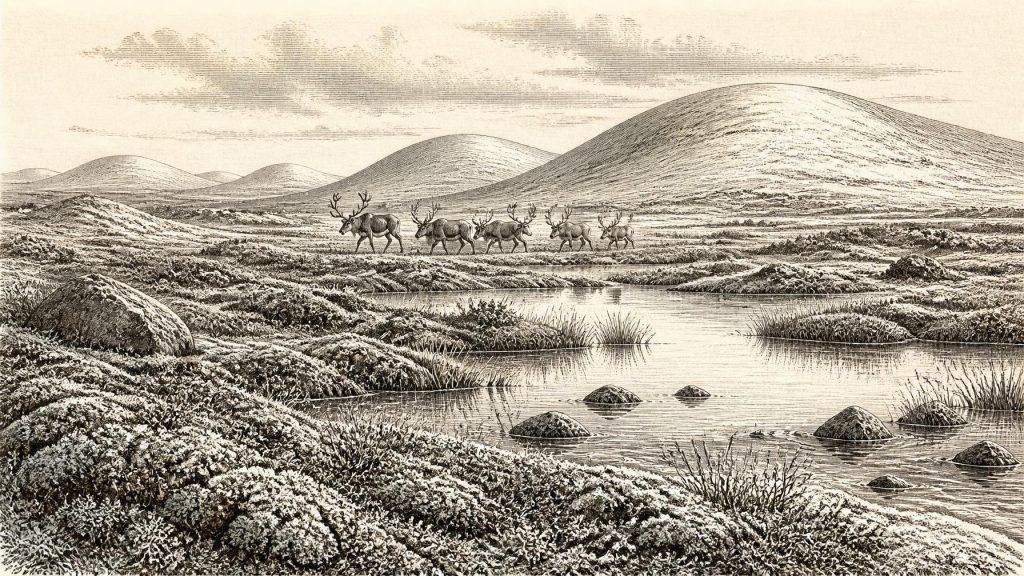
31,726 BCE is a modern label within an imprecisely dated Late Pleistocene interval, rather than a recoverable Irish year. Derryvree, County Fermanagh, preserves freshwater organic sediments between glacial tills, indicating locally ice-free, cold, wet, treeless tundra and muskeg during MIS 3. Castlepook Cave, County Cork, contains a long-accumulated fauna including mammoth, reindeer, giant deer, bear and hyena, but not a single-date census. A marked reindeer femur may indicate Upper Palaeolithic butchery, although it proves neither settlement nor continuity. Ice advances later buried or destroyed evidence. Together these fragmentary archives reveal regionally varied, unstable landscapes, animal life, and possible human visitors.
Dateline
31,726 BCE is a modern chronological label, not a year that can be recovered from Ireland’s prehistoric record. No Irish community wrote a date, named a ruler or left an event that can responsibly be assigned to this particular year. In calendar terms it corresponds to roughly 33,676 years before AD 1950, but archaeological dating at this depth works with probability ranges rather than annual precision. The most useful evidence comes from Late Pleistocene deposits dated broadly to Marine Isotope Stage 3 (MIS 3), especially the organic sediments at Derryvree near Maguiresbridge in County Fermanagh. Their calibrated range of about 36,900–31,700 years before present encompasses this point in time, but does not isolate it.
A Date Within a Range
The distinction matters. A radiocarbon result measures the remaining carbon-14 in once-living material; it is not a direct reading of a calendar. Atmospheric carbon-14 varied through time, so results must be calibrated against internationally maintained curves. Even with modern calibration, a sample this old commonly produces a wide calendar interval. The Derryvree material yielded a conventional age of 30,500 radiocarbon years BP, with substantial uncertainty; later calibration places it somewhere within a long span that roughly overlaps several abrupt Greenland interstadial episodes. It is therefore sound to say that Derryvree illuminates Ireland around 31,726 BCE, but not that its plants, insects or watercourse belonged to that exact year.
This was the later part of the Last Ice Age, but not the Last Glacial Maximum. The British–Irish Ice Sheet eventually reached its greatest overall volume much later, around 23,000 years ago, while its margins expanded and retreated asynchronously between roughly 30,000 and 22,000 years ago. Ireland at this earlier point should not be imagined either as uniformly ice-covered or as a mild, wooded island. It was a climatically unstable northern landscape in which conditions varied sharply between regions and through time.
The Derryvree Freshwater Record
Derryvree is invaluable because a road cutting through a drumlin exposed freshwater silts and fine sands trapped between two thick tills: deposits left by separate phases of glacial action. The intervening organic layer showed that, for a period, the locality had not been overridden by ice. It preserved pollen, plant remains and insects from a wet, cold environment. The evidence indicates open, treeless tundra-like ground and a periglacial climate, rather than forest or farmland. Mosses and sedges grew around shallow water and plant-rich pools; the assemblage has been described as a muskeg environment, a waterlogged mosaic rather than a single uniform plain.
That is evidence of a particular locality, not a complete weather report for Ireland. The organic silts prove that an ice-free or ice-marginal freshwater setting existed at Derryvree during the dated interval. They do not establish identical conditions in Cork, the western seaboard or every upland. Nor can they identify an exact season, rainfall total or temperature for 31,726 BCE. Nevertheless, they correct the old picture of an unchanging frozen island. Northern Ireland contained places where standing or slowly moving water, low vegetation and small invertebrate communities persisted between glacial episodes.
Open Ground and Moving Ice
The wider setting was one of ecological opportunity constrained by cold. Periglacial conditions mean that ground could freeze deeply and experience repeated thawing, with frost disturbance, sparse shrub growth and long winters. The vegetation inferred at Derryvree would have offered seasonal forage to grazing animals, but it was not the rich deciduous woodland familiar from later Irish history. Ice was an active regional force: earlier till lay beneath the organic bed and later till sealed it. In that simple sequence lies a large historical fact—habitable or at least biologically productive ground could be overtaken and its surface evidence destroyed by later glaciation.
Sea level was markedly lower than today because so much water was held in continental ice sheets. Yet lower seas do not prove an easy, continuous land route from continental Europe to Ireland. Coastlines, channels, ice margins and the extent of exposed shelf changed repeatedly, while the relevant geography remains difficult to reconstruct at fine chronological resolution. Animals and, if present, people may have moved through changing north-west European landscapes, but the evidence does not permit a precise route, crossing point or migration calendar.
Castlepook’s Animal Evidence
The richest direct evidence for Irish animal life in the broad period comes from Castlepook Cave, also called Mammoth Cave, near Doneraile in north County Cork. Antiquarian excavations recovered more than 2,000 bones from its limestone passages. Direct dates on individual specimens span a very long interval, approximately 45,700 to 19,950 years BP. The cave is thus a repository accumulated across many millennia, not a snapshot of one herd or one season. Water disturbance, carnivore activity and early excavation methods further limit attempts to arrange every bone into a single story.
Even so, Castlepook demonstrates that Ice Age Ireland supported a fauna far more varied than the island’s later historic mammal community. Its assemblage includes woolly mammoth, reindeer, giant deer, brown bear and spotted hyena; later cold-stage material also includes wolf, Arctic fox and lemmings. A National Museum of Ireland specimen records the physical presence of spotted hyena at Castlepook, while the cave’s fauna points to open grazing country, carrion, predation and mobile animal populations. It would be wrong, however, to assume that every listed species lived together at 31,726 BCE. They are securely relevant to the cave’s long Pleistocene history, not a census for a single year.
For everyday animal life, reindeer are especially suggestive. In seasonal open country they could supply meat, fat, hide, sinew and bone to human hunters; equally, they formed prey and carrion within a carnivore-rich ecosystem. Mammoths, giant deer and hyenas make clear that Ireland’s ecological past cannot be projected backwards from the later island of cattle, sheep, red deer and humans. The cave record also warns that survival in a museum drawer is selective: robust bones, sheltered caves and nineteenth- and early twentieth-century collecting practices shape what can now be known.
The Human Question
A reindeer femur from Castlepook is the most provocative object relevant to this era. County Cork heritage material dates it broadly to about 31,000 BC and reports a deep mark interpreted by zooarchaeologist Ruth Carden as damage from a sharp stone tool during butchery. If that interpretation is confirmed, it would indicate that people handled and processed a reindeer in Ireland during the Upper Palaeolithic, enormously earlier than the better-attested terminal Pleistocene evidence. The object deserves attention precisely because it challenges a long-standing assumption that human activity began much later.
But the limits are as important as the possibility. The radiocarbon result dates the animal bone, not an identifiable person, camp or social group. The diagnosis of a human-made incision is a separate taphonomic interpretation, which must be distinguished from carnivore damage, breakage, sediment movement and collecting damage. Nor was the femur recovered from a modern excavation of an intact occupation floor with associated stone tools, hearths, shelters and repeated food debris. No securely dated Upper Palaeolithic lithic assemblage has yet been established at Castlepook. The responsible conclusion is therefore modest: the bone may preserve evidence of human butchery, but it does not prove a permanent population, a village or continuity with later inhabitants.
No Kingdoms, No Recorded Wars
There is no basis for describing political affairs, diplomacy, chieftainship, territorial boundaries or organised warfare in Ireland at this date. There are no names, monuments, burials, houses, written words or recognisable cultural assemblages from which such institutions could be reconstructed. If small groups of people did reach the island, they would have operated within the practical demands of movement, shelter, fuel, food and safety in a cold landscape. That inference follows from the environment, not from direct evidence of Irish social organisation.
The same restraint applies to religion, language, learning and art. Caves have acquired ritual significance in many later societies, but Castlepook’s Ice Age fauna does not make it a shrine. There is no evidence here for ceremonies, sacred places, exchange networks or formal teaching. Nor can the possible butchery mark tell us whether hunters came from Britain, farther continental Europe or a local group. It offers a narrow potential trace of an encounter between people and an animal, not a recoverable biography.
Regional Change and Historical Loss
What can be said with confidence is that Ireland was not historically empty in the environmental sense. Its landscapes contained water, tundra vegetation, insects and mammals; in some places they lay beyond, or temporarily between, advances of ice. The Derryvree deposits in Fermanagh and the Castlepook bones in Cork are separated by geography, depositional setting and chronological uncertainty, yet together show an island of regional contrasts. Freshwater silts record cold wetland life in the north; cave remains record large mammals and carnivores in the south.
Later glacial expansion erased or buried much of the evidence that might have answered larger questions. That destruction is itself part of the history of 31,726 BCE. Rather than supplying a conventional annual chronicle, Ireland offers fragmentary archives: pollen in silt, insect remains, cave bones, radiocarbon measurements and the marks left by ice. Their combined message is compelling but bounded—an unstable, open and inhabited-by-animals landscape at Europe’s north-western edge, with a serious but still incomplete possibility of very early human visitors.
Primary Sources
- A Middle Midlandian Freshwater Series at Derryvree, Maguiresbridge, County Fermanagh, Northern Ireland
- The IntCal20 Northern Hemisphere Radiocarbon Age Calibration Curve (0–55 cal kBP)
- IntCal Publications
- IntCal History
- Growth and Retreat of the Last British–Irish Ice Sheet, 31,000 to 15,000 Years Ago: The BRITICE-CHRONO Reconstruction
- Growth and Retreat of the Last British–Irish Ice Sheet, 31,000 to 15,000 Years Ago: The BRITICE-CHRONO Reconstruction
- Extent and Timing of the Last Glacial Maximum (LGM) in Britain and Ireland: A Review
- Pattern and Timing of Retreat of the Last British-Irish Ice Sheet
- Growth, Dynamics and Deglaciation of the Last British-Irish Ice Sheet: The Deep-Sea Ice-Rafted Detritus Record
- Dimensions and Chronology of the Last Ice Sheet in Western Ireland
- Maximum Extent and Dynamic Behaviour of the Last British–Irish Ice Sheet West of Ireland
- Radiocarbon Constraints on the Age of the Maximum Advance of the British-Irish Ice Sheet in the Celtic Sea
- Castlepook Cave
- Spotted Hyena Skull
- Heritage Artefacts of County Cork
- 2022:564 – Castlepook Cave, Castlepook South, Cork
- The Irish Quaternary Fauna Project
- Ancient DNA, Radiocarbon Dating and Osteological Analyses of Red Deer from Ireland: Implications for Population History and Human Colonisation
- Episodic Speleothem Deposition Tracks the Terrestrial Impact of Millennial-Scale Last Glacial Climate Variability in SW Ireland
- Exploring Controls of the Early and Stepped Deglaciation on the Western Margin of the British Irish Ice Sheet
- Figure 6.— The Subdivision of the Quaternary Period in Ireland
- Irish Quaternary Association Publications
- New Insights on the Fauna of Ireland’s Younger Dryas and Early Holocene from Alice & Gwendoline Cave
- Reindeer Bone Found in Cork Cave Shows Human Activity in Ireland 33,000 Years Ago