Castlepook Carnivores31645 BCE
About 31,645 BCE, a modern label rather than a precise prehistoric date, Ireland lay in the unstable MIS 3 cold stage before the Last Glacial Maximum. Derryvree, County Fermanagh, preserves evidence of open, frost-affected wetland with tundra vegetation. Castlepook Cave, County Cork, yielded mammoth, giant deer, reindeer, bears, wolves, Arctic foxes, lemmings and spotted hyaenas, demonstrating diverse fauna but not a simultaneous community. A cut-marked reindeer femur may indicate transient human butchery, though no secure occupation evidence exists. Ice advances later erased much evidence. The period reveals changing environments and possible visits, not settled population, political history or human occupation.
Dateline
There can be no responsible chronicle for a single calendar year this far back. “31,645 BCE” is a modern numerical label, not a date that people in prehistoric Ireland could have recognised, and the evidence cannot distinguish one year from the next. In radiocarbon and calibrated-calendar terms it points broadly to about 33,600 years before AD 1950, within Marine Isotope Stage 3 (MIS 3), a climatically unstable phase of the Late Pleistocene. Individual Irish finds are dated with ranges and uncertainties; the historical task is therefore to describe the landscapes and possible activity illuminated by those ranges, rather than to invent an event for this notional year.
An Island in a Changing Ice Age
Ireland at this broad horizon was neither the familiar green, wooded island of later millennia nor necessarily a single uniform wilderness. It lay within the northern European Ice Age world, at a point when the British–Irish Ice Sheet was building towards its later maximum. A major review assigns the ice-sheet build-up to after roughly 35,000–32,000 years ago, with its maximum extent later, about 27,000–21,000 years ago. More recent reconstruction likewise places peak ice volume around 23,000 years ago. Thus 31,645 BCE belongs to an earlier, changing stage: some landscapes could support cold-adapted life, while advancing ice was already a decisive force in the region’s future.
It would be misleading to imagine that every part of Ireland was simultaneously ice-free, or that conditions in Cork, Fermanagh and the offshore shelf were identical. Ice margins shifted, uplands and basins responded differently, and later glaciers scoured away much of the evidence. The Last Glacial Maximum eventually covered most of Ireland and extended across the western continental shelf, but that later expansion must not be projected wholesale on to the earlier MIS 3 landscape. The patchy survival of old caves, buried sediments and fossil bone is itself part of the story: most potential campsites and open landscapes have either been destroyed, buried or remain undiscovered.
Derryvree’s Buried Wetland
The clearest environmental evidence relevant to this deep period comes from Derryvree near Maguiresbridge, County Fermanagh. Roadworks exposed freshwater silts and fine sands caught between two tills, the unsorted sediments laid down by glacial ice. The sequence proves that, before a later ice advance sealed the locality, water and vegetation occupied a low basin. Organic material produced a conventional radiocarbon age of 30,500 years BP, with a substantial uncertainty of +1,170/−1,030 years. That is a radiocarbon measurement, not a calendar date; calibration is essential, and cannot truthfully yield a precise year in the thirty-second millennium BCE.
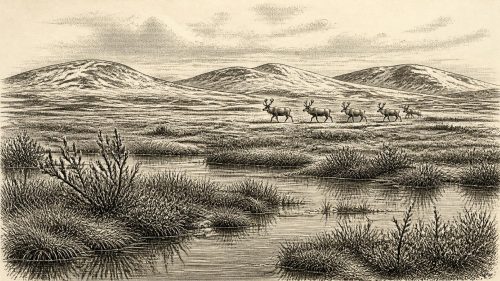
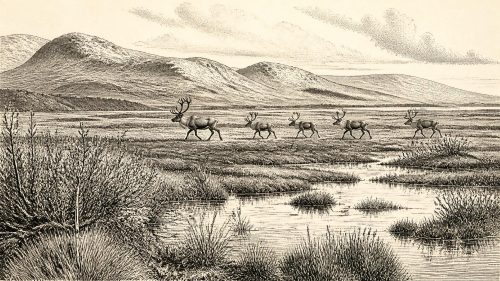
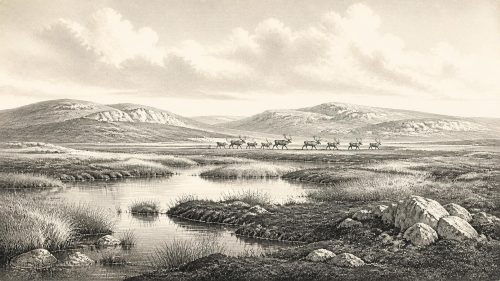
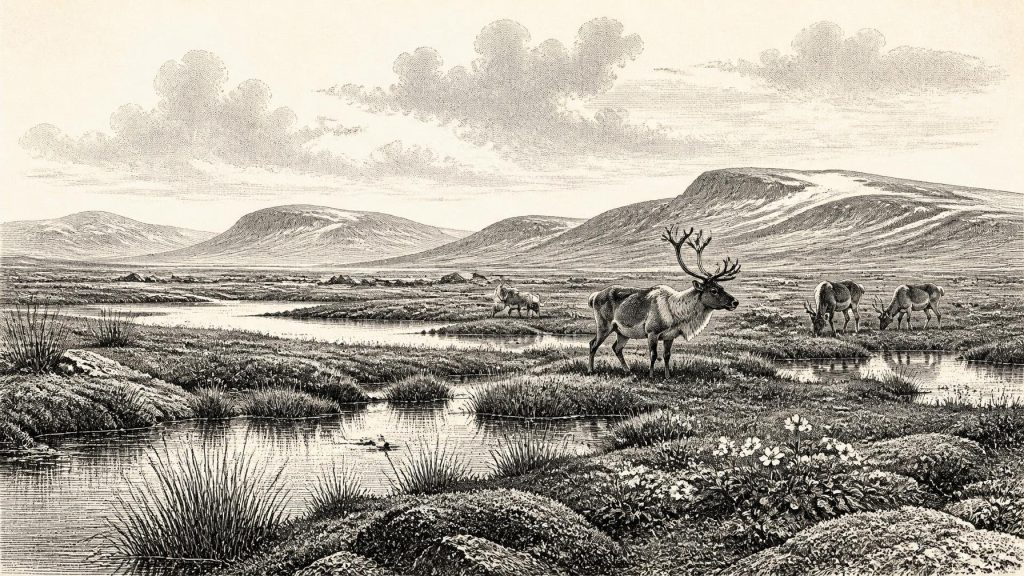
The Derryvree fossils support an interpretation of cold, open and largely treeless ground. Pollen was poorly preserved but predominantly herbaceous; plant macrofossils, mosses and insects add detail. Researchers describe a tundra or muskeg-like environment: wet, mossy or sedgy ground, shallow freshwater, frost-affected soils and a short growing season. Macrofossils include mountain avens (Dryas octopetala), an Arctic-alpine plant now most familiar in Ireland from limestone country in the west. This does not mean that Derryvree was a modern Arctic landscape transplanted intact to Fermanagh, nor that its precise plant community covered the whole island. It is firm local evidence for an open periglacial habitat during a broad cold-stage interval.
Such a setting had no fields, hedges, farms or villages. There is no evidence for cultivation, livestock, pottery, metalwork, built houses, monuments or territorial boundaries. Rivers and seasonal pools, exposed mineral ground, marshy vegetation and the shelter offered by relief would have mattered more than any political geography. The outlines of modern counties, provinces and coastlines are irrelevant to the period, although the site names used by archaeologists help locate the surviving evidence.
Castlepook’s Animal World
In north County Cork, Castlepook Cave near Doneraile—also known as Mammoth Cave—preserves Ireland’s richest known pre-Last Glacial Maximum vertebrate collection. Its limestone passages yielded remains of woolly mammoth, giant deer, reindeer, brown bear, wolf, Arctic fox, lemmings and spotted hyaena. The assemblage demonstrates that Ireland was reached, at intervals, by a striking range of large mammals and cold-adapted smaller animals during the Late Pleistocene. Improved collagen pretreatment and radiocarbon dating have been especially important: re-dating showed that several Castlepook specimens were thousands of radiocarbon years older than earlier determinations suggested, strengthening the evidence for an MIS 3 fauna.
These bones should not be read as a census from one day, one herd or even one generation. Castlepook accumulated material over long periods. Carnivores carried prey or scavenged carcasses into caves; water, sediment movement and earlier excavation disturbed deposits; species represented in adjacent galleries may be separated by millennia. A spotted-hyaena skull from the cave, now in the National Museum of Ireland, is an especially vivid reminder that caves were part of a predator and scavenger landscape as well as a potential refuge for animals. The word “hyaena” here denotes the Ice Age spotted hyaena, not an exotic visitor imagined from modern Africa.
Reindeer are particularly important for a reconstruction near 31,645 BCE. They favour open, cold environments and their remains accord with the Fermanagh evidence for tundra-like vegetation, although the two sites cannot be collapsed into a single simultaneous scene. Mammoth and giant deer attest to an ecological world capable, during favourable intervals, of supporting very large herbivores. Predators, scavengers and small mammals occupied different niches within it. What can be said securely is that Ireland was not biologically empty before the Last Glacial Maximum. What cannot be established is the size, permanence or exact distribution of each population across the island.
The Reindeer Femur Question
Castlepook also carries an arresting, but limited, possible human story. A reindeer femur from the cave collection has been presented as dating to about 31,000 BCE and bearing a single incision interpreted by Ruth Carden as a cut made by a sharp stone tool while fresh bone was being processed. County Cork’s heritage record appropriately treats it as a potentially momentous Palaeolithic artefact: if the interpretation is correct, it indicates that people handled a reindeer in Ireland far earlier than the island’s formerly accepted evidence for human presence.
Potentially is the crucial word. The bone was recovered from an old cave excavation, not a modernly excavated, sealed occupation floor. No securely associated stone tools, hearth, dwelling, human remains or butchery area of equivalent age has yet been recovered there. The date of a bone establishes when the animal died, within the range generated by the laboratory and calibration process; it does not itself prove when a mark was made, who made it, or where the carcass was killed. A carnivore could have transported the already marked bone into the cave. The prudent conclusion for 31,645 BCE is therefore not that Ireland possessed a settled human population, but that one specimen offers a serious hypothesis of transient human activity that requires further testing.
People Without a Proven Settlement
If people did visit Ireland during this interval, comparison with contemporary Upper Palaeolithic groups elsewhere in north-west Europe suggests mobile hunter-foragers, moving through seasonal landscapes and dependent on close knowledge of animals, weather, stone and shelter. That comparison is an interpretation, not direct Irish evidence. There is no demonstrated Irish camp, social group, language, leader or route of arrival from which to reconstruct a local society. Nor does lower global sea level automatically prove a usable land bridge between Britain and Ireland: ice loading, crustal movement, local sea levels and changing marine channels complicate the geography. Animal presence shows that movement into Ireland occurred, but not how often, by which exact corridor, or whether people followed the same paths.
Accordingly, there are no political affairs, diplomacy or warfare to narrate. There is no evidence for Irish ritual, formal burial, cave art, education or trade at this date. Stone tools may have been used if the Castlepook cut-mark interpretation proves sound, but no tool assemblage allows archaeologists to identify a technology or exchange network. It is more truthful to leave those categories blank than to give this remote period a borrowed version of later prehistoric Ireland.
A Threshold, Not an Origin Story
The importance of this horizon lies in its challenge to easy assumptions. Ireland was not merely a blank land waiting for the first Holocene settlers. Its caves and buried wetland deposits preserve a dynamic Late Pleistocene world of freshwater basins, sparse tundra vegetation, reindeer, mammoth, giant deer and dangerous carnivores. Yet neither is it possible to claim an established Ice Age nation or a continuous population. The later expansion of the ice sheet would remodel the island and erase much evidence, while the earliest unequivocal archaeological traces of sustained human settlement belong much later.
For this notional year, then, the most historically significant development is environmental: Ireland stood in a fluctuating cold-stage interval before the great glacial maximum. Derryvree shows open, frost-influenced wetland in Fermanagh; Castlepook demonstrates a rich Cork fauna and preserves a provocative possible trace of butchery. Together they offer not an annal for 31,645 BCE, but a disciplined portrait of what evidence can—and cannot—say about Ireland roughly 33,600 years ago.
Source References
Hover over a number to see the source. Select it to open the source.

- [1] A Reconsideration of the Radiocarbon Dating of the Marine Isotope Stage 3 Fauna from Southern Ireland
- [2] The Irish Quaternary Fauna Project
- [3] Castlepook Cave: County Geological Site Report
- [4] Spotted Hyena Skull
- [5] Heritage Artefacts of County Cork
- [6] Growth and Retreat of the Last British–Irish Ice Sheet, 31,000 to 15,000 Years Ago: The BRITICE-CHRONO Reconstruction
- [7] Growth and Retreat of the Last British–Irish Ice Sheet, 31,000 to 15,000 Years Ago: The BRITICE-CHRONO Reconstruction
- [8] Extent and Timing of the Last Glacial Maximum in Britain and Ireland: A Review
- [9] Late Pleistocene Chronostratigraphy and Ice Sheet Limits, Southern Ireland
- [10] Dimensions and Chronology of the Last Ice Sheet in Western Ireland
- [11] Oscillating Retreat of the Last British-Irish Ice Sheet on the Continental Shelf Offshore Galway Bay, Western Ireland
- [12] Response of the Irish Ice Sheet to Abrupt Climate Change During the Last Deglaciation
- [13] Early Deglaciation of the British-Irish Ice Sheet on the Atlantic Shelf Northwest of Ireland Driven by Glacioisostatic Depression and High Relative Sea Level
- [14] A Middle Midlandian Freshwater Series at Derryvree, Maguiresbridge, County Fermanagh, Northern Ireland
- [15] Palaeoecology
- [16] Figure 6.—The Subdivision of the Quaternary Period in Ireland
- [17] Dryas octopetala
- [18] The IntCal20 Northern Hemisphere Radiocarbon Age Calibration Curve (0–55 cal kBP)
- [19] IntCal Publications
- [20] The Problem of a Late Quaternary Landbridge Between Britain and Ireland
- [21] Deglaciation, Earth Crustal Behaviour and Sea-Level Changes in the Determination of Insularity: A Perspective from Ireland
- [22] Prehistoric Details
- [23] The Mesolithic in Ireland: When Was It?
- [24] First Evidence of a Late Upper Palaeolithic Human Presence in Ireland
- [25] New Insights on the Fauna of Ireland's Younger Dryas and Early Holocene from Alice & Gwendoline Cave
Primary Sources
- A Reconsideration of the Radiocarbon Dating of the Marine Isotope Stage 3 Fauna from Southern Ireland
- The Irish Quaternary Fauna Project
- Castlepook Cave: County Geological Site Report
- Spotted Hyena Skull
- Heritage Artefacts of County Cork
- Growth and Retreat of the Last British–Irish Ice Sheet, 31,000 to 15,000 Years Ago: The BRITICE-CHRONO Reconstruction
- Growth and Retreat of the Last British–Irish Ice Sheet, 31,000 to 15,000 Years Ago: The BRITICE-CHRONO Reconstruction
- Extent and Timing of the Last Glacial Maximum in Britain and Ireland: A Review
- Late Pleistocene Chronostratigraphy and Ice Sheet Limits, Southern Ireland
- Dimensions and Chronology of the Last Ice Sheet in Western Ireland
- Oscillating Retreat of the Last British-Irish Ice Sheet on the Continental Shelf Offshore Galway Bay, Western Ireland
- Response of the Irish Ice Sheet to Abrupt Climate Change During the Last Deglaciation
- Early Deglaciation of the British-Irish Ice Sheet on the Atlantic Shelf Northwest of Ireland Driven by Glacioisostatic Depression and High Relative Sea Level
- A Middle Midlandian Freshwater Series at Derryvree, Maguiresbridge, County Fermanagh, Northern Ireland
- Palaeoecology
- Figure 6.—The Subdivision of the Quaternary Period in Ireland
- Dryas octopetala
- The IntCal20 Northern Hemisphere Radiocarbon Age Calibration Curve (0–55 cal kBP)
- IntCal Publications
- The Problem of a Late Quaternary Landbridge Between Britain and Ireland
- Deglaciation, Earth Crustal Behaviour and Sea-Level Changes in the Determination of Insularity: A Perspective from Ireland
- Prehistoric Details
- The Mesolithic in Ireland: When Was It?
- First Evidence of a Late Upper Palaeolithic Human Presence in Ireland
- New Insights on the Fauna of Ireland's Younger Dryas and Early Holocene from Alice & Gwendoline Cave