

Castlepook’s Single Cut31646 BCE
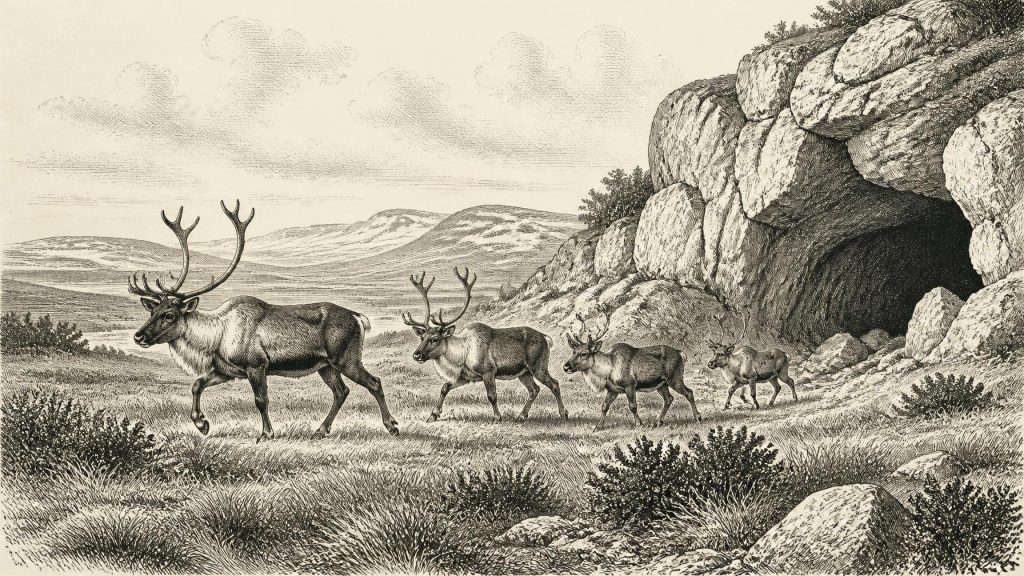
31,646 BCE is a retrospective label, not a datable Irish event, and evidence concerns the wider Late Pleistocene environment. Before the Last Glacial Maximum, parts of Ireland may have remained ice-free amid unstable, open habitats and lower seas. Castlepook Cave in County Cork preserves mixed faunal remains, including mammoth, reindeer, hyena and other cold-adapted species, spanning different periods. A reindeer femur dated roughly 33,000 years ago bears a possible stone-tool cut mark, suggesting hunters may have processed it. However, no associated settlement or tools exist. Castlepook therefore indicates possible intermittent human visits, while demanding cautious interpretation and further scientific research.
Dateline
31,646 BCE is not a date that can be assigned to an event in Ireland. It is a modern, backwards-counted calendar label, useful only as an approximate point on a much broader prehistoric timescale. In archaeological terms it falls about 33,600 calendar years before present, conventionally measured from 1950, during the Late Pleistocene and Marine Isotope Stage 3. At this depth of time, neither documentary history nor annual chronology exists. Radiocarbon determinations carry statistical uncertainty, and their conversion into calendar years depends on calibration curves that are themselves refined as evidence improves. The responsible question, therefore, is not what happened in Ireland in this particular year, but what the surviving geological and animal evidence can tell us about conditions in and around Ireland during the several millennia surrounding it.
A Landscape Before the Last Maximum
This was an Ice Age world, but not necessarily a vision of unbroken ice from coast to coast. The greatest expansion of the last British–Irish Ice Sheet came later, broadly between about 26,000 and 19,000 years ago. Research on mountain trimlines and glacial landforms indicates that parts of north-central Ireland remained ice-free until at least about 34,000 years ago, close to the chronological horizon represented by 31,646 BCE. That does not establish that every district was open country, nor does it provide a map for one exact year. It does show why Ireland should not be imagined simply as an empty white cap before the Last Glacial Maximum.
Climate in Marine Isotope Stage 3 was unstable. Greenland ice-core records reveal repeated swings between colder stadials and relatively milder interstadials, sometimes abrupt on geological timescales. Ireland lay on the Atlantic margin of that changing North Atlantic system. Conditions around 33,600 years ago may have supported a patchwork of grassland, herb-rich open ground, sedge wetlands, exposed mineral soils and sheltered valley habitats, rather than woodland comparable with modern Ireland. Local conditions depended on altitude, drainage, latitude and the proximity of ice. Later glacial erosion removed or reworked much of the evidence, so caves, protected sediment pockets and buried deposits carry disproportionate importance.
Sea levels were substantially lower than today as water was held in northern ice sheets, changing the outlines of coasts and exposing areas now beneath the sea. Yet the exact routes between Ireland, Britain and continental Europe remain uncertain. Lower sea level did not automatically produce one broad, permanent land bridge. Models of changing relative sea level, ice cover and isostatic movement offer differing reconstructions. The presence of large mammals in Ireland proves that dispersal was possible at particular times; it does not by itself reveal whether animals crossed dry ground, ice, narrow water barriers, or a changing combination of these. That uncertainty matters equally for any possible human movement.
The Castlepook Archive
The most suggestive evidence relevant to this period comes from Castlepook Cave, also called Mammoth Cave, near Doneraile in north County Cork. Excavations there from the late nineteenth and early twentieth centuries recovered a remarkable concentration of Pleistocene animal remains. The National Museum of Ireland’s collections include material from the cave, among it a spotted hyena skull. Castlepook has yielded evidence for a formidable animal community: woolly mammoth, giant deer, reindeer, brown bear, wolf, Arctic fox, lemmings and spotted hyena. These are not all proof of a single living community seen on one afternoon, or even in one century. A cave deposit can collect bones over long periods, and animals, water, gravity, excavation and later disturbance can mix material of different ages.
That warning is particularly important at Castlepook. The Irish Quaternary Fauna Project used accelerator mass spectrometry to date selected bones from old collections and demonstrated that Irish cave faunas encompassed several chronological phases. Subsequent reassessment has shown that some southern Irish faunal evidence belongs to Marine Isotope Stage 3, well before the Last Glacial Maximum, while other remains are considerably later. A radiocarbon measurement dates the death of the sampled animal within a probability range; it does not date every bone from the same cave gallery, still less an entire landscape. Castlepook is consequently a powerful archive of Ice Age Ireland, but not a neatly sealed settlement layer.
One object gives this article its focus: a reindeer femur fragment from Castlepook, reported as dating to roughly 33,000 years ago and bearing a deep linear mark interpreted by zooarchaeologist Ruth Carden as a cut made by a sharp stone tool. County Cork’s heritage record accordingly presents it as evidence that Stone Age hunters may have processed a reindeer in the region around c. 31,000 BCE. If that interpretation is sustained, it would represent extraordinarily early evidence of human activity in Ireland, long before the previously recognised terminal-Pleistocene traces and the far better attested Mesolithic settlement of the early Holocene.
Evidence, Not a Lost Settlement
The reindeer bone is important precisely because it is slight. It is not a house floor, hearth, burial, camp, weapon, stone-tool assemblage or group of securely associated butchered animals. No Palaeolithic settlement has been excavated at Castlepook, and no stone tool has been recovered in direct association with this femur. Nor can the bone show whether the animal was hunted, scavenged after death, butchered elsewhere and its remains later dragged into the cave by carnivores. Hyenas are especially relevant: caves often served as their dens, and their feeding, gnawing and bone-transporting behaviour can create complex accumulations.
The distinction between observation and interpretation should therefore remain visible. The observed facts are a fossil reindeer bone, an ancient date attributed to it, and a surface modification. The interpretation is that the mark is anthropogenic and records butchery by people using a stone edge. This is plausible enough to justify renewed investigation and to change the questions asked of Irish Palaeolithic archaeology. It is not enough to populate the landscape with a known tribe, name a migration, or claim a continuous Irish population from the Upper Palaeolithic onwards. Further fieldwork at Castlepook has also underlined how thoroughly earlier excavations emptied or disturbed many cave deposits, making fresh contextual discoveries difficult.
For this reason, the safest description of people in Ireland around 31,646 BCE is conditional. Small, mobile Upper Palaeolithic groups may have entered the region seasonally, perhaps following animal movements and exploiting a brief window of habitable terrain. They would have belonged to the wider world of Homo sapiens already present in parts of north-west Europe. But Ireland supplies no secure evidence for their numbers, sex and age composition, language, kinship system, routes, duration of stay or eventual fate. It is equally possible that visits were rare and discontinuous. A single possible butchery trace must not be inflated into a settled society.
Food, Movement and Everyday Risk
If people did process the Castlepook reindeer, the practical context was demanding. Reindeer offered meat, marrow, fat, hide, sinew, antler and bone: a large return for a mobile hunting party equipped to cut and carry portions away. Such a task required knowledge of animal anatomy, sharp-edged tools and decisions about transport, preservation and danger. Yet those general possibilities come from wider Upper Palaeolithic comparisons, not from a reconstructed Castlepook meal. Ireland has supplied no contemporary cooking place, hide-working area or toolkit from which to infer a local daily routine in detail.
Predators made carcasses contested resources. Spotted hyenas, wolves and bears were not symbols in a story but active competitors and scavengers; their remains and tooth marks help explain why caves can preserve bones while also complicating their interpretation. Mammoths and giant deer indicate that at least some Irish landscapes could support large grazing or browsing mammals during earlier cold-stage intervals. Reindeer and small cold-adapted mammals point towards open, often harsh conditions. The precise overlap of each species around 31,646 BCE cannot be assumed, but together they reject the old picture of a biologically vacant Ireland before the final ice advance.
There is no recoverable political history here. No chiefdom, territory, alliance, war, diplomacy, law or named community can responsibly be identified. Nor is there evidence for formal religion, monuments, art or teaching in Ireland at this date. If visitors came, they undoubtedly possessed learned skills and social traditions, but their beliefs and cultural practices have left no secure Irish trace. The most defensible cultural statement is negative but significant: the possible cut mark suggests technical knowledge carried into Ireland from a wider human world, while the absence of associated artefacts prevents closer identification.
A Fragile Northern Frontier
At this horizon Ireland was not the familiar island of farms, forests, parishes or kingdoms. It was a changing northern frontier in which open habitats, fluctuating ice margins, altered coastlines and animal dispersals shaped every possibility of movement. Castlepook’s bones offer direct testimony that such a landscape supported Pleistocene fauna. The reindeer femur may add the first faint testimony of people. Its value lies not in supplying certainty where none exists, but in making Ireland’s deep past less empty, more connected to neighbouring Ice Age Europe, and more open to careful future discovery.
Primary Sources
- The Irish Quaternary Fauna Project
- A Reconsideration of the Radiocarbon Dating of the Marine Isotope Stage 3 Fauna from Southern Ireland
- New Insights on the Fauna of Ireland's Younger Dryas and Early Holocene from Alice & Gwendoline Cave
- Preliminary Assessment of the Archive of Faunal Remains from Excavated Irish Cave Sites
- Spotted Hyena Skull
- Prehistoric Details
- Heritage Artefacts of County Cork
- Occurrence of Mammalia Relicts at Site Castlepook Cave
- Radiocarbon Dates from the University of Dublin, Trinity College, Ireland
- Mammoth Cave
- On the Discovery of Hyaena, Mammoth and Other Extinct Mammals in a Carboniferous Cavern in County Cork
- Last Glacial Maximum Cirque Glaciation in Ireland and Implications for Reconstructions of the Irish Ice Sheet
- Trimlines, Blockfields and the Vertical Extent of the Last Ice Sheet in Southern Ireland
- Dimensions and Chronology of the Last Ice Sheet in Western Ireland
- Vertical Dimensions and Age of the Wicklow Mountains Ice Dome, Eastern Ireland, and Implications for the Extent of the Last Irish Ice Sheet
- The Island of Ireland: Drowning the Myth of an Irish Land-Bridge?
- Quaternary
- The IntCal20 Northern Hemisphere Radiocarbon Age Calibration Curve (0–55 cal kBP)
- Recent Developments in Calibration for Archaeological and Environmental Samples
- Data – Ice Samples
- Stratigraphic Framework for Abrupt Climatic Changes During the Last Glacial Period Based on Three Synchronized Greenland Ice-Core Records
- The Colonization of Ireland: A Human Ecology Perspective