

Maguirebridge’s Calibrated Tundra31644 BCE
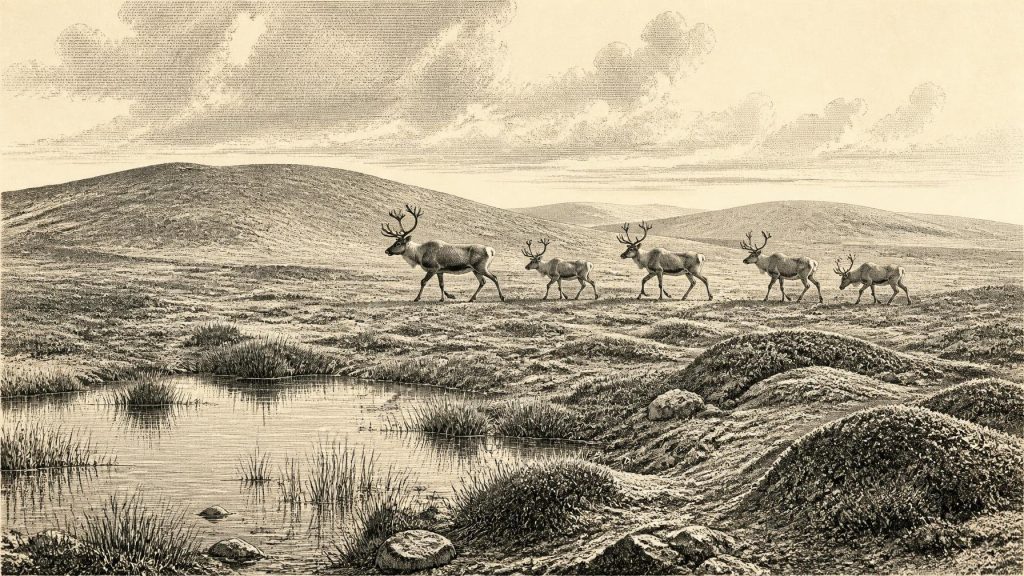
Around 31,644 BCE, Ireland’s history is reconstructed from environmental evidence rather than a datable event. Derryvree sediments near Maguiresbridge, calibrated to 36,900–31,700 cal BP, show Fermanagh was temporarily ice-free, with freshwater, tundra-like vegetation and severe seasonal conditions. Castlepook Cave preserves remains of reindeer, mammoth, giant deer and other cold-climate animals, although its deposits represent multiple periods and were disturbed. A possibly cut-marked reindeer bone suggests transient Upper Palaeolithic hunters, but permanent settlement remains unproven. Ireland was approaching wider glaciation, which later erased much evidence. Climatic oscillations and advancing ice, not political or cultural events, define this uncertain deep-prehistoric central horizon.
Dateline
31,644 BCE cannot be treated as an anniversary. No written calendar, named ruler, excavated settlement or securely dated human episode permits history at the scale of a modern year. In archaeological usage, the date corresponds roughly to 33,594 calibrated years before present (cal BP), with “present” defined as 1950. It falls in the later part of Marine Isotope Stage 3, a climatically volatile interval of the last Ice Age. The responsible approach is to examine evidence whose calibrated ranges overlap this horizon, rather than invent an event for it. The key Irish record lies beneath a drumlin near Maguiresbridge, County Fermanagh.
A Date Within a Range
The principal chronological anchor is the Derryvree freshwater deposit, exposed during roadworks in 1969 about two kilometres north-east of Maguiresbridge. Silts and fine sands containing organic material lay between two substantial sheets of till, deposits made by ice. The original radiocarbon determination, Birm-166, was 30,500 radiocarbon years BP and carried a large uncertainty. Recalibration places the material broadly at about 36,900–31,700 cal BP. That interval includes the nominal year considered here. It shows that this part of Fermanagh was ice-free at some point within that span, but cannot establish precisely what occurred there in 31,644 BCE. The range, rather than the numbered year, is the historical fact.
Derryvree is valuable because it preserves environmental evidence in its geological setting, but it also warns against false precision. A radiocarbon age is not identical to a calendar age: atmospheric carbon-14 levels changed over time, requiring measurements to be calibrated against independently dated archives. At this depth in time, calibrated intervals remain broad and may be refined as methods improve. The deposit records conditions during sediment formation and accumulation, not a complete annual diary of the locality. It is evidence for a cold-stage landscape over centuries or millennia, not an event on a particular day.
Open Ground in Fermanagh
Plant and animal remains from Derryvree indicate a treeless, periglacial environment. Recorded pollen was largely herbaceous, while plant macrofossils included mosses and species associated with cold, wet ground. The assemblage has been interpreted as tundra or muskeg-like vegetation beside freshwater. This was not the familiar green, wooded Ireland of later millennia. Dry ground may have carried sparse herb-rich cover, while shallow pools, wet hollows and sedge-rich margins punctuated a landscape exposed to frost, wind and strong seasonal contrasts. Such reconstruction remains interpretive, but it is closely constrained by the botanical evidence.
The landscape was not, however, a blank sheet of ice. Ireland was probably largely ice-free until roughly 32,000 cal BP, although expansion of the last Irish Ice Sheet was approaching and varied by region. The later Last Glacial Maximum, conventionally dated to about 26,500–19,000 years ago, would cover almost all of the island and profoundly rework older surfaces. At the horizon represented by Derryvree, local freshwater and vegetation records coexist with the larger story of deteriorating climate and advancing ice. Subsequent glaciation helps explain why evidence from this era is so sparse: it eroded, buried, mixed or removed many places where people and animals might once have left traces.
Caves and a Lost Fauna
In southern Ireland, Castlepook Cave near Doneraile in north County Cork provides a different archive. Early twentieth-century excavations recovered an extraordinary collection of Ice Age animal remains, including reindeer, woolly mammoth, giant deer, brown bear, wolf, fox, hare, lemmings and spotted hyaena. Later radiocarbon programmes established that the cave material accumulated during more than one period. The cave is therefore not a frozen moment, and its fauna should not be imagined as a single herd, pack and hunting party sharing one valley. Yet the collection securely shows that, during the broader MIS 3 interval, Ireland supported or was reached by a richer cold-climate mammal community than the modern island.
The distinction between a cave assemblage and a living landscape is important. Animals may have died in natural traps; carnivores may have dragged carcass parts underground; water may have moved bones; and early excavations disturbed deposits whose layers were not always recorded to modern standards. The Irish Quaternary Fauna Project noted extensive re-sorting at Castlepook and limits in its stratigraphy. More recent work has also shown that several older bone dates need revision because improved collagen pretreatment and ultrafiltration can remove contaminants that make samples appear too young. The strongest conclusion is not that every listed species lived together in 31,644 BCE, but that cold-adapted and open-country fauna repeatedly reached Ireland in the relevant prehistoric world.
The Human Question
The possibility of people in Ireland at this time rests chiefly on one controversial but important object: a reindeer femur from Castlepook that County Cork heritage interpretation presents as bearing a mark consistent with cutting fresh tissue using a sharp stone tool. It has been associated broadly with about 31,000 BCE. If the mark is anthropogenic and its association secure, it may indicate that one or more Upper Palaeolithic hunters processed a reindeer in Ireland during the wider Ice Age period. It would be a remarkable clue, not proof of a permanent colony. No securely associated hearth, stone-tool assemblage, dwelling, burial, art panel or repeated occupation floor has established an Irish community of this age.
Caution is essential because the National Museum of Ireland still describes the Palaeolithic human record as lacking clear evidence, apart from a much older flint flake at Mell, County Louth, thought to have been transported to Ireland by ice rather than made or used there. The cave femur merits continued scrutiny precisely because it challenges that conservative position. A current Castlepook research project has sought surviving undisturbed deposits and reassessed old collections. Until it produces a securely contextualised human artefact or repeated evidence of activity, the responsible conclusion is that transient human presence is possible, perhaps even plausible, but permanent settlement is unproven.
For comparison, the better-published cut-marked brown-bear patella from Alice and Gwendoline Cave, County Clare, is vastly later, dating to about 12,890–12,678 cal BP. Its two independent dates and microscopic assessment support the claim for a Late Upper Palaeolithic human visit. That find cannot be projected backwards more than twenty millennia to fill the silence at Derryvree or Castlepook. It does demonstrate the kind of evidence required: a directly dated bone, plausible cut marks, careful analysis and transparent publication. It also shows how Irish prehistory changes when neglected museum collections are revisited with improved methods.
Society Without a Settlement
If people entered Ireland around this horizon, the available evidence favours a very small, mobile party rather than a settled population. Reindeer, if locally available, would have supplied meat, fat, hide, sinew, antler and bone; other large herbivores could have offered similar resources. But this is an inference from animal ecology and wider Upper Palaeolithic practice, not direct evidence for a Castlepook camp. There is no basis for naming a tribe, assigning a language, reconstructing families or attaching visitors to a particular continental archaeological culture. Nor can an isolated animal-processing trace establish whether hunters arrived across exposed coastal plains, narrow water, or another route through a changing Irish Sea world.
Political affairs, warfare and diplomacy are beyond recovery. No states, kingdoms, borders, written agreements or named leaders are evidenced in Ireland. It would be misleading even to call a possible hunting party “Irish” in any later cultural sense. At most, social organisation may have involved the flexible co-operation needed for travel, hunting, carcass processing and survival in a demanding seasonal environment. Relations with groups in Britain or continental Europe remain unknown. The evidence permits mobility and contact as possibilities; it does not document routes, alliances, conflict or exchange networks.
Culture, Religion and Learning
No locally proven object supports claims about ritual, religion, art, music or formal learning in Ireland at this date. Upper Palaeolithic groups elsewhere in Europe made sophisticated blades, ornaments, figurative art and cave images, but Ireland has yielded no securely dated equivalent from this interval. Decorating an Irish Ice Age scene with continental art traditions or elaborate ceremonies would substitute analogy for evidence. The strongest cultural conclusion is more modest: whoever made a possible cut mark would have possessed practical knowledge of sharp-edged stone technology and animal anatomy. Even that depends on confirmation that the mark was made by a human.
Knowledge of the country was nevertheless embedded in the ecological record. Mammals capable of reaching Ireland, and any people who may have followed them, would have responded to terrain, weather, forage, water and seasonal opportunity. Derryvree’s wetland plants and Castlepook’s fauna reveal a landscape in which survival depended on reading those conditions. This was not an economy of fields, livestock, markets or imported goods, but a world of wild resources and precarious access. No evidence identifies trade in objects, though movement itself would have connected Ireland’s changing landmass to the wider north-west European Ice Age environment.
An Environmental, Not National, History
The central development around 31,644 BCE was environmental change. Within the calibrated span containing this nominal year, Fermanagh preserved freshwater sediments beneath open tundra; southern caves retained bones from animals adapted to a cold, largely treeless world; and Ireland was moving toward severe glaciation that would later overwhelm or transform much of the land. Crag Cave speleothem research in south-west Ireland independently indicates that last-glacial climates oscillated sharply, with interstadial conditions mild enough for liquid water and calcite growth alternating with colder phases. Ireland was not environmentally static, even where evidence cannot be narrowed to one year.
That is the appropriate history for this date: not an invented chief, battle or village, but a carefully bounded picture of a changing Ice Age landscape. Derryvree provides the clearest chronological window, Castlepook the most vivid faunal evidence, and the debated reindeer femur keeps open the question of very early human visitation. Together they describe an Ireland intermittently habitable for cold-adapted animals, perhaps briefly visited by hunters, and on the threshold of much more extensive ice. The uncertainty is not a defect to conceal. It is the defining feature of Ireland’s deep past, and the reason every surviving silt layer, bone and cave deposit matters.
Primary Sources
- A Middle Midlandian Freshwater Series at Derryvree, Maguiresbridge, County Fermanagh, Northern Ireland
- Palaeoecology
- Figure 6.— The Subdivision of the Quaternary Period in Ireland
- A Reconsideration of the Radiocarbon Dating of the Marine Isotope Stage 3 Fauna from Southern Ireland
- The Irish Quaternary Fauna Project
- Episodic Speleothem Deposition Tracks the Terrestrial Impact of Millennial-Scale Last Glacial Climate Variability in SW Ireland
- The Last Irish Ice Sheet: Extent and Chronology
- Late Pleistocene Chronostratigraphy and Ice Sheet Limits, Southern Ireland
- New Data for the Last Glacial Maximum in Great Britain and Ireland
- Pattern and Timing of Retreat of the Last British-Irish Ice Sheet
- Trimlines, Blockfields and the Vertical Extent of the Last Ice Sheet in Southern Ireland
- First Evidence of a Late Upper Palaeolithic Human Presence in Ireland
- New Insights on the Fauna of Ireland’s Younger Dryas and Early Holocene
- The IntCal20 Northern Hemisphere Radiocarbon Age Calibration Curve (0–55 cal kBP)
- 2022:564 – Castlepook Cave, Castlepook South, Cork
- Heritage Artefacts of County Cork
- Stone Age
- Guide to the National Museum of Ireland
- Irish Quaternary Association
- Phylogeographic, Ancient DNA, Fossil and Morphometric Analyses Reveal Ancient and Modern Introductions of a Large Mammal: The Complex Case of Red Deer (Cervus elaphus) in Ireland
- Investigating Seasonal Mobility in Irish Giant Deer Megaloceros giganteus Through Strontium Isotope Analysis
- Anthropogenic Changes to the Holocene Nitrogen Cycle in Ireland