
Castlepook’s Hyaena Den31598 BCE
About 31,598 BCE, Ireland lay within the climatically unstable Middle Midlandian of the last Ice Age, not a precisely datable historical year. Derryvree, County Fermanagh, preserves freshwater sediments between glacial tills, revealing treeless periglacial wetlands with sedges, mosses, insects and open tundra-like ground. Castlepook Cave, County Cork, yielded reindeer, mammoth, hyaena and other cold-stage fauna, although disturbed deposits prevent assuming a single community. Possible stone-tool cuts on reindeer bones may signal brief Upper Palaeolithic visits, but remain unconfirmed. No secure evidence demonstrates settlement, tools, camps or continuity of population. Environmental change, ice advance and poor preservation define this Irish past.
Dateline
The label 31,598 BCE creates a false impression of precision. No person in Ireland counted years in this way, and no archaeological deposit can identify an occurrence within that single modern calendar year. In calibrated terminology, it corresponds approximately to 33,548 years before AD 1950, within the later part of Marine Isotope Stage 3, a climatically volatile portion of the last Ice Age. The responsible subject is therefore not an anniversary, ruler or battle, but Ireland during a broad prehistoric horizon, illuminated by fragments of sediment, pollen, insects and animal bone. The evidence is exceptionally sparse, and its limits are as historically important as its discoveries.
A Cold Phase, Not a Single Year
Irish Quaternary scholars have conventionally placed this interval within the Middle Midlandian, sometimes termed the Derryvree Cold Phase. It preceded the fullest expansion of the last Irish Ice Sheet, which occurred much later, broadly during the global Last Glacial Maximum of c. 26,500–19,000 years ago. That does not mean that all of Ireland was comfortable, ice-free ground in 31,598 BCE. Ice margins, snowfall, frozen ground, rivers and vegetation altered markedly by region and through time. Modern reconstructions of the British–Irish Ice Sheet likewise show that advance and maximum extent were not simultaneous everywhere: some sectors advanced as early as c. 30,000 years ago, while the ice sheet reached its greatest overall volume around 23,000 years ago.
For a date so remote, climate must be described in ranges and tendencies. Greenland ice-core records demonstrate abrupt warming and cooling across Marine Isotope Stage 3, while Irish land records preserve only intermittent local responses. A colder, highly seasonal landscape is the strongest conclusion. It would have been unlike the familiar wooded and wet modern island: open ground, frost-disturbed soils, sparse plant cover and wetlands could exist alongside glacier ice or beyond its margins. Sea level was lower than today, changing the shape of coasts and the distances between landmasses, but the precise routes by which animals—and any people—could have moved into the region remain unresolved.
Derryvree’s Buried Wetland
The clearest Irish environmental archive relevant to this broad period came from Derryvree, near Maguiresbridge in County Fermanagh. There, roadworks exposed organic-rich freshwater sediments and fine sands lying between two tills: deposits left directly by glacier ice. Their order tells a compelling story. Ice had occupied the locality; a period followed in which freshwater sediment and organic material accumulated; later glacial activity sealed the record beneath a new layer of till. It is firm evidence for major environmental change, though not a year-by-year sequence.
The Derryvree organic material produced a conventional radiocarbon age of about 30,500 radiocarbon years BP, with a substantial uncertainty. Calibration converts such determinations into a broad and irregular calendar-age range rather than a neat date; published discussions place its relevance across parts of the later 30,000s and early 30,000s calibrated BP. Thus 31,598 BCE may fall within the general horizon represented by the deposit, but cannot be located as a moment inside it. Radiocarbon dating dates the death of the sampled organism, while sediments can incorporate materials over time; the distinction matters greatly here.
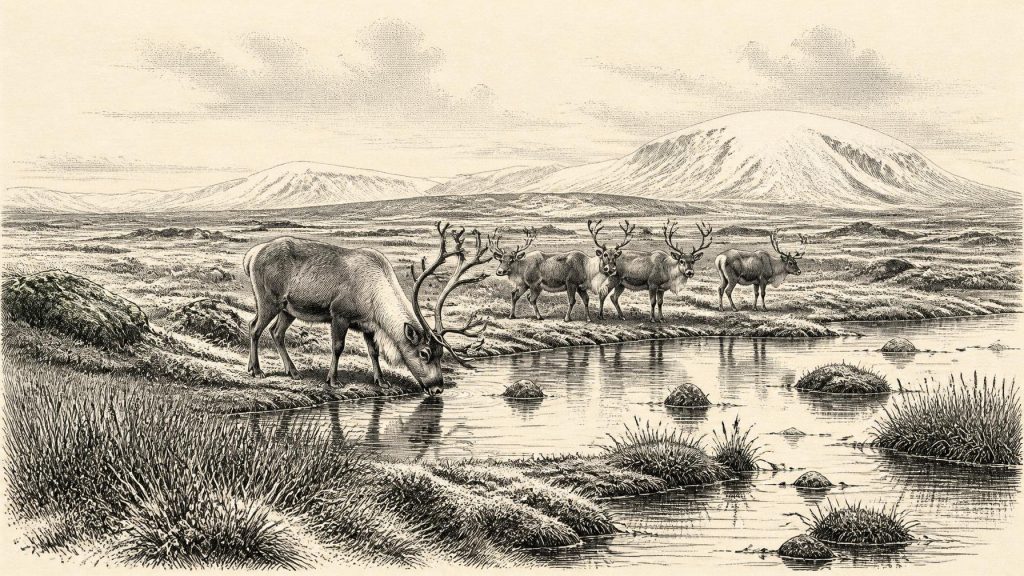
Pollen, plant macrofossils, mosses and insect remains from Derryvree indicate a treeless, cold, periglacial environment. Sedges and freshwater mosses grew around wet hollows, while finds including bogbean and alternate water-milfoil attest to freshwater habitats. The evidence has been interpreted as tundra or muskeg: waterlogged ground and pools in a landscape affected by severe frost, rather than dense forest. Trace amounts of tree pollen do not prove local woodland, since pollen can travel considerable distances. What is secure is the existence of a functioning, if harsh, mosaic of water, marsh and open ground in at least part of northern Ireland during an interval between glacial advances.
Castlepook and the Animal World
County Cork provides a different kind of evidence. Castlepook Cave, near Doneraile, is one of Ireland’s most important Pleistocene faunal sites. Excavations beginning in the late nineteenth and early twentieth centuries recovered a remarkable but problematic collection. Later radiocarbon work on the wider cave assemblage showed that mammals reached Ireland during a long span between at least about 45,000 and 20,000 radiocarbon years ago. The collection includes reindeer, brown bear, wolf, Arctic fox, hare, lemming, spotted hyaena and woolly mammoth. It demonstrates that Irish environments could at times support, or be visited by, a diverse cold-stage fauna.
These animals should not be imagined as members of one permanent, perfectly contemporaneous community. Cave deposits were disturbed, old excavations often recorded stratigraphy imperfectly, and bones could be accumulated by carnivores, water, collapse or human excavators. Spotted hyaenas are especially significant because a cave can be a den, a place to drag carcasses, or a natural trap rather than a human shelter. A mammoth bone or hyaena tooth proves neither that people hunted the animal nor that every species lived side by side. Nevertheless, the faunal evidence strongly supports an open-country landscape capable of sustaining herbivores and their predators during favourable intervals of the Ice Age.
Reindeer are central to the human question. A reindeer femur from the Castlepook collections has been reported as bearing a mark interpreted by zooarchaeologist Ruth Carden as a sharp stone-tool cut made during butchery. County Cork heritage publications place the animal’s death at roughly 30,000 BCE, and current Castlepook research has reported more than one reindeer bone with possible human modification. If microscopic analysis, dating and contextual work ultimately confirm that interpretation, it would indicate that people handled an animal in Ireland in the Upper Palaeolithic, many millennia earlier than the previously accepted evidence.
A Possible Visit, Not a Population
That striking possibility must remain conditional. The femur came from an old cave collection, not from a newly excavated occupation floor containing associated tools, a hearth or a dwelling. A date for bone establishes when the animal died within a range; it does not automatically date a cut, identify the agent who made it, or prove that a person lived nearby. Natural damage from carnivores, trampling, sediment movement, breakage and excavation can sometimes resemble deliberate marks. Nor can one bone establish a language, ancestry, named archaeological culture or a continuous population.
This caution is not an attempt to diminish the find. It is how archaeology distinguishes evidence from interpretation. Ireland’s national museum continues to state that no clear evidence has yet emerged for Palaeolithic human presence in the conventional archaeological record. Its famous flint flake from Mell, County Louth—possibly made hundreds of thousands of years ago—was fashioned elsewhere and later transported in glacial deposits; it is not evidence for a Palaeolithic Irish settlement. The clearest published evidence of people processing an animal in Ireland remains much later: cut marks on a brown-bear patella from Alice and Gwendoline Cave, County Clare, directly dated to c. 12,810–12,590 calibrated BP.
A prudent conclusion for 31,598 BCE is therefore modest but important. Small, mobile Upper Palaeolithic groups may have made brief journeys into the Irish region during favourable conditions, perhaps following game or exploiting a carcass; Castlepook offers a promising, contested indication of this. Yet no securely demonstrated camp, tool assemblage, burial, artwork or repeated occupation surface allows historians to write of established inhabitants. There is no basis for claiming direct descent between any such visitors and later peoples of Ireland.
Society Beyond the Evidence
Consequently, political affairs cannot be reconstructed. There were no known kingdoms, chiefs, borders, treaties or diplomatic institutions, and no evidence for organised warfare. Calling any possible visitors a “tribe”, much less an Irish nation, would impose later social categories on an almost silent record. Equally, there is no evidence for farming, domesticated animals, fields, villages, pottery, metalworking, formal trade routes or permanent settlement. Agriculture in Ireland lay tens of millennia in the future.
Religion, art and learning are also unknowable for Ireland at this horizon. Upper Palaeolithic peoples elsewhere in Europe possessed sophisticated technologies and rich symbolic traditions, but no Irish cave art, figurine, burial rite or ritual site of comparable age has been securely identified. It is reasonable to say that any humans present would have possessed social knowledge and practical skill: survival in cold environments required co-operation, movement planning, food-sharing and expertise in animal behaviour and materials. It is not reasonable to turn that general human capacity into a detailed Irish story.
Landscape as History
The most important development around this notional year was environmental instability. In Fermanagh, freshwater life briefly left a record beneath later ice. In north Cork, caves accumulated the remains of animals moving through an open, cold landscape, including predators that made those caves part of their own ecology. Across Ireland, advancing ice and shifting climate repeatedly erased or buried traces that might otherwise reveal more. The apparent emptiness of the human record is therefore not proof that people never came; it is also a consequence of erosion, glaciation, sea-level change and the rarity of preserved sites.
31,598 BCE should thus be read not as a dated event but as a window onto a precarious Ice-Age Ireland. The hard evidence is environmental and faunal: periglacial wetlands, reindeer, hyaenas and changing ice. The human story is a carefully framed question raised by a marked bone at Castlepook, not a settled fact. That distinction preserves the real wonder of the period: even the smallest surviving trace can alter the scale of Ireland’s deep past, provided it is allowed to remain as uncertain as the evidence requires.
Primary Sources
- The Irish Quaternary Fauna Project
- First Evidence of a Late Upper Palaeolithic Human Presence in Ireland
- New Insights on the Fauna of Ireland's Younger Dryas and Early Holocene from Alice & Gwendoline Cave
- Figure 6.— The Subdivision of the Quaternary Period in Ireland
- Irish Association for Quaternary Studies Guide 13
- Early Midlandian–Middle Midlandian, Pleistocene, Northern Ireland
- Castlepook Cave, County Geological Site Report
- Archaeological Heritage of County Cork
- Heritage Artefacts of County Cork
- Archaeology Research Excavation Grant Report: Castlepook Cave
- The Exploration of Castlepook Cave, Co. Cork. With 3 Plates.
- Occurrence of Mammalia Relicts at Site Castlepook Cave
- Dublin Radiocarbon Dates II
- BSBI: Menyanthes trifoliata
- BSBI: Myriophyllum alterniflorum
- Growth and Retreat of the Last British–Irish Ice Sheet, 31,000 to 15,000 Years Ago: The BRITICE-CHRONO Reconstruction
- Growth and Retreat of the Last British-Irish Ice Sheet, 31,000 to 15,000 Years Ago: The BRITICE-CHRONO Reconstruction
- Dimensions and Chronology of the Last Ice Sheet in Western Ireland
- Trimlines, Blockfields and the Vertical Extent of the Last Ice Sheet in Southern Ireland
- Oscillating Retreat of the Last British-Irish Ice Sheet on the Continental Shelf Offshore Galway Bay, Western Ireland
- Radiocarbon Constraints on the Age of the Maximum Advance of the British-Irish Ice Sheet in the Celtic Sea
- Prehistoric Details: Mell Flint Flake
- Stone Age
- The Mesolithic in Ireland: When Was It?