
Awbeg Limestone Corridor31597 BCE
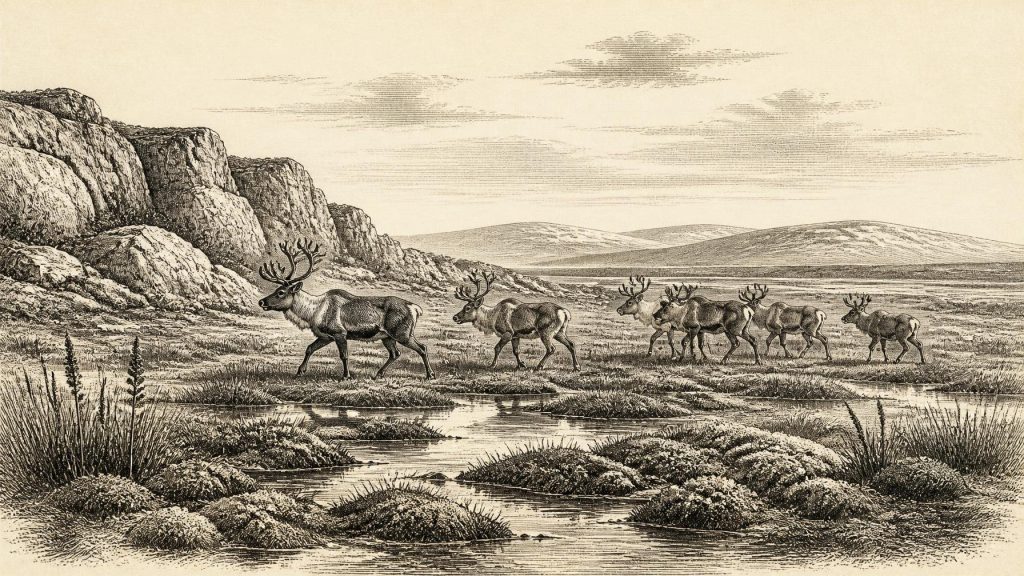
Around 31,597 BCE, present-day Ireland formed part of a low-sea-level, climatically volatile north-west European landmass during Marine Isotope Stage 3. It was not yet fully glaciated, although worsening conditions preceded later ice-sheet expansion. Fermanagh sub-till sediments indicate cold, open, treeless terrain with wetlands, freshwater and hardy vegetation. Castlepook Cave’s mixed faunal deposits document mammoth, reindeer, giant deer, bears, hyaenas and other cold-adapted animals, but cannot reconstruct one moment or locality. Cut marks on a reindeer bone may indicate a brief Upper Palaeolithic human visit, though this remains disputed. No settlements, institutions or ritual life are known; glaciation erased much evidence.
Dateline
The label 31,597 BCE offers a useful point of orientation, but it cannot describe a recorded Irish year. No calendar, inscription, settlement sequence or event narrative exists for Ireland at this depth of time. In simple chronological arithmetic it lies about 33,500 years before 1950, within the later part of Marine Isotope Stage 3 (MIS 3), a long and climatically unstable phase of the Last Glacial period. Archaeology and earth science can therefore illuminate a broad interval around this notional date, not identify what happened in Ireland during one particular year. The appropriate evidence is indirect and uneven: cave bones, marks on bone, buried freshwater sediments, pollen, plant remains, insects, glacial deposits and the wider reconstruction of the British–Irish Ice Sheet.
A Landscape Before Full Glaciation
This was not yet the Last Glacial Maximum, the later interval when a large ice sheet covered much of Ireland. The chronology of the ice sheet’s growth remains an active field of research, and regional conditions did not change everywhere at once. Nevertheless, deposits beneath later glacial sediments in County Fermanagh, together with wider geomorphological evidence, indicate that parts of north-central Ireland were ice-free until at least about 34,000 years ago. At the notional point represented by 31,597 BCE, the island was therefore probably approaching, rather than already experiencing, the fullest late-glacial expansion of ice.
“Ireland” is itself an anachronistic convenience. There was no island nation, no Irish people in any later cultural sense, and no fixed coastline resembling the modern one. Global sea levels were much lower than today because vast quantities of water were locked in northern ice sheets. Exposed shelves and changing coastal plains altered the relationship between Ireland, Britain and continental Europe, though ice, rivers, wetlands and arms of the sea still made movement complex. It is safest to speak of a western north-European landmass, with Ireland’s present land area forming one environmentally varied part of it.
Cold Ground and Fresh Water
The strongest local environmental clue comes from Derryvree near Maguiresbridge, County Fermanagh. There, road construction exposed organic silts and fine sediments trapped between two glacial tills: an ice-free freshwater episode, later sealed beneath renewed ice. The deposit produced a radiocarbon determination of 30,500 ± 1,170/1,030 radiocarbon years before present. That measurement is not a calendar date, and its uncertainty and calibration mean that it cannot be converted into a falsely exact year. It does, however, place the deposit in the broad middle-to-late MIS 3 world relevant here.
Pollen, plant macrofossils, mosses and insect remains from such deposits point to open, treeless terrain. Sedges, grasses and other hardy herbaceous plants occupied wet ground; mossy, muskeg-like patches and shallow freshwater pools occurred locally. Arctic-alpine taxa show that this was a cold landscape, but not a simple white wilderness. Seasonal thaw, running water and sheltered wetland created ecological niches. Dwarf shrubs may have occurred in suitable places, while frost action, sparse vegetation and wind exposed much bare ground. The precise pattern would have shifted rapidly with local drainage, elevation and climate.
Greenland ice cores demonstrate why such caution is necessary. MIS 3 was punctuated by abrupt shifts between colder stadials and comparatively milder interstadials. Some transitions registered in the ice-core record occurred over decades rather than over the slow, uniform millennia once imagined for the Ice Age. Irish deposits cannot be matched confidently to every Greenland fluctuation, but they show that Ireland was part of this volatile north Atlantic climatic system. A seemingly durable wetland or grazing ground could be transformed as temperature, snowfall, permafrost and meltwater changed.
Castlepook’s Animal Archive
In southern Ireland, Castlepook Cave near Doneraile in County Cork provides the principal faunal archive for the period leading towards the Last Glacial Maximum. Its narrow limestone galleries and chambers were excavated mainly in the early twentieth century, producing thousands of bones. Individual specimens have returned radiocarbon ages spanning a very long interval, roughly 45,700 to 19,950 radiocarbon years before present. That range is a warning as well as a resource: the cave is not a single, neatly dated occupation floor. Water disturbance, early excavation practices and the activities of animals mixed material from different times and places.
Its fauna nevertheless establishes what kinds of animals could reach Ireland during the wider period. Woolly mammoth, reindeer, giant deer, brown bear and spotted hyaena are represented, with Arctic fox, wolf and lemmings among other cold-adapted animals recorded from the cave’s Ice Age deposits. No single list proves that every species lived side by side in the Awbeg valley in 31,597 BCE. Rather, the assemblage reveals a changing regional fauna capable of using open, cold landscapes over many millennia. Reindeer especially evoke mobile grazing herds; hyaenas and wolves remind us that carcasses entered a food web of predators, scavengers and den-users before their bones became archaeological evidence.
Caves preserve this evidence precisely because bone survives better in sheltered limestone contexts than in the acidic soils and heavily glaciated landscapes beyond them. Yet they are biased archives. A mammoth bone in a cave does not mean mammoths lived inside it, nor does a hyaena accumulation mean people were absent from the surrounding country. Bones may have been dragged in, washed in, accumulated beneath entrances or left by animals that used a chamber intermittently. The most responsible reconstruction is therefore one of habitats and animal movements, not a populated scene frozen in time.
A Possible Human Trace
The outstanding, disputed human question concerns a reindeer femur from Castlepook. It has been reported as bearing deep marks consistent with cutting or chopping by a sharp stone edge, and the bone has been publicised as dating to about 33,000 years ago. If that interpretation is sustained by further study, it would be evidence that Upper Palaeolithic hunter-gatherers reached Ireland during the broader MIS 3 period—far earlier than the formerly accepted post-glacial human presence. It would be a consequential discovery, but a very small one: a modified animal bone rather than a settlement.
The distinction matters. The dated bone gives the age of the animal within a statistical range; it cannot by itself date the moment when a mark was made. Nor are securely associated hearths, stone-tool scatters, dwelling floors, burials, art, ornaments or human remains known from Ireland at this age. The marks must also be considered against other possible agents, including carnivore damage, breakage and cave taphonomy. Recent re-dating has shown that some older Irish cave radiocarbon results need revision, underlining the value of modern pretreatment and calibration. For this period, evidence should be described as a possible brief human incursion, not as continuous colonisation.
Life Without a Recorded Society
If people did visit, they were likely highly mobile foragers moving through a large, ecologically connected north-west European zone, perhaps following seasonal opportunities created by reindeer and other game. That is an interpretation based on the animals, the low sea levels and comparable Upper Palaeolithic lifeways elsewhere; it is not directly demonstrated for Ireland. The archaeological record cannot tell us how many people came, whether they travelled in family groups, how long they remained, what language they spoke or whether they returned. Even “hunting” must be used carefully: a butchered bone could show the processing of a hunted, scavenged or found carcass.
There is no evidence for political communities, leaders, diplomacy, territorial institutions, warfare, formal trade routes or permanent villages in Ireland around this point. Neither is there evidence for farming, herding, cereal cultivation, pottery, metalworking or monument building. Food procurement, where people were present, would have depended upon wild resources and acute knowledge of animal behaviour, weather, stone and terrain. Exchange may have occurred within wider hunter-gatherer networks, but no Irish artefact assemblage of this date allows trade to be demonstrated. The responsible historical answer is not that such relationships were impossible, but that Ireland’s evidence does not reveal them.
Belief, Culture and Silence
The same restraint applies to religion and culture. Late Upper Palaeolithic communities elsewhere in Europe made ornaments, images and ritualised deposits, but no comparable evidence can securely be assigned to Ireland around 31,597 BCE. Castlepook’s evocative later gallery names—such as Hyenahall and Elephant Hall—belong to modern exploration, not Ice Age belief. There are no Irish cave paintings, shrines, graves or symbolic objects from this period on which to build a narrative of ritual life. Absence of evidence does not prove an absence of thought, language, social bonds or spiritual practice; it marks the limit of what Ireland’s surviving record can presently support.
Approaching a Harder World
The great historical development visible from this date is environmental rather than political: the tightening of glacial conditions that would eventually remodel the country. Later ice movement eroded older surfaces, redistributed sediments and buried or destroyed much of the evidence that might otherwise survive. This helps explain why the record is so sparse and why a few caves and sub-till wetlands carry disproportionate weight. The Ireland of this broad interval was neither a timeless empty ice field nor a documented homeland. It was a changing cold-region landscape of open ground, wet hollows, large mammals, predators and possible transient human visitors, on the threshold of much more extensive glaciation.
Primary Sources
- Castlepook Cave
- A reconsideration of the radiocarbon dating of the Marine Isotope Stage 3 fauna from southern Ireland
- The Irish Quaternary Fauna Project
- First evidence of a Late Upper Palaeolithic human presence in Ireland
- Palaeolithic Ireland – New evidence emerges from the Emerald Isle
- New insights on the fauna of Ireland's Younger Dryas and Early Holocene from Alice & Gwendoline Cave
- Trimlines, blockfields and the vertical extent of the last ice sheet in southern Ireland
- Dimensions and chronology of the last ice sheet in Western Ireland
- Growth and retreat of the last British–Irish Ice Sheet, 31,000 to 15,000 years ago: the BRITICE-CHRONO reconstruction
- The timing and magnitude of the British–Irish Ice Sheet between Marine Isotope Stages 5d and 2
- Maximum extent and dynamic behaviour of the last British–Irish Ice Sheet west of Ireland
- Last Glacial Maximum cirque glaciation in Ireland and implications for reconstructions of the Irish Ice Sheet
- A stratigraphic framework for abrupt climatic changes during the Last Glacial period based on three synchronized Greenland ice-core records
- The IntCal20 Northern Hemisphere radiocarbon age calibration curve (0–55 cal kBP)
- The IntCal20 approach to radiocarbon calibration curve construction: a new methodology using Bayesian splines and errors-in-variables
- Figure 6: The subdivision of the Quaternary Period in Ireland
- Archaeological Heritage of County Cork
- Heritage Artefacts of County Cork
- Growth and retreat of the last British–Irish Ice Sheet, 31,000 to 15,000 years ago: open-access manuscript
- A model of subaqueous sedimentation at the margin of the Late Midlandian Irish Ice Sheet, Connemara, Ireland, and its implications for regionally high isostatic sea-levels