
Willow Beneath the Drumlin31599 BCE
Around 31,599 BCE, Ireland lay within the unstable Late Pleistocene climate of Marine Isotope Stage 3, approaching but preceding maximum glaciation. Derryvree, County Fermanagh, preserves freshwater sediments indicating cold, open tundra wetlands temporarily free from overriding ice. Ice-sheet advances later buried such deposits, leaving a fragmentary record. Castlepook Cave, County Cork, contains remains of reindeer, mammoth, giant deer, bears, wolves, foxes, lemmings and hyaenas, reflecting varied cold-stage ecosystems. A cut-marked reindeer bone may indicate human activity, but remains inconclusive. Lower sea levels altered regional geography and access. Evidence supports environmental reconstruction, not claims of permanent settlement, society or political history.
Dateline
A Date Beyond Annual History
There is no year-specific event to report for Ireland in 31,599 BCE. The number is a modern calendar label, not a date recognised by people then, and it falls approximately 33,550 years before AD 1950, the conventional reference point for radiocarbon dating. At this depth of time, modern calendar-year precision is unavailable: a radiocarbon determination can be calibrated into a broad range of possible calendar ages, not narrowed responsibly to a season, a named generation or a single year. The appropriate setting is the later part of Marine Isotope Stage 3, an unstable interval of the Late Pleistocene, before the island’s last full glacial maximum.
Consequently, this is not a story of rulers, political borders or recorded battles. No writing, personal names, monuments, settlements, graves, securely dated tools or contemporary human remains allow historians to identify a community in Ireland in this particular year. What can be investigated is the physical world that later became Ireland: deposits beneath ice-laid sediments, cave-bone collections, fossil plants and animals, and the changing geometry of the British–Irish Ice Sheet. They provide powerful evidence for landscapes and ecological possibilities, but they do not license a detailed invented account of an Ice Age society.
Derryvree’s Buried Wetland
The most informative evidence broadly relevant to this date comes from Derryvree, near Maguiresbridge in County Fermanagh. Road works in 1969 cut through a drumlin and exposed organic silts and fine sands enclosed between two tills – sediments deposited by glacier ice. The intervening freshwater beds produced a radiocarbon age of 30,500 radiocarbon years BP, with a substantial uncertainty. Published calibration places this deposit broadly at c. 36,900–31,700 cal BP. The nominal date represented by 31,599 BCE therefore lies within that wide calibrated span, but cannot be extracted from it as a precise moment.
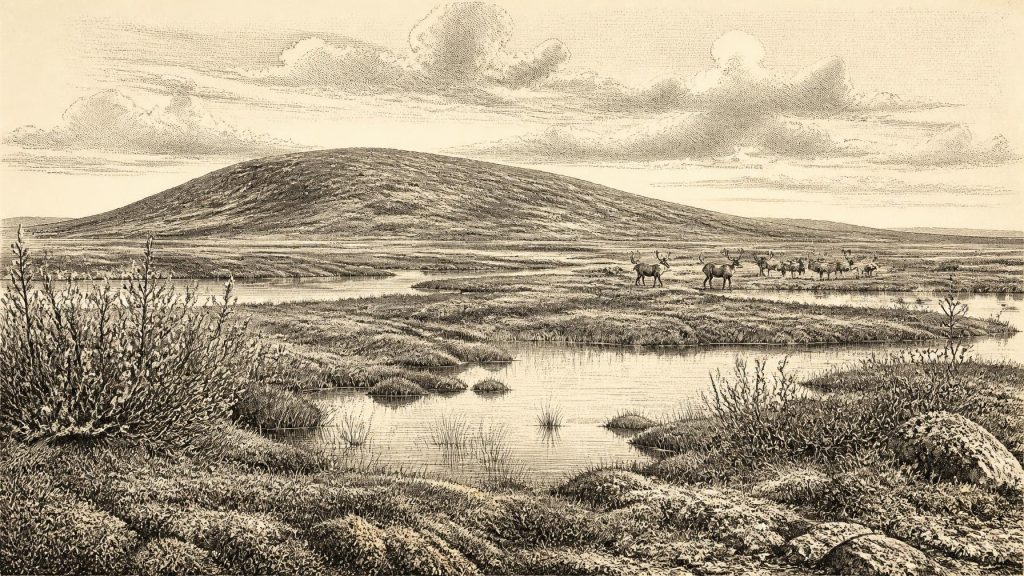
The Derryvree sequence establishes something important and local: when its freshwater sediments formed, this part of Fermanagh was not beneath overriding glacier ice. Its pollen, plant macrofossils, mosses and small-animal remains indicate an open, virtually treeless tundra or muskeg landscape under periglacial conditions. Wet hollows, shallow water and sedge-rich ground existed amid sparse terrestrial vegetation. The record includes plants adapted to cold, wet and exposed settings, rather than evidence for woodland or farmland. The image to retain is not a uniform snowfield but a difficult mosaic of damp ground, pools, low plants and frost-affected soil, changing with microtopography and season.
Derryvree also demonstrates why the Irish record is fragmentary. The organic layers survived because they were later sealed beneath glacial deposits. Across much of the island, advancing ice eroded, transported or buried older surfaces. A preserved pond or peat-rich hollow can therefore illuminate a brief environmental interval exceptionally well while saying little about conditions fifty kilometres away. The deposit is evidence for a Fermanagh wetland, not proof that all Ireland was open tundra at precisely the same time.
Approaching, Not Yet at, the Ice Maximum
At roughly 33.5 thousand calibrated years ago, Ireland was in the long approach to the Last Glacial Maximum rather than securely within its island-wide maximum extent. Modern reconstructions show that the British–Irish Ice Sheet grew and retreated asynchronously: different sectors responded differently to topography, marine waters and climate. Its maximum volume is reconstructed at about 23 ka, while Ireland and its shelf were extensively ice-covered around c. 27,000–23,000 cal BP. Those later dates are crucial. They prevent the misleading claim that the entire island was necessarily ice-covered in 31,599 BCE, while also warning against imagining a stable, hospitable land before the ice arrived.
Sea level was much lower than today because vast quantities of water were locked in continental ice sheets. The present shoreline is therefore a poor guide to the geography of the period. The Irish Sea basin, Atlantic shelf and western approaches contained landscapes now submerged, while ice margins and proglacial waters repeatedly altered routes across the wider north-west European region. Yet lowered sea level did not automatically create an easy, continuous land bridge from Ireland to Britain or continental Europe. Whether people or animals could move depended on the changing distribution of sea, glacier fronts, rivers, marshes and usable terrain.
There were no political affairs or diplomacy in the historical sense that can be recovered here. But the movement of ice and sea governed the practical equivalent of geography and access: where grazing animals could range, where predators could follow, and whether any human visitors could have entered or departed. Environmental change was the dominant force shaping opportunity.
Castlepook and the Animal World
In north County Cork, Castlepook Cave near Doneraile – historically called Mammoth Cave – provides a second, very different archive. It is Ireland’s most important known site for mammal remains from the last cold stage. Its collections include remains attributed to reindeer, woolly mammoth, giant deer, brown bear, wolf, Arctic fox, lemmings and spotted hyaena. Radiocarbon redating has shown that parts of the southern Irish cave fauna are considerably older than once believed and belong to MIS 3. This confirms that, at various times before the glacial maximum, Ireland formed part of a wider cold-stage ecological world.
That species list must be read with care. Cave deposits are palimpsests: bones can accumulate across millennia, be dragged in by carnivores, moved by water or disturbed by excavation. The early twentieth-century exploration of Castlepook recovered a remarkable quantity of material, but not with the fine stratigraphic recording, routine sieving and spatial plotting expected from modern excavation. A mammoth bone and a reindeer bone found in the same cave are not automatically evidence that both animals stood together on one day, let alone in 31,599 BCE.
Nevertheless, the faunal evidence is historically significant. Reindeer and other grazers imply open country somewhere within their usable range; predators such as spotted hyaena and wolf point to food webs rich enough, at least periodically, to support scavenging and hunting carnivores. Caves may have served as dens, traps, shelters or repositories into which bones were introduced. They are not settlements simply because they contain animal remains. The key economic reality visible in the record is ecological production: seasonal vegetation supporting herbivores, whose carcasses and movements sustained other animals.
The Narrow Human Question
A reindeer femur from the old Castlepook collection has been reported as roughly 33,000 years old and as bearing a deep mark interpreted by zooarchaeologist Ruth Carden as made by a stone tool during carcass processing. If that reading is confirmed, it would show that one or more people handled a reindeer in Ireland during the broad period relevant to this article. It would be an important Upper Palaeolithic trace, suggesting a visit or short-lived activity rather than demonstrating a permanent population.
The qualification is essential. The bone does not come from a securely excavated occupation surface with associated stone tools, hearth charcoal, dwelling remains, repeated food debris or human burials. Nor can its animal date alone establish when the incision was made, whether people killed the animal, whether they encountered an already dead carcass, or how the bone reached the cave. Recent scholarship continues to describe the butchered bear patella from Alice and Gwendoline Cave in County Clare, dated to the terminal Pleistocene, as the first unequivocal evidence for human presence in Ireland. The earlier Castlepook claim should therefore be treated as promising but not yet equivalent proof.
If people did enter Ireland at this time, their practical knowledge would have had to meet severe conditions: movement across exposed country, the use of fire and shelter, and the management of meat, fat, hide, sinew and bone from large animals. These are reasonable inferences from cold-climate hunter-gatherer life elsewhere in Upper Palaeolithic Europe, not things demonstrated by an Irish camp of this age. Ireland has no securely dated art, ornaments, ceremonial site, language, kinship system, exchange network or formal learning tradition from c. 33,550 cal BP. It would be wrong either to deny that visiting people possessed culture or to project continental evidence wholesale onto this island.
What the Evidence Allows
For Ireland around 31,599 BCE, the strongest history is environmental. Fermanagh preserves a freshwater tundra wetland later covered by ice. Cork caves preserve evidence for a varied cold-stage fauna and possibly a fleeting human encounter with reindeer. The wider ice-sheet record shows a world of advancing and reorganising ice, low sea levels and rapidly changing regional connections. Together these sources describe an island-scale landscape in transition, not a nation in formation.
There is no responsible basis for discussing Irish government, warfare, diplomacy, farming, trade, religion or settlement as if they were documented facts for this year. There were no known towns, fields or political communities. The enduring importance of the period lies instead in the fragile survival of its evidence: mosses and seeds in a buried Fermanagh hollow; bones from a Cork cave; and the stratigraphy of ice itself. These remains set the earliest possible background for later human history in Ireland while preserving the distinction that prehistory demands – between what was found, what it dates to, and what it may mean.
Primary Sources
- A Middle Midlandian Freshwater Series at Derryvree, Maguiresbridge, County Fermanagh, Northern Ireland
- Palaeoecology
- A Reconsideration of the Radiocarbon Dating of the Marine Isotope Stage 3 Fauna from Southern Ireland
- The Irish Quaternary Fauna Project
- The Exploration of Castlepook Cave, Co. Cork. With 3 Plates.
- Spotted Hyena Skull
- Prehistoric Details
- The Archaeological Heritage of County Cork
- Heritage Artefacts of County Cork
- New Insights on the Fauna of Ireland’s Younger Dryas and Early Holocene from Alice & Gwendoline Cave
- Growth and Retreat of the Last British–Irish Ice Sheet, 31,000 to 15,000 Years Ago: the BRITICE-CHRONO Reconstruction
- Ireland: Submerged Prehistoric Sites and Landscapes
- Dimensions and Chronology of the Last Ice Sheet in Western Ireland
- Trimlines, Blockfields and the Vertical Extent of the Last Ice Sheet in Southern Ireland
- The Deglaciation of the Western Sector of the Irish Ice Sheet from the Inner Continental Shelf to its Terrestrial Margin
- Timing and Pace of Ice-Sheet Withdrawal Across the Marine–Terrestrial Transition West of Ireland During the Last Glaciation
- New Data for the Last Glacial Maximum in Great Britain and Ireland
- The IntCal20 Northern Hemisphere Radiocarbon Age Calibration Curve (0–55 cal kBP)
- Cenozoic: Tertiary and Quaternary
- Castlepook, County Cork, 2022 Excavation Report
- Occurrence of Mammalia Relicts at Site Castlepook Cave
- Proceedings of the Royal Irish Academy, Volume 34