

The Doneraile Reindeer Femur31543 BCE
31,543 BCE is a modern chronological marker, not a recorded Irish year; evidence consists of uncertain radiocarbon ranges, deposits and animal bones. Before the Last Glacial Maximum, parts of Ireland supported wetlands, sparse treeless vegetation and cold-adapted fauna, although landscapes changed rapidly and later ice erased much evidence. Derryvree deposits demonstrate freshwater conditions, while Castlepook Cave near Doneraile preserves remains of reindeer, mammoth, giant deer and carnivores from different periods. A reindeer femur bearing a possible butchery cut mark suggests brief Upper Palaeolithic human presence around 33,000 years ago. It proves neither settlement nor society; dating and excavation are required.
Dateline
31,543 BCE is not a date that can be treated as a recorded Irish year. No calendar, written testimony, named community or datable event survives from this depth of time. In modern chronological terms it falls about 33,492 years before AD 1950, but such arithmetic should not imply annual precision. Archaeologists instead work with radiocarbon determinations, their calibrated probability ranges, stratigraphic relationships and comparisons with wider climate records. The responsible setting is the later Pleistocene, broadly Marine Isotope Stage 3, during the long, climatically unstable approach to the Last Glacial Maximum.
The nearest evidence to this notional date comes not from a settlement but from deposits and old animal-bone collections. It permits a vivid, if incomplete, account of an Ice Age Ireland: open country capable of supporting cold-adapted mammals; freshwater hollows in at least some districts; limestone caves that trapped and preserved bones; and, perhaps, a fleeting encounter between people and reindeer in north County Cork. It does not permit a history of a population, polity or culture in the usual sense.
A Date Within Ranges
The distinction between a radiocarbon age and a calendar age matters particularly here. Radiocarbon years are calculated from the residual carbon-14 in once-living material; calibration converts that measurement into calendar probabilities using independently dated records. At more than 30,000 years ago those probabilities can be broad, and the dates of old cave collections must also be considered alongside uncertainty over their original archaeological context. A label such as 31,543 BCE is therefore a useful point on a modern timeline, not a claim that scholarship can isolate a particular season, generation or occurrence in Ireland.
One valuable environmental range does encompass this point. At Derryvree, County Fermanagh, organic, moss-rich mud was found between glacial deposits beneath a drumlin. The radiocarbon determination known as BIRM-166 has been reported as 30,500 ± 1,100 radiocarbon years BP and recalibrated in later discussion to approximately 36.9–31.7 thousand calibrated years BP. It is an imperfect and much debated legacy date, rather than a precise timestamp, but it demonstrates why Ireland cannot simply be imagined as uniformly ice-covered throughout the whole later Ice Age. Freshwater and vegetation existed in north-central Ireland during part of this broad pre-maximum interval before later ice overran and sealed the deposit.
Country Before the Maximum Ice
At this stage the island was not yet in the full grip of the Last Glacial Maximum. The main expansion and greatest extent of the British–Irish Ice Sheet came later, conventionally placed broadly between about 27,000 and 21,000 years ago, although its growth and local behaviour varied by region. Evidence from Derryvree, Greenagho in Fermanagh, and marine records around the coast indicates that substantial areas were ice-free during parts of the preceding period. The landscape around 31,543 BCE should consequently be understood as changeable rather than uniformly frozen: exposed ground, valley systems, wetlands and patches of sparse plant cover lay within a North Atlantic world prone to abrupt swings in temperature and moisture.
Pollen, seeds and other plant remains from Irish interstadial deposits point to treeless or almost treeless communities, including sedges, mosses, dwarf shrubs and hardy herbs. They are not a photograph of every Irish district in one year. They do, however, fit an open, cold-stage mosaic in which wind exposure, thin soils, frost action and standing water restricted woodland. Such country could feed grazing and browsing animals, but its productivity would have varied strongly with season, local geology and climate. Later glacial erosion, deposition and sea-level change have removed or buried immense portions of the contemporary land surface, so the surviving record is inevitably selective.
Sea level was lower than today because so much water was locked in continental ice sheets, altering the outlines of coasts and enlarging coastal plains. Yet no securely demonstrated route, camp or crossing survives for people entering Ireland at this time. Ireland’s position beyond water remained a serious ecological and logistical threshold. Any claim that visitors travelled by a particular land bridge, boat type or route goes beyond the present evidence. The now-submerged shelves of the Irish Sea and Celtic Sea are important potential archives, but potential is not proof.
Castlepook’s Faunal Archive
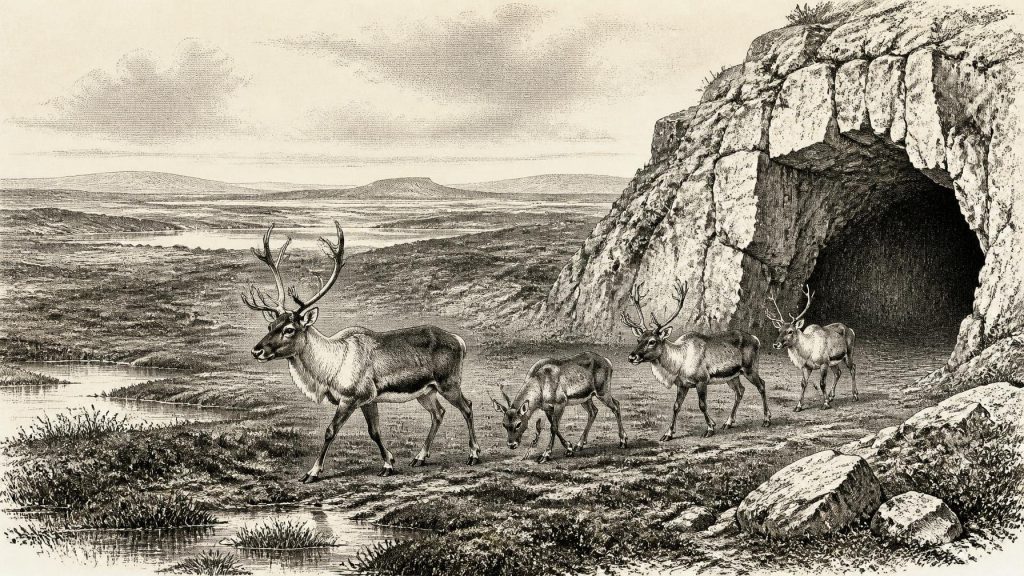
The most evocative Irish evidence lies at Castlepook Cave, near Doneraile in north County Cork, formerly called Mammoth Cave by its early excavator Richard J. Ussher. The cave system yielded a remarkable collection of Pleistocene animal remains, now principally associated with the National Museum of Ireland. Subsequent study and radiocarbon programmes have identified animals including reindeer, woolly mammoth, giant deer, brown bear, wolf, Arctic fox, lemming and spotted hyaena. Individual bones do not all belong to one phase: the collection spans many millennia, while cave sediments may be disturbed by animal activity, water, collapse, excavation and later handling.
That qualification is central. A cave is not automatically a human home. It can function at different times as a carnivore den, a hibernation place, a trap, a shelter, a channel for sediment and water, or a repository for bones dragged in from elsewhere. Hyaenas and wolves could carry carcass parts into darkness; scavenging, gnawing and trampling could mark or rearrange them. The Castlepook assemblage is decisive evidence that a varied Ice Age fauna reached southern Ireland, but it cannot be compressed into a single harmonious ‘mammoth-steppe’ scene or made to prove that every listed species lived together beside the cave in 31,543 BCE.
Nevertheless, reindeer are especially relevant. Their presence indicates that suitable cold, open habitats occurred during the broad interval represented by the assemblage. Reindeer could have supplied meat, fat-rich marrow, hides, sinew, antler and bone to any human hunters who encountered them. Those are general possibilities grounded in the animal’s anatomy and ethnographic analogy; the Castlepook material does not reveal which portions were taken, whether a kill occurred nearby, or whether people visited once or repeatedly. Nor should the traditional term ‘Irish elk’ mislead: giant deer were not uniquely Irish, despite their prominence in the island’s later fossil history.
The Marked Bone
A fragment of reindeer femur from Castlepook gives this period its exceptional human interest. Re-examined by zooarchaeologist Ruth Carden and publicly reported as dating to about 33,000 years ago, the bone bears a deep linear mark interpreted as having been made by a sharp stone implement during butchery. County Cork heritage material places it broadly at c. 31,000 BCE. That estimate is close enough in archaeological terms to make the specimen directly relevant to 31,543 BCE, but it must remain a broad association, not a year-specific event.
If the modification is confirmed as anthropogenic, it indicates that a person or small group handled a reindeer in Ireland during the Upper Palaeolithic, vastly earlier than the island’s long-established evidence for successful post-glacial settlement. It would be an important trace of hunting or carcass processing, not evidence for a permanent colony. No securely associated hearth, stone-tool assemblage, dwelling floor, burial, food-processing area or stratified occupation surface of equivalent age has yet been published from Castlepook. The femur dates the animal’s death; identifying the incision as a cut mark requires a separate taphonomic judgement.
The most cautious interpretation is therefore also the most informative. The bone suggests a possible episode of human activity in a landscape used by large mammals and carnivores. It does not establish the visitors’ language, ancestry, numbers, sex, season of arrival, duration of stay or relationship to later inhabitants of Ireland. Nor can it demonstrate an unbroken occupation through the climatic deterioration that followed. Later expansion of the ice sheet would have made much of Ireland hostile or inaccessible and would have destroyed, displaced or concealed earlier traces.
Society Beyond the Evidence
For political affairs, diplomacy and organised conflict, there is no direct evidence at all. There were no Irish states, rulers, boundaries or institutions recoverable from this period. It would be misleading to transform a possible butchery mark into a tribal history. Likewise, no Irish evidence of ritual, formal religion, art, language, teaching or burial can responsibly be assigned to this date. Upper Palaeolithic communities elsewhere in Europe made sophisticated stone tools, ornaments, images and long-distance social connections, but those wider achievements cannot simply be imported into Ireland without local finds.
Everyday life can only be approached conditionally. Had people been present, they would have needed mobility, warm clothing, reliable fire-making and detailed knowledge of animal movements and dangerous weather. A successful hunt might have involved cooperation and careful division of useful materials. But these are reasoned expectations from wider Upper Palaeolithic evidence, not observed facts at Doneraile. Ireland offers neither the tools nor the camp debris needed to reconstruct a household economy. The femur’s value lies precisely in its smallness: it may preserve a moment of contact otherwise almost erased.
What the Silence Means
31,543 BCE thus belongs to a prehistory of deposits rather than dates, landscapes rather than kingdoms, and probabilities rather than biographies. Derryvree’s buried wetland indicates that parts of Ireland supported vegetation and freshwater before the later maximum glaciation. Castlepook records the animals that exploited open, cold environments in the south. Its marked reindeer femur raises the possibility that people briefly entered this demanding world. The absence of a settlement record is not proof that no person ever arrived, but neither is one controversial specimen licence to populate the island with an enduring Ice Age society.
The proper historical emphasis is on that balance. Ireland around this point in the late Pleistocene was environmentally dynamic, biologically richer than its sparse surviving archive first suggests, and increasingly vulnerable to advancing ice. It may also have been touched by human hunters. Further controlled excavation, direct dating, microscopic study of bone surfaces and investigation of submerged landscapes may strengthen, qualify or overturn present interpretations. For now, the Doneraile reindeer femur remains a singular clue: a possible human mark in a country whose Ice Age past is mostly written in mud, bone and stone.
Primary Sources
- A Reconsideration of the Radiocarbon Dating of the Marine Isotope Stage 3 Fauna from Southern Ireland
- The Irish Quaternary Fauna Project
- New Insights on the Fauna of Ireland’s Younger Dryas and Early Holocene from Alice & Gwendoline Cave
- The Doneraile Reindeer Femur
- Archaeological Heritage of County Cork
- Extent and Timing of the Last Glacial Maximum (LGM) in Britain and Ireland: A Review
- Trimlines, Blockfields and the Vertical Extent of the Last Ice Sheet in Southern Ireland
- Exploring Controls of the Early and Stepped Deglaciation on the Western Margin of the British Irish Ice Sheet
- The Timing and Magnitude of the British–Irish Ice Sheet Between Marine Isotope Stages 5d and 2
- Maximum Extent and Dynamic Behaviour of the Last British–Irish Ice Sheet West of Ireland
- Advance and Retreat of the Marine-Terminating Irish Sea Ice Stream into the Celtic Sea During the Last Glacial: Timing and Maximum Extent
- Ireland: Submerged Prehistoric Sites and Landscapes
- The Colonization of Ireland: A Human Ecology Perspective
- Irish Pleistocene Biostratigraphy
- An All-Ireland Quaternary Map
- Quaternary Data and Maps
- The IntCal20 Northern Hemisphere Radiocarbon Age Calibration Curve (0–55 cal kBP)
- IntCal20 Northern Hemisphere Radiocarbon Age Calibration Curve PDF
- IntCal: Radiocarbon Calibration Curves
- Irish Quaternary Association
- Ireland’s Palaeolithic Archaeology – Fleeting Footprints in a Frozen Land
- Reindeer Bone Found in Cork Cave Shows Human Activity 33,000 Years Ago
- What Was on the Menu in Prehistoric Ireland?